Picture this: you're opening a new shop. Would you rather build it on some quiet, undeveloped backstreet and just hope people eventually wander by? Or would you set up right on a bustling main street, with tons of foot traffic from the moment you unlock the doors?
That main street option? That's pretty much what leasing a domain is all about. It's a ridiculously savvy move to get your hands on prime digital real estate without the massive upfront cost of buying it outright.
The Secret Shortcut to Online Authority
Starting a new website can feel like pushing a boulder uphill. You register a fresh domain, build a killer site, and then... crickets. It can take months, sometimes years, of grinding away to build any real credibility with Google, earn some decent backlinks, and see consistent organic traffic. It’s a slow, painful burn often called the "SEO sandbox," where new sites are basically stuck in digital purgatory, waiting to prove they're legit.
But what if you could just... skip all that? That’s the core promise of finding domains for lease.
Instead of starting from zero, you can rent an established domain name that already has history, authority, and—most importantly—the trust of search engines. It's just like taking over a well-known storefront; you instantly inherit its reputation and the people who already know where to find it. This gives your project a huge head start right out of the gate.
Why Leasing Is a Total Game-Changer
For startups, marketers, and SEO pros, leasing a domain can be an absolute game-changer. It lets you test a new idea or jump into a competitive niche with a domain that's already packing a serious punch. You get all the perks of an aged, authoritative domain without having to shell out five or six figures to own it.
This strategy is especially powerful for a few specific goals:
- Launching Niche Sites: You can establish authority in a new industry almost overnight by leasing a domain that already has relevant, powerful backlinks.
- Testing New Business Ventures: Got a hot new idea? Validate it with an authoritative domain before you go all-in on buying something permanent.
- Boosting SEO Campaigns: You can point the "link juice" from a powerful leased domain toward your main website and give it a serious ranking boost.
Here's the deal: when you lease a domain, you're not just renting a name. You're borrowing its entire history, its backlink profile, and its established trust with search engines. It lets you sidestep those painful early growth stages and start competing much, much faster.
The real trick, of course, is finding these gems. The best opportunities usually aren't posted on big, obvious marketplaces. They're often domains that have just recently expired but are still loaded with SEO value. The key is knowing where to hunt and being ready to move fast. For example, you can often find incredibly potent Available domains on platforms that list recently dropped names. That's your chance to snag a high-authority domain for a standard registration fee before anyone else even knows it's up for grabs.
Understanding How Domain Leasing Works
So, what exactly is domain leasing?
Think of it like this: leasing a domain is like taking over the lease on a popular, fully-equipped restaurant in a prime downtown spot. A brand new domain, on the other hand, is like getting an empty storefront in the middle of nowhere. You have to build the kitchen, buy the tables, create a menu, and then spend a fortune on advertising just to let people know you exist.
The leased restaurant, though? It already has top-tier equipment, a known address, and a line of regulars waiting outside. You just step in and start cooking. That’s the core idea here.
Leasing is all about getting access to a high-value digital asset without the massive, upfront cost of owning it. This is a game-changer for a lot of projects. Instead of dumping thousands—or tens of thousands—of dollars into buying a premium domain, you pay a much more manageable monthly or annual fee. That frees up your cash for what really matters: marketing, building out your product, or creating killer content.
The Core Benefits of a Domain Lease
The advantages go way beyond just saving money on the initial purchase. When you lease a domain, you're essentially borrowing its history and credibility with search engines. This can shave months, or even years, off the time it takes to get real, organic traffic.
Here’s what you stand to gain:
- Immediate SEO Traction: An aged domain with a clean track record and quality backlinks is already on Google's good side. This means your content has a shot at ranking much, much faster than it ever would on a fresh domain.
- Lower Upfront Risk: Not totally sure your new business idea is going to fly? Leasing lets you test the waters with a powerful domain without committing to a huge purchase you might regret later.
- Access to Premium Names: Let's be real, most of the best, most brandable one or two-word domains are long gone. They're owned by investors and carry price tags in the six-figure range. Leasing cracks the door open, making these "digital landmarks" accessible even to startups and smaller businesses.
At its heart, a domain lease works a lot like any other rental agreement. A tenant gets the right to use an asset for a set amount of time in exchange for regular payments. The contract is everything. Looking over a generic rental agreement template can give you a solid feel for the kind of terms and structure to expect.
Leasing vs Buying A Domain: Which Is Right For You?
Alright, so should you lease or buy? The honest answer is: it depends. It comes down to your budget, how quickly you need to see results, and your long-term plans. Neither path is automatically better; the right move is the one that fits your specific goals.
This side-by-side breakdown should help clear things up.
| Factor | Leasing a Domain | Buying a Domain |
|---|---|---|
| Upfront Cost | Low monthly or annual payments | High one-time purchase price |
| Financial Risk | Minimal; you can often walk away | High; you bear the full cost of a failed project |
| Ownership | You do not own the asset | You have full ownership and control |
| SEO Benefits | Immediate access to existing authority | You must build authority from scratch |
| Best For | Short-term projects, testing ideas, SEO boosts | Long-term brand building, core business assets |
This isn't just a niche strategy; it’s a reflection of a much bigger trend. The domain leasing market is starting to look a lot like the commercial real estate world, where demand for hot assets like data centers is so intense that new construction is 100% pre-leased in major markets before it's even built.
With AI companies flush with cash and desperate for instant authority, high-value expired domains with tech-related keywords are leasing for premiums of 25-50% above the average. It's a land grab for digital credibility.
Ultimately, leasing is a strategic shortcut. It’s a way to punch above your weight, giving you the power of an established online presence without the crippling financial commitment. For many, it's the perfect bridge between a great idea and a successful launch.
How to Vet a Domain Before You Commit
Jumping on a seemingly perfect domain without doing your homework is like buying a used car just because it has a shiny new paint job. It might look fantastic on the surface, but you have no idea what’s really lurking under the hood. The truth is, not all established domains are created equal. Some are digital liabilities, and leasing a domain with a toxic past can torpedo your entire project before you even get started.
Don't worry, you don’t need to be a digital detective to protect yourself. A little strategic vetting goes a long, long way. This is your guide to peeking under the hood and making sure the domain you lease is a high-performance engine, not a lemon waiting to break down.
First, let's get a high-level view. This decision tree helps map out when leasing makes sense for agile, short-term goals versus when buying is the right move for a permanent brand investment.
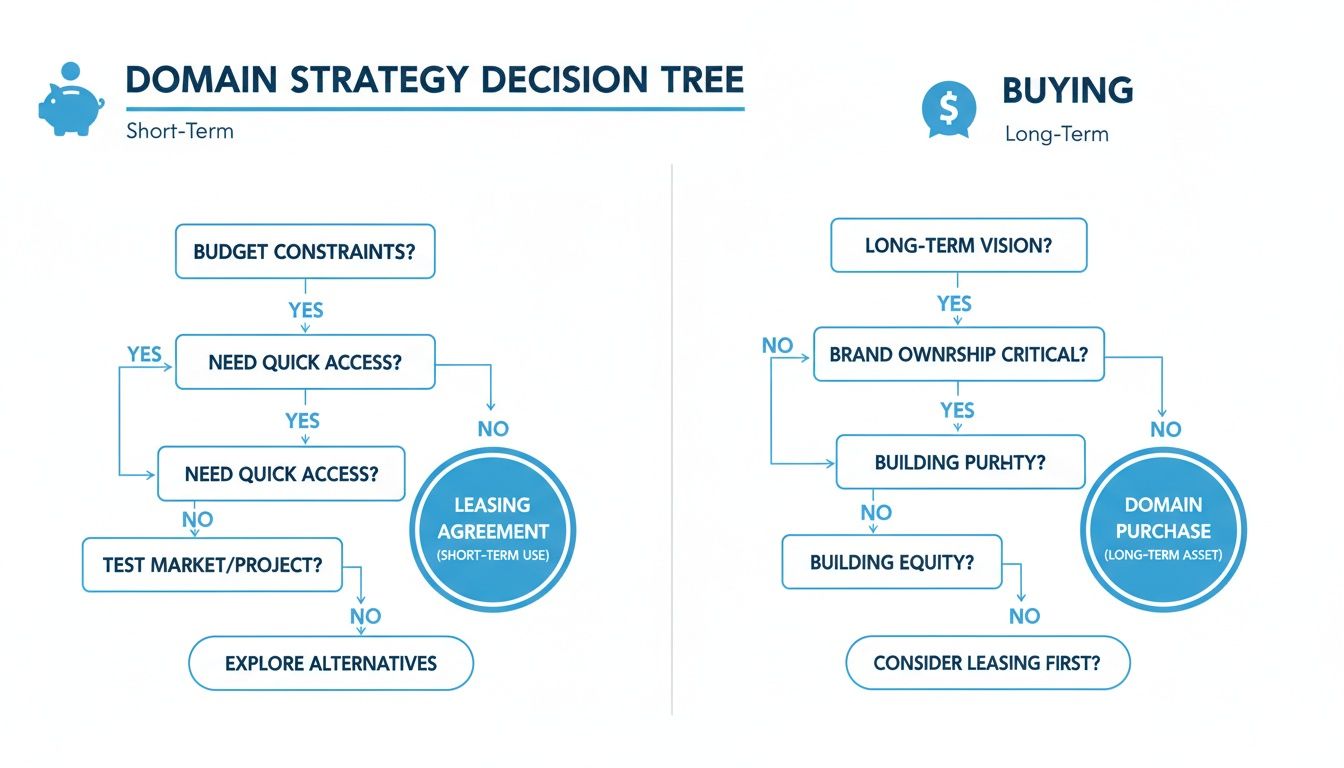
The key takeaway? Leasing is all about agility and lower risk for temporary projects. Buying is for planting a flag and building a brand for the long haul.
Checking the Core Metrics
First things first, let's talk numbers. Metrics like Domain Authority (DA) from Moz or Trust Flow (TF) from Majestic give you a quick, at-a-glance health check of a domain’s authority. These scores are designed to predict how well a site might rank in search results.
But a word of caution: while a high DA looks good, don't take it as gospel. Think of it like a credit score—it gives you a general idea of health but doesn’t tell the whole story. A domain could have an impressive DA that's propped up by thousands of garbage links, which is a massive red flag.
Digging into the Backlink Profile
This is where the real investigation begins. A domain's SEO value is directly tied to its backlink profile—that is, the collection of all the other websites linking to it. Your job is to assess not just the quantity of these links, but their quality.
Here are the red flags to watch out for:
- Links from Spammy Sites: Are the links coming from legitimate websites in a relevant niche? Or are they from sketchy blog networks, random foreign forums, or private blog networks (PBNs)?
- Irrelevant Anchor Text: The clickable text of a link should make sense for the domain's topic. If you're looking at a domain about dog training and its anchor text is all "buy cheap watches," you should run the other way. Fast.
- A Sudden Spike in Links: A natural, healthy backlink profile grows steadily over time. A sudden, massive influx of new links often points to manipulative SEO tactics that Google loves to penalize.
Doing your due diligence here is critical. A solid guide on backlink analytics and ROI can help you audit the existing links and figure out if they’re going to actually drive value or just cause you headaches down the road.
Uncovering a Domain's History
Every domain has a past, and you need to figure out if it was a saint or a sinner. A domain that was previously used for spam, gambling, or adult content could be permanently blacklisted by search engines. If that's the case, getting it to rank for anything is next to impossible.
A domain's history is its digital resume. You wouldn't hire someone without checking their references, so don't lease a domain without investigating its past life. A clean history is non-negotiable.
Tools like the Wayback Machine are your best friend here. They let you see what the site looked like in previous years. Was it a legitimate business, or was it a page stuffed with spam? This simple check can save you a world of hurt. For a deeper dive, our guide on how to check a domain's history gives you a full walkthrough.
This whole vetting process is precisely where the modern domain investing world lives and breathes. Expired domains are a goldmine, with platforms analyzing over 170,000 of them every single day. The savviest investors now focus on "what the domain already does"—its existing backlinks and traffic—not just its name.
A domain with strong metrics, like a Domain Authority above 40 and a few coveted .edu or .gov links, can easily lease for $500 to $5,000 per month. This makes leasing a powerful play for getting instant authority.
Ultimately, vetting domains for lease is all about risk management. By carefully analyzing a domain’s metrics, backlink profile, and history, you're ensuring you lease a powerful asset, not just inherit someone else’s problems.
Finding the Perfect Domain to Lease
Alright, so you know what a great lease candidate looks like. Now for the million-dollar question: where do you actually find these things? You could poke around the big, obvious marketplaces, but that's like fishing in a pond that everyone else already knows about. The real gems are often found just below the surface, in the fast-moving world of expired and recently dropped domains.
This is where the magic really happens. Every single day, thousands of solid domains expire. It's not always because they're junk, either—a business might pivot, a side project gets forgotten, or sometimes a credit card just fails to auto-renew. Many of these are aged domains with years of SEO history and powerful backlinks just sitting there. By hunting in this space, you get a shot at high-potential domains before they ever hit a crowded, competitive public auction.

Uncovering Hidden Gems in Dropped Domains
Think of dropped domains as digital real estate that just went into foreclosure. The previous owner is gone, the property is back on the market, and it's ready for someone new to move in. The trick is being the first one there to spot the opportunity.
This is where specialized platforms become your secret weapon. Instead of waiting for these domains to get snatched up by investors and relisted at a premium, you can get in on the ground floor. For instance, you can hunt for powerful domains that just dropped and are ready to register right now by exploring the Available domains on NameSnag. These are domains that have gone through their full expiration cycle and can be registered immediately by anyone, at any registrar.
Finding a great dropped domain is like discovering an undervalued classic car in a barn. It might need a little polish, but its powerful engine—its established SEO authority—is still intact and ready to roar.
Getting Ahead of the Curve with Expiring Domains
If finding available dropped domains is all about speed, then hunting for expiring domains is about strategy. These are domains that have expired but are still in a grace period—meaning they will be dropping soon, but aren't available just yet. This gives you a crucial window to do your homework and get ready to act.
Monitoring expiring domains lets you get way ahead of the competition. You have time to dig into their backlink profiles, check their history on Archive.org, and decide if they’re a good fit before they ever hit the open market. This proactive approach is a total game-changer for serious domain hunters.
Platforms like NameSnag let you browse Expiring domains that are about to drop, giving you the intel you need to make a smart move. When you find one that fits your criteria, you can set an alert and be ready to pounce the second it becomes available. Understanding how to use a good domain for SEO is key here, and this research phase is where you connect the dots between a domain's past and its future potential.
Using Filters to Pinpoint Your Perfect Match
Just staring at a massive list of domains is a surefire way to get overwhelmed. The real power comes from using filters to slice through the noise and zero in on exactly what you’re looking for. This is how you turn a firehose of data into a targeted list of A-grade lease candidates.
Effective domain hunting platforms give you robust filtering options. Here’s how to use them to your advantage:
- Filter by Metrics: Set minimums for metrics like Domain Authority (DA), Trust Flow (TF), or the number of referring domains. This instantly weeds out the weak domains and surfaces only the ones with real authority.
- Filter by Keywords: Looking for a domain in a specific niche? Use keyword filters to find names that contain your target terms, ensuring you've got brand relevance from day one.
- Filter by Age: Older domains often carry more weight with search engines. Filtering by domain age helps you find names with a long, stable history that Google already trusts.
- Filter by Time: Want to see only the freshest opportunities? Use time filters to view domains that dropped today, within the last 3 days, or over the past week.
By combining these strategies—hunting for both available and expiring domains and using smart filters to refine your search—you can consistently uncover high-value domains for lease that everyone else misses. This methodical approach transforms domain hunting from a game of chance into a repeatable, strategic process.
Negotiating Your Lease Agreement
So you've done your homework, vetted a killer domain, and you're ready to make your move. This next part can feel a little intimidating: hammering out the actual deal. Negotiating a domain lease is so much more than just haggling over a price—it's about building a solid, legally-sound partnership where everyone walks away protected. If you get this wrong, you could be signing up for a world of headaches.
The good news? You don't need a law degree to get this right. Just understanding a few key components will give you the confidence to craft an agreement that works for you and the domain owner.
Let's break down the most common ways these deals are structured and the must-have clauses for any contract you sign.
Common Pricing Models
When it comes to paying for the keys to the kingdom, you'll usually run into one of a few standard setups. Each has its own rhythm, so it's smart to figure out which one vibes with your project's goals and your wallet.
- Flat Monthly or Annual Fee: This is the simplest model by far—think of it just like renting an apartment. You pay a fixed amount every month or year for the exclusive right to use the domain. It's predictable, easy to budget for, and a perfect fit for shorter-term projects or focused SEO campaigns where you need a powerful domain for a set amount of time.
- Lease-to-Own (LTO): This one's a fantastic hybrid. With each payment you make, a slice of it goes toward the domain's final purchase price. It's an excellent choice if you've fallen in love with a domain but don't have the cash to buy it outright today. You get the immediate horsepower of a premium domain while you steadily work your way toward full ownership.
- Percentage of Revenue: This is less common, but some owners might be open to a performance-based deal. In this setup, they'd get a small percentage of the revenue your site generates. It can seriously lower your upfront risk, but it requires pretty sophisticated tracking and a huge amount of trust on both sides.
It's worth pointing out that the digital rental market has become a surprisingly stable way to generate passive income. While physical real estate markets are seeing forecasts of record-high rent hikes, savvy entrepreneurs are discovering that a clean, high-authority domain can net anywhere from $2,000 to $20,000 a year. To get a better feel for a domain's potential value, you can learn more about how to value domain names in our detailed guide.
Must-Have Clauses in Your Agreement
A handshake and a friendly email just won't cut it here. A clear, written agreement is absolutely non-negotiable. This document is your shield; it protects both you and the owner by setting crystal-clear expectations and heading off any misunderstandings before they can even start.
Here are the critical clauses your lease agreement has to include, no exceptions:
- Lease Duration and Renewal Terms: Be specific. State the exact length of the lease (12 months, 24 months, etc.). Does it auto-renew? If it does, what's the notice period required to end the agreement without penalty?
- Payment Terms: Nail down the specifics: the exact payment amount, the due date, and what happens if a payment is late. Some platforms or owners might offer a grace period, but this needs to be spelled out in the contract to avoid any nasty surprises.
- Usage Rights: What, exactly, are you allowed to do with the domain? Can you build a massive e-commerce site? Are there any hard restrictions, like using it for adult content or spam? Get granular here.
- Transfer of Control: The contract needs to detail how you'll gain control of the domain's DNS settings to point it to your web host. This is the technical linchpin that makes the whole thing work.
- Option to Purchase: If you're going the lease-to-own route, this is the most important clause in the whole document. It must outline the total purchase price, the term of the lease, and the final buyout process.
- Termination Clause: What happens if one of you needs to bail early? This section should define the conditions for early termination and any potential penalties. It’s a safety net for both sides against life's unexpected curveballs.
Your Domain Leasing Questions Answered
Even with a solid plan, jumping into the world of domain leasing can feel like you're learning a new language. You've got the big picture, but a few nagging questions are probably bouncing around your head. That's totally normal.
To tackle those last-minute "what ifs," I've put together answers to the most common questions I hear. Think of it as a quick field guide. The goal is to give you the confidence to move forward, knowing you’ve covered your bases.
What Happens to My SEO If the Lease Ends?
This is the big one, and for good reason. You've just spent months, maybe years, pouring your soul into building content and rankings. The thought of all that hard work vanishing if the lease isn't renewed is terrifying.
The good news is, you're in the driver's seat here. If you've built a killer website on that leased domain, you have a few powerful moves:
- Migrate Your Site: The classic play is a 301 redirect migration. This is where you move your entire website to a new domain you own, then set up permanent redirects from every old URL to its new counterpart. It's like sending a change-of-address form to the search engines, telling them, "Hey, we've moved! Please forward all our SEO mail to the new address."
- Negotiate a Purchase: If the site has become a core asset, the end of the lease is the perfect time to make an offer. You’ve already proven the domain’s value, which puts you in a surprisingly strong negotiating position.
- Renew the Lease: The simplest option, of course, is just to renew. If the arrangement worked for both of you, extending the lease can be a no-brainer, especially if you set clear renewal terms in your original agreement.
The absolute key is to have your exit strategy mapped out from day one. Don't wait until the last month of your lease to start figuring out your next move.
Can the Owner Just Sell the Domain from Under Me?
This is where your lease agreement transforms from a simple document into a suit of armor. A well-drafted contract absolutely must include a clause to prevent this exact nightmare scenario. What you're looking for is called a Right of First Refusal (ROFR).
A Right of First Refusal clause is a legal requirement for the domain owner to offer you the chance to buy the domain before they can sell it to anyone else. It's your insurance against being blindsided by a sudden sale.
If some third party comes along and makes an offer, the ROFR clause forces the owner to bring that same offer to you first. You then get a specific window of time to decide whether you want to match it. Without this clause, you're just hoping for the best, and hope isn't a business strategy.
Do I Still Get the Backlink Benefits If I Don't Own It?
Absolutely. In fact, this is one of the main reasons people hunt down domains for lease in the first place. When you control a domain's DNS, you control where all that precious "link juice" goes.
Search engines like Google don't really care who's listed on the WHOIS registration. They care about what's being served on the domain and the authority signals pointing to it. As long as that domain points to your server and your content, you reap 100% of the SEO benefits from its backlink profile. The authority is tied to the name, and for the life of your lease, that authority is yours to command.
What's a Fair Price for a Domain Lease?
Ah, the classic "it depends" question. A domain lease can run anywhere from $100 a month to several thousand, and it all boils down to a few key variables:
- Domain Authority and Metrics: A domain with a high DR, a squeaky-clean backlink profile, and tons of referring domains is going to command a premium. No surprise there.
- Brandability and Keywords: Short, memorable, keyword-rich names are worth far more than something clunky and forgettable.
- Existing Traffic: If the domain is already pulling in a steady stream of type-in traffic, its value shoots up.
Your best bet for gauging a fair price is to do your homework. See what comparable domains have sold or leased for. But remember, the real magic isn't always in leasing from a big marketplace. It's in finding a powerful domain that just dropped. You can often discover incredible Available domains on NameSnag with monster metrics that you can register for a standard fee, giving you total ownership from the get-go.
How Do I Handle a Website Migration Later?
If you decide it's time to move from the leased domain to one you own outright, a meticulous migration is non-negotiable for keeping your SEO value. It's a technical process, but it's completely manageable if you're methodical.
Your best friend in this process will be 301 redirects. You need to map every single URL on the old site to its new home and redirect each one individually. Think of it as a page-by-page authority transfer. Once the redirects are live, you'll use Google Search Console's "Change of Address" tool to give Google the official heads-up.
It demands attention to detail, but when done right, you can transfer the vast majority of your hard-earned rankings to your new, permanent address.
Ready to find that perfect domain without the guesswork? NameSnag uses AI to analyze over 170,000 domains daily, filtering out the junk to show you only the gems with real SEO power and branding potential. Stop wasting hours on manual checks and start discovering high-value domains in minutes. Find your next project's secret weapon at https://namesnag.com.
Find Your Perfect Domain
Get access to thousands of high-value expired domains with our AI-powered search.
Start Free Trial