
Ever see a headline about a domain selling for six or seven figures and just scratch your head? It’s not just about picking a catchy name. Those eye-watering prices are the result of a calculated assessment, treating the domain not as a simple address, but as a piece of digital real estate with its own unique history and earning potential.
Figuring out how to properly value a domain is less of a dark art and more of a learned skill. It’s like getting a treasure map to the internet's hidden gems, and I'm here to hand you the shovel.
This guide will walk you through the nitty-gritty of what separates a worthless string of characters from a powerhouse digital asset. We're going way past the surface-level stuff.
It’s More Than Just a Name
A domain's real value is a mix of hard data and gut feeling. The "gut feeling" part is its brandability—is it short, memorable, easy to spell? The "hard data" part comes from its technical stats and history.
To really get a handle on what a domain is worth, you have to dig into:
- SEO Authority: How much trust has this domain earned from search engines over the years? Metrics like backlink quality and overall domain authority are your best clues here.
- History & Age: What was this domain used for before? A clean, established history is a massive head start. A spammy past, on the other hand, can be a complete deal-breaker.
- Commercial Potential: Does the name itself tap into a lucrative industry or keyword? A domain like
carinsurance.comhas obvious commercial intent baked right in, which a random, made-up name just doesn't.
By the end of this, you'll have a solid framework for judging a domain's real worth. You'll be able to spot red flags from a mile away, identify hidden potential, and make offers based on data, not guesswork.
Finding Untapped Potential
The best deals are rarely found where everyone else is looking. While premium, high-profile domains get all the press, thousands of genuinely powerful domains are dropped or expire every single day. Many of these come with years of history and valuable backlinks already baked in.
This is where the real opportunity is. Think about it: finding a domain with a strong, clean backlink profile that was just dropped and is now available for anyone to register at the standard price. It's the ultimate score. You can hunt for these opportunities by searching for Available domains that were just released back into the wild.
Want to get a jump on the competition? You can monitor Expiring domains that are in their grace period but will be dropping soon. This lets you find and plan for valuable digital assets before they even hit the open market. It’s like having a crystal ball for digital real estate.
The Four Pillars of Domain Valuation
To really get a feel for how to value a domain name, you need to think like a digital real estate developer. Some domains are prime beachfront property, ready to build on. Others are fixer-uppers in a sketchy neighborhood. The difference comes down to four core pillars that hold up a domain's value. Nail these, and you'll have a repeatable framework for spotting gold.
This diagram breaks down the hierarchy of domain value into three key areas: History, Authority, and Potential.
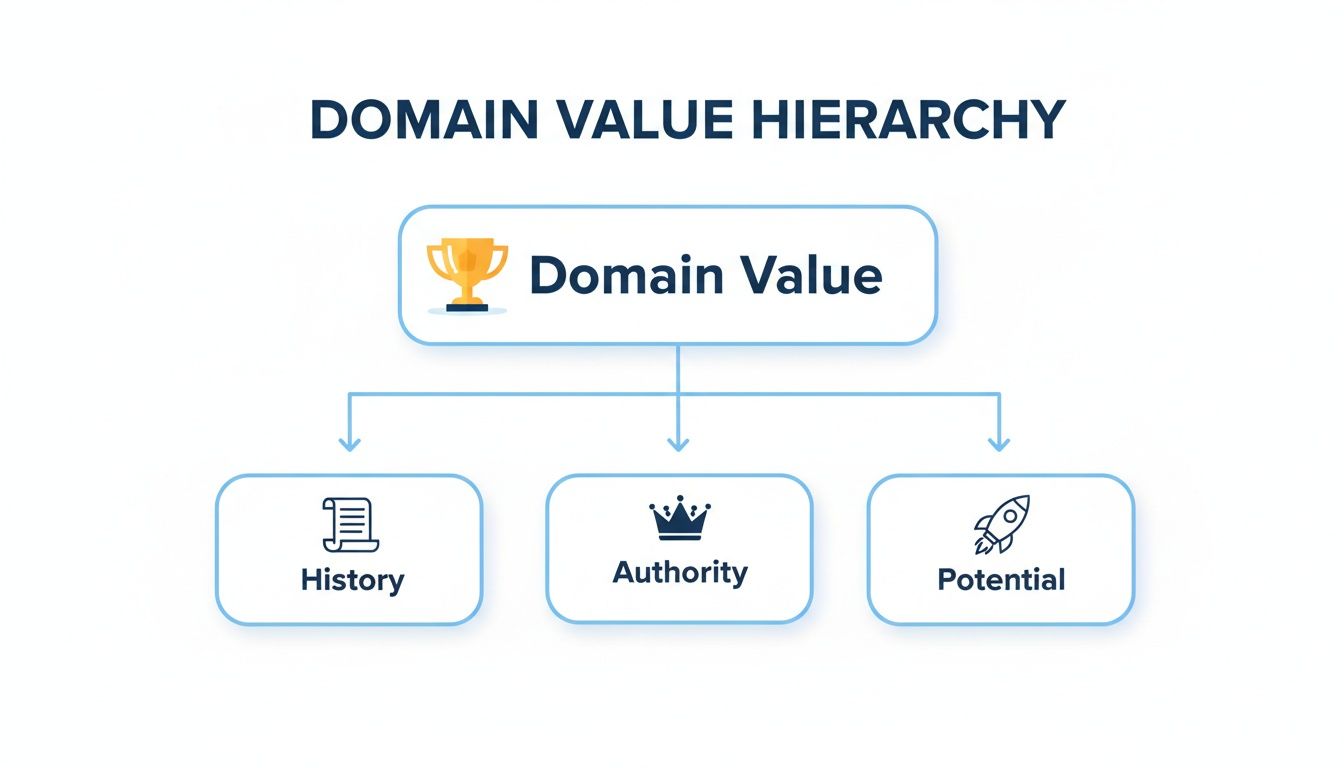
As you can see, a domain's overall value is a blend of its past performance (History), its current strength in the eyes of search engines (Authority), and its future business viability (Potential). Let's dig into the metrics that define these pillars.
I've put together a quick reference table to make sense of the key metrics we're about to cover. Think of this as your cheat sheet for the initial once-over.
Key Domain Valuation Metrics at a Glance
Use this quick reference to understand the most important metrics and what they mean for a domain's potential value.
| Metric | What It Measures | Why It Matters | What to Look For |
|---|---|---|---|
| Trust Flow (TF) | The quality and trustworthiness of backlinks pointing to a domain. | High-quality links are a massive SEO signal. TF is harder to fake than other metrics. | A score of 10+ is a good start. 20+ is strong. |
| Referring Domains (RDs) | The number of unique websites linking to the domain. | More unique, relevant domains linking to a site signal broader authority. | The higher, the better. Look for a healthy ratio of RDs to total backlinks. |
| DA / DR | A proprietary score (from Moz and Ahrefs) that predicts a site's ranking potential. | A quick, at-a-glance indicator of overall link authority. | Scores of 20+ are decent. 30+ indicates a powerful domain. |
| Domain Age | The length of time since the domain was first registered and indexed. | Older domains with a clean history are often seen as more trustworthy by search engines. | 5+ years of continuous, clean history is a positive signal. |
| Brandability | The subjective quality of the name itself—how memorable and marketable it is. | A great brand name is easier to market, remember, and build a business around. | Short, memorable .coms that are easy to spell and pronounce. |
This table gives you the what and why, but the real art is in the interpretation. Let's break down how these pieces fit together.
SEO Authority and Backlink Profile
First up is SEO authority. This is the most direct, data-driven part of the valuation. Metrics like Domain Authority (DA), Domain Rating (DR), and Majestic's Trust Flow (TF) aren't just vanity numbers; they're scores that estimate a domain's credibility with search engines. A higher score means the domain is seen as more trustworthy, and that trust is transferable to a new project you build on it.
But where does this authority actually come from? It's all about the backlink profile. Think of a backlink as a vote of confidence from another website.
Not all votes are created equal, though. A single link from a major university (.edu) or a government site (.gov) is worth more than a hundred links from spammy, irrelevant blogs. When you're assessing a domain, you have to play detective and investigate the quality of its backlinks.
- Relevance: Are the links coming from sites in the same niche? A link from a marketing blog to a marketing tool's domain is a fantastic signal.
- Authority: Are the linking sites themselves powerful and respected?
- Diversity: Does the domain have links from various sources (blogs, news sites, forums), or do they all come from one sketchy-looking network?
The modern aftermarket for domains leans heavily on these quantifiable SEO signals. Time and time again, we see domains with strong backlink profiles, with dozens or even hundreds of referring domains and high Trust Flow, consistently sell for much more than comparable names that lack this link history. It's the digital equivalent of good soil. You can learn more about how these trends shape domain investing from this insightful breakdown of the market.
Domain Age
Next, consider the domain's age. An older domain with a continuous, clean history is like a well-aged wine—it has had time to build trust and prove its stability. Search engines tend to view older domains with more authority than brand-new ones, assuming their history is spotless.
Age isn't just about the registration date; it's about the consistency of its existence. A 15-year-old domain that has been actively used, indexed by Google, and has never been dropped or used for spam is an incredibly powerful asset. It has a track record that a new domain simply can't replicate overnight.
If you want to dive deeper, you can explore our guide on the best tools to check domain age and why it's such a crucial factor.
Key Takeaway: Domain age provides a foundation of trust. A new domain is an unknown quantity to search engines, while a seasoned domain with a clean record has already established a level of credibility.
Brandability
Finally, we have the most subjective yet critically important pillar: brandability. This is where the "gut feeling" part of the equation comes in, but you can still break it down logically. A highly brandable domain has characteristics that make it inherently valuable for building a business around.
Ask yourself these simple questions:
- Is it short and memorable? Think
Uber.comversusPremiumRideSharingService.com. Shorter is almost always better. - Is it easy to spell and pronounce? If you have to spell it out over the phone, it’s not a great brandable name. Hyphens and numbers are usually a no-go.
- Is it intuitive? Does the name suggest what the business does?
Stripe.comis a fantastic brand name, even though it doesn't literally describe payment processing. It feels right. - Is it a
.com? While other extensions are gaining ground,.comis still the gold standard. It carries the most perceived trust and commercial value.
A name that ticks all these boxes has immense potential, even if its SEO metrics aren't sky-high. When you find a domain that combines a killer brandable name with established age and authority, you've found a true gem. That's the trifecta we're all looking for.
Conducting a Background Check to Avoid Bad Buys
A domain can look like a superstar on paper—great metrics, perfect keywords, a decent age. But underneath that shiny exterior might be a toxic history just waiting to sink your investment.
Think of this next step as digital forensics; it’s a non-negotiable background check to make sure you're not buying a lemon. This is where you put on your detective hat and look for red flags that could render an otherwise promising domain completely worthless.

Time Travel with the Wayback Machine
Your first stop should always be the Internet Archive's Wayback Machine. This incredible tool has been taking snapshots of websites for decades, giving you a peek into what a domain was used for in the past. It’s a genuine time machine for the web.
Just plug in the domain name and start digging through its history. Was it a legitimate business? A personal blog? Or something... less savory?
What you're hunting for are signs of abuse. A history of spammy, low-quality content is a massive red flag. For instance, if you see the domain was previously used for a sketchy pharmacy site from a non-English speaking country or was plastered with adult content, that's a hard pass.
Even if the content was just completely irrelevant to your niche, it could be a sign that the existing backlink profile isn't as valuable as it seems.
Pro Tip: Look for major gaps in the archive. If a domain was active for years, then suddenly disappears for a long time before reappearing, it might have been dropped and picked up by spammers. A consistent history is a sign of a healthier domain.
Dissecting the Backlink Profile for Spam
A strong backlink profile can be a domain's most valuable asset, but it can also be its biggest liability. Spammers have gotten incredibly skilled at manipulating metrics by building links from shady sources. Your job is to spot the fakes.
You’ll need a solid backlink analysis tool for this—Ahrefs, Moz, and Majestic are the industry standards. When you pull up the link profile, be on the lookout for these classic signs of manipulation:
- Irrelevant Foreign Links: Does the domain have hundreds of links from Russian, Chinese, or Arabic websites when it's clearly an English-language name? This is a huge, flashing warning sign.
- Suspicious Anchor Text: Is the anchor text—the clickable words in a link—stuffed with spammy keywords like "cheap v!agra" or other questionable terms? Run.
- Private Blog Networks (PBNs): These are networks of websites created solely to link out and manipulate search rankings. Telltale signs include sites with thin content, generic themes, and an unnatural number of outbound links.
- Low-Quality Directory or Comment Spam: A few directory links are fine, but if the majority of links come from thousands of junk directories or blog comments, they are likely toxic.
A clean backlink profile should have links from relevant, authoritative sites in its niche. The difference is night and day once you know what to look for. For a deeper dive, our guide on how to use a domain spam score checker can help you automate some of this sleuthing.
Checking for Google Penalties
The ultimate deal-breaker is a Google penalty. A domain that has been penalized by Google is essentially invisible in search results, making it nearly worthless for any SEO purpose. There are two types of penalties to worry about.
A manual penalty is when a human reviewer at Google has flagged the site for violating their guidelines. An algorithmic penalty happens when Google's algorithm (like Penguin or Panda) demotes the site automatically.
Unfortunately, there's no public tool that definitively says, "this domain is penalized." But you can absolutely look for clues.
One of the best ways is to check if the domain is still indexed by Google. Just type site:domainname.com into Google search. If zero results show up for a domain that has a long history and lots of backlinks, it has almost certainly been de-indexed—a clear sign of a severe penalty.
Another trick is to check its historical traffic in a tool like Ahrefs. A sudden, catastrophic drop in organic traffic that never recovers is a strong indicator of a penalty.
Buying a penalized domain is like buying a beautiful house that's been condemned. It looks good from the outside, but it's fundamentally broken.
You’ve done the digital detective work, you’ve cleared the domain of any hidden skeletons, and you’re confident it has solid fundamentals. Now comes the million-dollar question (sometimes literally): how much is it actually worth?
This is where the rubber meets the road—where we turn abstract metrics into a concrete dollar figure.
Figuring out a domain's value isn't about pulling a number out of thin air. The process actually starts with a method that’s surprisingly similar to valuing real estate.
The Market Comparison Method
When a real estate agent prices a house, they don't just guess. They look at "comps"—recent sales of similar properties in the same neighborhood. We do the exact same thing with domains. The most reliable way to get a baseline value is to find out what comparable domains have recently sold for.
Now, a "comparable" domain isn't just any name with the same number of letters. You need to match the key characteristics:
- Top-Level Domain (TLD): A
.comis a single-family home in a prime neighborhood; a.infomight be a condo further out. You have to compare.comsales to other.comsales. - Keyword Type: Are you looking at a brandable name (
Zillow), a generic keyword (Houses), or a local term (NYRealEstate)? Match the type. - Length: A 4-letter domain plays in a completely different market than a 12-letter one.
- SEO Metrics: A domain with a DA of 30 and 100 referring domains is in a different league than one with a DA of 5. It’s not even close.
Websites like NameBio and DNJournal are goldmines for this kind of data, since they aggregate public sales records from all over the place. Find a handful of domains with similar profiles that have sold in the last year, and you'll quickly establish a realistic price range.
Key Insight: The domain market is massive and incredibly varied. Understanding where a specific domain fits helps set realistic expectations. For instance, the sheer dominance and high renewal rates of
.comdomains often justify their premium pricing over newer, less-proven extensions.
The scale of the market really sets the baseline for any valuation model. Total registrations across all top-level domains hit about 378.5 million by Q3 2025. The .com TLD alone made up roughly 159.4 million of those, and its renewal rate of around 75.3% signals a kind of sticky, end-user retention that just props up the value of short, aged, or keyword-rich .coms.
On the other hand, you have new gTLDs (ngTLDs) which grew quickly—reaching about 42.9 million registrations by the end of Q3 2025—but their renewal rate is way lower, estimated at about 32.2%. That suggests a lot more churn and, frankly, less long-term intrinsic value. You can dig into these trends and see what the latest industry data means for investors.
Quick Valuation Formulas for Fast Estimates
Market comps are the gold standard, no question. But sometimes you need a faster way to get a ballpark figure, especially when you're sifting through dozens of recently Available domains that just dropped. This is where a simple formula can be a lifesaver.
I like to think of it like this:
Value = (SEO Strength x Keyword Value) + Brandability Bonus
Let's break that down into real terms:
- SEO Strength: This is a multiplier based on the domain's authority metrics. A domain with zero backlinks might have a multiplier of 1x. One with a Trust Flow of 20 and 50+ good referring domains could be 10x or even 50x.
- Keyword Value: This is the base value of the words themselves. Is it a high-intent commercial keyword? A popular search term? This could range from basically $10 to thousands.
- Brandability Bonus: This is a subjective cash value you tack on for a name that's exceptionally short, memorable, or catchy. This bonus could be anywhere from $100 to $10,000+.
Valuation in Action: A Tale of Two Domains
Let’s see how this plays out with two hypothetical expiring domains you might come across.
Example 1: The Low-Value Domain
- Domain:
BestCarTipsOnline24.info - Metrics: DA 8, 5 referring domains, 1 year old.
- Analysis: Straight away, you can see the problems. The keywords are clunky and long, the
.infoTLD has almost no commercial appeal, and the SEO metrics are negligible. It's a non-starter. - Valuation:
- SEO Strength: 1x (no real authority)
- Keyword Value: $0 (no inherent value in this messy combination)
- Brandability Bonus: $0
- Estimated Value: At or near the registration fee (around $10). There’s no built-in leverage here at all.
Example 2: The High-Value Domain
- Domain:
GrowthKit.com - Metrics: DA 25, 80 referring domains (including some from legit tech blogs), 8 years old.
- Analysis: This one is a different story entirely. It's a short, brandable
.comthat's perfect for a SaaS or marketing tool. The existing SEO authority gives it a huge head start. - Valuation:
- SEO Strength: 25x (strong, relevant metrics)
- Keyword Value: Let's estimate the "base" keyword/brand appeal at $200.
- Brandability Bonus: We'll add a $1,500 bonus for being a superb, two-word brand name.
- Calculation: (25 x $200) + $1,500 = $5,000 + $1,500
- Estimated Value: Around $6,500. This is a realistic starting point for a domain that has both brand appeal and proven authority.
Finding High-Value Domains with Smart Automation
Manually juggling a dozen browser tabs to check Trust Flow, DA, referring domains, and domain age is a recipe for a headache. It's tedious, slow, and frankly, a huge waste of your time. This is where you stop working hard and start working smart, letting intelligent automation handle the heavy lifting.
Instead of drowning in data, you can use a single, streamlined platform that pulls all those critical valuation metrics into one organized dashboard. This shift in workflow is a total game-changer. It lets you go from sifting through digital junk to spotting high-potential assets in a fraction of the time.
Filter Your Way to Gold
The real power of automation lies in its ability to filter out the noise. Imagine you're hunting for a very specific type of domain—one with a clean history, existing backlinks from .edu or .gov sites, and a decent Trust Flow. Digging this up manually could take days. With the right tools, it takes seconds.
You can set up precise filters to instantly surface domains that meet your exact criteria. This means you get to focus your energy where it actually counts: analyzing pre-qualified domains with the highest potential for profit or SEO value. It’s the difference between panning for gold in a river and having a machine that only shows you the nuggets.
Find Freshly Available and Expiring Gems
Automation opens up two powerful avenues for finding valuable domains before the rest of the market even knows they exist. This is how you gain a serious competitive edge.
- Available Domains: These are domains that have just completed the deletion cycle and can be registered immediately at any standard registrar. Think of it as finding diamonds that just fell out of the back of the truck. You can instantly find freshly available domains with powerful stats that dropped Today or within the last 3 Days, grabbing them before anyone else is even aware.
- Expiring Domains: These are domains that have expired but are still in their grace period, meaning they'll be dropping soon. Monitoring expiring domains lets you plan ahead and prepare to catch a high-value name the moment it becomes available. It’s like knowing exactly where the next big opportunity will appear.
By replacing tedious manual checks with intelligent filtering, you can stop wasting time on low-quality names. Instead, your efforts become laser-focused on acquiring domains that already have the foundational strength needed for a successful project or a profitable flip.
If you’re interested in mastering this strategy, you can get more advanced tips from our guide on using an expired domain finder. This approach not only saves you countless hours but also dramatically increases your chances of securing a domain with real, measurable value. It’s the smartest way to build your portfolio.
Right, so you've done the hard work of figuring out what a domain is actually worth. That's half the battle. The other half? Turning that number into a real transaction that leaves you with a profit.
Whether you're trying to snag a hidden gem or sell a premium name, the deal itself is where you make or lose your money. Your valuation—all that data you just gathered—is your anchor. It keeps you from getting emotional and making a bad call during the back-and-forth.
The Buyer's Opening Play
When you're buying, your first move is everything. It sets the tone for the entire negotiation. You never, ever lead with your best and final offer.
Instead, you start with a reasonable but low bid based on what you think the domain is worth. This gives you room to move. For instance, if you've privately valued a domain at $2,000, kicking things off with an offer between $800 and $1,200 is a pretty solid start.
The trick is to justify your offer without giving away your whole playbook. You could say something like, "Based on what similar domains are selling for and its current backlink profile, I can offer X." This makes your offer feel like it’s grounded in logic, not just a random lowball number.
Pricing Strategies for Sellers
Flipping the script, if you're the one selling, how you price the domain is make-or-break. You've got a few different ways to play it, and the right choice really depends on the domain and what you're trying to achieve.
- Set a 'Buy It Now' (BIN) Price: This is for when you have a killer domain and you know it. A firm, take-it-or-leave-it price is perfect for high-demand names where you know the value and you're not in a rush. It immediately weeds out the tire-kickers.
- Take It to Auction: Got a trendy or super-brandable name? An auction can create a sense of urgency that drives the price way up. It’s a great move when you think a domain has broad appeal but you aren't quite sure what the ceiling is. Competition will find it for you.
- Accept Offers: This is a good middle-ground for domains that have clear potential but maybe not a crystal-clear market value. It opens the door for a conversation and lets you feel out the market. Just be ready for some wildly different opening bids.
Pro Tip: When you're selling, don't make the buyer do all the work. Your sales listing should practically be a valuation report. Highlight the domain's strengths—the SEO stats, the brand potential, possible uses, and any killer backlinks. You're building their confidence and justifying your price before they even make an offer.
No matter which side of the table you're on, patience is your best friend. Don't let excitement or a case of FOMO push you into a bad deal. A good negotiation takes time.
For buyers, that means being ready to walk away if the price blows past your valuation. For sellers, it's about holding firm on a price that your data says is fair. The end goal is a deal where both people walk away feeling like they got a fair shake, and that all starts with the solid valuation you already put together.
When you're first getting your feet wet with domain valuation, the same handful of questions seem to pop up again and again. It's totally normal. Let's run through the big ones so you can clear the fog and start making smarter buys.
Is Domain Age More Important Than Backlinks?
This is the classic "foundation vs. framework" debate. While both are important, a killer, relevant backlink profile almost always wins for immediate SEO impact.
Think of an aged domain like a plot of land with a solid, trustworthy foundation already poured. It’s a fantastic head start. But high-quality backlinks? Those are the active construction crews framing the house, running the electrical, and actually getting it ready for people to move in. They're the signals that actively boost your rankings and pull in traffic.
The dream, of course, is to find a domain that has both. But if you had a gun to your head and had to choose, a younger domain with incredible, niche-relevant links will often run circles around an ancient domain with a weak or nonexistent link profile.
How Much Is a Short 3 or 4 Letter .com Domain Worth?
This is where you throw the usual SEO playbook out the window. Short .com domains are a completely different animal, valued almost entirely on scarcity and brandability. It’s best to think of them as digital real estate or collectibles.
A three-letter (LLL) .com can fetch anything from tens of thousands to millions of dollars. A four-letter (LLLL) .com might go for a few thousand to well over $100,000. The final price tag really boils down to market demand—whether the letters form a real word, a common acronym, or just a random jumble.
It's the difference between
XYZ.comandCAR.com. The first is valuable as a short acronym, sure. But the second is a premium, dictionary word with universal recognition, making it exponentially more valuable.
Can I Rely on Automated Domain Appraisal Tools?
Look, automated tools can give you a ballpark figure to start with, but you should never treat their number as the gospel truth. Most of the free appraisal tools online use ridiculously simple algorithms. They completely miss the critical nuances like backlink quality, the domain's history, and its raw brand potential.
If you must use one, go with a platform that pulls in multiple data points for its calculation. But no matter what the robot says, you have to follow it up with your own manual deep dive. This is especially true before you sink any real money into a domain that looks like it has potential.
Ready to stop guessing and start finding high-value domains with real confidence? NameSnag cuts out the hours of tedious manual checks with intelligent, AI-powered analysis. Instantly find powerful Available domains that just dropped, or get the jump on your competition by scouting valuable Expiring domains before they ever hit the open market.
Find Your Perfect Domain
Get access to thousands of high-value expired domains with our AI-powered search.
Start Free Trial