Ever get that sinking feeling that all the good domain names are gone? It's a common roadblock. But here’s the secret: the best names aren't always invented from scratch. Sometimes, they're discovered. This guide is about digging into the world of brandable domain names for sale and showing you why the real gold is often found in expired and expiring domains.
The Hidden Market for Brandable Domains
You've been there. You nail down the perfect name for your next project, race over to a registrar, and... it was taken ten years ago. It’s frustrating. But what happens after that original owner lets the registration lapse? A whole new opportunity opens up for those who know where to find it.
Every single day, thousands of domains are dropped. We're not talking about random strings of letters, either. These are often aged domains with real history, powerful backlinks, and untapped brand potential that someone simply forgot to renew.
Why Pre-Owned is a Power Move
Think of it like buying a vintage, restored car versus one fresh off the assembly line. A brand-new domain starts with a completely blank slate. It has zero history, which means it has to earn every ounce of trust from search engines and often gets stuck in the dreaded "Google sandbox."
An aged domain, on the other hand, comes with a story. It has history and credibility already baked in.
Here’s why hunting for these gems is such a smart move:
- Instant Authority: Search engines tend to view older domains as more trustworthy right out of the gate.
- Inherited SEO Value: You can instantly acquire a portfolio of existing backlinks, some from highly reputable sites, giving you a serious head start.
- Skip the Sandbox: A domain with a clean track record can often sidestep the initial probation period that new sites face before ranking.
- Brand Recognition: Sometimes the name already has a bit of traffic or recognition you can build on.
A great domain is more than just a web address; it's a powerful business asset with built-in history and instant brand potential. Shifting your mindset from creating a name to discovering one can change the game entirely.
Of course, before you jump in, it helps to have a solid grasp of the fundamentals. For a good refresher, check out this guide on Domain Names: What They Are and How They Work.
This process isn't about getting lucky; it's about strategic hunting. Instead of starting from square one, you’re acquiring a digital asset that can save you months—or even years—of foundational work. The key is learning how to tell the treasure from the trash.
What Makes a Brandable Domain Truly Valuable
Alright, you're ready to start hunting. But how do you tell the difference between a digital diamond and a lump of coal? It’s easy to get hung up on the classic "short and catchy" advice, but the real value of a great brandable domain runs much deeper. It’s a mix of art and science, and getting a handle on the science part is your secret weapon.
Let's be real: the domain market is white-hot. Global registrations just blew past 378.5 million, and even the newer extensions like .shop and .guru are seeing a 13.5% jump year-over-year. Businesses are catching on that a strong domain is marketing gold—in fact, 46% say it directly boosts their credibility. That kind of competition means you have to be smarter and more methodical in how you evaluate potential assets.
Deconstructing the Metrics That Matter
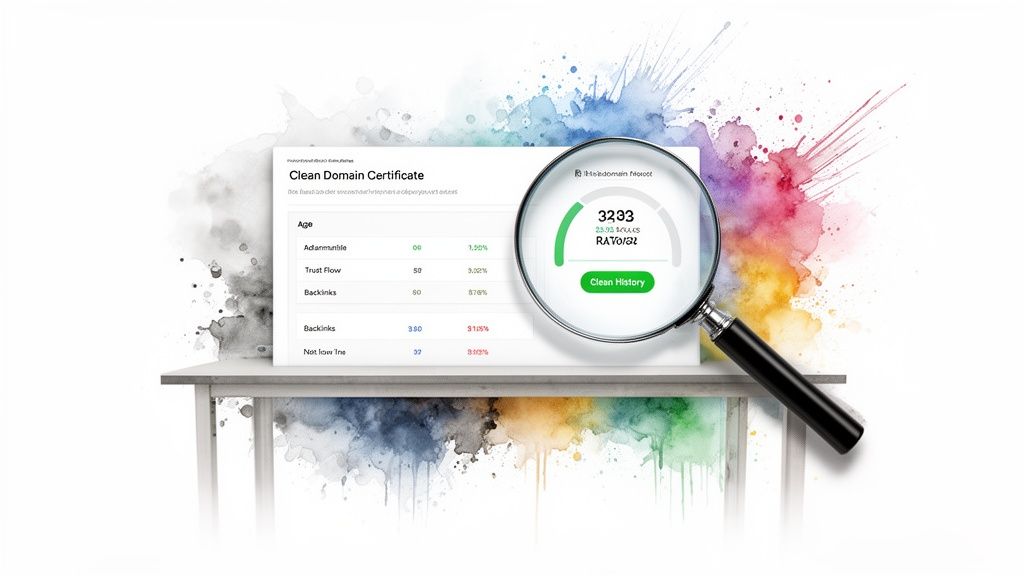
When you're sifting through hundreds of brandable domain names for sale, you’re going to get hit with a wall of metrics. They can look intimidating at first, but they’re really just telling you a story about the domain's past and its potential future.
Here's a quick look at the metrics that genuinely matter to an experienced buyer:
SnagScore: Think of this as your at-a-glance quality check. It's a proprietary score that rolls up all the important data points into one simple number. A higher SnagScore means less guesswork and a stronger foundation to build on.
Trust Flow (TF): This one is huge. It’s a metric from Majestic that measures a domain's perceived trustworthiness based on the quality of sites linking to it. A high TF score suggests links from authoritative sources, not spammy back-alley directories.
Backlinks: This is the raw count of links pointing to the domain. But here's the kicker: quality beats quantity every single time. A domain with five links from major news outlets or universities is infinitely more valuable than one with 500 links from junk blogs.
The ultimate prize is a domain with a high Trust Flow and a clean, relevant backlink profile. It's like inheriting a built-in network of referrals before you even launch.
Here’s a quick-glance guide to the essential metrics for evaluating a domain's potential for branding, SEO, or flipping.
Key Metrics for Vetting Brandable Domains
| Metric | What It Means | Why It Matters |
|---|---|---|
| SnagScore | An all-in-one score reflecting overall domain quality. | Saves time by instantly flagging high-potential domains. |
| Trust Flow (TF) | A score from 0-100 measuring the quality of backlinks. | Indicates how authoritative and trustworthy search engines will perceive the site. |
| Backlinks | The total number of links from other websites. | The foundation of a domain's SEO power, but requires manual inspection. |
| Domain Age | How long the domain has been registered and indexed. | Older domains can be seen as more established and trustworthy by Google. |
| Spam/Penalty Check | Verification that the domain has a clean history. | A penalized domain is a non-starter; it's almost impossible to rank. |
These metrics work together to paint a complete picture. A domain might look good on the surface, but a deep dive into these numbers tells you what you're really buying.
The Power of Age and a Squeaky-Clean Past
Domain age is another factor that search engines quietly respect. An older domain that has been consistently indexed for years is often seen as more established and less likely to be a fly-by-night operation. Think of it like a fine wine—its history can add to its character and value.
However, that history must be clean. If a domain was previously used for spam, a shady affiliate scheme, or anything else that violates search engine guidelines, it can come with some serious baggage in the form of a penalty. This is a deal-breaker. A penalized domain is a money pit, and it can be nearly impossible to get it ranking, no matter how much great content you publish.
This is exactly why a built-in spam check is non-negotiable. You need to verify that the domain has a clean bill of health before you even think about making an offer. You’re looking for an asset with a positive history, not a fixer-upper with hidden foundation cracks. For a deeper dive into how all these factors influence market price, check out our comprehensive guide on how to value domain names.
Putting It All Together: A Practical Checklist
When you find a promising domain, don't just fixate on one number. Analyze how the metrics work in concert. A high backlink count with a rock-bottom Trust Flow is a classic sign of a spammy past. On the flip side, a domain with a modest number of backlinks but an excellent Trust Flow and a high SnagScore is very likely a gem.
Your final evaluation checklist should look something like this:
- Check the SnagScore: Is it high enough to even warrant a closer look?
- Analyze Trust Flow: Does the score look respectable, indicating quality links?
- Review Backlink Sources: Are the links coming from relevant, authoritative sites? Think
.edu,.gov, or well-known industry blogs. - Confirm a Clean History: Has it passed a spam and penalty check with flying colors?
- Assess Brandability: Finally, is it memorable, easy to spell, and a good fit for your niche?
By following this framework, you move from just hoping a name is good to knowing it has the foundational strength to become a powerful brand. You’ll be able to confidently filter through the noise and spot the brandable domain names for sale that are truly worth your investment.
A Practical Guide to Hunting on NameSnag
Alright, theory is one thing, but now it's time to get your hands dirty. Let's fire up the treasure map and go hunting for some real-world brandable domain names for sale on NameSnag. I'm going to skip the dry, step-by-step nonsense and show you how I actually approach this—like a quest for digital gold.
The first thing you need to get your head around is the platform's core split. You’re essentially choosing between two very different types of treasure hunts.
Available vs. Expiring: The Two Paths to Domain Gold
When you first land on the domains page, you'll see two filters that define your entire strategy: Available and Expiring. Understanding the difference is everything, because it dictates not just what you find, but how you'll acquire your prize.
Available Domains: These are the instant wins. Think of them as gems just lying on the ground, ready to be picked up. These domains have already gone through the entire expiration and deletion gauntlet. They were just dropped and can now be registered immediately by anyone at any standard registrar for around $10-$20. Check out the Available domains list to see what's ready to grab right now.
Expiring Domains: This is where the real strategy comes in. These domains are owned by someone who forgot to renew, but they're still in a grace period before they officially drop. You can't just register them today. Instead, you see them coming and prepare to catch them the moment they become available, which usually means placing a backorder or jumping into an auction. The Expiring domains feed is your hunting ground for these upcoming opportunities.
So, which path do you take? It all comes down to your goal. If you need a domain for a project right now, start with the available list. If you have more time and want to snag a potentially higher-value name with more competition, the expiring feed is where you'll want to be.
Filtering Like a Pro: A Real-World Scenario
Let's walk through a real-world example. Imagine you're launching a new SaaS startup in the cloud computing space. You need a name that's short, professional, and carries a bit of weight. A generic name generator just isn't going to cut it; you want something with some history and authority baked in.
This is where the filters become your most powerful tool. Instead of drowning in thousands of irrelevant names, you can laser-focus your search.
Here's how I'd set up the hunt for our "Cloud SaaS" brand:
Set a Quality Baseline: First things first, we eliminate the junk. I'd set the minimum SnagScore to 70 and the minimum Trust Flow to 10. This single move immediately gets rid of the low-quality domains and ensures we're only looking at names with some level of authority.
Target Niche Keywords: Next, I'll use the keyword filter to zero in. Let's add words like "Cloud," "Data," "Flow," or "Sync." Just as important, you can use negative keywords to exclude terms you don't want, like "-games" or "-shop."
Specify the TLD: For a global SaaS brand, a
.comis still king. I'll check the.combox to narrow the focus to the most desirable extension.Define Freshness with Time Filters: This is a fantastic tactical advantage. You can filter for domains that dropped Today, within the last 3 Days, 7 Days, or even longer. I've found that searching the last 3 or 7 days is the sweet spot for finding fresh opportunities that haven't been picked over by the masses yet.
By layering filters, you transform a massive, overwhelming list into a curated handful of high-potential candidates. This is the difference between aimless wandering and strategic hunting.
After applying these filters, your list might shrink from 100,000 domains to just a few dozen. Suddenly, you're not looking for a needle in a haystack; you're choosing from a tray of polished gems. This is where you might see names like Cloudlytics.com or DataLeap.com pop up—short, brandable, and backed by solid metrics.
Advanced Tactics for Serious Hunters
Once you get comfortable with the basics, you can start digging for the truly hidden gems.
For instance, filtering specifically for domains with .edu or .gov backlinks can be a game-changer for SEO. These links are incredibly difficult to get and carry immense trust signals with search engines. It's a pro move.
You can also use the platform to keep tabs on specific names. If you have your eye on a particular expiring domain, set up an alert to get notified the moment it drops. This proactive approach ensures you never miss out on a key asset. For those who want to master this, exploring strategies for effective domain name monitoring can give you a serious competitive edge.
The key is to think like an investor. Use these tools to build a repeatable workflow that lets you scan for opportunities efficiently, every single day. The perfect domain for your next project might have just dropped this morning—and with the right strategy, you'll be the first one to find it.
The Final Steps: Vetting and Acquiring Your Domain
So, you've found it—the perfect domain. The SnagScore is great, Trust Flow looks solid, and it just feels right for your new project. High-five! Now for the part that can feel a little intimidating: actually making it yours. Don't worry, this is where having a clear playbook turns that anxiety into a confident final step.
Before you even think about spending a dollar, it's time for one last deep dive. Think of it as the final inspection before buying a house. You've already fallen for the great curb appeal (the metrics), but now you need to get in there and check the foundation for cracks.
The Final Due Diligence Checklist
Your first stop should be the Internet Archive's Wayback Machine. This thing is an absolute godsend, a time machine for the web that shows you snapshots of what a site looked like in the past. Was your pristine-looking domain previously home to a spammy mess of flashing ads, or something far worse? The Wayback Machine has the receipts. A quick check here can save you from a world of hurt.
Next, it's time to manually eyeball the backlink profile. Metrics give you the big picture, but a quick scroll through the actual referring domains can tell you a story. Are the links from legitimate sites, or are they from weird, foreign-language forums that have nothing to do with the domain's niche? Trust your gut; if it looks spammy, it probably is.
As part of this final check, you have to make sure your chosen brandable name is legally viable for your business. A domain might be available, but that doesn't mean it's free from trademark conflicts. In Canada, for instance, running a thorough NUANS report is a non-negotiable step to prevent some serious legal headaches down the road.
Navigating the Acquisition Path
Once your domain passes the final sniff test, how you actually get your hands on it depends entirely on its current status. This is where you need to shift your strategy.
For domains already listed for sale by an owner, the game is all about negotiation. Start by researching what similar domains have sold for to get a ballpark idea of a fair price. When you reach out, be professional and polite, but don't be afraid to start with an offer that's lower than their asking price. We've actually put together a whole guide on this with some battle-tested tips on how to successfully buy a domain that is already taken.
The aftermarket for brandable domain names for sale is absolutely booming, with sales projected to jump from $0.64 billion to $1.17 billion by 2033. This explosion is fueled by the simple scarcity of short, memorable names—the kind that can boost a business's credibility by 46%. Knowing these market dynamics gives you some real leverage in any negotiation. You can dig into more of these trends and discover insights on current domain statistics.
Setting a firm budget before you enter any negotiation or auction is the golden rule. It's the one thing that will protect you from overpaying in the heat of the moment.
For expiring domains, the process is a different beast entirely. These almost always end up in auctions where you'll be bidding against other interested buyers.
Winning at Auction Without Losing Your Shirt
Domain auctions can be a thrill, but they're also where it's easiest to get swept up and overspend. Success here comes down to two things: preparation and discipline.
Here’s a simple game plan:
- Set Your Max Bid: Before the auction even starts, decide the absolute highest price you're willing to pay. This is your walk-away number. Stick to it. No exceptions.
- Know the Platform: Every auction house has slightly different rules for things like bidding extensions and payment windows. Read the fine print so you don't get hit with any nasty surprises.
- Think About "Sniping": Some buyers like to place their bid in the final seconds of an auction to avoid driving the price up early. It can work, but it's risky if your internet connection decides to take a nap at the wrong moment.
- Stay Cool: Bidding wars are designed to trigger an emotional response. Don't fall for it. If the price blows past your max bid, let it go. I promise, there will always be another great domain.
Whether you're negotiating one-on-one with a seller or battling it out in an auction, this final phase is all about being prepared. With your due diligence done and a clear strategy in hand, you can confidently take that final step from discovering a great domain to proudly owning it.
Putting Your New Domain to Work
Snagging a great brandable domain is a huge win, but let's be honest, the real fun starts now. That digital asset you just bought is a blank canvas. What you do with it completely depends on your end goal, whether you're an SEO wizard, a startup founder, or a domain investor looking to turn a quick profit.
Your next moves are all about turning that initial investment into long-term value.
This whole game really boils down to three core steps: Research, Acquire, and Secure. Everything flows from this.
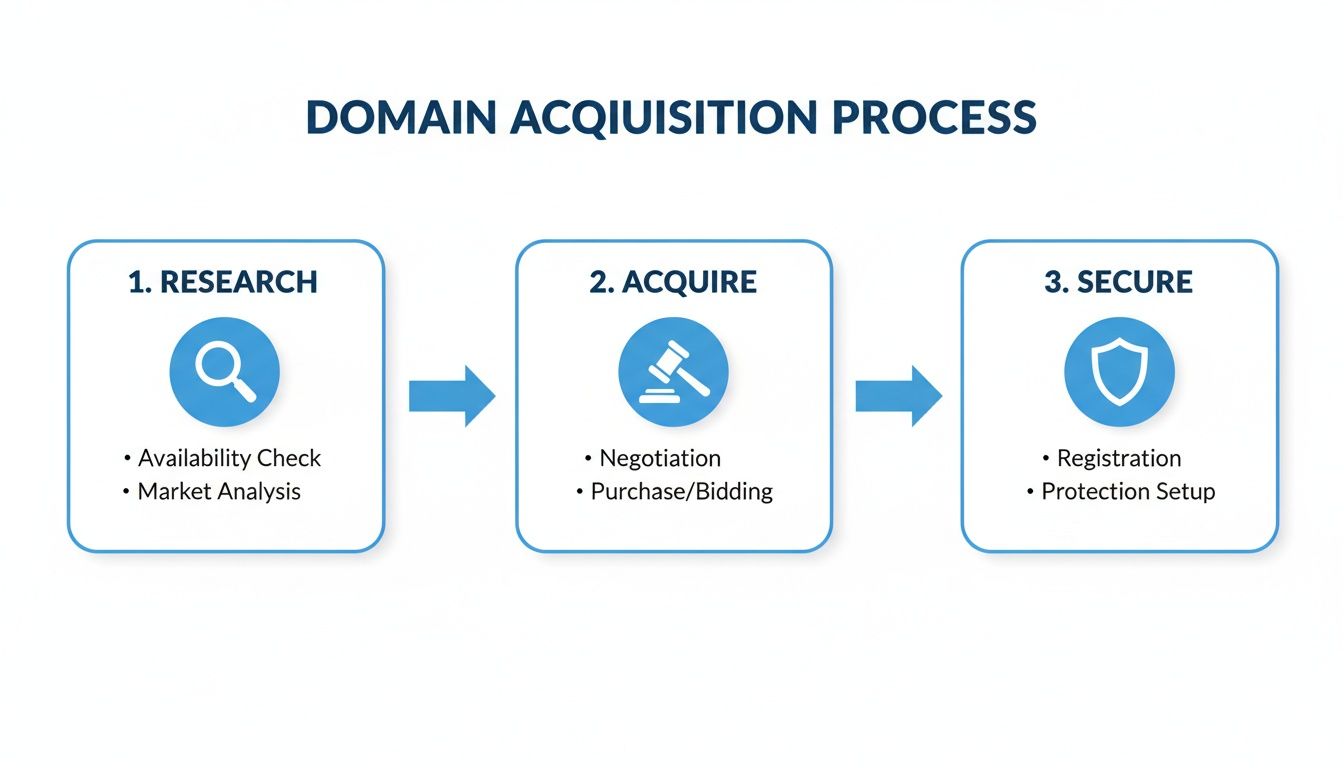
Getting this simple flow right is the foundation of any successful domain strategy. It's what lets you make smart, confident decisions instead of just guessing.
Strategies for the SEO Professional
If you’re in the SEO game, an aged domain with a clean history is basically a superpower. You have a couple of primary paths you can take to harness its built-in authority and give your projects a massive head start.
Your first option is the classic 301 redirect. You permanently redirect the aged domain to your main money site or a specific landing page, passing along a big chunk of its "link equity." This is an incredibly powerful tactic for boosting a new site's authority or juicing up an existing one. Just make sure the old domain’s niche is relevant to your target site to get the full SEO benefit.
The other route is to build it out as a high-authority niche site or a Private Blog Network (PBN) asset. This means creating a new, content-heavy website right on the domain. This can become a valuable traffic source on its own, a lead-gen machine, or just a powerful link in your wider SEO network, funneling targeted authority back to your main properties.
A single aged domain, leveraged correctly, can do more for your rankings in a few months than a brand-new domain could accomplish in a year. Its existing trust with search engines is your unfair advantage.
Blueprints for the Startup Founder
For entrepreneurs, a great brandable domain is the cornerstone of your identity. It's often the very first interaction a customer has with your business. You didn't just buy a name; you bought one with a bit of history, which can immediately make your new venture feel more established and trustworthy.
Here’s how you put it to work:
- Build Your Brand Story: Weave the name into your brand narrative. If it's a cool, made-up word, own its uniqueness. If it’s a keyword-rich domain, lean into that built-in authority.
- Launch with Confidence: A premium domain signals you're serious. It just looks better on a business card, in an email signature, and in investor decks. It projects professionalism from day one.
- Maximize Memorability: Your domain passed the "radio test"—it's easy to say and spell. Use this to your advantage everywhere, from podcasts to social media, making it dead simple for people to find you.
Your domain isn't just a technical asset; it's a marketing powerhouse. It helps you cut through the noise and build a brand that people actually remember.
The Playbook for the Domain Investor
If you bought the domain to flip it, your strategy pivots from building to marketing. Your job is to package this asset in a way that screams its value to the perfect buyer. A successful flip isn't about luck; it's about strategic positioning.
First, price it realistically. Use market data and comps to find a price that's competitive but profitable. The biggest mistake I see is overpricing a domain and letting it collect dust for years. It's almost always better to aim for a solid, timely return on your investment.
Next, you need to write a compelling sales description. This is your pitch. Don’t just list the name; sell its potential. Highlight the metrics that make it a steal:
- The SnagScore and Trust Flow that prove its quality.
- The number of high-authority backlinks.
- Its age and squeaky-clean history.
- Its brandability—is it short, catchy, or keyword-rich?
Finally, list it for maximum visibility. Use reputable marketplaces that syndicate your listing across a wide network of potential buyers. The more eyes you get on your domain, the faster you’ll find the right person willing to pay for the gem you've uncovered.
A Few Common Questions About Brandable Domains
Even with the best game plan, a few questions always seem to pop up once you start hunting for brandable domain names for sale. Let's tackle the most common ones. Think of this as a quick-reference guide to clear up any lingering doubts before you dive in.
Available vs. Expiring: What's the Difference, Really?
Getting this distinction down is probably the most important part of the whole process.
An "available" domain has already gone through its entire expiration cycle and been officially "dropped." It’s out there, right now, ready for you to register at any standard registrar. We're talking a simple $10-$20 registration fee. You can find these on our Available domains list.
An "expiring" domain, on the other hand, is in a bit of a limbo. The owner let it go, but it's still stuck in a grace or redemption period. You can't register it just yet, but it's about to drop. This is where the strategy comes in. Using a tool like NameSnag, you can keep an eye on the Expiring domains feed and be ready to pounce on a gem the second it becomes available.
Is Buying an Expired Domain a Risky Move?
It absolutely can be, which is precisely why doing your homework is non-negotiable.
The two biggest landmines are inheriting a nasty history of spam (which can come with a Google penalty) or accidentally stepping on an existing trademark. A penalized domain isn't an asset; it's a money pit, plain and simple. You'll spend ages trying to clean it up, if you even can.
The secret to turning this risk into a calculated investment is proper vetting. A tool with built-in spam checks and clear metrics is your first line of defense. But you can't stop there. Always follow up with a manual check on the Wayback Machine and a quick gut check of the backlink profile.
This two-step process weeds out the duds and lets you focus only on domains with a clean bill of health.
How Much Should I Actually Pay for a Good Domain?
This is the classic "it depends" question, but we can put some real numbers to it. The price spectrum is huge, from pocket change to a small fortune.
Here's a rough breakdown:
- Dropped/Available Domains: This is your cheapest way in. You're just paying the standard registration fee at a registrar.
- Expiring/Auctioned Domains: These can go for anything from under $100 to several thousand dollars. It all boils down to the competition and the quality of the domain's metrics.
- Premium Listed Domains: These are sold by other investors and often have much higher price tags, which reflect their perceived brand or SEO value in the open market.
The real question isn't "what does it cost?" It's "what is it worth to me?" Define its value based on your specific goal, whether that’s building a powerful SEO asset, launching a new brand, or flipping it for a profit.
So, What Exactly Makes a Domain "Brandable"?
Brandability is where the art of this business meets the science. It’s that hard-to-define mix of factors that makes a name stick in someone's head.
A truly brandable name is almost always short—aiming for under 12 characters is a great starting point. It's easy to remember and, crucially, simple to pronounce.
It has to pass the "radio test." If you heard it mentioned on a podcast, could you type it into your browser without having to guess the spelling? Invented words like "Zillow" or clever two-word mashups often make for the best brandable assets. And while other extensions are gaining ground, a .com is still the undisputed champion for building a global brand.
Ready to stop dreaming about the perfect domain and start finding it? NameSnag gives you the tools to uncover high-value, brandable domains with clean histories and powerful SEO metrics. Start your treasure hunt today at https://namesnag.com.
Find Your Perfect Domain
Get access to thousands of high-value expired domains with our AI-powered search.
Start Free Trial