
Finding expiring domain names is all about spotting and capturing the hidden SEO power in domains that other people have let go. It's a savvy move where you build on an existing domain's history and authority instead of grinding it out with a brand-new one. Think of yourself as a digital archaeologist, and the treasures you unearth can give your projects a serious, almost unfair, head start.
The Hidden Goldmine In Dropped Domains

Alright, welcome to the wild, and frankly, addicting world of domain hunting. If your experience with domains is just brainstorming new ideas and hoping they’re not taken, get ready for a completely different game. The stakes are higher, but the rewards can be massive.
Every single day, thousands upon thousands of domains with established authority, valuable backlinks, and real SEO history are just... dropped. Sometimes an owner forgets to renew, a business folds, or a project gets abandoned. These digital assets don't just disappear into the ether; they enter a cycle that eventually puts them back on the open market, ripe for a savvy SEO or entrepreneur to snap them up.
Why Old Is Better Than New
Let’s put it this way: registering a brand-new domain is like building a house on a raw, empty plot of land. You've got to pour the foundation, frame the walls, and then spend years of hard work just to build up its value.
Grabbing a quality expired domain? That's like buying a charming, well-built house in a fantastic neighborhood. It already has curb appeal, a solid foundation, and established connections. You're not starting from scratch; you're inheriting a legacy.
This "legacy" usually includes goodies like:
- Existing Backlinks: High-quality links from other sites that could take you years and a small fortune to build on your own.
- Domain Age: Search engines often have a soft spot for older, established domains. It's a signal of stability.
- Established Authority: A track record of being a trusted source on a particular topic.
The Daily Deluge of Opportunity
The sheer scale of this is hard to wrap your head around. We're not talking about a small trickle of domains becoming available. It’s a firehose.
Every day, hundreds of thousands of domains hit their expiration date. To give you a real-world snapshot, on February 20th, 2026, a staggering 713,509 domains are set to expire. The next day? Another 774,233. And the day after that, 740,438.
That’s over 2.2 million domains hitting the market in a mere three-day window. It's an ocean of opportunity.
The secret isn't trying to manually pan for gold in this flood. The secret is having the right tools to systematically filter out the junk and spot the undervalued assets before anyone else.
This is exactly where a platform like NameSnag becomes your unfair advantage. Instead of drowning in endless lists, you can instantly filter for the metrics that matter and find the true gems.
You can, for example, zero in on Expiring domains that are still in their grace period and will be dropping soon. This gives you a critical head start to plan your move. If you want to really get into the weeds on this, our guide on how to find expired domain names for sale is a great next step.

By focusing your search on high-authority domains before they officially drop, you can line up your acquisition strategy and be ready to act the moment they become available.
Decoding The Metrics That Actually Matter
So, you get it. Expiring domains can be a goldmine. But how do you tell the difference between a shiny nugget and a worthless piece of pyrite? Not all expiring domains are created equal—far from it.
Some are digital ghost towns plagued by spam, while others are prime real estate just waiting for a savvy buyer. This is where we get into the fun stuff: the data. You have to look past a catchy name or a coveted ".com" extension. The real value is buried in the metrics, the signals that tell you if a domain has genuine authority or is just dead weight. This is your field guide to decoding the numbers that actually move the needle.
The Core Authority Trio
Think of these three as the holy trinity of domain valuation. They give you a quick, powerful snapshot of a domain's strength and are the very first things I check.
- Domain Authority (DA): This score from Moz (from 1 to 100) predicts how well a site will rank. A higher DA suggests stronger ranking potential. Grabbing a domain with a DA of 30+ is like getting a massive head start in the SEO race.
- Trust Flow (TF): A metric from Majestic, TF measures a domain's trustworthiness based on the quality of its backlinks. A domain with links from spammy neighborhoods will have a low TF, even with thousands of links. A high TF, especially above 20, is a strong sign of a clean, authoritative history.
- Referring Domains (RDs): This is simply the number of unique websites linking to the domain. It’s arguably more important than the total backlink count, as 100 links from one site is far less valuable than one link from 100 different reputable sites. A high RD count shows widespread recognition.
These metrics have to work together. A domain with a high DA but a rock-bottom TF is a major red flag, likely pointing to manipulative link-building in its past. You're looking for a healthy balance.
Going Deeper Than The Big Three
Once a domain passes the initial eyeball test with its DA, TF, and RDs, it's time to dig a little deeper. The best opportunities are often found by examining the finer details of a domain's profile.
Domain Age: Older domains often carry more weight with search engines. An 8-year-old domain has a history and stability that a brand-new registration simply can't fake. It's a signal of endurance.
The Golden Links (.edu & .gov): Backlinks from educational institutions (.edu) and government websites (.gov) are SEO gold. These links are incredibly difficult to acquire and are seen by search engines as massive votes of confidence. Finding an expiring domain with even one or two of these is a huge win.
A single, relevant backlink from a trusted .edu site can provide more SEO value than dozens of links from generic blogs. It’s the ultimate quality-over-quantity signal.
Brandability: Don't forget the human element! Is the domain easy to remember, spell, and pronounce? Does it sound like a legitimate brand? A short, memorable name like coffeebuzz.com is infinitely more valuable than a clunky, keyword-stuffed name like best-coffee-beans-online-shop.com.
For a quick reference, here are the core metrics I always keep in mind when evaluating a potential domain acquisition.
Key Metrics For Valuing Expiring Domains
| Metric | What It Measures | Why It Matters |
|---|---|---|
| Domain Authority (DA) | A 1-100 score predicting a site's ranking potential. | A higher score (e.g., 30+) indicates a stronger starting point for SEO. |
| Trust Flow (TF) | The trustworthiness of a site based on backlink quality. | A high TF (e.g., 20+) suggests a clean link profile, free from spam. |
| Referring Domains (RDs) | The number of unique websites linking to the domain. | Shows the breadth of a domain's authority and recognition. |
| Domain Age | The length of time the domain has been registered. | Older domains are often viewed as more established and trustworthy by search engines. |
| .edu/.gov Links | The presence of backlinks from educational or government sites. | These are powerful, high-authority links that are very difficult to earn. |
| Brandability | How memorable, short, and brand-worthy the name is. | A good brand name is easier to market and builds user trust. |
Ultimately, a strong domain will perform well across several of these categories, not just one.
The SnagScore Solution
Evaluating all these metrics manually for every potential domain would be a full-time job. It’s a slow, tedious process of cross-referencing multiple tools. This is where a composite score, like the SnagScore on NameSnag, becomes a game-changer.
SnagScore crunches all these numbers—DA, TF, RDs, age, link quality, and more—into a single, easy-to-understand score. It does the heavy lifting for you, instantly flagging the high-potential domains and saving you from wasting hours analyzing duds.
Instead of juggling a dozen browser tabs, you can see at a glance which domains are worth a closer look. It turns a complex analytical task into a simple sorting exercise.
Your Workflow For Finding High-Value Domains
Ready to get your hands dirty? Theory is one thing, but now it’s time to build a repeatable system for sniffing out incredible domains. This isn't about aimlessly scrolling through endless lists; it's about creating a smart, efficient process that brings the best opportunities right to you.
The goal here is to move from a manual chore to an automated hunt. We’ll set up filters and alerts so the perfect domains find their way to your inbox, not the other way around.
Setting Up Your Search Filters
The first step in any successful domain hunt is cutting through the noise. With hundreds of thousands of domains dropping every single day, you need a powerful filter to separate the gold from the garbage. Think of it like tuning a metal detector to ignore bottle caps and only beep for treasure.
Let’s walk through a couple of real-world scenarios.
- The Agency Builder: An SEO agency needs to build out a Private Blog Network (PBN) in the competitive legal niche. Their ideal domain needs authority and relevance. They could set their filters to find domains with a SnagScore over 50, at least one .gov backlink, and the keyword "law" or "legal" right in the name.
- The Startup Founder: A founder is hunting for a short, memorable, brandable name for their new tech app. They might filter for .com domains only, with a maximum length of 8 characters, a spotless history, and that just became Available domains today.
This is where you can get surgically precise. A tool like NameSnag lets you stack these conditions to create a highly targeted search. You can find domains about to drop in the Expiring domains section, or you can find gems ready for immediate registration in the Available domains list.
Expiring vs. Available: The Tactical Difference
It's really important to understand the strategic difference between these two categories.
Hunting for Expiring domains is about playing the long game. You're scouting domains that are in their grace period and will drop soon—maybe in the next 3 Days, 7 Days, or even 30 Days. This runway gives you plenty of time for deep-dive research so you can prep a backorder or get ready for an auction.
On the flip side, searching for Available domains is all about instant gratification. These domains have already gone through all the redemption periods and are ready to be hand-registered at any registrar, right now. It’s a faster game, perfect for snapping up a great brandable name that just slipped through the cracks.
The daily flood of expired domains means they aren't rare relics—they're a renewable resource. Platforms like NameSnag make it almost effortless by scanning 170,000+ domains daily. It scores them with SnagScore (based on Trust Flow, age, and backlink quality) and flags spam risks so you don’t waste time on duds. Imagine setting alerts for high-authority .coms expiring next week—long before they hit the chaos of GoDaddy auctions where over 56,000 domains can drop in a single day. You can see this daily churn for yourself over at ExpiredDomains.net.
Creating Your Custom Watchlist
Once you’ve dialed in your filters, you’ll start seeing some promising candidates. But you can't be chained to your computer 24/7. This is where creating a watchlist and setting up alerts becomes your secret weapon.
Think of it just like setting a stock alert. You spot a domain you're interested in, add it to your "Watcher," and then get a notification the moment its status changes. For competitive domains, this is absolutely essential. You’ll get an email or SMS heads-up right before it drops, giving you the critical edge needed to snag it.
This one simple step transforms your process from active hunting to passive monitoring. You do the strategic work upfront by defining exactly what you want, and then let the technology take over, making sure you never miss a golden opportunity just because you were busy.
As you build out your domain-finding workflow, it’s also helpful to think about the broader strategies of how to screen investment opportunities at scale. The principles of systematic evaluation apply perfectly here, helping you build a robust and profitable process.
Building an effective workflow is all about creating a system that works for you. Whether you're a domain investor, an SEO pro, or a startup founder, the right filters and alerts can turn an overwhelming task into something manageable—and highly profitable. For a closer look at the tools that can help, check out our guide on using an expired domain finder to streamline your search.
Mastering The Art Of Domain Due Diligence
So, you've tweaked your filters and a promising domain just popped onto your radar. The metrics look solid—good DA, decent TF, a healthy number of referring domains. It’s tempting to pull the trigger right then and there, isn't it?
Not so fast. This is where the real detective work begins.
A domain that looks great on paper can be hiding a toxic past, like a house with a fresh coat of paint covering up a cracked foundation. Buying a lemon won't just waste your money; it can torpedo your SEO efforts and set you back months. This stage is all about peeling back the layers to make sure your shiny new asset is actually as clean as it looks.
Uncovering The Domain's Past Life
Every domain has a story, and it's your job to become its biographer. Before you even think about buying, you have to understand what it was used for before. Was it a legit business blog, a harmless hobby site, or something... less reputable?
Your first and most essential tool here is the Wayback Machine. This digital time capsule lets you see snapshots of the website from months, or even years, ago.
Here's what you're looking for:
- Consistency: Was the site always about a single topic? A domain that was a dog grooming blog for five years is a great sign. One that was a dog grooming blog, then a sketchy online casino, then started selling weird supplements? That's a massive red flag.
- Content Quality: Did the old site have real, valuable content, or was it just spun garbage? You're looking for signs of a legitimate operation.
- Foreign Language Takeovers: A classic spammer tactic is to hijack a legit English-language site and plaster it with content in another language (often Chinese, Russian, or Japanese). If you see that in its history, run for the hills.
This whole process boils down to a simple workflow: filter for promising candidates, identify their true history, and then set alerts to grab the clean ones.
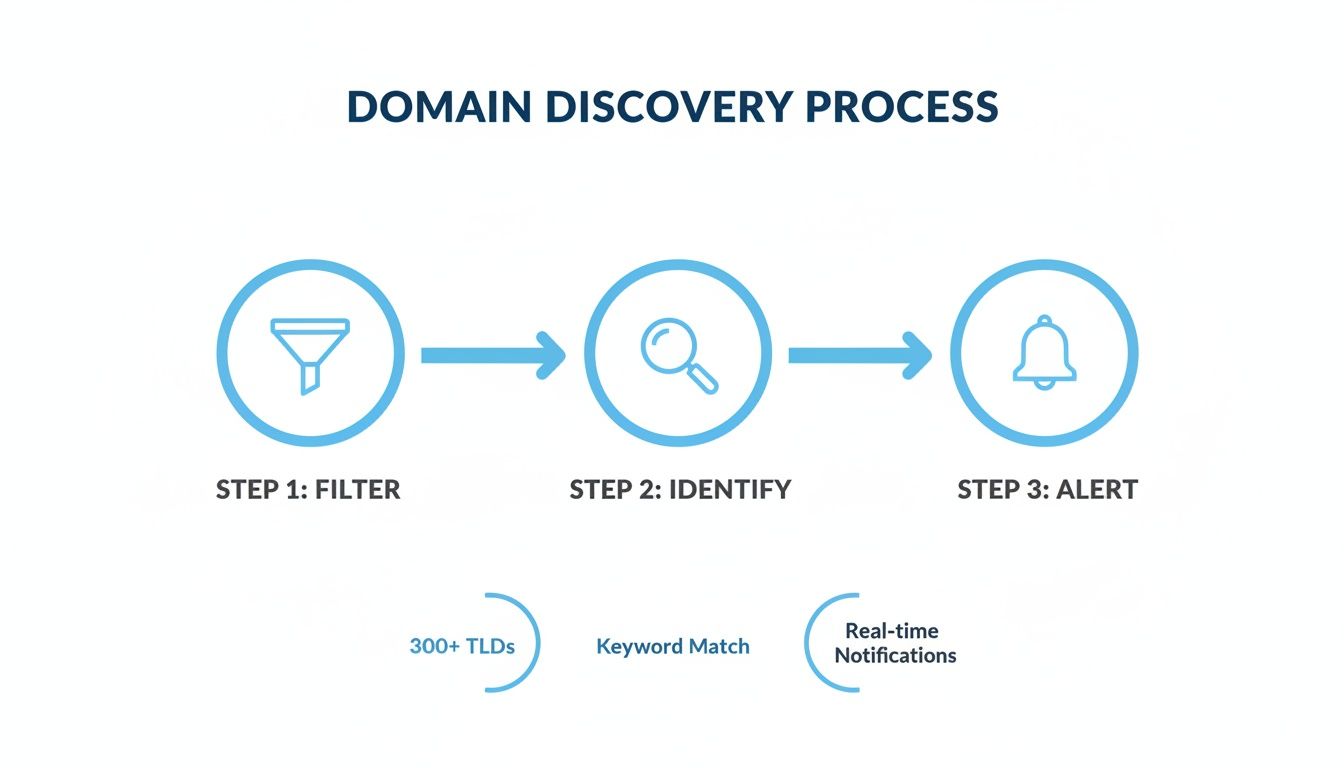
This just goes to show that effective domain hunting is a system, not a lottery. You move from a wide net to specific, actionable targets.
The Backlink Audit: A Clean Profile Is Non-Negotiable
A domain's backlink profile is its digital reputation, and you need to scrutinize who's vouching for it. A powerful domain with links from spammy, irrelevant, or downright shady websites is a liability, not an asset.
When you dig into its backlinks, you’re hunting for signs of manipulative SEO. Pay close attention to the anchor text—the clickable words in a hyperlink. If a huge percentage of the anchor text is aggressive, exact-match keywords like "buy cheap watches online," that's a dead giveaway of spammy tactics. A natural anchor text profile is diverse, full of brand names, generic phrases like "click here," and long-tail variations.
Think of it this way: a good backlink profile is like a collection of references from respected figures in your industry. A bad one is like a stack of recommendations from known con artists. Which one would you rather inherit?
Spotting The Phantom Menace: Google Penalties
The ultimate deal-breaker is a past Google penalty. A domain that's been punished by Google is essentially radioactive. Trying to build on it is an uphill battle you are almost guaranteed to lose.
So, how do you check? There’s no big red button that says "Penalized," so you have to look for clues.
- Check Google's Index: Do a simple
site:yourdomain.comsearch in Google. If nothing shows up, the domain has likely been de-indexed. That's the kiss of death. - Look for Traffic Drops: If you have access to historical traffic data from a tool like Ahrefs or Semrush, look for sudden, catastrophic drops in organic traffic that line up with known Google algorithm updates.
This whole due diligence process can feel like a lot, but it's the single most important step in your quest. For a deeper dive, check out our guide on how to check a domain's history for a complete checklist. Skipping this part is like buying a used car without ever looking under the hood—a gamble you just don't want to take.
You’ve done the hard work. You’ve sifted through the noise, done your due diligence, and finally landed on a domain that’s clean, powerful, and just right for your project. Now for the final, most critical step: making it yours.
The truth is, the acquisition process isn't one-size-fits-all. It can be as simple as a five-minute checkout or as intense as a high-stakes, multi-day auction. Knowing which path to take—and when—is the key to successfully landing your target without torching your budget. Let’s break down the three main ways you’ll be getting these domains.
The Instant Gratification Method: Hand-Registering
This is the most straightforward approach, and it’s a thing of beauty when it works out. This strategy is exclusively for domains that have completed their entire lifecycle—expiration, grace period, redemption—and have officially "dropped" back into the public pool for anyone to grab.
These are the gems you can find using the Available domains filter on platforms like NameSnag. Once a domain is listed as available, it’s a free-for-all. You can just head over to your favorite registrar (like GoDaddy or Namecheap) and register it on the spot, just like you would a brand-new name.
- Best For: Brandable domains that somehow slipped under the radar or lower-competition names with decent, but not mind-blowing, metrics.
- Pros: It's lightning-fast, cheap (you only pay standard registration fees), and the domain is yours instantly.
- Cons: The truly exceptional domains almost never make it this far. High-value names are usually snatched up by backorder services the very millisecond they drop.
This method is all about speed and timing. If you find an available diamond in the rough, don't think twice. Just grab it.
The Automated Catcher: Placing A Backorder
So what about those high-value domains you know will have competition? The ones with killer metrics that have multiple people drooling over them? Trying to hand-register these is like trying to catch a feather in a hurricane—your odds are basically zero.
This is where a domain backorder service becomes your best friend. You’re essentially paying a company (like SnapNames or DropCatch) to unleash their high-speed, automated systems to try and register the domain for you the microsecond it becomes available.
It's your best shot at grabbing a competitive domain. If you’re the only one who backordered it, congratulations, the domain is yours. If multiple people place a backorder, things get interesting. The domain typically goes to a private, 3-day auction between only those who placed a backorder.
Backordering is a non-negotiable tactic for any serious domain hunter. It’s an admission that you can’t beat the machines, so you might as well hire one to do the dirty work for you. For any domain with a strong SnagScore and a healthy number of referring domains, a backorder is a smart, strategic investment.
The Final Showdown: Expired Domain Auctions
This is where the most valuable, high-authority domains often end up. When a domain expires but is then renewed by the registrar specifically to be sold for a profit, it lands in a public auction. Welcome to the big leagues, often hosted by marketplaces like GoDaddy Auctions.
Unlike the private backorder auctions, these are open to absolutely everyone. This means way more competition and potentially much higher prices, but it’s also where you'll find domains with incredible, battle-tested SEO history.
To come out on top in an auction, you need a rock-solid strategy:
- Set A Hard Budget: Know your absolute maximum price before you even think about placing your first bid.
- Avoid Emotional Bidding: The adrenaline of a bidding war is real, and it’s an easy way to overpay. Stick to your budget, no exceptions. If the price flies past your limit, let it go. There will always be another domain.
- Bid Late (Sniping): Placing your true maximum bid in the final seconds of the auction is a classic and effective strategy to avoid driving up the price prematurely.
The renewal rates for different domain types really put the scale of this opportunity into perspective. While legacy gTLDs like .com have a 75.3% renewal rate, newer extensions (ngTLDs) see a renewal rate of just 34.2%. This churn is constantly feeding the stream of valuable expiring names. Missing out on these auctions and drops, as you can see from these domain name statistics, means letting powerful digital assets slip right through your fingers.
Answering Your Top Questions About Expired Domains
Diving into the world of expired domains always brings up a few head-scratchers. It’s a field filled with its own lingo and specific strategies that can feel a bit murky at first. Let's clear the air and tackle some of the most common questions I hear all the time.
Think of this as your quick-reference guide. The goal is to get you past the theory and into finding great domains with confidence, sidestepping those common rookie mistakes.
What's The Difference Between An 'Expiring' And An 'Available' Domain?
This is probably the single most important thing to get straight, because it dictates your entire game plan for getting a domain.
An Expiring domains has blown past its renewal date, but it's not a free-for-all just yet. It’s stuck in a kind of limbo—a "grace period" that can last anywhere from 30 to 75 days. During this time, the original owner can still waltz in and renew it. It's "on deck," so you can't have it now, but it might be up for grabs very soon.
An Available domains, on the other hand, has survived all those grace periods and has been officially "dropped." It's back in the public pool, and anyone can register it, right now, at any standard registrar.
This is exactly why tools that let you filter between the two are so crucial. On a platform like NameSnag, you can scout out domains that are about to drop to get a strategic heads-up, or you can go hunting for instant wins in the available list.
How Can I Use An Expired Domain For SEO?
Once you've snagged a great domain, the real fun begins. There are three classic, powerhouse strategies for putting its existing authority to work for you.
The Power Redirect: This is the simplest and often most effective play. You just use a 301 redirect to point the expired domain to your main website. This basically tells search engines, "Hey, all that link juice and authority from this old domain? Send it all over to my main site now." It can give your primary site a surprisingly quick and noticeable boost.
The Niche Site Build: If the domain has a strong, relevant history in a specific niche (think
prohomebrewing.com), you can build a new affiliate or content site right on that foundation. Its existing authority gives you a massive head start, letting you bypass a lot of that initial "Google sandbox" period where new sites struggle to get traction.The PBN Play: This is more for the advanced SEO crowd. High-authority expired domains are the perfect building blocks for a Private Blog Network (PBN). By creating a network of authoritative sites you control, you can build powerful, targeted links to your primary money-making websites.
Is Buying Expired Domains A Risky Strategy?
It absolutely can be—but only if you skip your homework. The single biggest risk is unknowingly buying a domain that was spammed into oblivion or hammered with a Google penalty. That's a one-way ticket to SEO purgatory.
The risk isn't in the strategy itself, but in the execution. Thorough due diligence is your insurance policy against buying a digital lemon.
This is why the vetting process we covered earlier is completely non-negotiable. You have to check its backlink profile for toxic junk, review its anchor text for spammy keywords, and use the Wayback Machine to make sure its past life was legitimate.
Using a platform with a built-in composite metric like SnagScore is a huge leg up here. It does a lot of that initial heavy lifting for you, instantly weeding out the most obvious garbage.
What Is A Backorder And When Should I Use One?
A domain backorder is a service where you pay a company to try and register a domain for you the exact millisecond it drops. It’s like hiring a highly specialized robot to do the impossible task of clicking "register" faster than any human possibly could.
You should always use a backorder for a high-value, competitive domain. If you've found a name with a great SnagScore, solid backlinks, and obvious commercial potential, you can bet you're not the only one who's noticed it. If multiple people backorder the same name, it usually goes to a private auction just between those bidders.
While it's not a 100% guarantee you'll get it, a backorder dramatically increases your odds from near-zero to a real fighting chance.
Ready to find your own hidden gems? NameSnag turns the chaotic hunt for valuable domains into a systematic, simple process. Stop wasting hours on manual checks and start discovering high-authority domains with real potential today. Explore thousands of Expiring domains now.
Find Your Perfect Domain
Get access to thousands of high-value expired domains with our AI-powered search.
Start Free Trial