Choosing the right keyword for a domain name is like your brand’s digital handshake—it's the first thing both users and search engines see. This isn't just about stuffing in SEO terms; it's about crafting a memorable, trustworthy identity that lays the groundwork for your entire online presence. And let's be honest, it's also kind of fun.
Why Your Domain Keyword Is Your Digital First Impression

Let's get one thing straight: your domain name is so much more than a web address. It’s your brand’s calling card, your virtual storefront sign, and a powerful SEO signal all rolled into one glorious package.
When someone hears your domain, it should instantly tell them what you’re about. Think of it as the ultimate elevator pitch. A strong, keyword-focused domain like veganpizzadelivery.com leaves absolutely no room for confusion. You know exactly what you're getting, right?
This initial clarity builds immediate trust. A relevant keyword tells visitors they've landed in the right place, which can lower bounce rates and improve user engagement—two things Google pays very close attention to.
The Power of Keywords for Authority
Weaving a primary keyword into your domain can give you a subtle but significant edge. It signals to search engines what your site's core topic is, helping you build topical authority from day one. While the days of exact-match domains guaranteeing a top spot are long gone, a relevant keyword still provides critical context.
Of course, the real challenge is finding one that isn't already taken. Imagine trying to snag a premium domain like 'coffee.com' today—good luck. The .com landscape is insanely crowded, with over 160 million registrations and counting. This saturation means keyword-rich .com domains are like digital gold, often commanding sky-high prices on the aftermarket. If you're curious about the numbers, you can explore the full domain name statistics.
Navigating the Crowded Domain Market
With so many names snapped up, the hunt for a good keyword for a domain name can feel like a treasure hunt where all the obvious spots have been dug up. This is where you have to get creative and strategic. Instead of throwing in the towel, savvy entrepreneurs and SEOs turn to different avenues to find those hidden gems.
Here are a couple of pro tactics that work wonders:
- Find Available domains: You can discover domains that were recently dropped and are ready to be registered immediately. These are fresh opportunities to find a keyword-rich name that someone else let go of. It's like finding a five-dollar bill in an old coat pocket.
- Hunt for Expiring domains: Another killer strategy is to look for domains that have expired but are still in their grace period. These often come with existing age and authority, which can give your SEO a nice head start.
Your domain is the anchor of your brand. A great one is intuitive, memorable, and sets expectations before a user even clicks. It's the difference between being
generic-online-store123.comand a name that people actually remember and trust.
Brainstorming Keywords That Actually Attract Customers
Okay, this is where the real work—and the fun—begins. Our goal isn't just to find any keyword for a domain. It's about digging deep to find the exact phrases your ideal customers are typing into Google when they're actively looking for what you sell.
This means you have to get inside their heads. Think like a problem-solver, not just a business owner trying to sell something.
Let’s be real for a second. If you're launching a custom dog collar business, dogcollars.com was taken before you were born. So, forget the obvious. Instead, think about the intent behind the search. Is someone looking for "personalized leather dog collars," "eco-friendly puppy collars," or maybe "durable collars for large dogs"? Each one of those phrases tells a completely different story and attracts a very different kind of buyer.
Think Like Your Customer
The first thing I always do is create a "seed list" of core ideas related to the business. Don't censor yourself here. Just start jotting down words and phrases that describe what you do, who your customers are, and the specific problems you solve for them.
Let's imagine a business selling eco-friendly cleaning supplies. Their seed list might look something like this:
- Core Product: "natural cleaner," "green cleaning," "non-toxic soap"
- Customer Pain Point: "safe for pets," "allergy-friendly," "chemical-free home"
- Location (if it matters): "brooklyn," "nyc delivery," "local eco cleaner"
This little exercise immediately moves you beyond generic terms and into the specific language your target audience actually uses. As you get into this, understanding the basics of a smarter SEO keyword strategy is crucial for making sure you're targeting effectively without just stuffing keywords everywhere.
Uncovering Hidden Gems
Once you have that seed list, it's time to expand it. A powerful—and slightly sneaky—tactic is to spy on your competitors. What keywords are they targeting in their domain names, page titles, and blog posts? Tools like Ahrefs or SEMrush are great for this, but honestly, even a few clever Google searches can give you some serious clues.
Another absolute goldmine is online communities. Go hang out where your potential customers are. I'm talking about niche Reddit subs, Facebook groups, and industry-specific forums. Pay close attention to the exact language people use when they're asking for recommendations or complaining about a problem. These are the authentic, high-intent keywords you're looking for.
The best keywords often come from real customer conversations, not just keyword research tools. Listen to how people describe their needs, and you'll find domain ideas that resonate on a deeper level.
Finally, you need to think about brandability. Sometimes the perfect domain is a creative mix of a keyword and a unique, memorable word. Getting this balance right is so important for standing out, which is something we explore in our guide to choosing a truly brandable domain name. Your brainstormed keyword list is the perfect launchpad for crafting a name that’s both descriptive and unforgettable.
Balancing SEO Power with Unforgettable Branding
This is where the art of branding bumps up against the science of SEO. It's a classic showdown!
Finding the perfect keyword for a domain name can feel like a home run, but what happens when that domain is a clunky, hyphenated mess? Sure, best-cheap-vegan-pizza-brooklyn.com is descriptive, but it's hardly rolling off the tongue.
This is the classic trade-off every domain hunter faces. A great domain needs to work for search engines and for people. It has to be descriptive enough to give Google the right signals, but catchy enough to stick in a customer's head.
After all, your domain isn’t just a signpost for bots; it’s the name your customers will type, share, and (hopefully) remember for years to come.
The Memorability Test
So, how do you know if you've gone too far down the SEO rabbit hole? Start by asking one simple question: Can someone hear this name once and remember it later? If your domain is a jumble of keywords or awkward phrases, the answer is probably no. A memorable name is short, simple, and easy to spell.
Think of it this way: could a customer hear your name in a podcast ad while driving and still recall it when they get home? That's the gold standard. If you want to dive deeper into what makes a name stick, check out our guide on what makes a good brand name.
A domain that’s easy to say is easy to share. Word-of-mouth is still incredibly powerful, and a simple, brandable name is its best fuel. Don't sacrifice shareability for a tiny, theoretical SEO boost.
When New Domain Extensions Make Sense
For decades, .com has been king. No question. But the game is changing, and the explosive growth of new generic top-level domains (gTLDs) is rewriting the playbook for keyword domain hunting.
New options like .shop, .online, and .tech have surged to 37.8 million registrations, driven by booming markets where businesses need relevant, available names. This gives niche site builders and affiliate marketers a serious edge, allowing them to snag keyword-rich domains without getting into a bidding war for an expensive .com.
So, should you grab artisancoffee.shop? For a lot of businesses, the answer is a resounding yes. These new extensions provide instant context and can make your domain shorter and far more relevant.
Keyword Domain Type Trade-Offs
To help you decide which path is right for your project, here’s a quick comparison of the different domain keyword strategies.
| Domain Type | Primary Benefit | Potential Downside | Best For |
|---|---|---|---|
| Exact-Match | Strong, immediate SEO signal for a specific term. | Often unbrandable, long, and can limit future growth. | Highly specialized niche sites or local service businesses. |
| Partial-Match | Balances a keyword signal with a brandable element. | Can sometimes feel generic or forced if not done well. | E-commerce stores, blogs, and service businesses. |
| Brandable | Memorable, unique, and allows for broad expansion. | Little to no initial SEO value from the name itself. | Startups, agencies, and brands with long-term vision. |
| New gTLD | High availability and instant context (e.g., .tech, .io). |
May have lower perceived trust than a traditional .com. |
Tech companies, online stores, and industry-specific sites. |
Ultimately, there's no single "best" answer—it all comes down to your specific goals, your market, and the brand you're trying to build.
The Final Scorecard
Choosing the perfect domain is a strategic decision, not just a technical one. You need a name that feels authentic to your brand while also giving search engines clear signals about what you offer. Don't forget, the URL itself is a powerful tool. You can find more insights on the importance of URL keywords to really maximize your visibility.
Weigh both sides—the functional SEO value and the creative branding potential—to find that sweet spot. That's how you land a domain that will set your business up for success for years to come.
Uncovering Hidden Gems in Expired Domains
Why build a brand-new house on an empty plot of land when you can start with a solid foundation already in place? That's the core idea behind hunting for expired domains—it’s a secret weapon for savvy SEOs and domain investors.
Instead of starting from absolute scratch with a brand-new name, you can find one that already has age, authority, and valuable backlinks baked right in.
Think of it like this: a new domain is a seed. With enough time and care, it can grow into a mighty tree. An expired domain, on the other hand, is a tree that's already grown—it just needs a new gardener. It comes with an established root system (backlinks) and has already weathered a few seasons (domain age), giving you a massive head start.
This strategy can literally save you months, or even years, of painstaking SEO work. Finding the right keyword for a domain name is crucial, but finding one that also comes with pre-existing authority is a total game-changer.
Spotting SEO Gold Before It's Gone
The real trick is knowing where and when to look.
When a domain expires, it doesn't just vanish into thin air. It enters a "grace period," which is a small window of time where the original owner can still renew it. If they don't, it eventually "drops" and becomes available for anyone to register.
This is where you can find some absolute gems. You can use platforms like NameSnag to specifically search for domains that are about to drop. It’s like having insider knowledge, allowing you to spot high-potential names before they hit the open market and a feeding frenzy begins.
By filtering for Expiring domains, you can actually plan your acquisition strategy. Maybe you find a fantastic domain dropping in three weeks. That gives you plenty of time to research its history, check its backlink profile, and get ready to pounce the moment it becomes available.
An expired domain with a clean history and relevant backlinks is one of the fastest ways to build topical authority. You're not just buying a name; you're acquiring a digital asset with a history that search engines already recognize and respect.
A Practical Workflow for Finding Hidden Gems
Let's walk through a real-world scenario. Imagine you're building a niche site about sustainable gardening. The keyword "eco-friendly gardening" is your target.
Start with the 'Expiring' Filter: Head over to a tool like NameSnag and select the filter for domains that are expiring. This immediately narrows your search to names that will be up for grabs in the near future.
Use Time Filters Strategically: You can get super specific and set the time filter to see what's dropping Today, within 3 Days, or even 30 Days from now. This helps you manage your time and prioritize which domains to investigate first. A domain dropping tomorrow requires immediate attention, while one dropping in two weeks can be added to your research list.
Layer on Keyword Searches: Now, add your keywords. Search for terms like "garden," "sustainable," "eco," or "green." This will show you expiring domains that contain your target keywords. You might uncover something like
SustainableGardenLife.comorEcoFriendlyPlanters.net.
By following this process, you’re no longer just blindly searching for a keyword for a domain name. You’re strategically hunting for aged assets that can accelerate your SEO success from day one. You can learn more about this approach by checking out our in-depth guide to finding expired domains and building a powerful online presence.
Vetting Your Shortlist Like a Domain Pro
You've got a shortlist of promising domains. High five! But before you get too attached and hit that "buy" button, it's time to put on your detective hat.
A domain that looks perfect on the surface can be hiding a sketchy past, and you really don't want to inherit someone else's digital baggage. This final quality control check is non-negotiable. A domain with a toxic history—think spammy backlinks from shady sites—can seriously kneecap your SEO efforts before you even get started.
Think of it as running a background check on a business partner. You need to know who they've been associated with.
Peeking into a Domain's Past Life
Your first stop should be the Wayback Machine. This incredible digital archive lets you see snapshots of what a website looked like over the years. Was it a legitimate business? A spammy blog filled with garbage content? Or something worse?
If the domain you’re eyeing for your new "organic dog food" blog was previously a site for online gambling, that's a massive red flag. You need to know.
Next up, dig into its backlink profile. This is the complete record of every other website that has ever linked to the domain. Tools like Ahrefs, Moz, or Majestic will show you this history in excruciating detail.
You're looking for two main things here:
- Relevance: Are the backlinks coming from sites related to your niche? Links from a respected pet care blog are gold. Links from a Russian link farm? Not so much.
- Quality: A handful of high-authority links are worth infinitely more than thousands of low-quality, spammy ones. A profile packed with junk can signal to Google that this domain has a bad reputation, and you’ll be fighting an uphill battle from day one.
The Clean Slate Strategy
Sometimes, the best history is no history at all.
If you'd rather have a fresh start without any potential baggage, your best bet is to find a clean domain that just dropped. These are names that have recently expired and been released back into the wild, ready for anyone to register immediately.
This approach lets you find a great keyword for a domain name success without the risk of a toxic past. The key is to act fast, because the good ones get snapped up quickly.
A simple workflow can help you filter, spot, and plan your acquisition of these high-value expired domains.
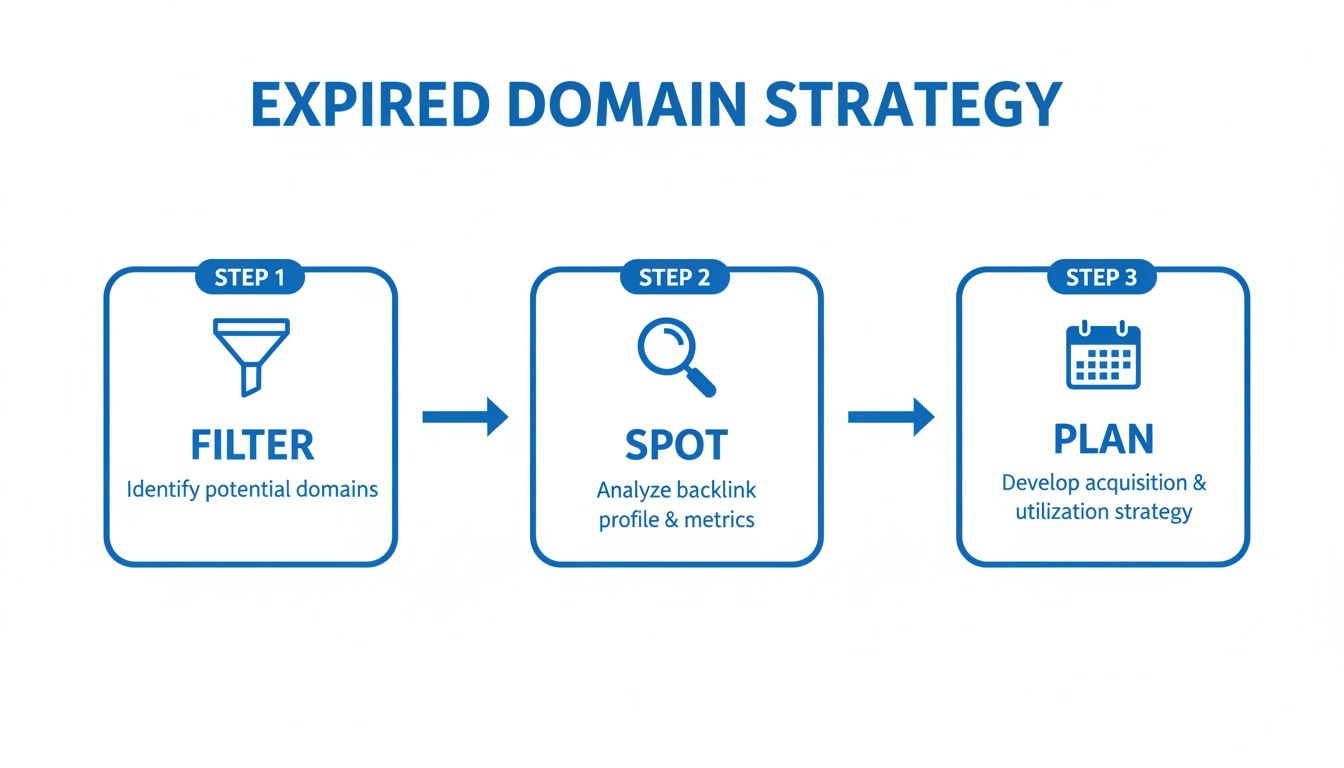
Following a process like this helps you systematically find valuable domains before they're gone, ensuring you get the best possible assets for your project.
Don't fall in love with a domain name before you've vetted its history. A great name with a toxic backlink profile is like a beautiful car with a blown engine—it looks good, but it's not going to get you anywhere.
You can use a platform like NameSnag to hunt for these fresh opportunities. Their filter for Available domains shows you names that were just released and can be registered instantly. It's the perfect way to grab a clean, keyword-rich domain before anyone else even knows it's on the market.
This way, you get all the benefits of a great name with none of the historical risks.
Common Questions About Keyword Domains
Even after all the brainstorming and research, a few questions always seem to pop up. It's easy to get bogged down in the details when you're trying to balance SEO potential with pure brandability. Let's tackle some of the big ones so you can lock in your choice with confidence.
Does My Domain Extension Matter for SEO?
This is probably the question I hear most, and the answer isn't a simple yes or no. Officially, Google claims all top-level domains (TLDs) get a fair shake. But the real world, and specifically user perception, tells a slightly different story.
The .com extension is still king. It's the one people know, trust, and type instinctively. While newer extensions like .io or .shop are definitely gaining ground and can add some nice context to your brand, a .com just feels more authoritative to the average person. That gut feeling can translate into higher click-through rates from search results.
Takeaway: A
.aior.cowon't directly penalize your SEO, but a.comgives you an immediate advantage in trust and memorability. If the.comyou want is available and makes sense, it's almost always the safest and strongest play for the long haul.
Should I Use Hyphens or Numbers in My Domain?
In a word: no. Just don't do it. While they're technically allowed, hyphens and numbers are poison for branding and user experience. They're a nightmare to say out loud and practically beg for typos.
Imagine telling someone your website is "top-rated-pizza-7.com" over the phone or on a podcast. You're just asking for them to forget the hyphen, type in the wrong number, and land on a competitor's site. Stick to letters only. It keeps your domain clean, professional, and far easier to remember.
How Do I Know If a Keyword Is Too Competitive?
The quickest way to get a feel for the competition is to just Google the keyword you're thinking about using. The search results will tell you a lot.
- Who's on page one? If you see giants like Amazon, Forbes, or Wikipedia hogging all the top spots, you're looking at a major uphill battle. These are established authorities.
- What type of content is ranking? Are the top results massive, in-depth guides? Major e-commerce category pages? That tells you the kind of resources and effort you'll need to even begin to compete.
- Check their Domain Authority (DA): Use a free DA checker to see the scores of the top-ranking sites. If they're all rocking DAs of 70 or higher, it’s a clear signal that the climb will be incredibly steep.
Often, pivoting to a less competitive, long-tail version of your keyword for the domain gives you a much better shot at ranking and carving out your own space in a niche.
Ready to find that perfect, keyword-rich domain without all the guesswork? NameSnag uses AI to analyze over 170,000 domains every single day, surfacing high-value names with real SEO potential. Stop the endless searching and start your hunt for Available domains or soon-to-drop Expiring domains today.
Find Your Perfect Domain
Get access to thousands of high-value expired domains with our AI-powered search.
Start Free Trial