So you've found a promising domain, but there's a catch: it has a hyphen. Now you're wondering if that's a deal-breaker. Is this the hill your new brand is going to die on?
The short answer is, yeah, it probably is. Avoid hyphens for your primary brand whenever you can. They almost always make a domain harder to remember, a pain to say out loud, and can come across as a bit unprofessional, like showing up to a job interview in flip-flops.
The Great Hyphen Debate: To Use or Not to Use?
The argument over using a hyphen in a domain name really boils down to a classic dilemma: what's technically allowed versus what actually works for branding in the real world. It's a fun little tug-of-war.
While search engines won't directly penalize you for using a hyphen (they're not that mean), the court of public opinion is far less forgiving. Your customers, partners, and potential visitors are where the real challenges begin.
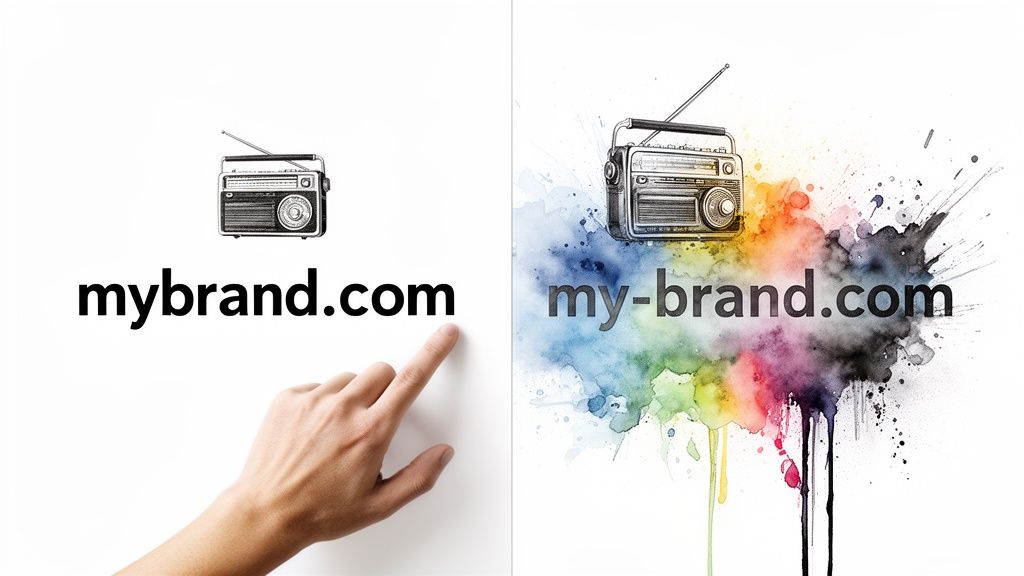
The core issue is simple human behavior. A great domain name should pass the "radio test"—an old-school marketing concept that's more relevant than ever in the age of podcasts and word-of-mouth.
The Radio Test: If you can't say your domain name out loud on the radio (or a podcast) and have people get it right without any explanation, it fails. Miserably.
Think about it. Saying "Visit my-cool-brand dot com... that's my dash cool dash brand..." is a branding nightmare. It's clumsy, confusing, and makes you sound like you're sending a telegraph.
This verbal mess leads directly to lost traffic. When users hear your domain, they will almost always default to typing the non-hyphenated version into their browser. If a competitor owns that version, you're essentially sending them free customers. It's a self-inflicted wound, and it stings.
Beyond the confusion, there's a lingering perception problem. For years, spammers and low-quality sites stuffed keywords into domains using hyphens, like best-cheap-laptops-online.com. That history has created a subconscious bias in many users, who may see a hyphenated domain as less trustworthy or professional.
This split-second judgment can ding your click-through rates and brand credibility before anyone even sees your website.
Hyphenated vs Non-Hyphenated Domains At a Glance
To make this crystal clear, here’s a quick-glance comparison of the core attributes between the two. No fluff, just facts.
| Attribute | Hyphenated Domain | Non-Hyphenated Domain |
|---|---|---|
| Memorability | Lower; often requires verbal explanation ("with a dash"). | Higher; easy to remember and type from memory. |
| Branding | Can be perceived as less professional or spammy. | Seen as more premium, trustworthy, and authoritative. |
| Verbal Sharing | Fails the radio test; difficult to communicate clearly. | Passes the radio test; easy to share in conversation. |
| Traffic Leakage | High risk of losing type-in traffic to the non-hyphenated version. | Low risk; captures all direct type-in traffic. |
As you can see, the non-hyphenated version wins on almost every front when it comes to building a primary brand. It's simply cleaner, stronger, and less prone to user error.
What Google Actually Says About Hyphenated Domains
Let's clear the air and bust the biggest myth right away: Google does not hate hyphens. From a purely technical, algorithmic perspective, Google just sees a hyphen as a word separator. It's like a space. No direct, automatic ranking penalty is coming your way just because your domain has one.
This isn't just me guessing; it comes straight from the folks at Google. For years, their top people have been remarkably consistent on this. They've made it crystal clear that using hyphens is a totally valid way to structure a domain name.
The Official Stance from Google
John Mueller, one of Google's most visible spokespeople, has said it plainly: "hyphens in domain names are not a sign of low quality." That's about as direct a confirmation as you can get that the algorithm isn't out to get you. This isn't a new development, either. Years before, Matt Cutts, then at Google, went a step further, saying hyphens are actually better than underscores for separating words in URLs.
So, if Google’s algorithm is officially neutral, why is the SEO community so dead-set against them? Why all the fuss?
This is where things get interesting. The disconnect comes from a misunderstanding between a direct algorithmic penalty and the very real, very painful indirect consequences that stem from how people behave.
The real problem isn't how the algorithm sees your domain; it's how people see it. While Google is neutral, your potential customers are not.
Where Technical SEO Meets Human Behavior
Think of it like this: Google’s entire job is to surface the most relevant, authoritative, and helpful results for what someone types into the search bar. It uses hundreds of signals to figure this out, and a huge chunk of those signals are based on how real people interact with websites. This is where hyphenated domains trip over their own feet.
Even though Google’s own guidance says hyphens won't get you penalized, market data and user behavior tell a different story—one of serious, indirect SEO damage. While the algorithm is perfectly happy with my-brand.com, real-world data shows these domains get hammered on user engagement metrics that indirectly tank their SEO value.
They bleed direct traffic because they're a pain to remember and type. They see higher bounce rates when frustrated users give up and land on the non-hyphenated version instead. And they get fewer backlinks because, frankly, they often look less credible or professional. You can get a full breakdown of the data on domaindetails.com.
These negative user signals—less traffic, more confusion, and lower trust—are precisely the kinds of things Google’s algorithm is designed to sniff out. Over time, these signals tell Google that your site is less authoritative or relevant than its non-hyphenated competitor, which indirectly pushes your rankings down.
For SEOs and domain investors using a tool like NameSnag, this distinction is everything. When you're sifting through Available domains that dropped today or scouting upcoming Expiring domains, you aren’t just looking for a technically valid name. You're hunting for an asset that people will trust, remember, and want to link to.
A hyphenated domain, despite being "safe" from a direct penalty, starts with a massive handicap in the court of user perception. And in the long run, that handicap almost always translates into weaker SEO performance.
Why Hyphens Are a Branding Disaster
Step away from the technical SEO arguments for a moment. Let's talk about the real reason hyphens are a business killer: they are a branding disaster waiting to happen.
Your domain name is the sign above your digital storefront. It’s the address on your business card and the very first impression you’ll ever make. A hyphen just clutters that sign, making it confusing, uninviting, and instantly less valuable.
Imagine you hear a podcast ad for a cool new company called "Awesome Widgets." You grab your phone and type in awesomewidgets.com. But what if their real domain is awesome-widgets.com? You’ve just hit a dead end, or worse, landed right on a competitor’s website. That simple mistake is the catastrophic failure of the "radio test."
The High Cost of Traffic Leakage
If you have to verbally explain your domain—"that's awesome, dash, widgets, dot com"—you've already lost. That awkwardness isn't just an inconvenience; it's a costly problem called traffic leakage.
Every single time a potential customer forgets the hyphen and types in the clean version, you are actively sending business to someone else. It's the digital equivalent of giving a customer confusing directions that lead them straight to your biggest rival's front door. This isn't a tiny drip; it's a constant drain on your marketing budget, actively undermining your ad spend and killing word-of-mouth growth. When picking a domain, businesses also have to navigate the minefield of trademark law to make sure their name doesn't send them into legal hot water.
The Lingering Stench of Spam
There's another, more subtle branding problem at play here: perception. For years, the darkest corners of the internet were dominated by spammy, keyword-stuffed domains like best-online-casino-free-spins.com. Spammers abused hyphens to cram as many keywords as they could into a domain, and that left a lasting, negative association in the minds of a lot of internet users.
This history has created a subconscious bias. Even if your business is completely legitimate, a hyphenated domain can trigger a split-second of distrust.
A hyphenated domain forces you to start every new customer relationship by overcoming a small hurdle of skepticism. It’s a trust deficit you build into your brand from day one.
This perception problem has real consequences:
- Lower Click-Through Rates (CTR): In a crowded search results page, users might subconsciously skip over a hyphenated domain. They'll click on a cleaner, more professional-looking non-hyphenated competitor instead.
- Reduced Backlink Acquisition: Other legitimate websites can be hesitant to link to a domain that looks less authoritative or spammy, making your link-building efforts that much harder.
- Damaged Professionalism: Your domain name shows up on every email, every social media profile, and every piece of marketing you produce. A clunky, hyphenated name looks like a second-choice option. It quietly suggests your business couldn't secure the "real" domain.
This is why, when hunting for opportunities on NameSnag, you need to think like a brand strategist, not just an SEO. You might find an Expiring domain with fantastic metrics, but if its hyphenated structure sabotages its branding potential, it’s probably not the gem you think it is. To build a strong digital presence, you have to understand what makes a truly brandable domain name.
In the end, a great brand is built on clarity and trust—two things a hyphen actively works to undermine.
An Investor's Guide to Hyphenated Domain Value
When you're treating domains as assets, branding theories and gut feelings take a backseat to one thing: cold, hard data. For a savvy investor or SEO, a domain's value isn't just about how it sounds; it's about its market performance and, ultimately, its return on investment.
So, let's cut to the chase and look at the numbers behind hyphens in a domain name.
The data paints a pretty stark picture. There’s a massive value gap between hyphenated and non-hyphenated domains. And we're not talking about a small difference here—it's a chasm that directly hammers your bottom line. All those branding headaches we talked about, like traffic leakage and low trust, are precisely why the market assigns them a lower financial value.
Digging into the Sales Data
If you're wondering just how big this gap is, the numbers are eye-opening. The market for hyphenated domains is a tiny, almost niche, slice of the overall pie.
Historical sales data from NameBio shows that over a five-year period, hyphenated .com domains made up only 1.7% of all .com sales. More recent figures show this trend holding steady, with just 3.1% of .com names currently listed for sale containing a hyphen. When you filter for higher-value sales (over $500), that number shrinks to a mere 1.8%. You can find a detailed analysis of these sales figures on Namepros.com.
The diagram below really brings home the core branding problems that cause this dramatic value difference.
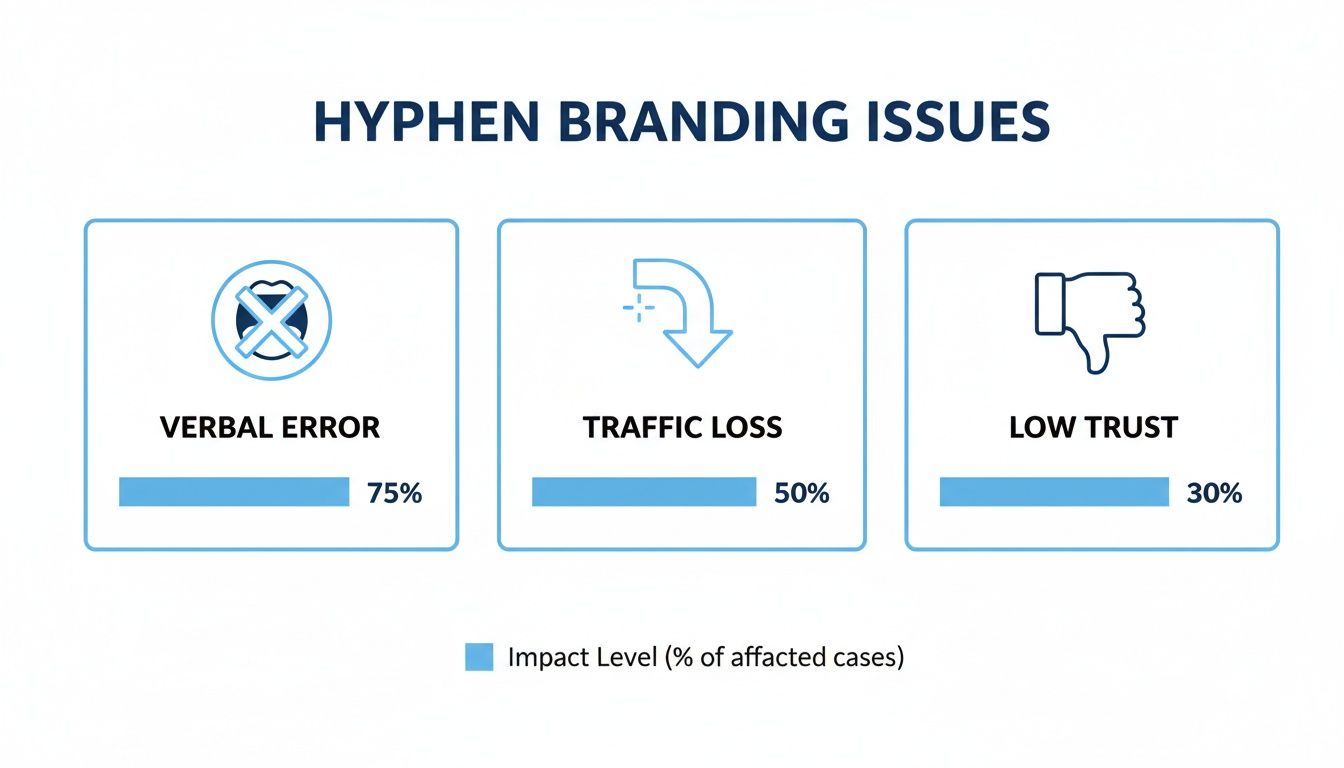
Each of these problems—verbal errors, traffic loss, and low trust—translates into a very real risk for any investor, which in turn drives down market demand and sale prices.
The Bottom Line for Investors
For an investor, the most crucial metric is the average selling price. And here, the story gets even clearer.
The average selling price for a hyphenated .com domain was just $658. Meanwhile, its non-hyphenated equivalent fetched an average of $1,518. That means, on average, a hyphen cuts a domain's market value by more than half.
This valuation gap isn't just a coincidence; it's a direct reflection of the lower utility and higher risk that come with hyphenated names. Some analyses even suggest the discount is far steeper, with hyphenated domains being worth 70-90% less than their cleaner counterparts. For a deeper dive into these kinds of valuation techniques, you can explore our complete guide on how to value domain names.
For anyone on NameSnag evaluating an expiring domain, this data is your north star. Even if a hyphenated name has decent metrics, its resale potential and its ability to serve as a primary brand asset are significantly handicapped from day one.
Unless you have a very specific, niche strategy in mind, the data overwhelmingly shows that a non-hyphenated domain is almost always the superior long-term investment. By focusing on available domains without hyphens, you are making a smarter, more profitable acquisition decision backed by years of market evidence.
When a Hyphenated Domain Is Actually a Genius Move
After all the warnings and data piling up against them, you might think a hyphenated domain is never the right call. But that's not quite the whole story. In a few very specific, calculated situations, a hyphen can be a surprisingly sharp tool in your arsenal.
These aren't scenarios for your primary, billion-dollar brand. Think of them as tactical plays for savvy SEOs, niche site builders, and domain investors who know how to turn a perceived weakness into a targeted advantage.
It's less of a branding move and more of a surgical SEO instrument. For these niche use cases, the goal isn't word-of-mouth memorability; it's about dominating a very specific search query where ranking is the only metric that matters.
Leveraging Exact-Match Domains for Niche SEO
One of the most common reasons to strategically pick up a hyphenated domain is for a hyper-targeted niche site or a local SEO campaign. Let's say you're an affiliate marketer gunning for the keyword "best cordless drill reviews."
The domain bestcordlessdrillreviews.com is almost certainly taken and would cost a fortune to acquire. But a quick search might reveal that best-cordless-drill-reviews.com is available, maybe even sitting in a list of expiring domains that will be dropping in the next 7 days.
For a niche affiliate site where organic search traffic is everything, this can be a goldmine. The hyphen clearly separates the keywords for search engines, and the domain name itself screams to users exactly what your site is about. Brand recall takes a backseat here; the primary mission is to rank for that high-intent keyword.
The Major Exception: Cultural and Language Differences
The biggest and most important exception to the "no hyphens" rule is localization. How users see hyphens isn't a global constant; it changes dramatically depending on language and culture. This is where a one-size-fits-all approach completely falls apart.
In Germany, for instance, compound words are a natural, everyday part of the language. As a result, German internet users are far more accustomed to and accepting of hyphens in .de domains. The hyphen actually provides clarity that aligns with how their language is structured.
The data backs this up decisively. A deep dive into regional variations shows that cultural factors heavily influence hyphenated domain preferences, particularly in German-speaking markets. An analysis of .de domains for sale found that a staggering 28.8% included hyphens—a rate nearly nine times higher than for .com domains. Even more telling, 13.0% of actual .de domain sales involved a hyphenated name, proving there's a strong and active market. You can find more fascinating data on regional domain preferences on namepros.com.
What this means in practice is that for an international SEO strategy targeting the German market, a domain like auto-versicherung.de (car insurance) is not just acceptable—it's perfectly normal. Ignoring this kind of cultural nuance means leaving valuable opportunities on the table.
Defensive Registrations and Redirects
Another incredibly smart move is to use a hyphenated domain defensively. If you own the coveted myawesomebrand.com, it's a wise, low-cost investment to also register my-awesome-brand.com.
You're not going to build a separate site on it. Instead, you'll set up a permanent 301 redirect, sending anyone who lands on the hyphenated version straight to your main, non-hyphenated domain.
This simple action protects your brand in a few key ways:
- Preventing Competitors: It stops a rival from scooping up the domain to siphon off your traffic or confuse your customers.
- Blocking Cybersquatters: It keeps bad actors from registering the name and trying to sell it back to you at a ridiculous price or, worse, using it for malicious purposes.
- Capturing Leaked Traffic: You reclaim any potential visitors who might have mistakenly typed the hyphenated version into their browser.
When considering advanced domain strategies or looking for alternatives to hyphenated main domains, understanding how to effectively manage your web properties is key. A solid guide on setting up subdomains can help you structure your site more effectively without resorting to a less-than-ideal primary domain.
These strategic plays show that hyphens in a domain name aren't universally bad. It all comes down to context and intent. For your main brand, you should probably avoid them. But for a targeted SEO tool, a defensive play, or an international campaign, they can be exactly the right move.
Your Hyphenated Domain Due Diligence Checklist
So, you’re scrolling through an expired domain marketplace and you spot it—a hyphenated domain with a killer backlink profile and an impressive authority score. The metrics are screaming "buy," but your gut is whispering, "it has a hyphen."
Should you pull the trigger?
This is where a little systematic investigation separates a savvy investment from a costly mistake. Instead of getting mesmerized by a high Trust Flow, run the domain through this quick but essential due diligence checklist. It will help you see past the numbers and make a smart, strategic call.
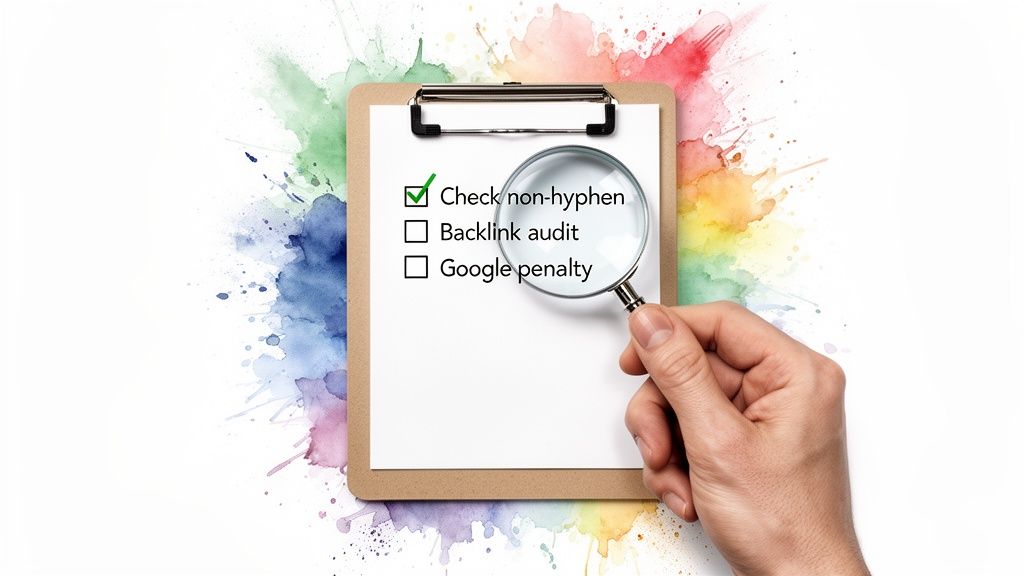
1. Investigate the Non-Hyphenated Version
This is your first and most important step. Before you do anything else, find out who owns the non-hyphenated version of the domain and what they’re doing with it.
- Is it a major competitor? If
your-niche-site.comis available, butyournichesite.comis owned by the biggest player in the industry, that's a massive red flag. You'll be constantly losing type-in traffic directly to your rival. Game over. - Is it a parked or unused domain? This is a much better scenario. It might mean you could acquire it later or that the competition for that exact brand name is low.
- Is it a completely unrelated site? If the non-hyphenated version is in a totally different industry, the risk of direct traffic leakage is a lot lower. This isn't a deal-breaker, but it's something to be aware of.
2. Scrutinize the Backlink Profile
A high backlink count can be incredibly deceiving. You need to dig into the quality of those links to figure out if they're a valuable asset or a toxic liability you're about to inherit.
A strong backlink profile is the main reason to even consider a hyphenated domain. If the links are weak or spammy, the domain's biggest selling point is gone.
Use a backlink checker to get some answers:
- Are the links from authoritative sites? You're looking for links from reputable news outlets, industry blogs, or maybe even a few .edu/.gov sites. These are the gems.
- Is the anchor text natural? A healthy profile has a mix of branded, naked URL, and natural anchor text. A profile overloaded with "best cheap widgets online" is a flashing neon sign of old-school spam tactics.
- Was it part of a Private Blog Network (PBN)? Check if the links come from a group of interconnected, low-quality sites that all look suspiciously similar. This is a huge penalty risk.
3. Check for Past Google Penalties
An expired domain might have a dark past. You need to be sure you aren't inheriting someone else's penalty, which can make ranking next to impossible. The best way to play detective is to check its history using the Wayback Machine (Archive.org).
Look for the tell-tale signs:
- Sudden drops in traffic that just so happen to align with known Google algorithm updates.
- Previous use as a spam or adult site, which can leave a toxic digital footprint that’s hard to wash off.
- A history of being a parked domain with nothing on it, meaning any "authority" is likely artificial and won't hold up.
To make this process faster, it's worth learning about due diligence automation, which can help you quickly assess a domain's history without spending hours on manual checks.
4. Define Its Strategic Purpose
Finally, be brutally honest with yourself: what do you actually plan to do with this domain? Your answer here is the ultimate tie-breaker.
- Main Brand Domain? Almost always a bad idea. The branding headaches, trust issues, and lost traffic will haunt you. Just don't.
- Short-Term Niche Site? This is a much more viable option. If you're building a site to rank for a specific keyword, make some money, and then flip it, branding is far less of a concern.
- 301 Redirect to Another Site? This is an excellent use case. If the domain has powerful, relevant backlinks, you can redirect it to your main site and pass along that precious "link juice."
By methodically working through this checklist, you can confidently decide whether that available domain is a hidden gem or just a well-disguised trap.
A Few Lingering Questions
We’ve dug through the SEO weeds and looked at the hard data. Still, a few common questions always come up right when you’re about to pull the trigger on a domain. Let's tackle those head-on so you can move forward with confidence.
Can a Hyphenated Domain Ever Outrank a Non-Hyphenated One?
Yes, it absolutely can. Google is looking at hundreds of signals, and a hyphen is a very, very tiny one. If a hyphenated domain has a much stronger backlink profile, killer content, and a better user experience, it can definitely leave a weak, non-hyphenated competitor in the dust.
But that’s not really the right question to ask. What you should be asking is, "What happens when all other factors are equal?" In that scenario, the non-hyphenated domain almost always has the upper hand. Its branding is cleaner, it’s easier to remember, and it just feels more trustworthy—that creates a natural advantage the hyphenated version has to constantly fight against.
If I Own the Main Domain, Should I Buy the Hyphenated Version?
This is called a defensive registration, and it's a no-brainer. For the cost of a couple of coffees a year, buying the hyphenated version of your domain is one of the smartest, cheapest ways to protect your brand. It slams the door on competitors or cybersquatters who might try to snatch it up to siphon off your traffic or confuse your customers.
Once you own it, you don't need to do anything complex. Just set up a permanent 301 redirect to point all traffic from the hyphenated version straight to your main site. It's a simple move that locks down your brand and catches anyone who might have typed your address wrong.
Think of it as cheap brand insurance. For a few dollars a year, you close a backdoor that a competitor could otherwise exploit.
Are Multiple Hyphens in a Domain Name Even Worse Than One?
Yes, by a long shot. Every extra hyphen you add just magnifies all the problems we’ve talked about. A domain with two or more hyphens becomes exponentially harder to remember, a nightmare to share verbally, and is far more likely to get flagged as spam by both users and search engines.
A name like my-best-new-site.com is basically impossible to pass along in a conversation. Worse, it looks exactly like the low-quality, keyword-stuffed domains that Google cracked down on years ago.
Unless you have a very specific, niche reason for it, just don't do it. One hyphen can be a calculated risk; two or more is a branding liability that’s almost never worth it. You're much better off finding a clean, non-hyphenated alternative from a list of high-quality Available domains that just dropped.
Finding the perfect domain—hyphen-free or not—requires sifting through thousands of options. With NameSnag, you can instantly filter through newly dropped and expiring domains with powerful SEO metrics, saving you hours of manual research. Find your next high-value domain today.
Find Your Perfect Domain
Get access to thousands of high-value expired domains with our AI-powered search.
Start Free Trial