Before you drop a single dime on a domain name, you need to put on your detective hat. A quick and dirty investigation involves a few key tools: the Wayback Machine to see what the site used to look like, WHOIS history lookups to see who owned it, and SEO tools like Ahrefs or Moz to check its backlink profile and any spam signals. This whole process is about figuring out if you're getting a clean slate or a can of worms—think hidden spam issues or old Google penalties.
Why You Must Become a Domain History Detective
Buying a domain without checking its history is like buying a used car without popping the hood. Sure, you might get a great deal on a machine that runs like a dream. Or, you could end up with a digital lemon that stalls out before you even get it home. In the world of websites, a domain's past life has a direct, and often brutal, impact on your future. Ignoring it is a risk you just can't afford to take.
This isn't just about dodging a name that was once a spammy link farm, either. It's about spotting hidden gold. A domain with a clean, authoritative history can give your SEO a massive head start, like building your new project on a pre-poured foundation. On the flip side, a domain with a toxic past is an anchor, and it will drag your rankings down no matter how brilliant your content is.
The Stakes of a Domain's Past
Every domain has a story. Was it a respected industry blog with a treasure trove of valuable backlinks? Or was it part of some sketchy network that Google penalized for manipulative junk? You have to find the answers, because search engines have very, very long memories.
- Inherited Authority: A domain that was previously owned by a legit business in your niche can come with powerful, relevant backlinks. It's like getting a warm referral from a trusted friend—it immediately boosts your credibility with search engines.
- Hidden Penalties: If a prior owner used "black hat" SEO tricks, the domain might be carrying an invisible penalty. You could spend months creating amazing content only to find your site is permanently stuck on page ten of Google, all because of something that happened years ago. Understanding your domain name reputation is critical here, as it shows how a domain's past haunts its present.
- Brand Misalignment: Just imagine launching your shiny new children's toy brand on a domain that used to host an online casino. Yikes. Even if the content is long gone, old links and search engine associations can create confusing and damaging signals for your brand that last for years.
Becoming a domain history detective means you're not just buying a name; you're investing in an asset with a verifiable backstory. It's the difference between building on solid ground and building on quicksand.
To get really good at this, you need to develop a critical eye. It's a lot like learning how to analyze primary sources. You’re piecing together clues to make an informed decision, saving yourself from a world of future headaches and potentially thousands of dollars.
Your Toolkit for Investigating a Domain's Past
Every good detective needs a reliable set of tools, and checking a domain's history is no different. You don't need a trench coat, but you absolutely need a few specific platforms to uncover the story a domain's past has left behind. Think of it as assembling your own digital forensics kit.
Let's start with the essentials.
Essential Domain History Check Tools
Before diving into the nitty-gritty, it helps to know which tools to have open in your browser tabs. Here's a quick rundown of the gear I use for almost every domain investigation.
| Tool | Primary Use | Key Signal to Check |
|---|---|---|
| Wayback Machine | Visual History | The content and design of the previous site. Was it legit or spam? |
| Ahrefs / Moz | SEO Authority & Backlinks | The quality and relevance of referring domains and anchor text. |
| WHOIS History Tools | Ownership Records | Frequent, unexplained changes in ownership can be a major red flag. |
These three categories of tools give you a panoramic view of the domain's life—what it looked like, who owned it, and what kind of reputation it built online.
Your first stop is always the time machine: the Wayback Machine. This free tool from the Internet Archive is non-negotiable. It lets you see actual snapshots of a website over the years. Was it a high-quality blog in your niche, or was it a spammy mess of flashing ads and sketchy links? This is where you find out, visually.
We've got a whole guide on getting the most out of the Archive.org Wayback Machine if you want to become a pro.
After seeing what was on the site, you need to follow the paper trail with WHOIS history tools. A standard WHOIS lookup only shows you who owns the domain now. Historical WHOIS data, on the other hand, reveals the entire chain of custody. If you see frequent, unexplained ownership changes, that's a bad sign. It often means the domain was passed around like a hot potato for a reason. Stability is what you want to see.
Unleashing the SEO Powerhouses
Now it's time to bring in the heavy hitters. SEO tools like Ahrefs, Moz, and Majestic are crucial for digging into the signals that give a domain its real value. These platforms analyze a domain's backlink profile—one of the most important factors for ranking well in Google.
Here’s exactly what you should be looking for:
- Backlink Quality: Are the links from respected sites in your niche? Or are they from low-quality, spammy directories and forums? A few great links are worth more than thousands of bad ones.
- Authority Metrics: These tools have scores like Domain Authority (DA) or Trust Flow (TF). A high score looks promising, but you must verify it by manually spot-checking the links. Numbers can be gamed.
- Anchor Text: This is the clickable text in a backlink, and it tells you what the old site was known for. If you're buying a domain for your new finance blog and see anchor text related to gambling or pharma, run the other way.
Piecing all this together helps you figure out if you’re about to acquire a powerful asset or a digital liability that will cost you time and money to clean up.
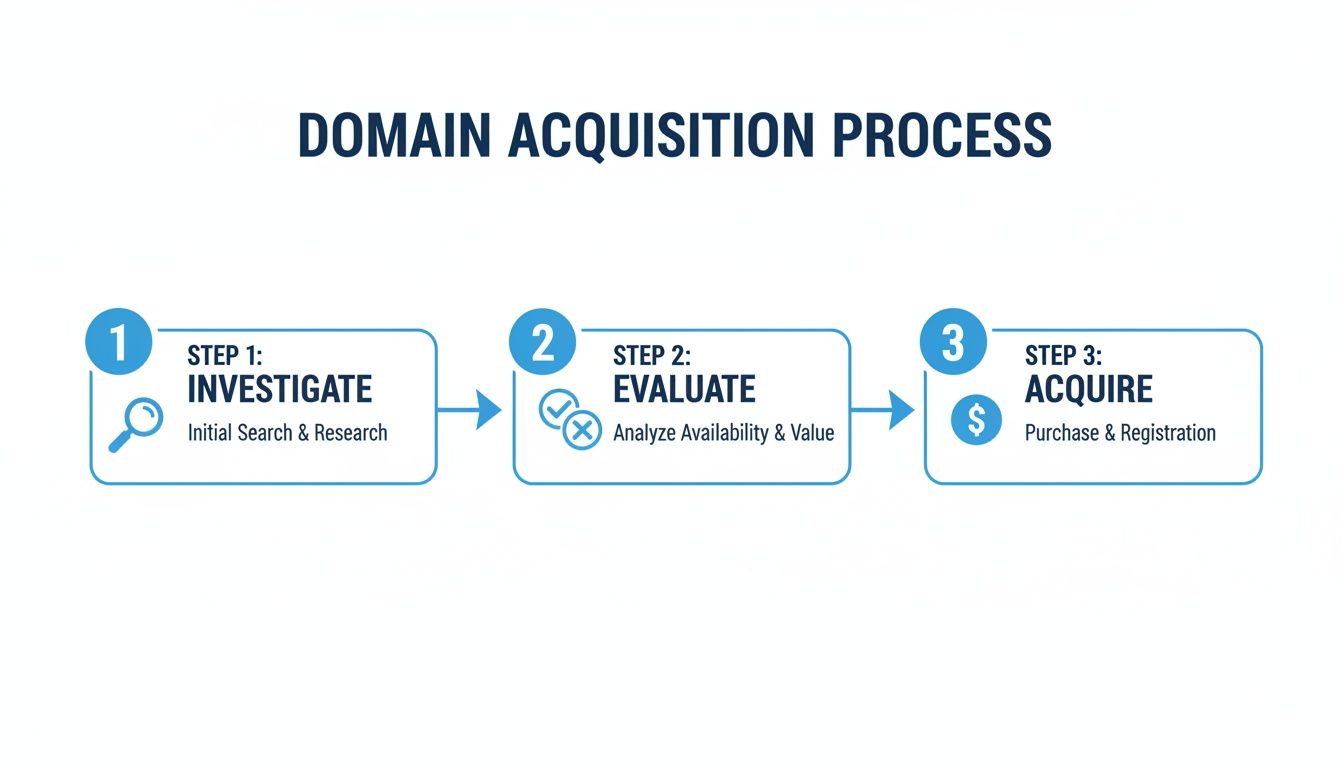
This process really boils down to three steps: investigate the past, evaluate the findings, and only then, acquire the domain. The investigation is the foundation. Skipping it is like buying a used car without ever looking under the hood.
A shady domain history can quietly sabotage your SEO efforts for years. Google has a long memory for penalties and spam. In a market where domain registrations jumped by 10.1 million in just two quarters of 2025, the competition for clean, quality names is intense. The historic 2.1% drop in .com and .net registrations in late 2024 proves that premium names are getting harder to find, pushing smart investors toward expired domains that already have a proven, positive history. You can find more of these trends over at Wix.com's domain landscape report.
Knowing this, the hunt for a great domain becomes much more strategic. You’re not just trying to find a catchy name; you’re looking for a clean slate that can act as a launchpad for your project. Whether you're hunting for instantly Available domains or setting your sights on high-potential Expiring domains, this toolkit is your first and most important line of defense.
Decoding the Clues: A Guide to Red Flags and Green Lights

Alright, you’ve got the tools. But having a shovel doesn’t make you a treasure hunter—you need to know where to dig and what the clues actually mean. This is where the real work begins.
We're moving beyond just collecting data and into the art of making a smart decision. It's about recognizing the patterns that scream "run away" versus those that whisper "this is the one." This is your field guide for telling a goldmine from a landmine.
Spotting the Blatant Red Flags
Some historical issues are as subtle as a neon sign in a library. These are the absolute dealbreakers, the signs that tell you to slam that browser tab shut and never look back. A domain carrying this kind of baggage will cost you more in time, money, and sanity than it could ever be worth.
A toxic backlink profile is probably the biggest and brightest red flag. If you see the domain is peppered with links from shady, irrelevant sites—think casinos, adult content, or pharma spam—that's a massive problem. These aren't just "bad" links; they're a stain on the domain's reputation that Google won't easily forget. You can use a domain spam score checker to get a quick read on these toxic signals.
Other critical warning signs include:
- Sudden Traffic Nosedives: A sharp, unrecoverable plunge in organic traffic often points to a past Google penalty, either manual or algorithmic. You don't want to inherit that mess.
- Frequent Ownership Changes: If the domain has been passed around more than a hot potato, it’s a sign that previous owners either failed to make it work or were just flipping a problematic asset.
- De-Indexed by Google: Do a quick
site:yourdomain.comsearch in Google. If zilch comes up, the domain has likely been hit with the ultimate penalty: complete removal from Google’s index. Hard pass.
A messy ownership transition can also be a red flag. When digging into a domain's past, understanding major events like how to change a domain and keep your SEO ranking can reveal both past challenges and future potential.
Recognizing the Glowing Green Lights
On the flip side, some domains practically radiate potential. These green lights are the indicators that you've stumbled upon a high-value asset with a rock-solid foundation. These are the domains that can give you an incredible head start.
The ultimate green light is a clean, relevant backlink profile. Imagine finding a domain with high-quality links from authoritative .edu or .gov sites, or from well-respected blogs in your niche. That's pure SEO gold. It means the domain already has a vote of confidence from some of the most trusted sources on the web.
Here are other positive signals to hunt for:
- Consistent Content History: The Wayback Machine shows the domain was used for a legitimate site in a stable niche, ideally one related to your own plans. No weird pivots into spammy topics.
- Long-Term Ownership: A domain held by the same person or company for years suggests stability and a clean, well-maintained history.
- Strong, Stable Metrics: Look for consistent Domain Authority (DA), Trust Flow (TF), and a healthy ratio of referring domains to backlinks. Steady, reliable numbers are far more valuable than a history of dramatic spikes and drops.
Think of it this way: you're comparing two potential domains. One is a former industry blog with a decade of consistent content and links from universities. The other was used for a Private Blog Network (PBN), got de-indexed by Google, and was flipped three times last year.
Once you know how to read the signs, the choice becomes obvious.
Ditching the Grind: How to Find Clean Domains Fast
Let's be honest. Manually checking a list of domains is a special kind of hell. You've got ten tabs open—WHOIS, Wayback Machine, Ahrefs, Moz, Majestic—and you're trying to cross-reference everything while your eyes glaze over. It's tedious, it's slow, and it's a surefire way to miss a critical red flag buried in all that data.
There’s a much smarter way to do this. A specialized tool like NameSnag can be your secret weapon, turning that entire detective process into an automated workflow so you can focus on finding gems, not wrestling with spreadsheets.
Let the Machines Do the Heavy Lifting
Instead of bouncing between a dozen different tools, imagine having one dashboard that pulls everything together. The best domain research platforms centralize the critical data from heavyweights like Moz, Majestic, and Ahrefs, giving you the complete story at a glance.
This is exactly why NameSnag was built. We got tired of the manual grind ourselves. The platform crunches through over 170,000 domains daily, doing all that initial vetting for you.
In a market this competitive, that kind of automation is a massive edge. Overlooking just one detail can cost you thousands. The domain name market hit 378.6 million registered names in 2024 and is on track to reach 459.9 million by 2030, according to ResearchAndMarkets.com. If you want a piece of that action, you have to move fast and be absolutely certain about what you're buying.
A platform that automates domain history checks isn't just a convenience; it's a competitive advantage. It lets you sift through thousands of options to find the few that have real, untapped value.
From Raw Data to Actionable Insights
The real magic of a centralized tool isn't just seeing the numbers—it's understanding what they mean. For example, NameSnag uses a proprietary SnagScore to grade each domain. This isn't just a single metric; it's an algorithm that blends multiple factors to give you a true sense of a domain's health.
- Backlink Quality: It looks past the raw count to analyze the authority and relevance of linking sites.
- Domain Age & Authority: It weighs established trust signals that search engines actually care about.
- Brandability: It even factors in how memorable and marketable the name itself is.
This algorithm does all the hard work, analyzing the clues we've talked about to surface the diamonds in the rough. You can instantly filter for high-potential domains without having to piece the puzzle together yourself.
This completely changes your workflow. You can quickly find Available domains that just dropped and are ready to be registered on the spot. Or, you can hunt for high-value Expiring domains right before they hit the open market. You can even filter by how recently they dropped, from today to the last 30 days. It turns what used to be a multi-hour research project into a few clicks.
From Detective to Investor: 3 Smart Plays for Your New Domain
Alright, you've done the hard work. You've sifted through the junk, dodged the spammy landmines, and come out the other side with a domain that has a clean history and some real SEO potential.
So, now what? This is where the real strategy comes in. All that due diligence is just a sunk cost if you don't have a smart plan to cash in on your new asset.
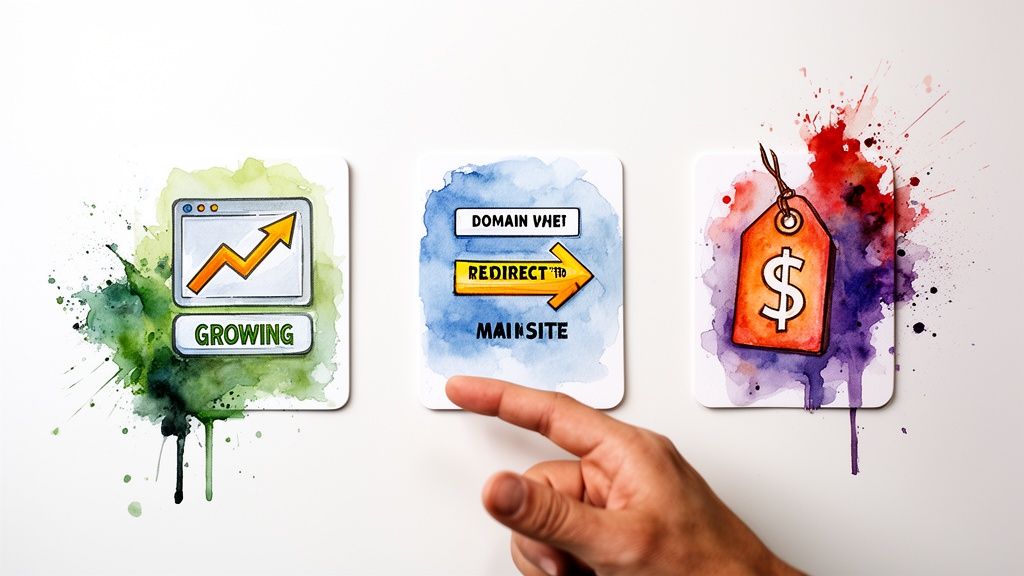
There are really three main paths you can take from here. The right one for you boils down to your goals, how much time you have, and the resources you're willing to commit. Each route is a powerful way to capitalize on the authority you just acquired.
Build a Niche Authority Site
Let's say the domain used to be a well-regarded blog about specialty coffee roasting. It has history, relevance, and probably some great, on-topic backlinks. In a case like this, your best move is often to just bring it back to life.
By building a new authority site on this existing foundation, you get a massive head start. You’re not starting from scratch in the Google sandbox; you're building on land that's already been prepped and fertilized. Create fresh, high-quality content that honors the domain's past, and you'll find it ranks far faster than anything on a brand-new domain. It’s like skipping the tutorial level and jumping straight into the action.
Execute a Strategic 301 Redirect
Maybe your plan isn't to build another website from the ground up. Maybe you just want to give your main website a serious boost. This is where the classic 301 redirect comes into play.
By setting up a permanent redirect from the domain you just bought to your primary site, you can pass over most of its accumulated "link equity"—what some people still call "link juice."
This is an old-school SEO play for a reason: it works. It's one of the quickest ways to funnel authority into your money site, which can lead to a very real bump in rankings and organic traffic. The key is to make sure the old domain's topic is a close match for your main site's. A coffee blog redirecting to a coffee e-commerce site? Perfect. A coffee blog redirecting to a crypto site? Not so much.
Flip It for a Tidy Profit
Then there's the simplest path of all: flip it. If you've found a real diamond in the rough with solid metrics and a clean slate, odds are good that another SEO, agency, or business owner will be happy to pay a premium for it.
This is a fantastic option if you love the thrill of the hunt but aren't looking to get bogged down in a long-term project. The market for quality aged domains is always humming. As the number of registered domains climbs toward a projected 557.7 million by 2026, the best names get snapped up quick, pushing smart buyers toward domains that already have a proven track record. You can read more about these market dynamics in this global domain names report.
Common Questions That Come Up When Checking Domain History
Even when you've got the right tools and a solid process, digging into a domain's past can feel like detective work. You’ll inevitably run into a few head-scratchers that make you pause. Let's walk through some of the most common tricky situations I've seen over the years so you can make smarter, more confident calls on your next domain.
What if a Domain Has No History at All?
Every so often, you'll stumble upon a domain with a completely blank history. No snapshots in the Wayback Machine, no old WHOIS data—nothing. It feels like hitting the jackpot, right? A truly clean slate.
And most of the time, you'd be right. This usually just means someone hand-registered the domain and never got around to building anything on it, which is the ideal scenario.
But don't get too excited just yet. While it's rare, a blank history could also mean the domain was so toxic that it was deliberately scrubbed from archives. The quick sanity check here is to see if it’s indexed in Google. If you find a blank slate that Google still recognizes, you've almost certainly found a fresh, unused domain.
How Much Does the Old Niche Really Matter?
This one comes up all the time. You find a domain with incredible metrics—great authority, solid links—but it was a blog about dog grooming, and you want to launch a crypto site. Is it salvageable?
Honestly, it's a huge risk. A domain builds up topical relevance over the years. Google learns to associate it with certain keywords and ideas. If you try to pivot to a completely different niche, you're fighting against all of that established history.
A slight pivot can work (think moving from 'digital cameras' to 'drone photography'), but a hard pivot throws away most of the domain's value. You’re often better off with a domain that has a weaker link profile in the right niche than a powerhouse domain in the wrong one.
How Can I Spot the Sneaky Spam Signals?
Automated tools are fantastic for catching obvious spam, but some of the old-school manipulation tactics are designed to fly under the radar. One of my go-to manual checks is looking at the anchor text distribution. If you see a suspiciously high percentage of exact-match keyword anchors, that’s a classic red flag for old, manipulative link building.
Another subtle clue is the timing of when the backlinks were built. Did the domain get thousands of links in a single month and then go completely quiet? Natural growth doesn't look like that. It’s the footprint of a PBN or a paid link campaign that Google has likely already slapped down. Keeping an eye out for these patterns will help you dodge domains that look clean on the surface but are hiding trouble underneath.
The best way to avoid these headaches is to start with a pool of domains that have already been vetted. Instead of digging through digital graveyards yourself, NameSnag brings high-quality domains with clean histories right to you. You can find instantly Available domains or hunt for gold in the Expiring domains list, which can save you countless hours of detective work.
Find Your Perfect Domain
Get access to thousands of high-value expired domains with our AI-powered search.
Start Free Trial