Choosing the right domain for SEO is like picking the foundation for a house. A strong one supports everything you build on top of it, while a weak one can cause endless problems down the road. It's the difference between starting a race at the starting line versus halfway to the finish.
The best domains either give you a clean slate for branding or, even better, come with a built-in history of authority and trust. That pre-existing credibility can give you a massive head start in the search rankings. So, let's dive in and find you a domain that works as hard as you do.
Your Domain Is Your Digital Foundation
Ever wonder why some websites seem to gain traction almost overnight while others languish on page ten of Google for years? A huge part of that story is the domain name itself.
Think of your domain as more than just a catchy address; it's the bedrock of your entire online presence. It's one of the very first signals you send to search engines, and it carries a surprising amount of weight. A powerful domain for SEO isn't just a name—it's a strategic asset loaded with history, authority, and trust.
It tells search engines that you're a credible player from day one. Instead of spending years building that credibility from scratch, you can acquire a domain that already has it baked in.
To get a clearer picture of what makes a domain strong, let's break down the key factors we'll be diving into.
Quick Guide to SEO Domain Factors
| Factor | Why It Matters for SEO | Quick Tip |
|---|---|---|
| Trust Flow (TF) | A Majestic metric that measures the trustworthiness of a domain based on the quality of its backlinks. Higher TF is a strong signal of authority. | Aim for TF 15+ for a solid starting point. Anything above 25 is excellent. |
| Referring Domains (RDs) | The number of unique websites linking to your domain. A high number from diverse, quality sources indicates broad authority. | It's not just about the number. 50 high-quality RDs are far better than 500 spammy ones. |
| Backlink Quality | Not all links are created equal. Links from authoritative, relevant sites (like the New York Times) are gold. Links from spam blogs are toxic. | Manually check the top 5-10 backlinks. Are they from real, reputable websites? |
| Domain Age | An older domain with a consistent, clean history is generally seen as more trustworthy by search engines. | Look for domains with at least 2-3 years of clean history. Tools like Archive.org are your best friend here. |
| Domain Authority (DA) | A Moz metric that predicts a site's ranking potential. While not a direct ranking factor, it's a useful comparative score. | Use it as a quick benchmark, but don't rely on it alone. Always verify with other metrics. |
| Spam Signals | A history of spam, penalties, or toxic backlinks can kill your SEO before you even start. This is a non-negotiable check. | Look for weird anchor text, links from adult/gambling sites, or a history of being a Private Blog Network (PBN). |
| Brandability | Your domain needs to be memorable, easy to spell, and relevant to your niche. A clunky, forgettable name is a handicap. | Is it easy to say out loud? Does it pass the "radio test"? Avoid hyphens and numbers if you can. |
This table is just a starting point. Now, let's explore how these concepts play out in the real world.
Why Old Can Be Gold
Imagine two scenarios.
First, you register a brand-new, never-before-used domain. It's a blank canvas. Great for branding, but it has zero authority. In Google's eyes, you're a complete unknown, and you'll have to earn every single ounce of trust from the ground up.
Now, picture this: you find a domain that expired just a few days ago. The previous owner spent five years building a legitimate business on it, earning high-quality backlinks from reputable industry sites. That domain has a history. It has an established "credit score" with Google.
By acquiring that second domain, you inherit its valuable history. This is the secret sauce many successful SEOs use to bypass the dreaded "sandbox" period where new sites often struggle to get any traction.
Finding Your SEO Head Start
The real trick is knowing where to find these hidden gems and how to tell the good from the bad. They generally fall into two categories, and understanding the difference is key to your strategy.
- Available Domains: These are domains that were just dropped and are now available for anyone to register immediately at a standard price. They're perfect for grabbing a valuable asset without the hassle of an auction. You can find a fresh list of newly Available domains that dropped today.
- Expiring Domains: These have expired but are still in a grace or redemption period. They will be dropping soon, which gives you a crucial window to analyze them and prepare to snap them up the moment they become available. Checking for Expiring domains lets you get ahead of the competition.
The goal isn't just to find an old domain; it's to find a clean, relevant, and powerful one. Think of it as adopting a well-trained dog versus a stray with a troubled past—one is ready to be your best friend, while the other might chew up your couch.
In the rest of this guide, we’ll cut through the technical jargon and give you actionable strategies. We'll show you why metrics are your new best friend, how to spot a penalty-ridden domain from a mile away, and most importantly, how to uncover those valuable expired domains that give you an incredible head start.
What Makes a Strong Domain? Let's Decode the Metrics.
So, what makes a domain a true SEO powerhouse? It's not just about a clever name. It's about the data story it tells search engines. Think of it like a resume for your website—a strong one gets you an interview with Google, while a weak one gets tossed aside.
To find a domain with a killer resume, you have to become a bit of a data detective. We’re going to break down the core signals of quality and authority that matter, helping you separate the contenders from the pretenders.
The Domain "Credit Score"
The fastest way to size up a domain is by looking at its "authority" scores. These are metrics created by third-party tools that act like a credit score, giving you a quick snapshot of a domain's credibility and potential to rank.
- Domain Authority (DA): This is Moz's score, running from 1-100, that predicts how well a website will rank on search results pages. A higher score means a greater ability to rank. Simple as that.
- Trust Flow (TF): A metric from Majestic, Trust Flow zeroes in on the quality of links pointing to a site. The idea is that links from trustworthy places—think university websites or major news outlets—pass on more "trust" than links from a thousand spammy blogs.
A high DA looks great on the surface, but a high TF is often a much stronger sign of a clean, powerful backlink profile. We get into the nitty-gritty of this in our guide on Domain Authority vs Page Authority. A solid domain for SEO will have a healthy balance of both.
Beyond the Score: Backlink Quality Is King
While those authority scores are a decent starting point, the real power is hiding in the backlink profile. A domain's history is written in the links pointing to it. A handful of powerful links from respected, authoritative sites is worth infinitely more than thousands of garbage ones.
Imagine getting a job recommendation from the CEO of a Fortune 500 company versus getting one hundred recommendations from random strangers on the street. That CEO's endorsement carries serious weight. It's the exact same principle with backlinks.
A domain's value isn't just in the number of links it has, but in the reputation of the sites providing those links. Quality over quantity is the golden rule here.
The data backs this up, and it's not even close. An incredible 96% of websites in Google’s top 10 search results have more than 1,000 links from unique domains. On top of that, the highest-ranking pages have roughly 3.8 times more backlinks than those further down the page. It's clear: links are still a massive part of the SEO game.
The Tie-Breaker: Domain Age
Finally, let's talk about age. Is an older domain automatically better? Not really, but it can be a powerful tie-breaker when all else is equal. An older domain that's been consistently active and has kept a clean profile is seen as more stable and trustworthy by search engines.
Think of it like this: Google is more likely to trust a business that's been operating reliably for a decade than a brand-new startup that just popped up yesterday. Age, when combined with a strong backlink profile and solid authority scores, creates a powerful trifecta for SEO success. Getting a handle on these metrics is your first step to finding a domain that starts working for you from day one.
The Untapped Goldmine of Expired Domains
What if you could skip years of grinding away at link building and jump right into the big leagues with an authoritative site? That’s the incredible leg up you get from using expired domains.
These are domains that someone else poured time, money, and effort into, building up valuable backlinks and history, only to let them go. When you pick one up, you're essentially inheriting all that hard-earned SEO equity. It’s one of the smartest shortcuts in the game for gaining a real competitive edge.
This section is your treasure map. I'm going to show you exactly how to hunt for these digital gems and put their existing power to work for you.
Why Expired Domains Give You a Head Start
Think about building a skyscraper. A brand-new domain is like starting with an empty lot. You have to dig the foundation, pour the concrete, and build every single floor from the ground up. It’s a long, tough process.
An expired domain, though, is like finding a building with a solid foundation and framework already in place. The last owner did all the heavy lifting, establishing authority and earning backlinks. Your job is to come in, renovate, and build on that existing structure—which is a whole lot faster and easier.
This "inherited authority" is precisely why a good expired domain for SEO is such a prize. It lets you sidestep that initial "sandbox" period where Google is still trying to figure out if your new site is worth trusting.
The Two Flavors of Expired Domains
As you start hunting, you’ll run into two main types of expired domains. Knowing the difference is key to your whole strategy.
- Available Domains: These are domains that have gone through the entire expiration process and have been "dropped." That means they're back on the open market for anyone to register at the standard price. They offer the thrill of the chase—find one, register it, and it's yours in minutes.
- Expiring Domains: These domains have expired but are still in a "grace period" before they officially drop. This gives you a critical window to do your homework, analyze their stats, and get ready to snatch them up the second they become available.
A tool like NameSnag is perfect for this. You can filter specifically for Available domains that you can register right now, or get a sneak peek at powerful Expiring domains that will be hitting the market soon. This lets you stay one step ahead of everyone else.
The core idea is simple: find a domain with a clean, relevant backlink profile and grab it before anyone else does. This is where good timing and the right tools make all the difference.
For a much deeper dive into the specific tactics, our guide on how to find expiring domains will walk you through the entire process, step by step.
How to Leverage Your New Asset
Once you’ve got your hands on a powerful expired domain, you have two main strategic options. The path you take really depends on your goals.
- Build a New Website: If the domain name is brandable and fits your niche, you can build a new authority site or niche blog right on top of it. This lets you tap into its existing power from day one, helping your content rank way faster than it would on a fresh domain.
- Use a 301 Redirect: The other play is to use a 301 redirect to pass the domain's "link juice" and authority over to your main website. This can give your primary site a serious rankings boost, acting as a supercharged link-building tactic.
Both strategies can be incredibly effective, but they demand that you do your homework first. Not all expired domains are created equal. In the next section, we’ll get into how to spot the toxic ones you need to avoid at all costs.
How to Spot a Toxic Domain and Avoid Disaster
Not all aged domains are vintage wine; some are pure poison for your SEO. Snapping up a domain with a toxic past can sabotage your efforts before you even write your first blog post. It's a lot like buying a used car—you've got to look under the hood, not just admire the fresh coat of paint.
This section is your domain forensics kit. We're going to turn you into a digital detective, capable of spotting the red flags that send other SEOs running for the hills. Learning to identify these warning signs will save you from the massive headache of trying to clean up someone else's digital mess.
Uncovering a Spammy Backlink History
The biggest offender, by a long shot, is a history of spammy or manipulative backlinks. A domain previously used for shady tactics carries that baggage with it, and trust me, Google has a long memory. A high spam score is a deal-breaker, full stop.
When you investigate a domain’s link profile, you’re looking for patterns of abuse. This involves more than just glancing at the Domain Authority score. You need to dig deeper into the kinds of links pointing to the site.
Here are the toxic signals to watch for:
- Links from Shady Neighborhoods: Are backlinks coming from websites related to gambling, adult content, or pharmaceuticals? These are colossal red flags and can poison a domain's reputation.
- Suspicious Anchor Text: Look at the actual text used in the backlinks. If you see a high volume of foreign language characters, spammy keywords, or phrases that are just too perfectly optimized, it’s a clear sign of manipulative link building.
- Private Blog Network (PBN) Footprints: PBNs are networks of websites created for the sole purpose of building links. If a domain has a ton of links from low-quality blogs with thin content and identical ownership info, it was almost certainly part of a PBN.
A domain with a history of these kinds of links is a liability. For a more detailed breakdown, it's worth understanding the factors that go into a domain spam score checker and how to interpret what it tells you.
Playing Historian with the Wayback Machine
Another critical step is to investigate the domain's past life. What was this website before it expired? Fortunately, tools like the Internet Archive's Wayback Machine act as a time machine for the web, letting you see snapshots of a site from years ago.
This step is absolutely non-negotiable. You’re looking for a consistent, legitimate history. If the site was a real business, a personal blog, or a community forum, that’s a fantastic sign.
Think of the Wayback Machine as a background check for your domain. A clean record shows a history of legitimate use, while a sketchy past is a clear warning to walk away.
However, if you find that the domain was previously used for a spam blog filled with nonsensical articles, hosted foreign-language content completely unrelated to its name, or was just a parked page plastered with ads, it’s best to steer clear. These histories suggest the domain has little to no real authority to pass on and may even be flagged by Google.
Checking for Previous Penalties
The ultimate disaster is buying a domain that has an active penalty from Google. A manual penalty can make it nearly impossible to rank for anything, effectively rendering the domain worthless for SEO.
Unfortunately, there's no public tool that lets you check for manual penalties on a domain you don't own. The best you can do is hunt for circumstantial evidence. A classic sign is a domain with strong-looking metrics (like a high DA or TF) but absolutely zero organic traffic or keyword rankings. That kind of disconnect often means something is seriously wrong under the surface.
By combining these three forensic checks—backlink analysis, historical review, and penalty assessment—you can confidently separate the valuable domains from the toxic disasters. Taking the time to do this due diligence is the most important investment you can make when choosing a domain for SEO.
Finding the Sweet Spot Between Brand and SEO
It’s the classic tug-of-war every founder gets into: do you snag a short, snappy, brandable name, or a clunky but keyword-stuffed domain? The right answer isn't as clear-cut as it used to be. A decade ago, a domain like BestPlumbersNYC.com might have been an SEO golden ticket. Today? Google’s a lot smarter than that.
These days, brandability almost always wins in the long run. A unique, memorable name is just plain easier to market. It builds real trust with customers and, crucially, encourages direct traffic—the holy grail of people typing your URL straight into their browser. Think about it: you remember Slack.com, not TeamCollaborationSoftware.com. That kind of recall is a massive advantage.
But that doesn't mean keywords are dead. A domain that cleverly hints at your industry or service can still signal relevance and even nudge up your click-through rates in search results. The key is to sidestep the blunt, spammy-sounding names and find a creative middle ground.
The Hybrid Approach: A Winning Strategy
The most effective strategy is a hybrid one. You want a name that’s memorable for people but also gives a clear signal to search engines. It's about blending a unique brand idea with a relevant keyword.
Just look at these examples:
PlumbGenius.com(instead ofBestPlumbersNYC)Copyblogger.com(instead ofContentMarketingBlog)LawnGuru.com(instead ofLawnCareServices)
Each one is short, easy to remember, and instantly communicates what the business is about. This approach gives you the best of both worlds, setting a strong foundation for your brand identity and your long-term SEO. This balance is critical when evaluating any potential domain for seo.
Your domain name is often the first handshake a customer has with your brand. A clever, hybrid name feels professional and trustworthy. An overly-optimized, keyword-stuffed domain can come across as cheap or, worse, spammy.
Why The .com TLD Still Reigns Supreme
With hundreds of new top-level domains (TLDs) popping up, from .io to .ai, it's tempting to think the classic .com is a relic. Don't fall for that trap. When it comes to building trust and authority, especially in competitive commercial markets, the .com extension is still the undisputed champ.
It’s the extension everyone knows, trusts, and defaults to. When someone hears your brand name, their first instinct is to type YourBrand.com into their browser. Owning the .com is like having a flagship store on Main Street—it signals you're credible and here to stay. While niche TLDs have their place, .com is the gold standard for broad appeal.
The numbers tell the story. As of late 2025, the combined base of .com and .net registrations stood at a staggering 171.9 million domains. The .com extension alone accounted for over 159.4 million of those. This isn't just a vanity metric; it's proof that .com remains the king of commercial identity. It boasts a solid renewal rate of around 75.3%, reflecting active use by businesses that are serious about their long-term plans. You can dig into more data on TLD dominance by exploring the full 2025 domain industry report.
Your Action Plan for Finding a Powerhouse Domain
Okay, let's turn all that theory into a repeatable game plan. This is your playbook for finding, vetting, and grabbing the perfect domain for SEO. Think of this as the process that takes you from scratching your head to confidently hunting down high-value domains.
The whole journey is a balancing act between creative branding and hard SEO data. You can really go down one of three paths: chasing a brandable name, prioritizing raw SEO stats, or hitting that sweet spot right in the middle—the hybrid approach.
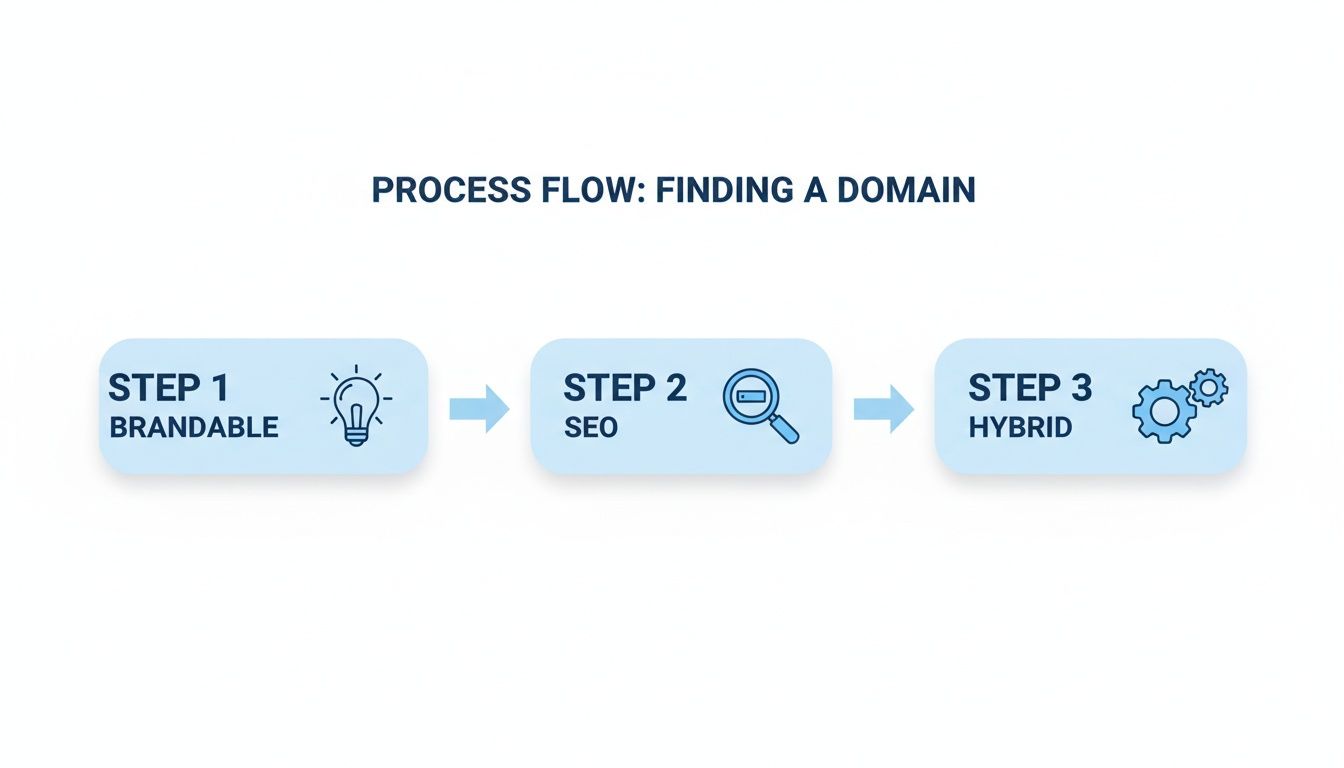
As you can see, the hybrid path gives you the best of both worlds. You end up with a name that’s memorable for people and already has some authority in the eyes of Google. Let's break down how you actually do this.
Step 1: Define Your Mission
Before you even think about looking at domains, you need to know why you're looking. What’s the end goal here? Are you building a new niche site from scratch? Snagging a powerful domain to redirect to your main business? Or are you just looking for a killer brand name for a new project?
Get a piece of paper—or open a doc—and brainstorm a list of your core topics, target keywords, and any brand ideas you have. This list is your compass. It'll keep you from getting distracted by shiny domains that look cool but don't actually move you closer to your goal.
Step 2: Surface the Opportunities
Now for the fun part: the hunt. This is where you bring in a specialized tool to do the heavy lifting for you. Instead of manually digging through thousands of duds, you can get right to the good stuff.
A great place to start is with domains that were just dropped and are available to register right now. You can find an always-updated list on NameSnag by filtering for Available domains. This is the simplest way to grab a great name without getting into a bidding war.
Want to get ahead of the game? You can also scout for powerful domains that are about to drop. Check out the Expiring domains list. This gives you a crucial window to do your research on the best ones and get ready to pounce the second they're available.
Step 3: Run the Gauntlet
Once you've got a shortlist of promising domains, it's time for interrogation. This is the crucial vetting stage where you separate the true gems from the polished rocks.
- Analyze Backlink Quality: Manually check out their top referring domains. Do they look like real, authoritative websites, or spammy junk?
- Investigate Historical Content: Use the Wayback Machine to see what the site used to be. You’re looking for a clean history, not a sketchy past.
- Verify Key SEO Metrics: Double-check the numbers. Does the Trust Flow, number of referring domains, and DA hold up under scrutiny?
This vetting process is absolutely non-negotiable. Skipping it is like buying a used car without even looking under the hood—you might be in for a nasty, expensive surprise.
Step 4: Make the Call and Secure Your Asset
With all your research done, it's decision time. Weigh the domain's raw SEO power against its brand potential. Is it a perfect hybrid, or does it lean heavily one way? Go back to your mission from Step 1 and make the call.
If the domain is available, register it immediately before someone else does. If it's expiring, get ready for the auction or backorder process. As soon as it’s yours, you can start making your first moves, whether that’s setting up a 301 redirect or starting the buildout of a brand new site.
A Few Common Questions About SEO Domains
Once you start digging into the world of domains for SEO, a bunch of questions usually bubble up pretty quickly. It's a field with plenty of nuance, and a few clear answers can save you a lot of headaches down the road. Let's tackle some of the big ones.
Is an Expired Domain Better Than a New One?
If we're talking pure SEO firepower, a clean expired domain with some history behind it is almost always the smarter play. It’s like buying a house that’s already built versus buying an empty plot of land. You get a massive head start, potentially skipping months—or even years—of the grinding link-building work a brand-new domain always requires.
That said, a new domain gives you a totally blank slate for branding, and there's a lot to be said for that. The real unicorn, the ultimate prize, is finding that perfect hybrid: an expired domain that happens to be super brandable and dead-on relevant to your niche.
How Much Does the Extension Really Matter?
Technically, Google will tell you all top-level domains (TLDs) get a fair shake. But out here in the real world, how users perceive them tells a totally different story. The .com extension is what people know and trust. It just feels legitimate, which often means better click-through rates and more authority in the eyes of your potential customers.
For most businesses trying to reach a wide audience, .com is still the gold standard. It's the safest bet you can make for long-term success. Sure, some niche extensions like .io or .ai can work well in specific tech circles, but .com carries the most universal weight.
Build a New Site or Just Redirect?
This really comes down to what you're trying to accomplish. There's no single right answer, just the right answer for your specific goal.
- Build a New Site: If the expired domain's name and original topic are a perfect fit for a new project you have in mind, building out a fresh site on it is a fantastic move. You get to tap into its existing authority from day one, which can help your new content get noticed and ranked much faster.
- Redirect It: Already have a main website you’re focused on? Then a 301 redirect is an incredibly powerful strategy. You're essentially telling search engines, "Hey, all the trust and authority this old domain had? Send it over to my main site." It can deliver a serious SEO boost to your existing property.
How Quickly Will I See Results?
Patience is always a virtue in SEO, but using a good expired domain definitely puts things in the fast lane. If you 301 redirect a domain, you can often feel a positive bump in your main site's rankings within a few weeks to a couple of months.
If you build a new site on it, you've got that head start, but you still need to create content and let Google do its thing. In that scenario, you can expect to see real traction within 3-6 months—a timeline that beats starting from absolute zero every single time.
Finding and vetting these domains used to be a soul-crushing, manual process that took hours. NameSnag completely changes that. Our platform automates the entire discovery and analysis grind, surfacing powerful Available domains you can register on the spot or a curated list of valuable Expiring domains to get ahead of the competition. Stop guessing and start finding domains with real SEO potential today.
Find Your Perfect Domain
Get access to thousands of high-value expired domains with our AI-powered search.
Start Free Trial