
Think of domain names less like web addresses and more like deeds to digital property. They're strategic assets with real, tangible value. Tracking them for availability, watching for expirations, and keeping an eye on ownership changes can uncover incredible opportunities for SEO, investment, or building a brand. With millions of domains being registered and dropped every single day, there's a constant churn that creates a vibrant market for anyone sharp enough to spot the gems.
Why Monitoring Domain Names Is a Digital Gold Rush

Let's be real: the internet is a massive, chaotic land grab, and domain names are the titles to prime digital real estate. Every single day, tens of thousands of domains expire and hit the open market. This constant churn isn't just noise; it's a massive opportunity for anyone with the right strategy.
Forget thinking of domains as simple addresses. It's time to start seeing them as powerful, strategic assets that can be acquired, developed, or flipped for a profit. For SEOs, marketers, and entrepreneurs, learning how to monitor domains is like discovering a secret marketplace hiding in plain sight.
The Two Sides of Domain Hunting
When you start hunting for domains, you'll quickly find there are two main objectives, each with its own playbook. Knowing your goal from the get-go is the key to finding exactly what you need without wasting countless hours.
- Hunting for Brandability: This is all about finding a name that’s short, memorable, and marketable. Picture a startup founder searching for that perfect
.comthat’s easy to say and spell. Here, the name itself is the asset. - Hunting for SEO Juice: This approach is purely about performance. The name could be clunky or nonsensical; what truly matters is its history. An expired domain with a clean, powerful backlink profile from authoritative sites is an SEO goldmine.
The first is an art, the second is a science. Both require a keen eye and the right tools to spot opportunities before anyone else does.
A Real-World SEO Catapult
I once worked with a small e-commerce site stuck on page three of Google for its main keywords. They had great products but absolutely zero authority. We kicked off a campaign to monitor domain names in their niche, looking specifically for one with clean, relevant backlinks.
After a few weeks, we found it: a domain that once belonged to a defunct industry blog. It had links from several major trade publications. We snagged it for a standard registration fee and set up a 301 redirect, pointing all that inherited "link juice" straight to our client's main money page.
The result was almost immediate. Within six weeks, their rankings shot up from position 28 to position 4. That single, expired domain delivered more SEO impact than six months of tedious content creation and outreach.
This isn't a fluke; it's a repeatable strategy. The key is knowing what to look for and having a system to find these gems.
Whether you want a killer brandable name or an SEO powerhouse, the opportunities are out there. You just need to start looking. For instance, you could browse for Available domains that just dropped or get a head start by looking at Expiring domains that will be up for grabs soon.
Understanding the Domain Lifecycle and Key Metrics
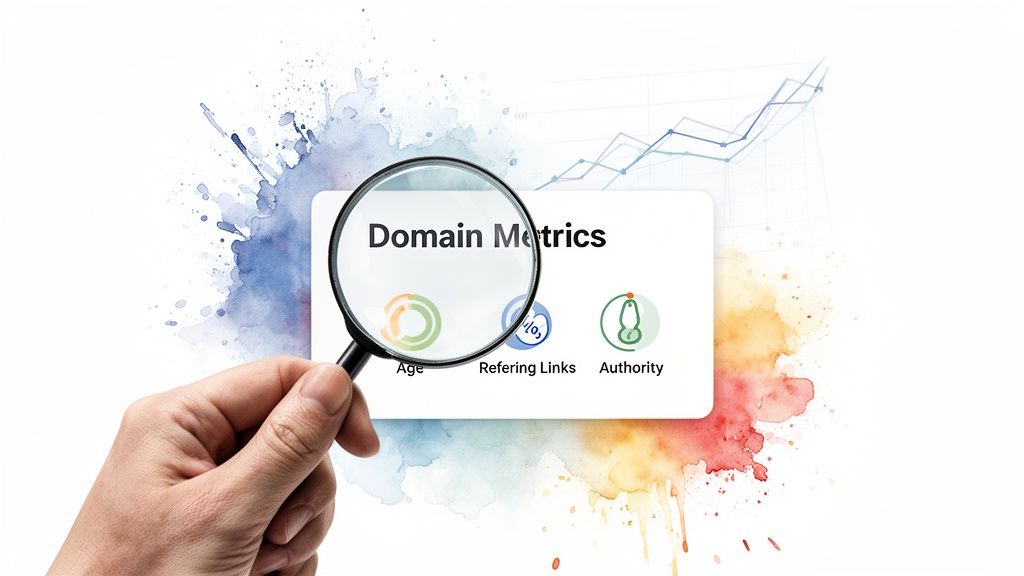
If you want to get good at monitoring domains, you have to get good at timing. It’s everything. A domain isn’t just a binary "taken" or "available"—it moves through a predictable lifecycle. Understanding these stages is your secret weapon, letting you swoop in at just the right moment.
Think of it this way: a domain starts its life when registered (Active). Once it hits the expiration date and isn't renewed, it slips into a Grace Period, which is typically 30-45 days. The original owner can still easily reclaim it here. If they don't, it's on to the Redemption Period, and then finally, the Pending Delete phase right before it's released back into the wild. Each stage is a unique window of opportunity.
Decoding a Domain's Vital Signs
Look, not all expired domains are worth your time. In fact, most of them are digital junk. The real skill is learning how to spot the gems, and you do that by analyzing the metrics that actually signal value. These are the vital signs that tell you whether you’ve found a powerful asset or a money pit.
Here are the core metrics I never ignore:
- Domain Authority (DA): A score from Moz that predicts a site's ranking potential. A higher score (closer to 100) means a stronger, more trusted domain.
- Referring Domains (RDs): The total number of unique websites linking to the domain. This is often more important than the raw number of backlinks. A healthy count of quality RDs is a huge green flag.
- Domain Age: Older domains, assuming they have a clean history, often carry more weight with search engines. They’ve simply had more time to build trust and authority.
Beyond these big three, you have to play detective. A quick search on the Wayback Machine can show you what the domain was used for in the past. Was it a legit business, or something you wouldn't want to touch with a ten-foot pole?
Key Domain Metrics and What They Really Mean
To make this easier, here's a quick-reference table to help you decode the most important metrics when you're hunting for valuable domains.
| Metric | What It Tells You | Why It Matters for SEO or Investing |
|---|---|---|
| Domain Authority (DA) | A 0-100 score predicting how well a site will rank on search engines. | A high DA gives you a massive head start in SEO, making it easier to rank for competitive keywords. |
| Referring Domains (RDs) | The number of unique websites linking to this domain. | A high number of quality RDs shows widespread trust and is a powerful ranking signal. |
| Backlinks | The total number of individual links pointing to the domain. | The context and quality of these links are key. Links from relevant, high-authority sites are gold. |
| Domain Age | How long the domain has been registered. | Older domains can be seen as more trustworthy by search engines, provided their history is clean. |
| Spam Score | A metric (like Moz's) that estimates the risk of a domain being penalized. | A low spam score is non-negotiable. A high score means the domain is likely toxic and worthless. |
| Indexed Pages | The number of pages from the domain that Google has in its index. | A sudden drop to zero could indicate a penalty. A healthy number shows Google is actively crawling the site. |
Think of this table as your cheat sheet. When you find a domain, run it through these checks. It's the fastest way to separate the contenders from the pretenders.
Why Cleanliness Is Next to Godliness
A domain with a toxic backlink profile is like a house with a bad foundation—it’s just more trouble than it’s worth. Before you even think about buying, you have to vet its "cleanliness." Are there a bunch of spammy links from foreign sites? Links related to gambling or adult content? Signs of a private blog network (PBN)? These are all giant red flags.
A domain with 10 high-quality links from relevant, authoritative sites is infinitely more valuable than a domain with 1,000 low-quality links from spammy directories. Quality always trumps quantity in the SEO game.
This due diligence is what separates the amateurs from the pros. A clean, powerful domain can give your project an incredible launchpad, but a penalized one can sink it before it ever sets sail.
This constant churn of registrations and expirations creates a massive river of opportunity. In Q2 2025 alone, newly registered domains shot up to over 26.0 million worldwide. That tidal wave means an endless stream of expirations is always coming, creating a prime hunting ground for those who know what to look for.
Knowing these metrics is step one, but applying them is what really counts. When you monitor domain names, you aren't just checking for availability; you're hunting for a specific cocktail of stats that matches your goal. And understanding the nuances, like the strategies for improving Domain Authority, is what turns a good domain into a great investment.
For a deeper dive into what makes a domain truly powerful from an SEO perspective, check out our guide on what Domain Authority is in SEO for a more detailed breakdown.
Manual vs. Automated Domain Hunting: Pick Your Weapon
When you're hunting for digital real estate, there are really only two ways to go about it: the old-school, roll-up-your-sleeves manual way, or the smarter, faster automated route. Both can get you to the finish line, but one feels like digging for gold with a spoon while the other is more like using a high-tech metal detector.
The manual method is the classic grind. It's an endless cycle of scrolling through auction sites, poring over daily drop lists from a dozen different registrars, and pasting domain after domain into tools like Moz or Ahrefs to see if they're worth a damn. It’s tedious, it’s slow, and honestly, it can be pretty soul-crushing. You're always a step behind, and by the time you find something with potential, it's usually already been snatched up.
The Grind of Manual Domain Monitoring
Let's paint a picture. You've got five auction sites and a couple of forums bookmarked. Every morning, you carve out an hour just to sift through thousands of names, and let's be real, most of them are absolute junk. Then, a glimmer of hope: best-dog-treat-recipes.net. Now the real work starts.
You have to manually:
- Check its Domain Authority and eyeball the backlink profile.
- Dive into the Wayback Machine to make sure it wasn't some spammy mess in a past life.
- Cross-reference its referring domains to see if the links have any real juice.
By the time you're done, you've sunk 20 minutes into a single domain, only to find out it has a spam score that would make your skin crawl. Now, imagine doing that a hundred more times. It’s an inefficient burn of your most valuable resource—your time. It might be a decent way to learn the ropes, but it’s definitely not a scalable strategy if you're serious about this.
Shifting Gears to Automated Hunting
This is where the game completely changes. Instead of digging by hand, you let specialized tools do the heavy lifting for you. Platforms like NameSnag are built for exactly this purpose, turning hours of grunt work into a few minutes of strategic filtering. You’re not just saving time; you’re giving yourself a massive competitive advantage.
The idea is simple: you tell the system exactly what you're looking for, and it pings you the second a matching domain pops up. It's faster, more precise, and frankly, a lot more fun. Many of these automated strategies rely on web scraping to collect huge amounts of data. To do it right, understanding the best proxies for web scraping is key to avoiding blocks and keeping the data flowing.
Setting Up Smart Filters to Find Gold
Alright, let's get practical. Say you’re building an affiliate site in the hyper-competitive "home coffee brewing" niche. You need a domain with some built-in authority to get a running start. With an automated tool, you don't just search; you command.
You can set up filters to find a domain that meets these exact criteria:
- Keywords: Must contain "coffee," "brew," or "espresso."
- Domain Authority: A minimum DA of 15.
- Backlinks: Needs at least one backlink from a .edu or .gov domain for that extra trust.
- Age: Registered for at least 3 years.
With those rules in place, the platform scans hundreds of thousands of domains for you and only shows you the ones that fit your perfect profile. You've just cut out 99% of the noise.
Automation transforms domain hunting from a reactive chore into a proactive strategy. You're no longer chasing domains; you're letting the perfect domains come to you.
This level of precision is a true game-changer. For a deeper look at how this works behind the scenes, you might find value in learning more about automating your due diligence process, which is crucial for making fast, informed decisions.
Hunting for Available vs. Expiring Domains
Automation also lets you strategically target domains at different points in their lifecycle. On a platform like NameSnag, you can focus your search with pinpoint accuracy.
You can filter specifically for Available domains. These are domains that have already dropped and are ready for you to register right now at any standard registrar. This is the fast-track approach—find it, like it, buy it. It's perfect for when you need a domain today.
Alternatively, you can zero in on Expiring domains. These are domains sitting in their grace period, about to be dropped. Monitoring these gives you a crucial head start to research the domain, assess its value, and get ready to pounce the second it becomes available—often before it ever hits a public auction.
To narrow your focus even more, you can use time filters. Only want to see the freshest opportunities? Set the filter to Today or 3 Days. This lets you get to the best domains before the competition even knows they exist. That blend of smart filtering and timing is what separates a lucky find from a repeatable, successful domain acquisition strategy.
Crafting Your Perfect Domain Monitoring Strategy
Having the right toolkit is one thing, but it’s like owning a top-of-the-line kitchen with no recipes—you need a solid strategy to make any magic happen. When you monitor domain names, your approach has to be dialed in to your specific goal.
Let's be clear: the playbook for an SEO pro hunting for link equity is wildly different from the one a domain investor uses to flip names for a quick profit.
So, let's stop just talking about tools and start mapping out some real-world workflows. Having a clear plan is what separates a lucky one-off find from a repeatable, successful acquisition machine.
The SEO Pro’s Playbook for Authority Building
For SEOs, the mission is crystal clear: find domains that carry authority. This isn't about stumbling upon a cute, brandable name. It’s a targeted hunt for digital assets with a history of trust and relevance—assets you can use to give your own projects a serious boost.
Your primary targets are domains with:
- A clean, relevant backlink profile: You're looking for links from sites that are thematically aligned with your niche. Quality over quantity, always.
- High Domain Authority (DA) or Domain Rating (DR): A solid score here means it already has ranking potential baked in.
- A squeaky-clean history: No spam, no penalties, no weird past lives. A background check is non-negotiable.
Once you land a domain that fits the bill, you have two main strategic options. You can set up a 301 redirect, funneling all of that juicy link equity directly to your main website. Or, you can rebuild the domain into a niche site or a powerful blog that acts as a support asset for your primary money site.
The Domain Investor’s Blueprint for Profit
Domain investors are playing a totally different game. While SEO metrics are a nice-to-have, the real value is in the name itself. The goal here is to spot short, memorable, and highly brandable domains that a startup or an established business would pay top dollar for.
Your focus should be laser-sharp on domains that are:
- Short and sweet: One or two-word
.comdomains are the holy grail. They always have been. - Easy to spell and pronounce: If you have to spell it out over the phone, it’s probably not a winner.
- Keyword-rich and commercially viable: Think about industries with high customer value, like finance, tech, or health. That's where the money is.
The investor’s strategy is all about volume and speed. You need to be scanning thousands of names, identifying the few with true brand potential, and snapping them up before anyone else even notices. From there, it's about listing them on marketplaces and finding the right buyer.
This decision tree gives a simple visual guide for choosing your path, whether you prefer a hands-on manual approach or a more efficient, automated one.
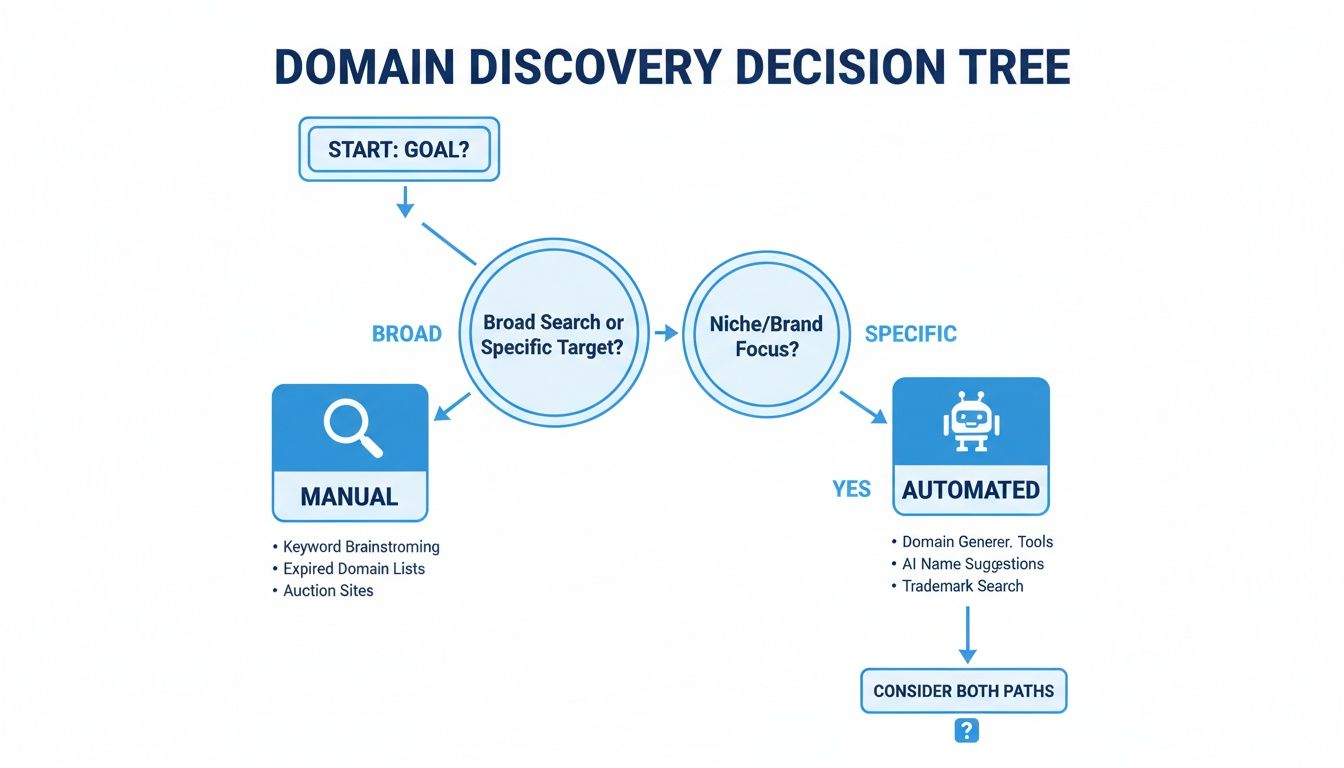
Ultimately, the infographic highlights a simple truth: your goal—whether it's finding a brandable name or an SEO powerhouse—is the first and most critical step in defining your search strategy.
A Real-World Scenario Hunting for an Affiliate Site Gem
Let's get practical. Imagine you want to launch a new affiliate site dedicated to "artisanal dog food." It's a competitive niche, so you need every advantage you can get. The goal is to find an expired domain with some existing SEO power to hit the ground running.
Here’s how you could set up your monitoring strategy:
- Define Your Filters: You'd fire up a tool like NameSnag and create a watchlist. You would filter for domains containing keywords like "dog," "pup," "pet," "food," or "treats." Then, you’d set a minimum Domain Authority of 15 and require at least 10 referring domains to weed out the weaklings.
- Focus on Fresh Drops: To get a head start, you’d narrow your search to domains that have dropped within the last 7 days. This ensures you're looking at the freshest opportunities before they get picked over.
- Monitor Both Expiring and Available: You’d want to set alerts for both. You might check the Available domains list for something you can register instantly. You'd also keep a close eye on the Expiring domains list to prepare for any high-value names about to hit the auction block.
After a few days, an alert hits your inbox:
HealthyPawsBlog.com. It has a DA of 18 and backlinks from two relevant, pet-focused blogs. It fits your criteria perfectly.
This systematic approach removes the guesswork. You’re not just randomly searching and hoping for the best; you’ve built a specific, goal-oriented system to monitor domain names that brings the perfect opportunities directly to you. It's about working smarter, not harder.
From Alert to Acquisition: Securing Your Target Domain
The alert finally hits your inbox. After weeks, maybe months, of patiently watching, the domain you’ve been after is finally within reach. This is the moment where a cool head and a clear plan are your greatest assets. It can feel like a mad dash to the finish line, but if you've got a solid action plan, you can close the deal with confidence.
Before you slam that "buy" button, it’s time for one last, rapid-fire due diligence sprint. These last-minute checks are your safety net. They're what keep you from accidentally acquiring a digital lemon. Don't skip this, no matter how tempting the domain is.
Your Pre-Flight Checklist
Think of this as your three-point inspection before takeoff. It should take you less than five minutes but can save you from months of headaches down the road.
- Final History Check: Pop the domain into the Wayback Machine one last time. Does its past life still look clean? A quick visual scan confirms it wasn't a spam site or something else that could come back to haunt you.
- Backlink Profile Confirmation: You've probably already done this, but give its referring domains a final glance using a tool like Ahrefs or Moz. You just want to make sure the high-quality links are still there and no toxic ones have popped up recently.
- Trademark Verification: A quick search on the USPTO database (or your country's equivalent) is non-negotiable. The last thing you want is a legal notice because your supposedly "brandable" domain is already someone else's registered trademark.
These checks are your final go/no-go. If you want to dig deeper into what to look for, you should learn more about how to properly check a domain's history before you put your money down.
The Acquisition Game Plan: Available vs. Expiring
Once the domain passes your final checks, how you acquire it depends entirely on its status. This isn't a one-size-fits-all process; you have to adapt your approach based on whether the domain is immediately available or heading to auction.
And if you're hunting in a competitive space, you're not alone. The digital real estate market is booming. By the end of Q2 2025, global domain name registrations hit a staggering 371.7 million. The 10.4 million new .com and .net registrations in that quarter alone show just how many people are looking for the same opportunities you are. You can get more insights from the full domain name industry brief for Q2 2025.
The Available Domain Dash
For an available or "dropped" domain, the only thing that matters is speed. It’s purely first-come, first-served. Have your accounts at your favorite registrars logged in and ready to go. Don't hesitate—if it’s a good one, someone else is probably seconds behind you.
The Expiring Domain Auction
When an expiring domain goes to auction, it becomes a game of strategy and nerve. This is where it's incredibly easy to overpay if you're not careful. Emotional bidding is your worst enemy here.
Mastering the Auction Without Losing Your Shirt
If your target is heading to auction, you need a plan. Going in without one is a surefire way to get sucked into a bidding war and torch your budget.
- Set Your Maximum Bid (and Stick to It): Before the auction even starts, decide the absolute maximum price you are willing to pay. Write it down. This is your walk-away number, no exceptions.
- Use Proxy Bidding: Almost every auction house offers proxy (or auto) bidding. Just enter your maximum bid, and their system will automatically bid up for you in small increments. This stops you from having to babysit the auction and helps you avoid those emotional, last-second decisions.
- Avoid Early Bidding Wars: Don't jump in and start bidding aggressively right out of the gate. This often just drives the price up and signals your strong interest to competitors. Let the early bidders tire themselves out, then place your serious bid closer to the auction's end.
By following this disciplined approach, you turn a potentially chaotic scramble into a calculated acquisition. You'll snag the domains you truly want at a price that makes sense, setting yourself up for success from day one.
Common Domain Monitoring Questions
Diving into domain monitoring can feel like learning a new language. You've got expiring domains, dropped domains, backorders... it’s enough to make your head spin. It's totally normal for questions to pop up as you get started.
Let's clear the air and tackle the most common ones. Think of this as the quick-start guide to the stuff everyone asks (or is afraid to). Getting these basics down is the key to making smart, fast decisions instead of costly rookie mistakes.
Expiring vs. Available Domains
One of the first hurdles is just figuring out the lingo. What's the real difference between an "expiring" domain and one that's "available"?
An expiring domain is one where the owner failed to renew it. It's now in a sort of limbo—a grace period that can last a month or more. You can't just register it directly. Instead, you'll need to backorder it or get ready to bid if it heads to auction. You can keep an eye on these soon-to-be-released gems by checking out lists of Expiring domains to get a head start.
An available domain, on the other hand, has already gone through all the grace and redemption periods. It's been officially deleted and is back in the wild. Anyone can register it immediately for the standard fee. You can find and snag these in minutes by browsing Available domains. Speed is your biggest advantage here.
Spotting a Domain with a Spammy Past
Not all expired domains are hidden treasures; some are haunted houses filled with spammy ghosts. How do you tell if a domain has a sketchy, penalty-ridden past?
Your best bet is a two-pronged attack.
First, use a tool like Ahrefs or SEMrush to check its backlink profile. You're looking for red flags: a flood of links from low-quality foreign sites, casino or adult-themed links, or anything that just feels unnatural.
Second, take a trip to the Wayback Machine. A quick look at past snapshots of the site will tell you in seconds if it was a legitimate business or a spam farm pumping out junk.
A domain's history is its permanent record. A clean past is non-negotiable because search engines have long memories, and a previously penalized domain can be nearly impossible to rehabilitate.
SEO Value or Brandability: Which Is Better?
This is the ultimate "it depends" question. Should you chase a domain with built-in SEO authority or one that’s short, catchy, and brandable? The right answer comes down to what you're trying to accomplish.
For SEO Projects: If you're building a niche affiliate site or setting up a 301 redirect strategy, SEO value is king. A clunky name like
TopCoffeeGrinderReviews24.comwith a DA of 25 is far more valuable than a slick, brandable name with zero authority. The existing backlinks and trust are the entire point.For a New Business: If you're launching a startup, the name is the brand. A short, memorable, and easy-to-spell domain is priceless. You're building from scratch, so you need a name that sticks in people's minds, not one that just has a few old, irrelevant backlinks.
Knowing your objective from the start is the most critical part of your domain monitoring strategy. It dictates everything—what you look for, what you ignore, and ultimately, what will bring you the most value.
Ready to stop digging through digital junk and start finding high-value domains? NameSnag uses AI to analyze over 170,000 domains daily, giving you a curated list of opportunities with real SEO and brand potential. Find your next domain with NameSnag today!
Find Your Perfect Domain
Get access to thousands of high-value expired domains with our AI-powered search.
Start Free Trial