Ever feel like all the good domain names are taken?
Think again.
Every single day, thousands of valuable domains expire and pop back onto the market. It's often due to something as simple as a forgotten renewal or an expired credit card. This isn't about luck; it's about knowing where and when to look for these digital gems.
The Hidden Goldmine in Expired Domains
It's easy to assume every short, brandable, or keyword-rich domain is locked up forever. But the reality is that digital real estate is constantly in motion. Domains aren't just registered; they're abandoned, forgotten, or intentionally let go every single day.
This daily churn is where the opportunity lies. A business might pivot, a side project gets shelved, or an invoice just gets missed. When that happens, a domain with an established history, backlinks, and even existing traffic can suddenly become available.
Just How Big Is the Opportunity?
We're not talking about a small trickle of domains here. The numbers are staggering.
Take a look at the data from a service like Whoxy: on January 1, 2026, a whopping 397,930 domains were set to expire. That number jumps to 626,353 on January 2 and hits 685,583 by January 3. At that rate, you're looking at roughly 21 million domains expiring in a single month. Other services like DomCop track these stats, and they all paint the same picture: it's a massive treasure trove.
This constant flow means you don't have to build a new project from scratch. Instead of starting on a brand-new, unproven domain, you can acquire one that already has a head start. It’s like buying a house with good bones instead of building one on an empty lot.
The key isn't just finding any expired domain; it's about finding the right one. A name with a clean history and existing authority can give your project an incredible boost from day one.
So, Why Should You Care?
Understanding this cycle is your first step toward uncovering high-value assets. These aren't just random strings of letters; many are premium, memorable names that someone once invested real time and money into.
Here’s a quick rundown of why expired domains are such a powerful strategy.
Why You Should Care About Expired Domains
| Benefit | Why It Matters for You |
|---|---|
| Instant SEO Authority | Acquire a domain that already has powerful, trusted backlinks from reputable sites. |
| Brandability | Grab a short, catchy, and memorable name perfect for a new venture without the premium price tag. |
| Built-in Traffic | Some domains still get direct or referral traffic you can capture and redirect immediately. |
| Cost-Effectiveness | It's often cheaper to buy a strong expired domain than to build authority from zero. |
Learning how to value domain names is a crucial skill in this game. By spotting these opportunities, you can find incredible domains for your next project, SEO campaign, or investment portfolio. The secret is knowing that the perfect domain might not be one you create, but one you rediscover.
Decoding the Domain Expiration Lifecycle
So, you've found the perfect domain, and its expiration date is just around the corner. You might think it's a simple waiting game—once the clock strikes midnight, it's yours for the taking.
Not so fast. The moment a domain expires, it enters a surprisingly complex lifecycle with multiple phases, each with its own rules and timelines. This isn't a free-for-all; it's a structured process.
Understanding this journey is your secret weapon. It’s the difference between snagging a high-value asset and watching it slip through your fingers while you wait for a drop that isn't coming when you think it is. Let's break down what really happens.
The Auto-Renew Grace Period
This is the first stop on the journey. The moment a domain passes its expiration date, it doesn't just vanish. For most common extensions like .com, the registrar grants the original owner a bit of a safety net: the Auto-Renew Grace Period.
- Typical Duration: Varies by registrar but often lands somewhere between 30-45 days.
- What’s Happening: The domain is effectively "on hold." The website and email services stop working, but the original owner can still renew it, usually for the standard fee, no questions asked.
- Can You Get It? Nope, not yet. This is the owner's last chance to reclaim it without a fuss.
Think of it as the friendly reminder phase. It’s the registrar’s way of saying, “Hey, your credit card might have expired. Are you sure you want to let this go?” During this time, the domain is in limbo, waiting for its owner to act.
This period is crucial for tracking. While you can't register the domain, you can monitor it closely. If it passes through this stage without being renewed, your chances of acquiring it increase dramatically.
The Redemption Grace Period
If the owner doesn't renew the domain during that initial grace period, things get more serious—and more expensive for them. The domain now enters the Redemption Grace Period (RGP). I like to call this the "expensive oops" phase.
- Typical Duration: Usually a standard 30 days for most generic TLDs.
- What’s Happening: The domain is officially deleted from the registrar but is now held by the registry. The original owner can still get it back, but it now comes with a hefty redemption fee on top of the regular renewal cost.
- Can You Get It? Still no, but you're getting much closer. This is the absolute final window for the original owner.
At this point, you can start exploring platforms that list Expiring domains. These are the domains currently in this RGP or the preceding grace period, giving you a clear view of what’s about to become available. You can even filter by when they'll drop—like in the next 3, 7, or 30 days—to plan your attack.
The Pending Delete Phase
Once the Redemption Grace Period ends, the domain's fate is sealed. It enters the Pending Delete phase, a short, final stage before it's released back into the wild. No more second chances.
- Typical Duration: This phase is brief, typically lasting only 5 days.
- What’s Happening: The domain is locked. It cannot be renewed or recovered by anyone, not even the original owner. The registry is preparing to completely erase it from their records.
- Can You Get It? Almost! At the end of these five days, the domain will "drop" and become available for anyone to register on a first-come, first-served basis.
This is the moment you've been waiting for. Once a domain drops, it joins the ranks of Available domains that can be registered immediately.
To make this crystal clear, let's map out the entire timeline for a typical .com domain.
The Domain Expiration Timeline
This table breaks down the whole process, from the day it expires to the moment it's up for grabs again.
| Lifecycle Stage | Typical Duration | What's Happening? | Can You Get It? |
|---|---|---|---|
| Auto-Renew Grace Period | 30-45 Days | Website/email stop working. Owner can renew at the standard price. | No. |
| Redemption Grace Period | 30 Days | Domain is held by the registry. Owner can restore it for a high fee. | No. |
| Pending Delete | 5 Days | Domain is locked and being prepared for deletion. No one can recover it. | Almost! |
| Available for Registration | Indefinite | The domain is released and can be registered by anyone. | Yes! Go for it. |
Knowing this lifecycle gives you a precise timeline to plan your acquisition strategy. Instead of guessing, you can track a domain's status and be ready to act the second it becomes available.
Your Toolkit for Finding a Domain's Expiration Date
Alright, ready to start hunting for that perfect domain? First thing's first: you need the right tools for the job. We're going to move past the theory and get straight into the practical, actionable steps for figuring out exactly when a domain is set to expire.
We'll kick things off with the old-school method that’s still a cornerstone of any domain researcher's process. The most direct route to checking a domain's status is through a WHOIS lookup. This is essentially a public file cabinet containing the key details about a domain's registration—who owns it, when they registered it, and the golden ticket: the Registry Expiry Date.
The Classic WHOIS Lookup
Running a WHOIS search is dead simple. While there are countless free tools online, your best bet is to go straight to the source: the official ICANN Registration Data Lookup Tool. Just pop in the domain name you're curious about and hit search.
In a perfect world, the report that comes back gives you the exact date you're after. Simple. But you'll almost immediately run into a very common roadblock: WHOIS privacy protection.
Most domain owners (myself included) use services that mask their personal info from the public record, swapping it out for the registrar's generic details. It's great for privacy, but it can make your detective work a little more challenging.
Navigating WHOIS Privacy and Modern Tools
So, what do you do when the WHOIS data is hidden behind a privacy shield? This is where you have to get a bit smarter and lean on modern tools.
Even with privacy enabled, the crucial Registry Expiry Date is often still visible. But if it’s not, you need to shift gears from one-off manual checks to automated monitoring. This is exactly why platforms like NameSnag exist. Instead of you having to remember to check a domain over and over, these tools do all the heavy lifting. They scan thousands of domains, cut through the noise of privacy services, and serve up the critical data you need.
The real power here isn't just finding a single date; it's about tracking a domain through its entire expiration lifecycle. Automated tools watch for every status change, so you get an alert the moment a domain moves from 'Active' to 'Grace Period' and eventually into 'Pending Delete'.
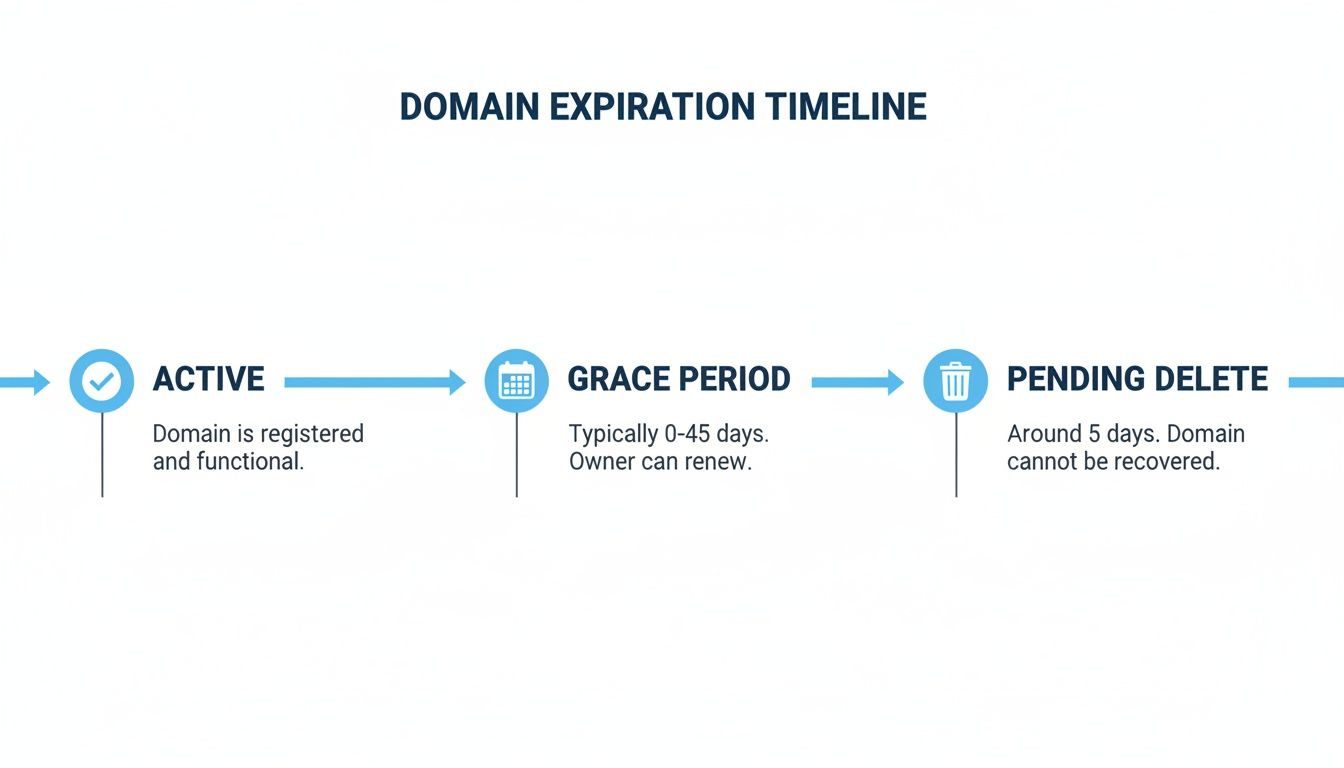
As you can see, the journey from being actively registered to becoming available again involves distinct stages. Each of these phases is a window of opportunity, but you have to know they’re happening.
By combining quick, manual WHOIS lookups with automated platforms for the domains you're serious about, you build a powerful strategy. It's an approach that ensures you’re always in the loop and ready to act the second an opportunity arises. For a deeper look at this process, check out our complete guide to domain name monitoring.
From Expiring to Available: Snagging Your Target Domain
Figuring out a domain's expiration date is just the starting line. The real race kicks off the moment you decide you actually want to own that domain. This is where a little bit of strategy separates the spectators from the successful domain snipers.
Your entire approach hinges on the domain's current status. Are you trying to grab something that’s still in its grace period, or one that has just been released back into the wild? Let's break down the playbook for each scenario.
The Two Arenas of Domain Acquisition
Think of the expired domain market as having two distinct fields of play, and each one demands a different game plan.
- Expiring domains: These domains are currently sitting in their Auto-Renew or Redemption Grace Period. You can't just hand-register them yet, but they're on a clear path to being dropped if the current owner doesn't step in.
- Available domains: These domains have run the full gauntlet of the expiration lifecycle and have just been "dropped" by the registry. They're up for grabs, first-come, first-served, by anyone.
Knowing the difference is critical, because the way you go after them is fundamentally different. For a deeper dive, you might be interested in our guide on how to buy expiring domains.
Strategy 1: The Backorder for Competitive Expiring Domains
For highly sought-after Expiring domains—I'm talking short, brandable names or ones with juicy SEO metrics—you won't be the only one watching. Trying to manually register it the second it drops is like trying to catch a falling star with tweezers. It's nearly impossible.
This is where a domain backorder service becomes your best friend. You essentially place a "bet" on a domain before it drops. The service then unleashes a battery of high-speed servers to try and register it for you the millisecond it becomes available. If you're the only person who backordered it, congratulations, it's yours. If a few people did, it typically heads to a private auction between the bidders.
This is the pro move for competitive names. It's your best shot, hands down, at grabbing a domain that has a lot of eyes on it.
Strategy 2: Speed and Precision for Available Domains
On the flip side, you have the domains that have just become Available domains. These are the ones that survived all the grace periods, redemption phases, and auctions without being reclaimed or won. They are now fair game for immediate registration at any standard registrar.
Here, the game is all about speed and awareness. This is where tools that serve up curated lists of freshly dropped domains are worth their weight in gold.
Platforms like NameSnag cut through the daily noise, presenting a clean, filterable list of domains that are ready to be registered right now. You can see what just dropped Today, in the last 3 days, or even 7 days ago. This allows you to quickly spot and secure high-value targets without the fuss of backorders or auctions.
The sheer volume of domains dropping every day is mind-boggling. On a single day in early 2024, over 5.2 million domains were flagged as expired or dropping—a testament to the relentless churn of digital real estate. While many are lower-value extensions, the premium .com domains remain highly coveted. In fact, over 90% of startups still prioritize them for the instant credibility they provide.
Ultimately, your success hinges on matching the right strategy to the right domain. For the big fish everyone is chasing, a backorder is your best bet. For the hidden gems that slip through the cracks, a powerful monitoring tool and quick reflexes will have you building an enviable portfolio in no time.
Common Mistakes to Avoid When Hunting Expired Domains
Chasing expired domains feels a lot like a treasure hunt. The thrill of the chase is real, but it’s dangerously easy to get so caught up in the excitement that you completely miss some serious red flags.
Making one of these all-too-common mistakes can quickly turn a potential goldmine into a frustrating and expensive liability. Let’s make sure you skip the buyer's remorse.
The single biggest mistake? Falling for a domain with a toxic past. A name might have some impressive-looking metrics, but if it was ever used for spam, a shady link farm, or other black-hat activities, it’s basically radioactive. Google has a long memory, and any penalties or negative associations can stick to that domain like glue.
Another classic blunder is not checking what the domain used to be. Before you even think about putting in a bid, you absolutely have to check its history. A tool like the Wayback Machine is non-negotiable here. It gives you snapshots of the site over the years, revealing whether it was a legitimate business or something you’d never want associated with your brand.
Getting Lost in the Metrics
It's tempting to fixate on a high Domain Authority (DA) or a mountain of backlinks. While these metrics have their place, they don't paint the whole picture. Not even close.
A domain with a high DA might have earned it from thousands of low-quality, irrelevant, or downright spammy links. That's not an asset; it's a cleanup project.
A domain's history is its digital resume. If you wouldn't hire someone without checking their references, you shouldn't acquire a domain without investigating its past.
Always step back and ask yourself a few critical questions:
- Is it brandable? Does the name actually sound professional and is it easy to remember? A domain like
BestCheapSEOTricks247.commight have good metrics on paper, but it’s a terrible foundation for a credible brand. - Is it relevant? Take a look at the old backlinks. Do they come from sites within your niche? A bunch of links from unrelated industries won’t do you much good and can even look suspicious to search engines.
- Is it actually indexed? This one is huge. A quick
site:domain.comsearch on Google will tell you if the domain is even showing up in Google's index. If it’s not, that's a massive red flag that it may have been penalized into oblivion.
Overlooking the Drop Process
Finally, a common slip-up is failing to understand how a domain will actually become available. The drop process isn't one-size-fits-all.
Some domains go to a backorder auction, some drop into a pool of Expiring domains you can grab for a set price, and others simply become Available domains for anyone to register at the standard fee.
There's no worse feeling than overpaying in a heated auction for a domain you could have snagged for a simple registration fee a few days later. By sidestepping these pitfalls, you can hunt for domains with confidence, knowing you’re picking up a true gem, not just someone else’s digital baggage.
Your Domain Expiration Questions Answered
We’ve covered a lot of ground, from the lifecycle of a domain to the common mistakes people make when hunting for them. Still, sometimes you just need a quick, straightforward answer. Let's tackle some of the most common questions that pop up when you're trying to figure out when a domain will expire.
Can Someone Else Buy My Domain After It Expires?
Yes, absolutely. Once a domain makes its way through all the grace periods and the registry officially deletes it, it's tossed back into the public pool of available names. This is precisely where the opportunity for others—and the risk for you—comes in.
Competitors, savvy domain investors, or really anyone with an internet connection can register it on a first-come, first-served basis. This is exactly why enabling auto-renewal on your important domains is one of the smartest, simplest things you can do to protect your digital real estate.
How Long Do I Have to Renew After It Expires?
This is where things can get a bit fuzzy, as the answer depends heavily on your registrar and the domain extension (like .com vs. .io).
- For most
.comdomains, you typically get a 30-45 day "Auto-Renew Grace Period." During this time, you can usually renew at the standard price without any drama. - After that window closes, there's often a 30-day "Redemption Grace Period." You can still get the domain back, but be prepared to pay a hefty penalty fee on top of the normal renewal cost.
Some country-code extensions (ccTLDs) have much shorter grace periods—or sometimes none at all. Always, always check the specific rules for your domain type.
The key takeaway here is to act fast. The longer you wait after the expiration date, the more complicated and expensive recovery becomes. Don’t assume you have a full 75 days; treat the actual expiration date as your final deadline.
Will I Definitely Get the Domain If I Backorder It?
Nope, a backorder is not a guarantee. Think of it more like buying a ticket for a high-stakes raffle. Placing a backorder gives you a powerful shot at grabbing a competitive domain because the service uses high-speed systems to try and register it the very instant it drops.
If you’re the only person who backordered a specific domain with a particular service, your chances are excellent. But if multiple people placed a backorder, the domain will almost always go to a private auction between the bidders. A backorder gets you a seat at the table, but it doesn't guarantee you'll win the prize.
Where Can I Find Domains That Are Dropping Soon?
This is where you graduate from manually checking individual domains to strategic monitoring. Instead of playing whack-a-mole, you can use a dedicated platform to browse a curated list of valuable names that are about to hit the market.
For example, you can easily find Expiring domains that are currently in their grace period and will be dropping in the near future. This lets you plan ahead, research the best targets, and get your backorders in place for the names you really want. It's the smartest way to get an edge on the competition.
Ready to stop guessing and start snagging high-value domains? NameSnag uses AI to analyze over 170,000 domains daily, cutting through the junk to find you spam-free gems with real SEO potential. Find your next winning domain today.
Find Your Perfect Domain
Get access to thousands of high-value expired domains with our AI-powered search.
Start Free Trial