Ever feel like all the great domain names were snapped up back when dial-up was a thing? It's a common frustration. But what if I told you there’s a digital gold rush happening every single day, right under our noses?
Thousands of high-value domains are dropped and become available daily. Many of them have powerful SEO histories and established backlink profiles. This isn't some myth; it's just the natural churn of the internet.
Think of yourself as a digital treasure hunter. Instead of a map and a shovel, you're armed with smart tools and strategic alerts. This is the heart of domain name monitoring. It’s not just a defensive tactic for mega-corporations protecting trademarks. It’s a game-changing offensive strategy for SEOs, niche site builders, affiliate marketers, and anyone looking for that perfect digital address.
Unlocking a Hidden Digital Goldmine
The sheer scale of this opportunity is massive. By Q3 2025, the domain name industry hit 378.5 million total registrations. With renewal rates hovering around 75.3% for major TLDs like .com and .net, a staggering number of domains expire and fall back into the open market. This creates a constantly refreshing pool of digital real estate for those who know where to look. You can explore more about these domain trends and statistics for a deeper dive.
This constant churn means valuable assets are always up for grabs. Monitoring is about being in the right place at the right time, armed with the right information to catch them the moment they become available.
Domain name monitoring is less about watching and waiting, and more about strategically positioning yourself to catch valuable digital assets the second they fall. It turns the vast, chaotic domain market into a predictable source of opportunity.
Finding Your Next Big Thing
So, how does this actually work? Instead of manually checking if that dream domain is finally free, you set up a system to watch it for you. This is what separates the amateurs from the pros. You’re mainly interested in two types of domains:
- Available domains: These have already dropped and can be registered on the spot. It’s a first-come, first-served race, so speed is everything.
- Expiring domains: These have passed their expiration date but are still in a grace period before they drop. Watching these lets you do your homework—researching a domain's history and metrics—so you're ready to pounce.
By keeping an eye on both, you build a powerful pipeline for acquiring high-quality digital real estate. It’s one of the smartest moves you can make, turning what feels like a saturated market into your own personal treasure chest.
So, you’re thinking about monitoring domains. Smart move. But how do you actually tell a diamond in the rough from a lump of coal?
It's a lot like inspecting a classic car before you buy it. You don't just kick the tires; you pop the hood, check the ownership history, and listen to how the engine sounds. The same principle applies here. Sizing up a domain is way more than just seeing if it’s available. You've got to decode its vital signs to really understand its potential. This is what separates a lucky guess from a savvy investment.
The Domain Lifecycle Explained
Every single domain follows a predictable journey, from the moment it's registered to when it eventually expires. If you get your head around this lifecycle, you'll know exactly when—and how—to make your move. A domain isn't just "taken" one day and "available" the next. It's a process, and that process has distinct stages you can watch.
This diagram breaks down how a domain moves from being actively registered to potentially being up for grabs.
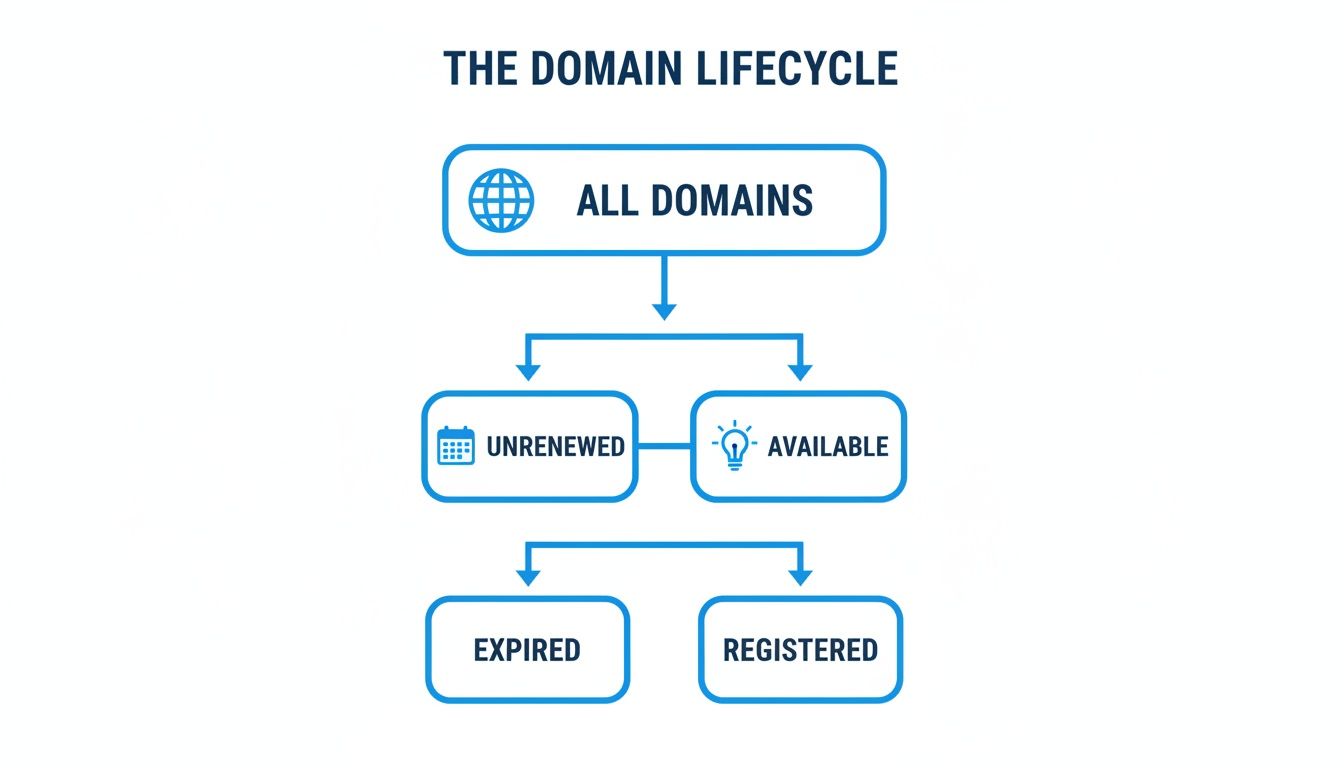
As you can see, there’s a critical window of opportunity right after a domain goes unrenewed. That's your chance to pounce before it hits the open market.
Core Signals You Absolutely Must Monitor
Let's get into the nitty-gritty. Think of this as your pre-flight checklist for any domain that catches your eye. Each signal tells a piece of the domain's story, helping you figure out what it's really worth.
Expiration and Drop Status: This is ground zero. Is the domain about to expire? Has it already been dropped and is now available for anyone to register? This single piece of information dictates whether your strategy is to watch and wait or to act immediately.
WHOIS Changes: The WHOIS record is basically the domain's public title deed. If you see sudden shifts in ownership, registrar, or contact details, it could be a red flag—maybe a sale, maybe a security problem. On the flip side, consistent, long-term ownership is almost always a good sign.
DNS Records: The Domain Name System (DNS) is the internet’s phonebook. Keeping an eye on DNS records tells you if a domain is actively powering a website or email service. If a domain with great metrics suddenly has its DNS records wiped clean, it's a strong hint that the owner is about to let it go.
These are your foundational checks. They give you a quick snapshot of a domain's current health and history. But to find the real SEO power, you need to dig a whole lot deeper.
To give you a quick reference, here's a breakdown of the key signals in one place.
Key Domain Monitoring Signals at a Glance
| Signal to Monitor | What It Tells You | Why It Matters |
|---|---|---|
| Expiration Date | When the current registration ends. | Gives you a timeline for potential acquisition. |
| WHOIS Record | Ownership history, registrar, contact info. | Reveals ownership stability and potential red flags. |
| DNS Changes | If it's being used for a site, email, etc. | Active use indicates value; wiped records signal a drop. |
| Backlink Profile | The quality and quantity of links pointing to it. | The foundation of its SEO authority. High-quality is key. |
| Trust Flow / DA | A score estimating its authority (e.g., Majestic, Moz). | A quick gauge of its SEO power and trustworthiness. |
| Penalty Status | If it has ever been penalized by search engines. | A penalized domain is a toxic asset; avoid at all costs. |
Think of this table as your cheat sheet. When you're scanning dozens of potential domains, these are the vital signs that help you quickly sort the winners from the duds.
Uncovering SEO and Authority Metrics
Okay, this is where you find the real treasure. A domain with a strong, clean history can supercharge an SEO campaign right out of the gate. You're essentially buying a house that's already built on a rock-solid foundation, saving you months—or even years—of grinding.
A domain's value isn't just in its name; it's locked up in its history. A clean, authoritative past can give you an incredible head start.
If you really want to get into the weeds of valuation, our guide on how to value domain names is the perfect next step.
For now, here are the key performance metrics you need to be looking at:
Backlink Quality: Don't get mesmerized by the sheer number of backlinks. Quality is what matters. Are the links coming from respected, relevant websites, or a bunch of spammy link farms? A handful of links from true authorities is worth infinitely more than thousands of toxic ones.
Domain Authority (DA) and Trust Flow (TF): These are the industry-standard scores from tools like Moz and Majestic that estimate a domain's authority and trustworthiness. While they aren't the be-all and end-all, a high score—think 30+—is often a solid indicator of a strong, established backlink profile.
Penalty Checks: This one is non-negotiable. You must make sure the domain isn't carrying any baggage from a past Google penalty. A domain that got slapped for spammy tactics is often a lost cause, making it a toxic asset that will do you more harm than good.
Alright, we’ve covered the "what" and "why" of checking a domain's vital signs. Now for the really fun part: how does domain monitoring actually put money in your pocket or give your projects a massive leg up? This is where the rubber meets the road.
Think of monitoring not just as a defensive shield but as an offensive playbook for growth. Let's walk through four powerful strategies that turn expiring domains into tangible assets. These aren't just theories; they're real-world tactics used by savvy marketers, entrepreneurs, and investors every single day.
Strategy 1: Brand Protection
Imagine you’ve poured your soul into building a popular brand, "SuperCoolGadgets.com." Then, out of nowhere, a cybersquatter snags "SuperCoolGadget.net" and starts peddling low-quality knockoffs or, even worse, runs a phishing scam. Your brand reputation takes a nosedive, and customer trust evaporates.
This happens way more often than you’d think. Typosquatting is one of the oldest tricks in the book for a reason.
Smart domain monitoring is your digital bodyguard. By setting up alerts for variations of your brand name, you get an instant heads-up and can register those look-alike domains before the bad actors even have a chance.
This proactive defense involves:
- Monitoring common typos: like "SuperColGadgets.com"
- Watching different TLDs: such as .net, .org, or .shop
- Catching hyphenated versions: for example, "super-cool-gadgets.com"
By scooping up these variations, you're building a protective moat around your primary digital asset, making sure your traffic and reputation stay right where they belong—with you.
Strategy 2: Strategic Asset Acquisition
Launching a new website from scratch is a grueling uphill climb. You’re starting with zero authority in the eyes of search engines, which means burning months of effort just to see a trickle of organic traffic. But what if you could skip the line?
That's the magic of acquiring expired domains that already have some authority baked in. By monitoring for domains with a strong backlink profile, high Domain Authority (DA), and a relevant history, you can give your new project a ridiculous head start.
An expired domain with a clean history is like buying a restaurant that already has five-star reviews and a line out the door. You're not starting from zero; you're building on established trust and authority.
You can filter for Available domains that have just dropped and grab them immediately. This tactic is perfect for building out a private blog network (PBN), launching a new affiliate site, or even 301 redirecting the domain's authority to your main website for a powerful SEO jolt.
Strategy 3: Backlink Reclamation
Over time, websites that have linked to you will inevitably shut down and their domains will expire. When that happens, the valuable "link juice" they were passing to your site just vanishes. It's like a vote of confidence that suddenly disappears, and your SEO rankings can take a hit because of it.
Backlink reclamation is a clever way to claw that lost authority back. By using a backlink analysis tool to find domains that once linked to you but are now expired, you can simply register them yourself.
Once you own the domain, you can either restore its old content or 301 redirect it to your site. You've effectively "reclaimed" that lost SEO value. It's one of the most efficient ways to strengthen your backlink profile without the grind of building new links from scratch.
Strategy 4: Profitable Domain Flipping
Finally, there's the art of domain flipping—the digital equivalent of real estate investing. The game is simple: find undervalued domains, buy them cheap (often for just the registration fee), and sell them for a significant profit.
Success here hinges on spotting potential that others miss. This could be a short, brandable .com, a domain with surprisingly high SEO metrics, or a keyword-rich name in a booming industry.
By setting up alerts for Expiring domains that meet specific criteria—like a high Trust Flow or a certain age—you can build a watchlist of promising assets. This gives you time to do your homework on their history and potential before they drop, putting you in the perfect position to snag the best ones for your portfolio.
Your Step-by-Step Domain Hunting Playbook
Having all the data in the world is useless without a game plan. Information overload is a real drag, and it can quickly turn an exciting opportunity into a chore. This is where a repeatable system—a playbook—comes in, turning the chaos of daily domain drops into a simple, effective hunting process.
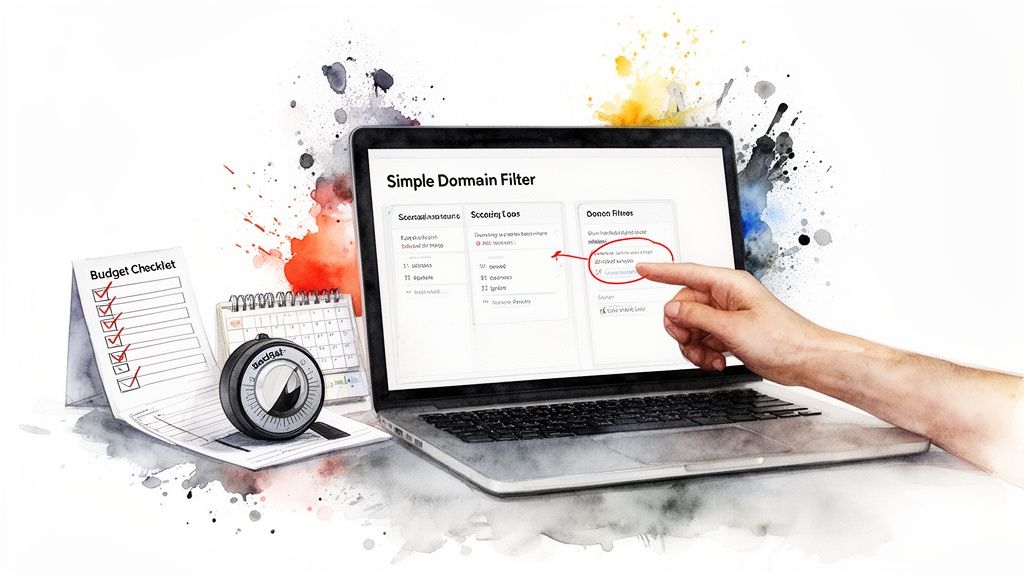
This isn't about spending hours glued to a screen. It's about setting up smart, sustainable workflows that do the heavy lifting for you. Let’s build your personal domain hunting strategy from the ground up.
Step 1: Define Your Mission
Before you even glance at a single domain, you have to know what you’re hunting for. Your goal dictates your entire strategy. Are you a startup founder looking for a killer brand, an SEO pro digging for digital gold, or a domain flipper searching for the next big score?
You need to answer one question first: What does the perfect domain look like for me?
- For a Startup: You're probably after something short, memorable, and brandable. Your primary filter will be keywords related to your industry with a heavy bias for
.comTLDs. Simple as that. - For an SEO Project: You need a domain with a squeaky-clean history and solid authority metrics. You’ll be filtering for a minimum Domain Authority (DA) or Trust Flow (TF) and a healthy number of referring domains. No compromises.
- For a Domain Flipper: You’re on the hunt for undervalued assets. This could be a short, numeric domain, a three-letter acronym, or a keyword-rich name in an emerging niche like AI or biotech.
Once you know your mission, you can set the rules of engagement. If you want to get deeper into the timing of domain availability, our guide on how to see when a domain name expires is a good place to start.
Step 2: Set Your Filters and Alerts
Now it's time to cut through the noise. The sheer volume of expiring domains every single day is enough to make your head spin. Smart filters are your best friend here, helping you ignore 99% of the junk to focus on the 1% that actually matters.
Start by plugging your mission criteria into your monitoring tool. In a platform like NameSnag, this is where you can get super specific.
Example Filter Setup for an SEO Project:
- Domain Status: I'd look at both Expiring domains to plan ahead and Available domains for immediate wins.
- Time Frame: I might start by looking at domains dropping in the next 7 Days or 14 Days to build a shortlist.
- SEO Metrics: Set some non-negotiable minimums, like a DA of 20+ or a Trust Flow of 15+.
- Backlinks: Filter for domains with at least 10 referring domains to make sure they have some link equity to begin with.
- Keywords: Throw in keywords relevant to your niche, like "solar," "crypto," or "marketing."
Once your filters are dialed in, set up daily email or SMS alerts. This puts the discovery process on autopilot, dropping the best candidates right into your inbox while you do other things.
Step 3: Create a Simple Scoring System
When you have a shortlist of potential domains, you need a quick way to compare them side-by-side. A simple scoring system is the perfect antidote to analysis paralysis. You can throw together a basic spreadsheet or even just use a mental checklist.
A scoring system isn't about complex algorithms; it's a quick gut check to surface the best opportunities. It forces you to prioritize what truly matters for your specific goal.
Here’s a sample scoring model I've used, based on a simple 1-5 scale:
- Brandability (1-5): Is it short, memorable, and easy to spell? Or is it a jumbled mess?
- SEO Strength (1-5): How strong are its DA, TF, and backlink profile? Be honest.
- Keyword Relevance (1-5): Does the name contain a high-value keyword, or is it generic?
- Clean History (Pass/Fail): A quick check—are there any obvious signs of past spam or penalties? This is a deal-breaker.
A domain that scores highly across your most important categories is a clear winner. This simple framework makes decision-making fast and consistent, turning your domain monitoring efforts into a well-oiled machine.
For the longest time, the domain world felt like a one-horse race. If you couldn't get the .com, you were pretty much out of luck. That landscape has totally changed, and it's created a massive new playground for anyone hunting for the perfect domain.
Welcome to the era of new generic top-level domains, or ngTLDs. We're talking about extensions like .xyz, .shop, .ai, and hundreds of others that have absolutely exploded onto the scene. This isn't just some minor trend; it's a fundamental shift in how digital real estate works.
This boom opens up some incredible doors. You can now find short, memorable, and keyword-rich domains that are long gone in the crowded .com space. It's a fresh frontier for branding and niche marketing, letting you get creative and snag the perfect name for your next big idea.
The New Gold Rush in Alternative TLDs
The growth here is pretty staggering. These new TLDs are the fastest-growing part of the market, surging 21% year-over-year to 42.9 million registrations. This isn't just noise; it's a major market shift driven by extensions like .xyz, .shop, and .online. You can dig into the specifics with this TLD market data analysis to get the full picture.
What this means for you is that every single day, valuable domains on these new TLDs are expiring and hitting the market. Smart investors are diversifying their portfolios, grabbing brandable names in emerging industries before they become mainstream and expensive. Think about it:
- Industry-Specific: A marketing firm could snatch up
growth.agencyor a coffee startup could landnitro.coffee. - Tech-Focused: An AI company finds a perfect fit with a
.aior.techdomain that instantly signals what they do. - E-commerce: A new online store can immediately communicate its purpose with a
.shopor.storeextension.
Keeping an eye on these TLDs gives you a first-mover advantage. You can pick up premium names for a fraction of what their .com cousins would cost.
A Word of Caution Navigating the New Frontier
While these ngTLDs offer amazing opportunities, they do come with a small catch. Because they're newer and often cheaper to register, some of these extensions can be magnets for spammy or low-quality sites. It’s a bit like the wild west out there, and you need to be a discerning sheriff.
This is where your domain monitoring strategy needs a slight tweak. You can't just look at the name; you have to vet the domain’s history even more carefully than you would with a traditional TLD.
The rise of ngTLDs has opened the door to incredible branding opportunities, but it also demands a sharper eye. The real skill isn't just finding a cool name; it's verifying its history to ensure you're building on solid ground, not a digital swamp.
When you're evaluating an ngTLD, double down on checking its backlink profile for toxic links and look for any signs of past penalties. A great name on a spam-heavy TLD can sometimes do more harm than good if you’re not careful. Your goal is to find the hidden gems, not the fool's gold.
By expanding your monitoring to include these emerging TLDs, you open up a whole new world of possibilities. You can find some incredible bargains and brandable names by looking at the full spectrum of what's dropping every day—from the tried-and-true .com to the exciting new .ai.
From Manual Checks to Automated Tools
Let's be honest, the old way of domain hunting is a special kind of nightmare. You probably know the routine all too well. It’s that chaotic juggle of a dozen browser tabs—one for your favorite registrar, another for Moz to check Domain Authority, and a third for Majestic to make sure the Trust Flow is solid.
You spend hours dumping data into a messy spreadsheet, trying to figure out if a domain is a hidden gem or just digital junk. It’s slow, tedious, and frankly, a terrible use of your time. By the time you've actually done the research on a promising domain, chances are someone else has already swooped in and snagged it.

This manual grind is exactly why dedicated domain name monitoring tools were born. They ditch the chaotic, multi-tab shuffle for a single, automated workflow that actually makes sense.
The New Way: Work Smarter, Not Harder
Instead of you chasing down the data, the data comes to you. Modern platforms are built to do the heavy lifting, pulling all the critical metrics you need into a single, easy-to-digest dashboard. Imagine seeing a domain's availability, SEO scores, and backlink quality all in one place.
That’s the power of automation right there. It turns a frustrating, time-sucking chore into a simple, strategic process. You can set your ideal criteria just once and let the system scan hundreds of thousands of domains for you, every single day.
The biggest advantage of automated domain monitoring isn't just about saving time; it's about gaining a massive competitive edge. It lets you make smarter, faster decisions, ensuring you never miss out on a high-value opportunity again.
This approach gives you back your most valuable asset: your time. You can finally focus on strategy and evaluation instead of getting bogged down in the mind-numbing work of data collection.
From Data Overload to Instant Clarity
The best tools take it a step further than just throwing raw numbers at you. They offer a simple, consolidated quality score that tells you instantly if a domain is worth a closer look. They also shoot you instant alerts the moment a domain matching your criteria becomes available.
This means you can be the first to know when a high-authority domain is about to drop, giving you a crucial head start. To get a better sense of how this works in practice, our guide on using an expired domain finder breaks down the entire process. By embracing automation, you’re not just working more efficiently; you're fundamentally changing the game in your favor.
Got Questions About Domain Monitoring?
You're not alone. When you first dive in, domain monitoring seems to have a lot of moving parts. But once you get the hang of it, the core ideas are pretty straightforward. Let's clear up some of the most common questions we get.
How Soon Can I Register a Domain After It Expires?
It's not instant—there's a whole process with a few waiting periods involved. After a domain officially expires, it doesn't just become a free-for-all.
First, it drops into a Grace Period, which typically lasts 30-45 days. During this window, the original owner can still waltz in and renew it, usually for the standard fee. No harm, no foul.
If they don't, things get more serious. The domain might then slide into a Redemption Period for another 30 days. Renewing it now gets a lot more expensive. If the owner still doesn't reclaim it, it enters a final Pending Deletion phase for about five days. After that, it finally "drops" and becomes available for anyone to register. Watching Expiring domains is how you track this whole journey so you're ready to pounce the second it's available.
Is Buying an Expired Domain a Good Idea?
It can be an incredibly sharp move, but only if you do your homework. The biggest landmine you can step on is buying a domain that looks great on the surface but is secretly loaded with a spammy backlink profile or a Google penalty. A high Domain Authority score doesn't tell the whole story.
The real gold in an expired domain is its clean, authoritative history. A high DA is a good start, but a penalty-free past is totally non-negotiable for any serious SEO or branding project.
You absolutely have to dig into its backlink profile for toxic links and check out its history with tools like the Wayback Machine. This is exactly why modern monitoring platforms go beyond simple metrics, offering spam-free verification and a complete quality score to make sure you're buying a powerful, clean asset, not someone else's headache.
What Is the Difference Between Expiring and Available Domains?
Think of it as the difference between planning a heist and grabbing cash in a windstorm.
Monitoring Expiring domains is all about strategy. These are valuable domains that are going to drop soon, which gives you the precious time you need to research their history, value, and how you might use them. You get to line up your shot and prepare your move in advance.
On the flip side, monitoring Available domains is all about speed. These domains have already run the gauntlet of the expiration process and can be registered right now. It’s a flat-out race to see who can snag the best ones first, which makes getting instant alerts absolutely crucial for winning.
Ready to stop guessing and start finding high-value domains? NameSnag uses AI-powered analysis to surface the best expiring and available domains daily, saving you hours of manual research. Find your next digital asset with NameSnag today!
Find Your Perfect Domain
Get access to thousands of high-value expired domains with our AI-powered search.
Start Free Trial