
Snagging a good expired domain is like getting an SEO authority and backlink head start, all for the price of a normal registration. It's one of the few real shortcuts that lets you skip the dreaded "sandbox" period new websites often get stuck in.
The Hidden Value in Expired Domains
Ever wonder why so many SEOs and entrepreneurs obsess over expired domains? It's not just about finding a clever, brandable name (though that’s a nice bonus). It's about buying a digital asset with a past—a history that often comes packed with valuable backlinks, established domain authority, and maybe even some leftover traffic.
Think of it like buying property. You could get an empty plot of land and build from the ground up. That takes a ton of time, money, and work. Or, you could find a spot where someone else already poured a solid foundation. An expired domain is that ready-made foundation for your next web project.
Expiring vs. Available: What Is the Difference?
Before you start digging for gold, you need to get two key terms straight: expiring and available. They sound alike, but they're two totally different stages in a domain's lifecycle.
Expiring Domains: These are domains whose owners missed the renewal date. They're not on the open market yet; they're stuck in a "grace period" where the original owner can still rescue them. Watching these is like keeping an eye on a property about to hit the auction block.
Available (Dropped) Domains: These domains went through the whole expiration process—grace period, redemption, the works—and were officially deleted. Now, they're back on the open market for anyone to register instantly. This is the house with the "For Sale" sign planted firmly in the front yard.
Knowing the difference is key to your strategy. With a platform like NameSnag, you can scout the Expiring domains list to see what’s coming down the pipeline, or you can cut straight to the chase and browse high-quality Available domains that you can grab right now.
Tapping into a Constant Flow of Opportunity
The scale here is pretty mind-boggling. Every single day, over 150,000 domains expire and are released back into the wild. This creates a massive, constantly churning pool of potential for anyone willing to look.
Of course, most of them are junk—domains with spammy histories or Google penalties. This is where the right tools make all the difference. They sift through that daily flood, filter out the garbage, and save you from endless hours of manual vetting. It's this constant turnover that keeps creating new opportunities for digital entrepreneurs day after day.
Key Takeaway: The real goal isn't just to find a cool name. It's to acquire an asset with pre-existing SEO equity. By understanding the difference between expiring and available domains, you can sharpen your search and turn someone else's forgotten domain into your next big win.
Alright, you've got the "why" down. Now for the "where."
Finding a killer expired domain is basically treasure hunting. You've got to know the right spots to dig, and the landscape is split into a few key territories, each with its own vibe and potential payoff.
The first place many people look is the high-stakes world of domain auctions. Think of platforms like GoDaddy Auctions as the big leagues. This is where you find domains with serious SEO juice and impressive backlink profiles getting sold off to the highest bidder. Expect fierce competition, but the prize is often worth it.
Then you have the flip side: daily drop lists. These are just what they sound like—lists of domains that became available today for anyone to register at the normal price. It takes a lot more sifting to find the gold here, but the feeling of snagging a powerful domain for less than $20 is unbeatable.
Navigating the Hunting Grounds
Where you decide to look really comes down to your budget and how much grind you're willing to put in. Each method is a different game, from aggressive bidding wars to patient, eagle-eyed searching.
Here’s a quick breakdown of your main options:
- Auction Platforms: This is where the real action is for premium domains. You're bidding against other investors, SEO pros, and agencies. It's fast, it can get pricey, but it’s often the fastest path to a domain with proven authority.
- Backorder Services: This is like hiring a sniper. You spot a fantastic domain that's about to expire but hasn't dropped yet, so you place a backorder. A service then uses their tech to try and register it for you the millisecond it becomes available.
- Consolidated Tools: Let's be honest, manually checking dozens of auction sites and drop lists is a soul-crushing time sink. That’s why platforms that pull all this data together are so valuable. They funnel everything into one place and save you countless hours of grunt work.
A recent Dynadot survey found that a whopping 37% of domain investors consider expired domain auctions their number one tool, ranking them even higher than AI assistants. That tells you just how central these platforms are. And with the domain aftermarket projected to explode from $0.64 billion to $1.17 billion by 2033, using the right tools to find these assets isn't just smart—it's critical. Check out more of these domain investing trends for 2025.
A Smarter, More Efficient Approach
The real secret isn't just knowing where to look, but how to look without burning yourself out. Instead of bouncing between GoDaddy, Sedo, and endless spreadsheets of dropped domains, a centralized tool can serve as your command center.
This is where a platform like NameSnag completely changes the game. It vacuums up domains from all those different sources and gives you powerful filters to zero in on exactly what you need.
For instance, you can browse all the Available domains that just dropped today and are ready to be registered immediately. This is my go-to for finding hidden gems without getting sucked into an auction frenzy.
Or, if you’re playing the long game, you can keep an eye on Expiring domains that are still in their grace period. This gives you a heads-up on high-potential domains before they drop, letting you prep a backorder or get ready to bid. Understanding this cycle is huge, and you can get the full rundown on the timeline of domain expiration.
By using smart filters and a consolidated dashboard, you stop wasting time sifting through junk. You start spending your time analyzing real opportunities. This is the strategic shift that separates the casual hunters from the pros who consistently find and flip valuable digital assets.
How to Vet Domains and Avoid Bad Buys
Alright, you've found a domain that looks promising. It’s got a decent age, maybe a killer name, but now comes the moment of truth. This is the vetting process, where you put on your detective hat to separate the digital gold from the polished-up junk.
Skipping this part is like buying a used car without popping the hood. Sure, you might drive off with a high-performance machine, but you could just as easily end up with a lemon that’s one breakdown away from the scrapyard. A thorough check is the only way to know you’re buying a real asset, not inheriting someone else’s hidden problems.
Looking Beyond Surface-Level Metrics
The first trap nearly everyone falls into is getting star-struck by a high Domain Authority (DA) from Moz or a big Trust Flow (TF) number from Majestic. While these are decent starting points, they absolutely do not tell the whole story. A domain could have a DA of 50, but if it got there through spammy, manipulative tactics, that authority is worthless—and potentially toxic.
You have to dig deeper into the one thing that truly matters: the quality of its backlink profile.
- Spotting the Gold: You're looking for links from high-authority, trusted sources. Links from .edu and .gov domains are the absolute gold standard. They are incredibly difficult to get and send a massive trust signal to search engines. Just a handful of these can be more powerful than hundreds of low-quality links.
- Identifying the Red Flags: Keep your eyes peeled for toxic links. These often come from private blog networks (PBNs), irrelevant foreign language sites, or sketchy directories that look like they haven’t been touched since 2005. A backlink profile loaded with these is a major warning sign to back away slowly.
Pro Tip: Think of backlinks like professional recommendations. A single, glowing recommendation from a Harvard professor (.edu) is infinitely more valuable than a hundred vague compliments from random strangers online.
Becoming a Digital Archaeologist with the Wayback Machine
Next up is your most powerful free tool: the Wayback Machine on Archive.org. This is your personal time machine, letting you see exactly what the domain was used for in its past lives. Was it a respected industry blog, a legitimate e-commerce store, or a spam farm pushing questionable pills?
Don't just glance at the most recent snapshot. Go back through its entire history. You're looking for sudden, drastic changes in the site's design or content. If a blog about organic gardening suddenly became an online casino overnight, that's a huge red flag. It almost certainly means it was sold and repurposed for spam. You need to make sure its history is clean and, ideally, relevant to what you want to do with it.
If you want to get a better handle on a domain's full lifecycle, our guide on how to see when a domain name expires offers some extra context.
This flowchart gives you a bird's-eye view of the different paths to acquiring a domain, helping you see where your current hunt fits into the bigger picture.
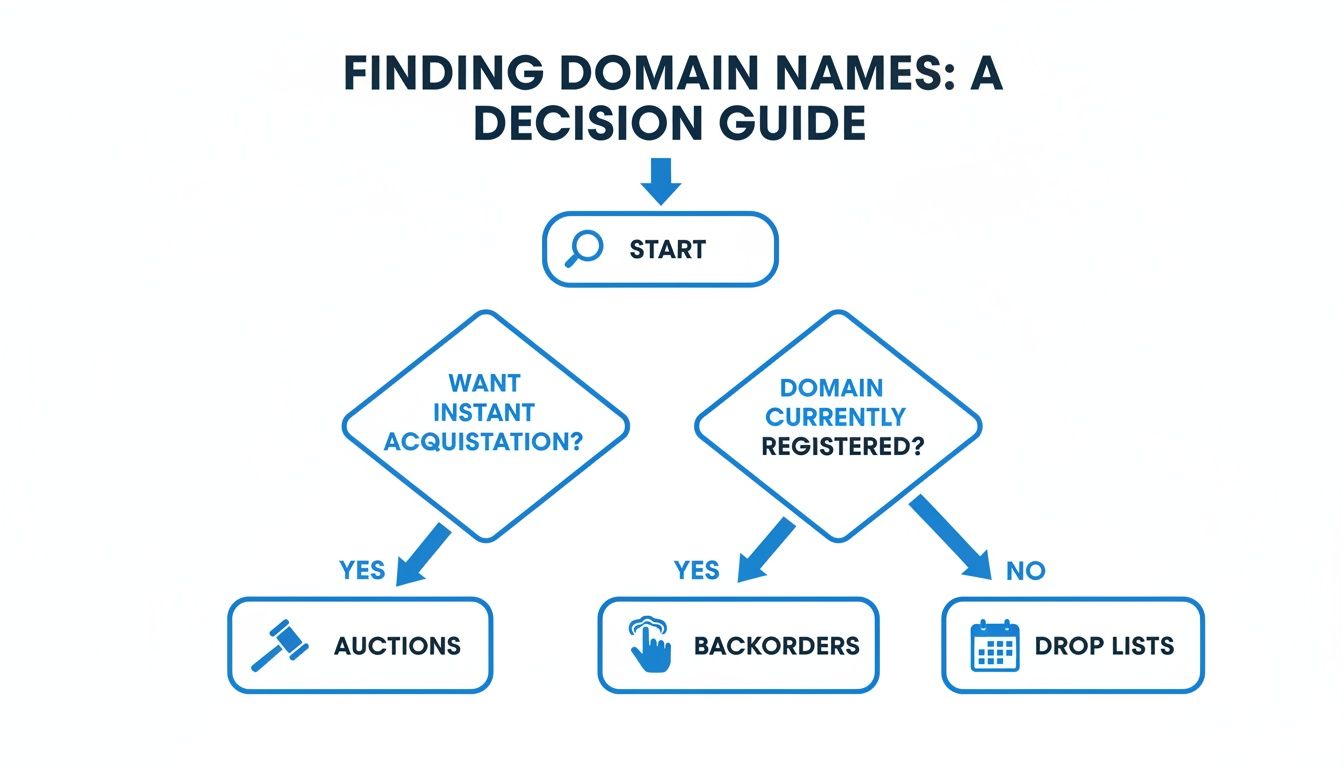
As the diagram shows, whether you're battling it out in auctions, placing strategic backorders, or scanning daily drop lists, the next critical step is always the same: a diligent, thorough vetting process.
To help you keep the essential checks straight, I've put together a quick-reference table. This is what I look at every single time.
Key Metrics for Vetting Expired Domains
This table breaks down the key signals to look for when evaluating an expired domain. Remember, you're looking for a balanced, healthy profile—don't get hung up on just one impressive number.
| Metric | What to Look For (The Good) | What to Avoid (The Bad) |
|---|---|---|
| Backlink Quality | Links from relevant, high-authority sites (.edu, .gov, top industry blogs). | Links from PBNs, spammy directories, foreign language sites, or irrelevant niches. |
| Trust Flow (TF) | A TF score of 15+ is a great starting point, indicating trustworthy links. | A very low TF score, especially when paired with a high Citation Flow (CF). |
| Referring Domains (RDs) | A healthy number of unique domains linking in (50+ RDs is a solid baseline). | A huge number of backlinks coming from just a handful of low-quality domains. |
| Archive.org History | Consistent, legitimate use in a single niche. The content looks clean. | Sudden topic changes, spammy content (pills, gambling), parked pages, or "404" errors for years. |
| Google Index Status | The domain is still indexed in Google (use a "site:domain.com" search). | The domain has been de-indexed, which is a massive red flag for a past penalty. |
| Anchor Text Profile | A natural mix of branded, URL, and generic anchor text. | Over-optimized anchor text with too many exact-match keywords (e.g., "best personal injury lawyer"). |
Think of these metrics as a complete health checkup. High blood pressure alone isn't a death sentence, but when combined with other warning signs, it's time to be concerned. The same goes for domains.
Streamlining Your Vetting Workflow
Manually checking backlinks with one tool, digging through history with another, and pulling metrics from a third can take hours for just one domain. It's a grind. This is where a centralized platform becomes a game-changer.
A tool like NameSnag pulls all these critical data points into a single, clean dashboard. It runs automatic spam checks and analyzes the entire backlink profile, boiling everything down into a simple ‘SnagScore’. This gives you an instant read on a domain's health, flagging potential nightmares before you waste an afternoon on a deep dive.
Even if you use a tool to speed things up, knowing why the numbers matter is what will set you apart. Understanding how to read the signals yourself is the skill that separates the amateurs from the pros in the domain hunting game.
What to Do With Your Awesome New Domain
So, you did the hard work, navigated the digital treasure hunt, and snagged a killer expired domain. Awesome. But the real fun starts now. An expired domain is like a powerful, unshaped tool—its value comes from what you actually build with it.
You're holding a digital asset packed with potential, and there are a handful of solid strategies to put its built-in authority to good use. Think of this as picking the right game plan for your new star player. The play you call depends entirely on your goals, whether you're trying to juice an existing project, launch something from scratch, or just turn a quick profit.

The Niche Site or Authority Blog Play
This is easily one of the most popular and powerful ways to leverage an expired domain. Why start a brand-new blog from zero and spend months—or even years—stuck in the Google sandbox? Instead, you can build your site on a domain that already has a history and a backlink profile that would take an eternity to build manually.
Let's say you found a domain that used to be a popular blog about organic dog food. You can resurrect it, pump out fresh, high-quality content on that exact topic, and instantly tap into its existing authority. This gives you a massive head start in the search rankings, letting you compete with established sites much faster than you ever could with a fresh domain.
This approach is perfect for affiliate marketers or anyone trying to build a long-term, valuable asset. The trick is to make sure the domain's past life is super relevant to your new project. A mismatch in topics just confuses search engines and waters down the value of those precious backlinks.
The Strategic 301 Redirect
What if you already have a main website you're trying to grow? This is where the 301 redirect becomes your best friend. A 301 is a permanent redirect that tells search engines one domain has moved to another. By pointing your newly acquired domain to your main site, you can pass a significant chunk of its "link juice" and authority over.
Heads-Up: This is a tactic that requires a bit of finesse. Redirecting a completely irrelevant domain can look spammy as heck to Google. For the best results, the expired domain needs to be in the same or a very similar niche as your target site. Redirecting that old dog food blog to your new tech startup's website? Yeah, probably not the best idea.
Done right, this method is an incredible way to give your primary money site a quick and powerful SEO boost. It’s like finding a shortcut to building more authority without having to grind out dozens of new links by hand.
The Domain Flipping Hustle
For those with more of an investor's mindset, domain flipping is a fun game to play. The idea is simple: buy low, sell high. You hunt for undervalued expired domains—maybe ones that just dropped and are available for a standard registration fee—and then sell them for a tidy profit to someone who sees their true potential.
To be a successful flipper, you need a sharp eye for value. You're looking for domains with:
- Strong SEO metrics: High Trust Flow, a clean backlink profile, and a solid number of referring domains.
- Brandable names: Short, catchy, and keyword-rich names are always in demand.
- Commercial intent: Domains tied to profitable niches like finance, law, or health are often much easier to offload.
You can scour the daily lists of Available domains that can be registered on the spot. It’s a numbers game, for sure, but landing just one high-value domain can make the entire hunt worth it.
Launching a New Brand with Instant Credibility
Starting a new business is tough. One of the biggest hurdles is just establishing trust from day one. An aged domain can give your new brand an immediate sense of history and credibility that's otherwise impossible to manufacture. A domain registered ten years ago just feels more established than one registered yesterday.
If you find an aged domain with a clean history and a great brandable name, you can use it to launch your new company, product, or service. The existing backlinks and domain age provide a foundational layer of trust with search engines, helping you get noticed much faster. It's the perfect blend of smart branding and a savvy SEO play, giving your new venture a running start right out of the gate.
Automating and Scaling Your Domain Hunting
Finding that one perfect expired domain is a great feeling. But doing it consistently, day in and day out? That's a different game entirely.
If you want to move from just getting lucky to building a real portfolio, you have to stop doing everything by hand. You need a system that surfaces opportunities for you, even when you're not actively hunting. It's the only way to scale, whether you're building a niche site empire or just flipping domains for a living.
The idea is to graduate from being a hunter to being a farmer. You plant seeds by setting up smart alerts and then let the opportunities come to you. This is how you stop spending your life scrolling through endless lists and instead get pre-vetted domains delivered right to your inbox. It’s the leap from hobbyist to pro.
Building Your Automated Alert System
At the heart of scaling is automation. You need a setup that pings you the second a domain matching your exact criteria is about to become available. This gives you a massive edge over the competition, most of whom are still digging through lists manually.
First, get crystal clear on what your ideal domain looks like. For example:
- A minimum SnagScore: You only want to see domains that meet a certain quality bar right off the bat.
- Powerful backlinks: You can set alerts specifically for domains with those coveted .edu or .gov links.
- Keyword relevance: Get a notification if a domain containing your money keywords (think "solar," "crypto," or "fitness") is about to drop.
By creating these "watchers," you’re building a personalized domain-finding machine. A tool like NameSnag lets you fine-tune these alerts so you're not getting spammed with junk—just high-potential candidates that have already passed your initial sniff test. This is all about working smarter, not harder.
Creating a Rapid-Fire Vetting Checklist
Automation brings you the leads, but you still have to make the final call. The key to scaling this part is moving with speed and discipline. You need a repeatable checklist that lets you evaluate a domain in minutes, not hours.
Your checklist has to be a non-negotiable part of your workflow. It stops you from getting caught up in the excitement and making emotional buys. Every domain you acquire should be a calculated investment, not a gamble.
The domain aftermarket is a big business—projected to grow from $0.64 billion to $1.17 billion by 2033. That growth means more competition, but it also means more opportunity if you have an efficient system. Platforms that scan 170,000+ domains daily are essential for spotting gems before they hit the major auction houses. To learn more about the tools of the trade, check out our guide on choosing the best expired domain finder.
From System to Scalable Portfolio
Once you have alerts bringing you domains and a checklist to vet them fast, you have a scalable system.
You can efficiently sift through Expiring domains that are dropping soon or quickly jump on recently Available domains. You’re no longer just looking for a single domain; you’re building a pipeline of potential assets.
This is the exact approach that allows serious investors to manage large portfolios and niche site builders to launch multiple projects at once. You stop relying on sporadic wins and create a predictable flow of high-quality domains. You’ve built an assembly line for acquiring value, turning a time-sucking hunt into a streamlined business operation. It's how you consistently find the needles in the ever-growing digital haystack. Just look at the booming domain aftermarket statistics to see the scale of the opportunity.
Got Questions About Expired Domains? We've Got Answers.
Jumping into the world of expired domains feels a bit like learning a new language. You're hit with weird terms, what-if scenarios, and a whole lot of jargon. It's perfectly normal to have a ton of questions when you're just starting out.
Let's cut through the noise and tackle the most common questions that pop up. My goal here is to give you clear, no-fluff answers so you can start hunting with confidence and sidestep the usual rookie mistakes.
What's the Real Difference Between an 'Expiring' and a 'Dropped' Domain?
This is the big one, and it trips up almost everyone at first. The terms seem interchangeable, but they're not.
Think of it like this: an ‘expiring’ domain is like a house in pre-foreclosure. The owner missed their renewal payment, but they're still in a grace period—usually around 30-40 days—where they can swoop in, pay up, and get it back. If they don't, it might slide into a "redemption" phase, which is just a pricier, last-chance saloon to reclaim it.
A ‘dropped’ domain is one that went through that whole circus and was never renewed. It’s been officially released back into the wild. This is the house with a "For Sale" sign on the lawn. Anyone can register it, first-come, first-served, for a standard registration fee.
This distinction is everything for your strategy. A tool like NameSnag lets you watch the Expiring domains to see what's about to hit the market, or you can cut to the chase and browse the Available domains to find assets you can register right now.
Is It Safe to Use an Expired Domain for My Main Website?
It absolutely can be—but only if you do your homework. This part is non-negotiable. The biggest landmine you can step on is inheriting a Google penalty that the previous owner earned with their spammy antics. A penalty can completely suffocate your site's ability to rank, making the domain worthless for SEO.
The Bottom Line: You have to become a digital detective. Use the Wayback Machine to see what the site looked like over its entire history. Scrutinize its backlink profile for toxic, irrelevant, or shady links. Make sure its past life was clean and legitimate. A domain with a great, relevant history can give a new business an incredible head start, but a bad one is a project-killer from day one.
How Much Does a Good Expired Domain Actually Cost?
The price range here is absolutely massive. We're talking anywhere from the cost of a coffee to the price of a small car.
Standard Registration Fee: You can absolutely find gems for just the cost of registration ($10-$20). These are typically recently dropped domains with decent, but not mind-blowing, metrics. Finding them is a game of patience, sifting through daily drop lists.
Auctions: The really juicy domains—the ones with strong SEO profiles, great keywords, or serious age—almost always end up in auctions on places like GoDaddy Auctions. Here, prices can easily jump from a hundred dollars into the thousands, and for premium assets, tens of thousands isn't unheard of.
The key is to set a budget before you even think about bidding. Figure out what that domain is realistically worth to your project and stick to your number. It’s way too easy to get swept up in the auction frenzy otherwise.
Will Google Penalize Me Just for Using an Expired Domain?
This is a really common fear, but it's based on a slight misunderstanding. Google doesn't penalize a site because the domain once expired. The penalty is tied to the domain's history and what you do with it now.
If you buy a domain that was part of a spam network and you immediately throw up a low-quality site, you're basically waving a giant red flag at Google. You’re signaling that you're continuing the spammy behavior, and you'll probably get the same treatment.
On the other hand, if you find a domain with a clean, reputable past and you build a high-quality, legitimate website on it, Google will see that. The domain's existing authority can become a huge asset that helps you rank faster. As a best practice, the very first thing you should do after acquiring a domain is add it to Google Search Console and check for manual actions. That way, you know you're starting with a 100% clean slate.
Ready to stop theorizing and start finding your first high-value domain? With NameSnag, you can ditch the hours of manual checks and start discovering pre-vetted opportunities with real SEO potential. Filter through thousands of daily drops, set up alerts for domains that match your exact criteria, and find the perfect asset for your next big project.
Explore the latest Available domains you can register this very minute.
Find Your Perfect Domain
Get access to thousands of high-value expired domains with our AI-powered search.
Start Free Trial