Think of your domain name as your business’s digital address. But what if that address could also act as a giant, flashy billboard, telling customers exactly what you do before they even pull into the driveway?
That’s the magic behind using domain name keywords. These are specific, relevant terms baked right into your domain that give you a serious leg up on both SEO and brand clarity. It's one of the smartest first moves you can make online.
Why Domain Name Keywords Still Matter

In a world buzzing with social media handles and slick app names, it’s easy to think a domain is just a formality. A box to check. But hold on—the right domain is so much more than a place for your website to live; it's a foundational piece of your online identity that works for you 24/7.
Let's say you're opening a new coffee shop. A creative, brandable name like StarlightBrew.com sounds nice. It’s memorable, sure. But compare that to SeattleCraftCoffee.com.
This second name tells a much richer story in just three words. It instantly signals:
- What you do: You sell craft coffee.
- Where you do it: You're in Seattle.
- Who you're for: Coffee lovers looking for high-quality, local brews.
That immediate clarity is a massive advantage. Before anyone even clicks a link, they know exactly what to expect. That precision can boost click-through rates and, more importantly, attract the right kind of audience.
The Strategic Edge for Everyone
Figuring out the art of domain name keywords isn't just for one type of professional. It offers a unique set of benefits depending on what you’re trying to achieve.
- For Startup Founders: A keyword-rich domain can give you an early SEO boost, helping you gain traction in a crowded market while carving out your niche. It's a shortcut to communicating your value proposition.
- For SEO Professionals: Domains with existing authority tied to relevant keywords are pure gold. Snagging an expired domain that once ranked for your target terms can fast-track a campaign, potentially saving months of link-building.
- For Domain Investors: The entire game is about identifying domains with high-value commercial keywords. Understanding search volume and user intent is how you spot assets that businesses will eventually pay a premium for.
Your domain name is your brand’s first impression. Choosing one with the right keywords makes sure that impression is clear, targeted, and immediately valuable to both search engines and potential customers.
This guide will break down the strategies behind choosing and evaluating these kinds of domains. We’ll explore how to strike the right balance between a catchy brand and an SEO workhorse, how to spot domains with hidden potential, and what common mistakes to avoid.
Whether you’re building a new digital identity from scratch or hunting for a profitable domain to flip, understanding this concept is your first step.
The EMD vs Brandable Domain Playbook

When you're hunting for a domain, you'll hit a fork in the road almost immediately. Do you go for an Exact Match Domain (EMD), like BuyUsedLaptops.com, or do you choose something more abstract and brandable, like TechCycle.com? This isn't just about what sounds good; it’s a foundational business decision.
Back in the day, EMDs were basically an SEO cheat code. If your domain matched a popular search term, you shot to the top of the rankings with an almost unfair advantage. But Google's algorithm grew up. It started rewarding things like user experience and brand authority, not just simple keyword stuffing in a URL.
The rules of the game have changed, but EMDs are far from dead. They just play a different position now.
The Case for Exact Match Domains
Think of an EMD as a specialist—a surgeon, not a general practitioner. It's built for one very specific job, and it communicates that job with laser-like clarity. For a niche business, a local service provider, or a focused affiliate site, an EMD brings some powerful, immediate perks to the table.
- Instant Clarity: A domain like PhoenixEmergencyPlumbing.com tells you exactly what they do and where they do it. There's zero ambiguity. That kind of clarity can seriously boost click-through rates from search results because people know they've found what they're looking for.
- Perceived Authority: An EMD can make a business look like the definitive source for that one thing. It projects a focused expertise that can build trust right out of the gate.
- Potential SEO Tie-Breaker: While it's no longer a golden ticket, having your main keywords in the domain still sends a relevancy signal. If all other ranking factors are equal between you and a competitor, it just might give you that slight nudge over the finish line.
But being a specialist has its drawbacks. EMDs are rigid. What happens if the owner of BuyUsedLaptops.com wants to start selling new tablets or offering repair services? The name suddenly becomes a straightjacket. It boxes you in, making it tough to pivot or expand.
The Long Game of Brandable Domains
Now, let's flip the coin and look at brandable domains. A name like TechCycle.com doesn't describe a product; it hints at a concept—reusing and recycling technology. This is the long game. It's about building a memorable identity, not just ranking for a single search term.
A brandable name is a blank canvas. It doesn’t define your business from the start; you define it over time through your products, service, and marketing. This flexibility is its greatest strength.
For a business with big ambitions, this approach has some massive advantages.
- Scalability and Flexibility: TechCycle can sell laptops today, repair phones tomorrow, and launch a corporate e-waste program next year, all without the name feeling out of place. The brand expands with the business.
- Memorability and Word-of-Mouth: Quirky, unique names are just plain easier to remember and share. Nobody tells their friend to check out "that website that sells used laptops," but they might say, "I got a great deal on TechCycle."
- Building True Brand Equity: A brandable domain lets you build an identity that people can connect with. Think about names like Zillow or Kayak. They were meaningless at first, but now they're household names, synonymous with their entire industries.
Of course, the challenge with a brandable name is that you're starting from scratch. You have to put in the time and marketing spend to teach people what your brand is all about. It's more work up front, but the potential payoff is exponentially larger. Which path is right depends entirely on what you're trying to build.
How to Evaluate Domains Like a Seasoned Pro
Finding a promising domain with the right keywords feels like striking digital gold. But before you rush to register, you need to play detective. Is it a hidden gem that will give you a head start, or is it fool's gold hiding a toxic past?
Think of it like buying a vintage car. It might look great on the outside, but you've got to pop the hood and check the engine, mileage, and accident history. In the domain world, this means digging into its SEO metrics and digital footprint. You have to understand a domain's past to have any hope of predicting its future.
Beyond the Name: SEO Metrics That Matter
A domain's real value isn't just in the words it contains; it's in the authority it has built up over time. Experienced investors look at a handful of key metrics to quickly size up a domain's strength. While there are dozens of data points you could look at, a few stand out as the most telling signs of a domain's health and power.
These are the big ones you'll run into:
- Domain Authority (DA): A score cooked up by Moz that predicts how well a website will rank in search results. A higher DA (on a scale of 1-100) suggests a stronger potential to rank from day one.
- Trust Flow (TF): This metric from Majestic zeroes in on the quality of the links pointing to a domain. A high TF score means the domain is getting linked to from trustworthy, authoritative sites—not a bunch of spammy junk.
- Referring Domains: This is simply the total count of unique websites linking back to the domain. Generally, the more high-quality referring domains you have, the more authoritative and valuable the domain is.
Trying to check all these manually is a real headache. Historically, you had to jump between multiple tools, pulling data from each and trying to piece together a coherent picture. Modern platforms have changed the game by pulling all this data into one place, giving you a much more complete view. Some professional APIs, like those used by SpyFu, can now retrieve comprehensive domain stats, showing SEO trends and keyword counts all in one go—a process that used to take hours.
Digging for Digital Skeletons
Even a domain with fantastic metrics can have a dark past. This is why checking its history is a crucial, non-negotiable step. Was it previously used for a spammy affiliate site? Was it linked to from shady industries? Did Google ever penalize it?
Buying a domain with a toxic backlink profile is like buying that vintage car only to discover it has a salvaged title. It's going to cause you endless problems down the road.
A clean history is just as important as strong metrics. A domain that passes the spam check is a clean slate, while one with a questionable past can actively poison your SEO efforts from day one.
This is where you have to be meticulous. You can use tools like the Wayback Machine to see old snapshots of the site and manually inspect its backlink profile for any red flags. It’s a time-consuming process, but it’s absolutely vital to avoid inheriting someone else's digital baggage. Understanding the full picture of a domain's worth is a complex skill, which is why we've put together a deeper dive into how to value domain names effectively.
This screenshot from NameSnag shows how multiple data points are brought together to help you evaluate domains quickly.
Notice how metrics like Domain Authority, Trust Flow, and age are all presented alongside a simple score, making it easy to compare potential domains at a glance.
This is where a tool that synthesizes all this information becomes a massive time-saver. Platforms like NameSnag automate this entire evaluation process. The proprietary SnagScore combines all these critical metrics—DA, TF, backlinks, age, and more—into a single, easy-to-understand number. It does the heavy lifting for you, saving you from the tedious task of cross-referencing multiple SEO tools and letting you spot the true gems instantly.
Strategies for Unearthing High-Value Domains
The best domains aren't just sitting around waiting to be found; you need a smart hunting strategy to separate the digital gold from the digital junk. Think of it like treasure hunting. You could wander around a field with a shovel hoping to get lucky, or you could bring a map and a metal detector. The latter is far more efficient.
To unearth high-value domains, you need to know where to dig. The two main hunting grounds are available domains—those that were recently dropped and are ready for immediate registration—and expiring domains, which are in a grace period but will soon drop. Each requires a slightly different approach, but both can yield incredible results.
The Instant Gratification Method: Available Domains
Sometimes, you need a great domain right now. This is where the hunt for Available domains comes in. These are names that have just been released back into the wild, often because the previous owner forgot to renew them or their project fizzled out. This creates a fantastic opportunity to snap up a domain with existing history and SEO value for nothing more than the standard registration fee.
The trick is speed. High-quality dropped domains are often snatched up within minutes, sometimes seconds, of becoming available. Manually checking for drops is nearly impossible.
This is where automated tools become your best friend. On NameSnag, you can find a curated list of domains that have just become available. By filtering for domains available Today, you get a real-time feed of opportunities, letting you act fast before someone else does.
The Strategic Long Game: Expiring Domains
While available domains offer a quick win, the expiring domain market is where the true strategists play. These are domains that haven't been renewed but are still in their grace period. The owner might still come back for it, but if they don't, the domain will eventually be released. Monitoring these names gives you a serious head start.
Think of it as having insider knowledge. You can identify a high-value domain weeks before it becomes public, giving you time to do your research, check its history, and prepare to acquire it the moment it drops. This is how pros snag domains with powerful backlink profiles and established authority.
The most valuable domains are rarely won by chance. They're secured by those who monitor the expiring market, identify potential gems early, and plan their acquisition strategy before the domain ever hits the public auction block.
This is where you can flip the script from reactive to proactive. Instead of scrambling for what's available now, you build a watchlist of future assets. Using our Expiring domains filter lets you see what's coming down the pipeline in the next 3, 7, or even 30 days. For a deeper look into this tactic, our guide on effective domain name monitoring covers advanced strategies for tracking these future assets.
This flowchart breaks down the simple decision-making process for spotting a potential gem.
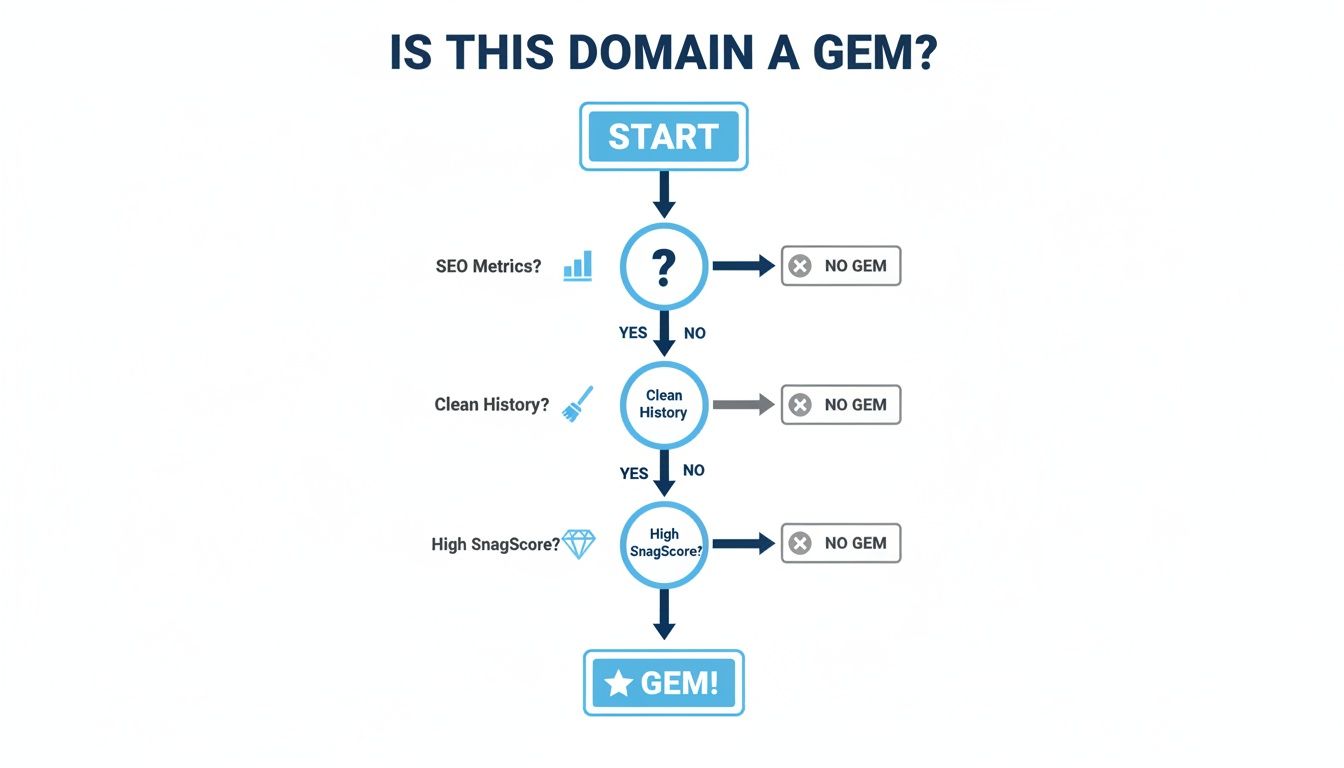
Ultimately, the key is to systematize your evaluation with a few core checkpoints. This ensures you never skip a critical step like verifying its history or checking its authority scores.
Turning Manual Labor into an Automated Hunt
Whether you're chasing dropped domains or tracking expiring ones, the theme is the same: automation is essential. Manually sifting through hundreds of thousands of daily domain drops is a terrible use of your time. A successful strategy relies on tools that can filter, score, and alert you to the opportunities that actually matter.
Here’s a simple workflow to streamline your process:
- Define Your Criteria: Know what you're looking for. Are you after a specific keyword, a minimum Domain Authority, or a certain domain age?
- Set Up Filters: Use a platform like NameSnag to filter the daily lists based on your criteria. You can search for domains containing keywords like "solar" or "AI" and set a minimum SnagScore to weed out the low-quality options.
- Create Watchlists and Alerts: For expiring domains, add promising candidates to a watchlist. Set up email or SMS alerts so you're notified the second it becomes available for registration.
By using these strategies, you stop being a passive observer and become an active hunter. You're no longer relying on luck; you're using a data-driven system to find valuable keyword domains before the competition even knows they exist.
Decoding a Domain's Past Performance
Think about a domain name like it’s a job applicant. It has a resume, a work history. You wouldn't hire someone without knowing what they've done before, right? The same logic applies here. A domain with a solid track record is a much safer bet than one with a blank slate, which is why digging into its past keyword performance is so critical.
A domain that used to rank for valuable, commercial keywords has already proven itself to search engines. It's established relevance and, in many cases, built up some real authority. This "SEO equity" can give you a massive head start, letting you skip past that painful initial sandbox period where new sites often feel like they're shouting into the void.
Why Historical Data is a Goldmine
Looking at old ranking data isn't just about checking off a box. It's about uncovering the story behind the domain. Was it a one-hit-wonder that rode a short-lived trend, or did it consistently own a keyword with real, lasting demand? This context is what separates a wild guess from a calculated, data-driven investment.
For instance, a domain that peaked by ranking for "best fidget spinners" back in 2017 isn't nearly as interesting as one that reliably ranked for "emergency roof repair." One was a flash in the pan; the other represents a steady, high-intent need that isn’t going anywhere. This is where historical context makes all the difference.
The ability to look back in time has become a non-negotiable part of modern SEO and domain investing. Since about 2012, the historical keyword data industry has exploded, with major platforms now offering incredible depth. Some top-tier SEO tools can show you month-by-month performance stretching back over a decade, letting you analyze trends with surgical precision. You can get a sense of the depth of this historical SEO data and how pros put it to work.
A domain's past isn't just a list of old data points; it’s a blueprint for its future potential. A strong history of ranking for relevant, high-intent keywords is one of the clearest signals of a domain's true value.
From Data Points to Strategic Insights
Once you have access to a domain's history, your entire evaluation process changes. You can look right past fuzzy metrics like Domain Authority and see the actual, real-world impact the domain once had.
Here’s what a domain’s past performance can really tell you:
- Keyword Relevance: Did it rank for the terms you actually want to target? This is your proof of topical alignment.
- Ranking Stability: Did it sit comfortably in a top spot for months or even years, or did it just have a brief moment in the sun? Stability is a sign of a healthy, authoritative profile.
- Penalty History: A sudden, catastrophic plunge in rankings is a massive red flag. It could easily point to a Google penalty that’s still lingering. Understanding a domain's past is crucial for its overall health, and our guide on domain name reputation dives deeper into this.
At the end of the day, a domain with a proven history is a de-risked asset. For an SEO pro launching a new affiliate site, it could mean ranking faster and seeing traffic much sooner. For a domain investor, it’s a tangible asset with a performance record, making it a far more predictable and profitable play than a brand-new, unproven name.
Common Red Flags and Mistakes to Avoid
Diving into the domain market can feel like walking through a minefield. For every hidden gem, there are dozens of traps laid for an eager buyer. Learning to spot these red flags is crucial—it's the difference between landing a valuable asset and inheriting a digital headache that poisons your projects from the get-go.
Some domains look perfect on the surface but hide a toxic history. Getting good at identifying these problems will save you a world of time, money, and frustration down the road.
Spotting a Problematic Past
A domain's history is its permanent record, and some stains are damn near impossible to wash out. The biggest red flag by a country mile is a spammy or toxic backlink profile. If a domain was previously used for shady niches—think online gambling, adult sites, or sketchy pharmaceuticals—search engines have probably already blacklisted it. Buying a name like that means you start the race a lap behind, fighting an uphill battle against a penalty you can't even see.
Another landmine is trademark infringement.
Registering a domain that hijacks a trademarked term is a legal time bomb. Grabbing a name like NikeShoeDeals.com might seem clever for a moment, but it almost certainly ends with a cease-and-desist letter or legal action that forces you to hand it over.
Do yourself a favor and run a trademark search before you get your wallet out. The U.S. Patent and Trademark Office's TESS database is a solid place to start.
Avoiding Unforced Errors
Beyond a domain's sketchy past, some of the worst mistakes are the ones we make ourselves. They usually happen when we try too hard to cram keywords into a name, ending up with something clumsy and totally ineffective.
Here are a few common blunders to sidestep:
- Awkward Keyword Combinations: Forcing keywords together creates names that are a nightmare to say and remember. A domain like BestPlumberPhoenixAZService.com is a mouthful and just screams "spam" to both users and search engines.
- Using Hyphens and Numbers: It might feel like a slick workaround, but domains with hyphens (best-plumber.com) or numbers (bestplumber4u.com) are almost always seen as lower-quality. They're a pain to share verbally and invite typos.
- Difficult Spelling: If you have to explain how to spell your domain name ("That's plumber, but with a 'ph' at the end"), you've already lost the battle. Simple wins, every single time.
Once you train your eye to spot these red flags, you can confidently filter out the junk and focus your energy on finding available domains that have real potential.
Your Domain Keyword Questions Answered
We’ve covered a lot of ground on this journey, and by now you're probably buzzing with a few final questions. Let's tackle some of the most common ones that pop up. This quick rundown will give you the straight answers you need to start your domain hunt with confidence.
Are Exact Match Domains Still Good for SEO?
Yes, but they’re no longer the golden ticket they once were. An Exact Match Domain (EMD) can still give you a nice relevancy signal, especially for local search. Think of it as a potential tie-breaker in a close race, not the whole game itself.
But let's be clear: an EMD will never, ever save a site with terrible content, a clunky user experience, or a backlink profile that looks like it was built in a back alley. A strong brand with excellent, helpful content will trounce a low-quality EMD site almost every single time.
How Long Does It Take for an Expiring Domain to Drop?
The whole process can take up to 80 days, sometimes even a bit longer. It's not an instant thing; the domain goes through a few distinct stages.
- Grace Period: Once a domain expires, it enters a grace period of roughly 30-45 days. This gives the original owner a chance to wake up and renew it.
- Redemption Period: If they don't, it often slides into a redemption period for another 30 days. Renewal is still possible here, but it's going to cost them a lot more.
- Pending Deletion: Finally, it hits a short "pending deletion" phase for about 5 days before it’s released back into the wild for anyone to grab.
This is exactly why an Expiring domains filter is so valuable. You can track these names through the whole messy process and be ready to pounce the second they become available.
What Makes a Keyword Valuable in a Domain Name?
A truly valuable keyword isn't just about what sounds good; it's a careful blend of three critical traits that drive actual results.
The sweet spot for a great keyword domain lies at the intersection of search volume, commercial intent, and achievable competition. Nailing all three transforms a simple domain into a strategic business asset.
Here’s what you're looking for:
- Healthy Search Volume: This is the baseline. Are real people actually typing this term into a search engine? A keyword nobody is looking for is a dead end.
- Commercial Intent: This is huge. You need to know if the searcher is looking to buy, hire, or take action right now. "Emergency plumber Miami" is dripping with commercial intent. "How do pipes work" is just curiosity.
- Achievable Competition: You have to be able to win. Targeting a keyword dominated by massive, decades-old brands is like trying to win a fistfight with a bulldozer. Find a battle you can realistically win.
Finding that perfect domain—one that's both memorable and packed with SEO potential—is the ultimate prize. NameSnag was built to cut through the noise, analyzing over 170,000 domains daily to find the hidden gems. Stop guessing and start discovering domains with real value today at https://namesnag.com.
Find Your Perfect Domain
Get access to thousands of high-value expired domains with our AI-powered search.
Start Free Trial