So you’ve found the perfect domain name, but—of course—it’s already taken. Bummer. Your first question is probably, "Okay, so when can I grab it?" The short answer is that a domain doesn't just pop back on the market the second it "expires." It actually goes through a whole dramatic process that can last up to 75 days after its official expiration date. For a savvy domain hunter like you, this is where the real game begins.
What Really Happens When a Domain Expires
Let's clear up the confusion with a simple analogy. Think of a killer domain name like a coveted apartment lease. When the lease (the expiration date) is up, the landlord doesn't just put a "For Rent" sign on the door for the first person who walks by.
Instead, there's a specific process to follow. The original tenant gets multiple chances to renew, maybe with a small late fee. It's only after they've clearly packed their bags and moved on that the apartment becomes available to the public again.
This journey from expiration to public availability is key. It’s not one single event, but a series of stages, each with its own rules, timelines, and costs. If you want to snag a great name, you need to understand these stages to time your move just right.
The Four Main Stages of Expiration
The whole lifecycle breaks down into four distinct phases. Each one dictates who’s in control of the domain and what they can—or can't—do with it.
- Active Phase: Everything is normal. The domain is registered, paid for, and working perfectly. The owner is in the driver's seat.
- Grace Period: The moment the expiration date passes, the domain enters a forgiving "grace period." The original owner can still renew it, usually for the standard price, without any major drama.
- Redemption Period: If the grace period ends without a renewal, things get serious (and expensive). The owner can still get the domain back, but now they'll have to pay a steep redemption fee on top of the renewal cost. Ouch.
- Pending Deletion: This is the final, nail-biting phase. The domain is locked down. The original owner can't renew it anymore. It's just sitting there, waiting to be released back into the wild.
Understanding this lifecycle is what separates the amateurs from the pros. You’re no longer just wishfully waiting for a domain to become available; you’re anticipating its release and preparing to make your move.
Once a domain makes it all the way through this cycle, it "drops"—meaning it's finally deleted and becomes available for anyone to register on a first-come, first-served basis. This is the moment you've been waiting for. The quickest person to register it wins.
To make this even clearer, let's break down the timeline with a quick-reference table.
The Domain Expiration Lifecycle at a Glance
This table gives you a snapshot of each stage, its typical length, and what it means for you as a potential buyer.
| Stage | Typical Duration | What It Means for You | Can the Owner Still Renew? |
|---|---|---|---|
| Active | 1-10 Years | The domain is owned and not available. | Yes, at any time. |
| Grace Period | 0-45 Days | You can't register it, but you can get ready. The owner can still renew easily. | Yes, at the standard renewal price. |
| Redemption Period | 30 Days | The domain is offline and locked. Your chance is getting closer. | Yes, but with a high redemption fee. |
| Pending Deletion | 5 Days | The final countdown. The domain is about to drop. No one can touch it. | No, renewal is no longer possible. |
As you can see, the path from "expired" to "available" is a structured, predictable process. Knowing these windows of opportunity is the first step toward building a strategy to capture the domains you really want.
Decoding the Full Domain Expiration Timeline
To truly master the art of snagging a high-value domain, you have to know the entire expiration timeline like the back of your hand. It's not just a single date on a calendar; it's a multi-stage process where each phase offers a different kind of opportunity—or risk.
Think of it less like an appointment and more like a journey. By understanding this journey, you can stop being a hopeful spectator and become a strategic player, ready to act at the perfect moment. Let’s zoom in and break down each stage.
This timeline lays out the typical path a domain follows from the moment it expires to when it might become yours.
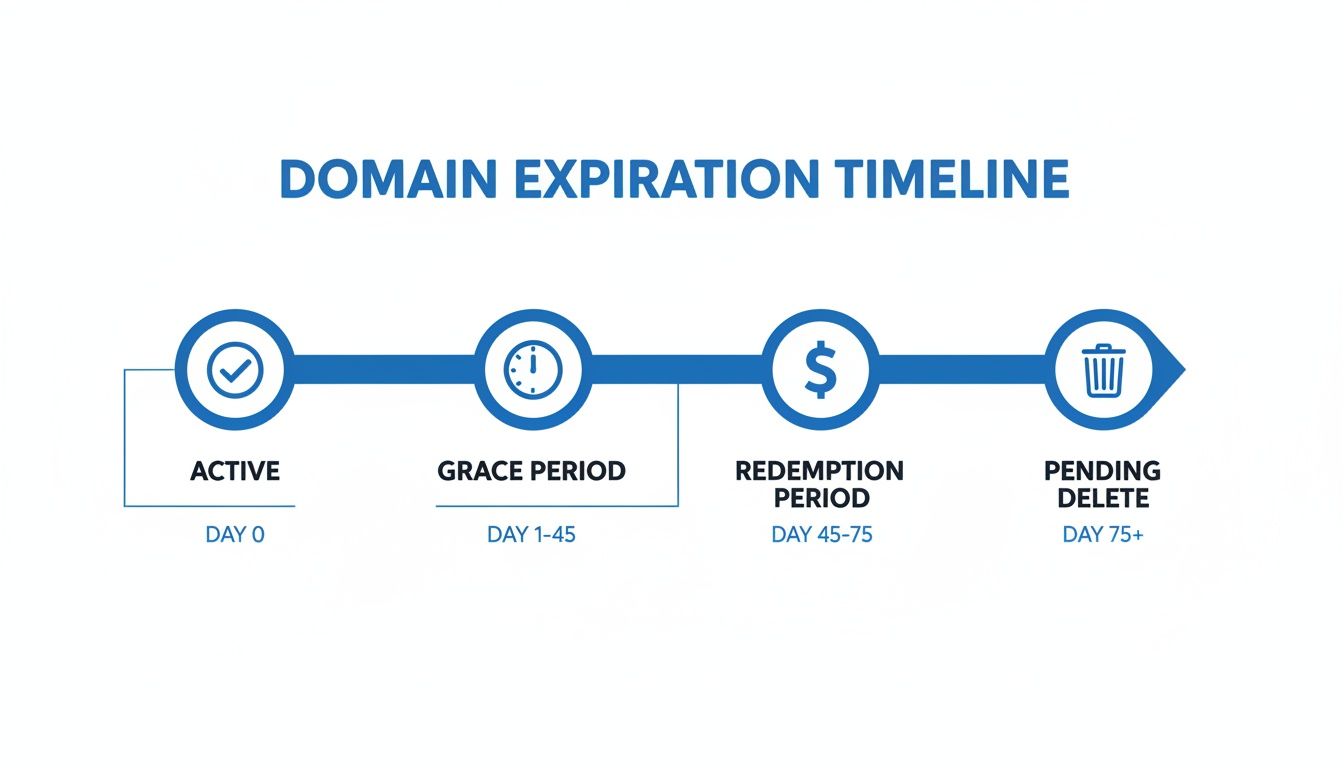
As you can see, the window of opportunity can last over two months, giving you plenty of time to plan if you know what to watch for.
The Initial Grace Period
The moment a domain isn't renewed, the clock starts ticking on the Expiration Grace Period. This is basically a safety net for the original owner, typically lasting anywhere from 0 to 45 days, all depending on the registrar's policies. During this time, the owner can renew the domain at the standard price, no questions asked.
For a domain hunter, this is the first real signal that a name might become available. The website might be down, but the domain isn't up for grabs just yet. This is your cue to start paying attention.
This grace period is the perfect time to add a domain to your watchlist. It’s like seeing a "Sale Pending" sign on a house—you can't buy it now, but you can be first in line if the deal falls through.
This is where a dedicated tool is a game-changer. Instead of manually checking every day, you can use a platform like NameSnag to filter for Expiring domains. This lets you see which names have just entered this grace period, giving you a crucial head start to research their value before they ever hit the open market.
The Expensive Redemption Period
If the owner fails to renew during the grace period, the domain tumbles into the Redemption Period. Think of this as the last-chance saloon. This phase usually lasts for about 30 days. The original owner can still reclaim their domain, but it comes at a steep price—often a hefty redemption fee on top of the regular renewal cost.
At this point, the odds of the domain dropping for good increase significantly. Many owners simply aren't willing or able to pay the high fees, especially if the domain wasn't a high priority to begin with. Your monitoring efforts become even more critical here.
Pending Deletion: The Final Countdown
After the redemption period ends, the domain moves into its final stage: Pending Deletion. This is a short, nail-biting phase that lasts about 5 days.
During this time, the domain is completely locked by the registry. Nobody can renew it, and nobody can register it. It's in limbo, just waiting to be officially dropped. Once this period is over, the domain is deleted from the registry database and becomes available for anyone to register on a first-come, first-served basis. This is the moment of truth.
Understanding these timelines is crucial because not all domains are created equal. For instance, renewal rates for legacy TLDs like .com and .net are a solid 75.3%, while newer TLDs have a much lower 34.2% renewal rate. This difference drives a huge volume of expirations, especially since over 90% of startups still chase a .com for credibility. You can discover more about how domain choices impact user trust on Wix.com.
How to Find a Specific Domain's Expiration Date
Alright, so you've got your eye on the perfect domain, and now it’s just a waiting game. But how do you find out exactly when it might hit the market? It’s time to put on your detective hat and do a little digging. Your number one tool for this mission is a WHOIS lookup.
Think of a WHOIS lookup as a background check for a domain name. It pulls up all the public registration data tied to it, including who the registrar is, when it was first registered, and—the real prize—the Registry Expiry Date. That’s the piece of the puzzle you’re looking for.

Using a WHOIS Lookup Tool
You'll find dozens of free online tools that can run a WHOIS lookup for you. Just punch in the domain name, and it will spit out the public record in seconds.
For instance, let’s say you’re after VintageFinds.com. A quick search might reveal its Registry Expiry Date is October 25, 2025. That date is your starting pistol; it’s when the whole expiration timeline we walked through earlier officially begins.
These days, privacy protections often hide the owner's personal information, which is a good thing. But even when the owner's name and email are redacted, the Registry Expiry Date is almost always public. It's the one reliable clue you can count on. If you want a deeper dive, our guide on using a domain expiration date checker can help you master these tools.
Pro Tip: Don't just check the expiration date once and forget it. I always set a calendar reminder to check again as the date gets closer. There’s nothing worse than getting your hopes up, only to find out it was renewed a week before expiring. That’s a sign to take it off your watchlist for another year.
The Problem with Manual Checks
Checking WHOIS records by hand works just fine if you’re only tracking one or two domains. But what if you’re watching ten? Or a hundred? It spirals into a mind-numbing, inefficient chore pretty quickly. It's shockingly easy to miss a critical date and lose a golden opportunity just because you forgot to check that one domain on that one day.
This is exactly why serious domain hunters don't do it manually. Why would you spend hours clicking through records when a specialized tool can do all the heavy lifting for you?
Instead of juggling a spreadsheet of dates, platforms like NameSnag let you skip the manual labor entirely. You can browse curated lists of Expiring domains that are already deep into their grace or redemption periods. Better yet, you can jump straight to domains that became Available today and register them on the spot. This kind of automation saves you countless hours and turns domain hunting from a tedious slog into a real strategic advantage.
The Risks and Rewards of Targeting Expiring Domains
Chasing expiring domains is the ultimate high-stakes treasure hunt. Get it right, and you can land a domain loaded with powerful SEO assets—like established backlinks and high domain authority—or snag a memorable brand name that comes with its own traffic you can monetize from day one. It’s a shortcut to credibility that can save you years of grinding.
But this hunt has its share of booby traps. What if that amazing domain has a toxic backlink profile from a shady past life? Suddenly, your treasure is a liability, potentially dragging your brand down with it. This is where sharp-eyed due diligence becomes absolutely non-negotiable.
The Goldmine: High-Value Assets
The rewards for finding a great expired domain are massive. Imagine acquiring a name that already has a solid history and online presence baked right in.
- Inherited SEO Power: You can gain a domain with a strong backlink profile, immediately boosting your site's authority.
- Ready-Made Traffic: Some domains still get direct or referral traffic, giving you an instant audience.
- Brandability: You might find a short, catchy, or keyword-rich domain that’s perfect for your next big project.
The Landmines: Hidden Dangers
On the flip side, a bad domain can be a serious headache. Without proper vetting, you risk inheriting a mess that could take months to clean up, if it's even possible. The biggest danger is a history of spammy practices that got it slapped with a penalty from search engines.
That’s why you need a system to check domains for quality before you even think about buying one. This isn't just about looking at one metric; it's about seeing the full picture. Our guide on how to use a domain name authority checker gives you more detail on what to look for.
The goal isn’t just to find an expired domain; it’s to find a clean, high-value asset. A great domain accelerates your growth, while a bad one puts you in reverse.
This is precisely why we built spam checks and our proprietary SnagScore metric right into NameSnag. It crunches multiple data points to give you a clear, reliable score, helping you instantly tell the difference between digital gold and fool's gold.
The timing of these opportunities is also becoming more dynamic. The domain world is adapting to new security standards, with upcoming changes in 2026 set to slash the reuse period for SSL certificate validation from 397 to 199 days. You can read more about these validation changes on DigiCert.com.
This speeds up the digital lifecycle, and as new top-level domains grow (21% year-over-year), their low renewal rates (only 32.2%) continue to fuel the expiration market. This constant churn means more domains are dropping daily, making automated, quality-first tools more essential than ever.
Your Tactical Playbook for Acquiring Expired Domains
Alright, let's get down to brass tacks. Hunting for expired domains isn't about getting lucky; it's a game of strategy. The pros don't stumble upon goldmines by manually refreshing WHOIS pages. They have a system, and it's almost always automated.
Forget the spreadsheets and endless manual checks. The modern approach is about using platforms that do the heavy lifting, monitoring thousands of domains every single day. This is how you shift from being a spectator to an active player.
Step 1: Start with the Pipeline
Your first move is to see what's coming down the pike. This means looking at domains that are already in their grace or redemption periods. They haven't dropped yet, but they're on the conveyor belt heading that way.
Using a tool like NameSnag lets you immediately filter for Expiring domains that are set to drop soon. This gives you a massive head start. You can research their history, check out their backlink profile, and figure out if they're worth your time, all without the pressure of a live auction. You can even zero in on names dropping in the next 3 Days or 7 Days to focus your efforts where it counts.
Step 2: Set Up Automated Alerts
Once you know what you’re looking for, it's time to put technology to work. Trying to track everything manually is a recipe for missed opportunities. The real key is building a system that brings the best domains straight to you.
The most successful domain hunters operate on a simple principle: let alerts do the work. This frees you up to focus on strategy and due diligence instead of tedious, repetitive tasks.
Set up "Early Access Alerts" for domains that fit your exact criteria. Maybe you only want to know about names with a high SnagScore, a certain number of backlinks, or specific keywords. This way, the moment a promising domain enters the expiration cycle, you get a tap on the shoulder.
To really build out a tactical playbook, it helps to understand how to gather intelligence from various sources. For instance, knowing how to extract data from websites can be a powerful skill when you're monitoring for expiring domains on a larger scale.
Step 3: Target Newly Dropped Domains
While keeping an eye on the pipeline is a solid long-term play, there's incredible value in domains that just hit the open market. These are the names that have made it through the entire expiration lifecycle and are now up for grabs, first-come, first-served.
This part of the game is all about speed and precision. In NameSnag, you can just flip the filter to Available domains that dropped Today. Because these gems have already been vetted for quality and spam, you can pull the trigger with confidence.
Don't underestimate the sheer volume here. The renewal rate for legacy TLDs was 73.9% in 2024. That means over a quarter of all domains just… expired. This daily churn creates a constant river of opportunity for investors who can sift through the noise to find high-value names with leftover SEO juice. Our guide on effective domain name monitoring can help you sharpen your process even more.
Got Questions About Domain Expiration?
You're not the only one. The whole process can feel a bit mysterious, but it's pretty straightforward once you get the hang of it. Let's walk through some of the most common questions I hear.
If a Domain Expires, Can I Register It Immediately?
Not a chance, and this is a classic misconception. When a domain first expires, it doesn't just pop back onto the open market. Instead, it enters a grace period for the original owner, which can last up to 45 days. Think of it as a friendly reminder for them to renew.
If they still don’t, it then slides into a redemption period (usually about 30 days). This is their last, much more expensive, chance to get it back. Only after a domain survives both of those stages without being renewed does it finally get deleted and become available for anyone to register. The trick is to watch it during these phases so you're ready to pounce the second it drops.
What's the Difference Between an Expiring and an Available Domain?
Picture it this way: an "expiring" domain is like a house with a "Sale Pending" sign out front. You can't buy it right now because the original owner is still in the process of either renewing their mortgage or walking away for good. This is the perfect time to do your research, check out the neighborhood (i.e., its backlink profile), and get your finances in order.
An "available" or "dropped" domain is like that same house, but now it has a big "For Sale" sign hammered into the lawn. The previous owner is long gone, the paperwork is cleared, and it's up for grabs on a first-come, first-served basis.
This distinction is everything. On NameSnag, you can filter for Expiring domains to build your watchlist for future opportunities, then flip over to Available domains to find gems you can register right now.
Is Buying an Expired Domain a Good SEO Strategy?
It can be an absolute monster of an SEO play, but only if you do your homework. A high-quality expired domain comes with a ready-made history of backlinks and authority. That's an SEO head start that could otherwise take you years and a small fortune to build from scratch.
But here's the catch: a bad one is a liability. It might be weighed down by a history of spammy links or even a Google penalty that will drag your project straight to the bottom of the search results. This is precisely why a tool with built-in quality checks, like a composite score that measures authority and trust, is non-negotiable. It helps you grab a valuable asset, not someone else's digital garbage.
How Can I Get an Alert Before a Domain Becomes Public?
This is where you get a serious leg up on the competition. Trying to manually check on a list of domains is a fool's errand; you'll miss the drop every time. The smart move is to use a monitoring service that does the heavy lifting for you.
You can set up alerts based on what you're looking for—say, domains with a certain authority score, that contain a specific keyword, or that end in .com. The service will then ping you the moment a domain matching your criteria hits the expiration cycle. This gives you the runway you need to vet the domain and be ready to claim it the instant it becomes available.
Ready to stop guessing and start snagging high-value domains? NameSnag gives you the tools to find, vet, and acquire quality expired domains before anyone else. Explore our daily lists of Available and Expiring domains and discover your next digital asset today.
Find Your Perfect Domain
Get access to thousands of high-value expired domains with our AI-powered search.
Start Free Trial