Ever notice how some brands just feel important? A big part of that feeling often starts with their digital address. A one-word domain name isn't just a URL; it's a powerful statement of authority and a massive branding shortcut.
It's the online equivalent of prime real estate. Owning Thrive.com is like setting up a flagship store on Fifth Avenue. It’s concise, memorable, and immediately signals that you're a major player in your space.
On the other hand, a domain like GetThrivingOnlineNow.com feels more like a small shop in a sprawling suburb. It’s functional, sure, but it lacks that instant prestige.
The Psychology of Simplicity and Trust
Our brains are wired to prefer simplicity. When a customer can remember your name effortlessly, you've already won half the battle. That kind of instant recall translates directly into more direct traffic, better word-of-mouth, and much stronger brand recognition down the line.
A one-word domain acts as a psychological cue. It implies you were savvy enough to get there first, that your business is established, and that you are the definitive source for whatever that word represents.
This perception of leadership is priceless. It’s an asset that works for you 24/7, building trust before a visitor even sees your homepage. It’s why entrepreneurs, investors, and marketers are constantly on the hunt for these digital gems.
One Word vs Multi-Word Domains at a Glance
To put it in perspective, let's quickly break down how a single-word domain stacks up against a longer, multi-word alternative. The differences are pretty stark.
| Attribute | One Word Domain | Multi-Word Domain |
|---|---|---|
| Branding | Establishes immediate authority and leadership. | Often feels descriptive or niche, less authoritative. |
| Memorability | Extremely high recall; easy to type and share. | Can be cumbersome and prone to typos or errors. |
| Credibility | Perceived as established, trustworthy, and premium. | May seem less established or more of a startup. |
| Marketing | Clean, concise, and fits anywhere. | Can be long for branding materials and social media. |
| Value | High-value asset that often appreciates over time. | Lower intrinsic value, treated as a utility. |
As you can see, the advantages of brevity and authority are hard to overstate. They touch every aspect of how your brand is perceived in the market.
The Core Advantages of a Single Word
Ultimately, the obsession boils down to a few key benefits that give any business a significant head start:
- Effortless Brand Recall: Single words are just easier to remember and type. This reduces the friction for potential customers trying to find you online.
- Instant Credibility: Owning a category-defining word positions you as an authority in your industry from day one. You are the destination.
- Unmatched Brevity: They look clean and professional. They fit perfectly on business cards, social media profiles, and advertisements without clutter.
- Long-Term Asset Value: Much like fine art or prime real estate, a premium one-word .com is an asset that tends to appreciate significantly over time.
What's Behind the Million-Dollar Price Tag on Single-Word Domains?
Let's talk about the digital equivalent of beachfront property. A one-word domain name isn't just a quirky branding decision; it's a serious asset class, with prices that can easily hit five, six, seven, or even eight figures. This isn't just hype—it’s a market driven by a few very powerful, very real forces.
To get why someone would drop millions on a URL, you have to think about scarcity and authority. There’s only one Finance.com and only one Shop.com. When you own that single, definitive word in the .com extension, you instantly position your brand as the king of that entire category.

The Anatomy of a High-Priced Domain
Not all single-word domains are created equal, of course. A short, commercially potent word like Insurance.com is in a totally different league than some obscure, lengthy one. Valuing them is a mix of art and science, but a few key factors consistently send the price into the stratosphere.
- Commercial Intent: Words directly tied to big, profitable industries (think finance, travel, or health) are pure gold. They don't just represent a brand; they represent entire markets.
- Memorability and Brevity: The shorter and more common the word, the better. Easy recall means more people typing your URL directly into their browser and a brand that sticks.
- TLD Authority: The
.comextension is still the undisputed champion. It carries a level of trust and global recognition that other TLDs just can't touch.
Put these elements together and you have an asset that is incredibly rare and fiercely sought after by established companies and well-funded startups desperate for an immediate competitive edge.
The Million-Dollar Sales Club
The proof is in the jaw-dropping sales figures. We're talking about the absolute peak of digital assets. For a stunning example, look at Voice.com, which sold for a staggering $30 million back in 2019.
Historically, an incredible 66% of the top 100 reported domain sales of all time have been one-word .com names, with an average sale price of $3.5 million. More recent blockbusters like Root.com at $1.3 million and Unlock.com at $1.228 million just go to show the market is as hot as ever.
Owning a one-word domain is like owning the keyword itself. It’s a permanent, top-of-mind advantage that marketing campaigns can only dream of achieving.
This isn't just about owning a cool name; it's about acquiring an asset that works for your business around the clock. The built-in authority, trust, and direct traffic make it a powerful long-term play. If you're looking to go deeper, you might want to check out our guide on how to value domain names. Understanding these principles is the first step toward appreciating why these digital properties are some of the most valuable in the world.
How a Single Word Domain Becomes an SEO Superpower
A killer one-word domain name is way more than just a nice thing to have on a business card. Think of it as a strategic weapon in the never-ending fight for search engine visibility. Sure, Google will tell you that exact-match domains don't get a special, direct ranking boost these days, but the indirect benefits are massive. They create a powerful, long-term competitive moat that’s tough for anyone else to cross.
It all boils down to basic human psychology. These kinds of domains are link magnets, drawing in high-quality backlinks because they just feel like the ultimate authority.
Put yourself in the shoes of a writer working on an article about meditation. You're looking for a definitive source to link to. Which one do you instinctively trust more: Meditation.com or BestMeditationGuidesOnline.net? The choice is a no-brainer.
That instant credibility leads to a natural pile-up of authoritative links, which is the absolute bedrock of strong SEO. Every one of those high-quality backlinks is a vote of confidence in the eyes of search engines, telling them your site is a trustworthy heavyweight in its field.
Riding the Wave of Type-In Traffic
Then there's the whole phenomenon of type-in traffic. This is when a user doesn't even bother with a search engine. They just open their browser and punch your domain directly into the address bar. They're making an assumption: the most authoritative source for a topic must own the category-defining domain.
This direct traffic is pure gold, and here’s why:
- It’s Highly Intentional: These aren't casual browsers. They know exactly what they want and they've already decided you're the best place to find it.
- It Signals Authority to Google: While it's not a direct ranking factor, a high volume of direct traffic strongly suggests your brand is popular and well-recognized.
- It Bypasses the Competition: You win the click before a search even starts. Your competitors are left sitting on the search results page, wondering where the traffic went.
Owning the one-word domain for your industry is like having a digital landmark. People know how to find you without needing a map, and that direct path builds an incredible foundation for organic growth and brand dominance.
Winning the Click in the SERPs
Even when you do show up in search results right next to everyone else, a memorable one-word domain gives you a huge advantage in click-through rates (CTR). A clean, authoritative URL like Coffee.com just pops. It stands out and inspires more confidence than a longer, clunkier alternative.
A higher CTR is a powerful signal to search engines that your result is more relevant and appealing to users, which can absolutely nudge your rankings up over time. Every little piece of your digital footprint matters. If you want to dive deeper into how any website can make the most of search, this ultimate guide to SEO optimization is a great place to start.
When you add it all up, a one-word domain acts as a force multiplier for every other SEO effort you undertake. It helps you earn valuable links with less effort, captures high-intent direct traffic that your competitors can't touch, and makes your brand the most clickable, trustworthy option in search results. That creates a powerful cycle of ever-increasing visibility and authority.
The Hunt: How to Find Your One-Word Domain
Alright, so you're sold on the power of a one-word domain. Awesome. The only hiccup is you probably don't have a spare $30 million lying around like the buyers of Voice.com. Don't sweat it. This is where a sharp strategy completely outplays a massive budget.
Since pretty much every premium, single-word .com is already owned, the game isn't about discovering a hidden gem—it's about smart acquisition. The real action happens in three main hunting grounds: bustling domain marketplaces, direct private negotiations, and the secret weapon of savvy investors—tracking expiring domains. This is where the magic is. You're not just looking for a name; you're looking for an opportunity, a prize that a previous owner let slip for one reason or another.
Strategy 1: The Available and Expiring Domain Pools
Your first and most potent tactic is to keep a close eye on domains that have recently become available or are just about to. This is the most direct path to ownership, often letting you skip the sky-high aftermarket prices altogether.
- Available Domains: These are domains that were recently dropped by their previous owners. They’ve gone through the full expiration cycle and can be registered right now by anyone for the standard fee. No auction, no negotiation—just pure speed. You can find a live list of Available domains that dropped today or in the last few days.
- Expiring Domains: These are names that have expired but are still in a grace period. The owner failed to renew, but the domain hasn't been released to the public just yet. This is your chance to get a head start, identify a target, and be ready the moment it drops. Watching the Expiring domains list is a pro move to scout for future gems.
Tools are your best friend here. For instance, with a platform like NameSnag, you can instantly filter for one-word domains that just became available or are expiring within the next 30 days. Think of it as your treasure map for names you can claim immediately or plan to grab soon.
The screenshot above shows you exactly what this looks like—a live list of available domains, complete with the crucial metrics you need to make a snap decision. By focusing on recently dropped names, you can bypass the crowded auction scene entirely.
Strategy 2: Hunting in the Aftermarket
The next layer of the hunt is the secondary market, where domains are bought and sold just like any other asset. This is where you'll find established domains, often with an existing history, but it usually comes with a bigger price tag.
The key is to understand market trends. Data shows that one- and two-word domains consistently lead the top sales. With the right tools, you can spot these valuable assets before they even hit the big public auctions.
The sales volume for one-word .coms reveals a robust, always-moving market. A few years back, there were 475 such sales in a single year, a 71% jump from the year before, which just goes to show how liquid these assets are. When you get a feel for these market dynamics, you can turn stats into actionable wins. You can dig into more insights on what a one-word .com is worth over on NamePros.
Monitoring these pools is a proactive strategy, not a passive one. If you're serious about the hunt, you might find our guide on how to set up a domain name monitor incredibly helpful for automating the search. This kind of systematic approach ensures you’re always one of the first to know when a high-value one-word domain name becomes available.
Your Pre-Purchase Due Diligence Checklist
Finding a fantastic one-word domain feels like striking gold, but don't pop the champagne just yet. The thrill of discovery is only half the battle; the real work starts now. You need to become a digital detective to make sure your shiny new asset doesn't have a toxic past that could poison your brand before it even launches.
This pre-purchase investigation, or due diligence, is absolutely non-negotiable. Skipping it is like buying a classic car without ever looking under the hood. You might be inheriting years of spammy backlinks, a penalty from Google, or a legal headache just waiting to happen.
This handy visual breaks down the different paths to getting your domain, whether you're hunting for something available now, waiting for one to expire, or shopping in the aftermarket.
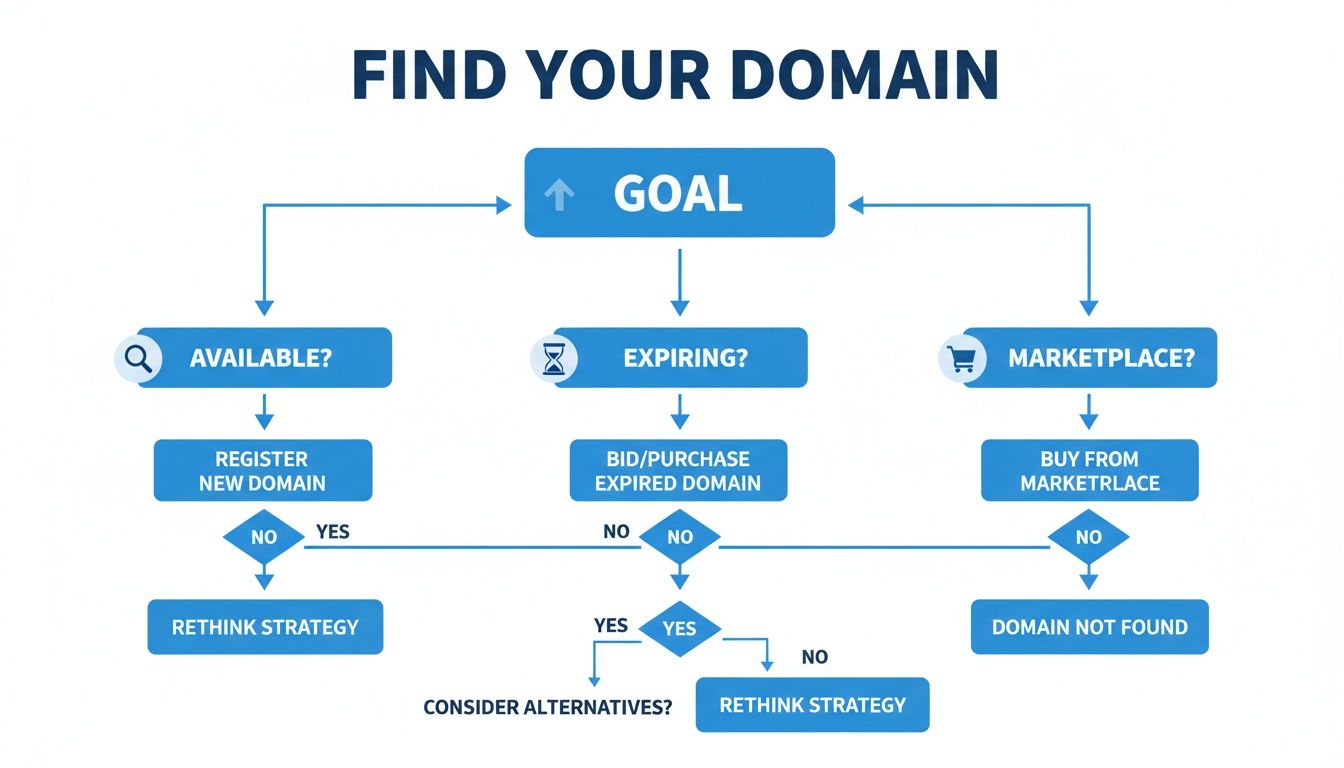
Each path demands its own careful investigation to ensure you're making a smart, safe investment.
Check for a Sketchy Past
Your first mission is to dig into the domain's history. Has it been used before? If so, for what? A quick search on the Wayback Machine (Archive.org) can show you what the site looked like in previous lives. You're hoping to see a legitimate business, not a spam farm or something unsavory.
Next up, you have to get your hands dirty with its backlink profile. This is a record of every other website that has ever pointed a link at the domain.
- Look for Red Flags: Are there thousands of links from low-quality, foreign-language, or totally irrelevant websites? That’s a huge warning sign of past spam activity.
- Analyze Anchor Text: Is the text used in these links natural and brand-focused, or is it stuffed with spammy keywords?
- Check Domain Authority Metrics: Use tools like Moz, Ahrefs, or Majestic to get a feel for the domain's authority. Any sudden, massive drop in these numbers could point to a past penalty.
This whole process can be a real time-sink, forcing you to juggle multiple tools and cross-reference a ton of data. You can learn more about how to streamline these checks in our post on due diligence automation.
Investigate Trademark Risks
This step is critical and, believe me, it's the one people overlook most often. A one-word domain is a powerful brand, but that power is completely useless if someone else already has a legal claim to the name. You have to conduct a thorough trademark search to ensure your chosen word isn't already registered by another company in your industry.
If you skip this, you're opening yourself up to a world of pain. You need to make absolutely sure your domain won't be confused with an existing brand's product or service, which could lead to claims of high-level trademark infringement. Ignore this, and you could be facing cease-and-desist letters, expensive legal battles, and the very real possibility of losing the domain you worked so hard to get. Protecting your brand starts right here.
Beyond .COM: Exploring Opportunities in Other TLDs
Let's be honest: a one-word .com is the undisputed heavyweight champion of the domain world. But obsessing over it exclusively feels a lot like searching for a needle in a haystack—a haystack made of other, much smaller needles. The good news? The digital world is way bigger than just .com, and some seriously amazing branding opportunities are hiding out in other Top-Level Domains (TLDs).
For a startup building the next big developer tool, a name like Platform.io instantly signals its niche and speaks the language of its tech-focused audience. In the same way, a creative agency rocking Create.co sounds fresh, modern, and perfectly in sync with the startup scene. It’s all about matching the extension to your brand’s personality and the people you’re trying to reach.
Finding Your Fit in New TLDs
Choosing a non-.com TLD isn't a compromise; it's a strategic move. Over time, certain extensions have developed their own powerful industry associations:
- .io & .ai: This is premium real estate for tech, SaaS, and artificial intelligence companies. These TLDs are a clear signal of innovation to a crowd that knows what's up.
- .co: Widely seen as a sharp, global alternative to .com, it's a favorite among startups and forward-thinking brands that want to stand out.
- .org: Still the gold standard for non-profits, open-source projects, and community-driven organizations. It immediately conveys trust and a sense of mission.
Think of it like a neighborhood. While .com is the bustling, expensive city center, TLDs like .io are the trendy tech districts where the right businesses don't just survive—they thrive.
The pool of available names opens up dramatically once you look past the usual suspects. While finding a one-word .com is next to impossible, there are an incredible 1,381,826 brandable one-word domains listed across 93 different TLDs. It's a market that's only getting bigger, as you can see from recent premium domain sales.
Your One-Word Domain Questions Answered
Jumping into the world of one-word domains tends to kick up a lot of questions. Let's walk through some of the most common ones so you can start your hunt with a bit more confidence.
Is a One-Word Domain in a Non-COM TLD a Good Investment?
For the right business, it can be a fantastic investment, particularly if you're in the tech space. For SaaS companies, developers, and AI startups, TLDs like .io and .ai aren't just alternatives; they carry real credibility and are seen as premium assets in their own right.
Sure, they might not hit the same stratospheric valuations as their .com cousins, but they offer a much more realistic entry point for a punchy, one-word brand. A name like that just clicks with a tech-savvy crowd, giving you a dose of instant industry cred right out of the gate.
How Can I Check If a Domain Has a Bad History?
You've got to put on your detective hat for this one. The first stop is almost always the Wayback Machine to see what the site used to be. Was it a real business, an abandoned project, or something much sketchier?
Next, you'll want to peek at its backlink profile using an SEO tool to see if it's littered with spammy links from questionable neighborhoods of the internet. This legwork is absolutely crucial. While a platform like NameSnag can automate a lot of this by giving you a history score and verification, it's always smart to do your own digging before pulling the trigger on a major purchase.
What's the Difference Between Available and Expiring Domains?
This is a great question, and understanding it is key to a smart domain hunting strategy.
Think of an Available domains as being on the shelf, ready for you to grab immediately for a standard registration fee. It was dropped by its previous owner and is now fair game. Speed is everything here—first come, first served!
An Expiring domains is more like an item that's been returned but hasn't been put back on the shelf yet. The owner let it lapse, so now it's in a grace period before it's officially dropped. You can't register it on the spot, but you can scout it out, do your research, and be ready to pounce the second it becomes available.
Ready to find your own high-value, brandable domain? NameSnag cuts through the junk by analyzing over 170,000 domains daily, giving you a clear path to the best available and expiring names on the market. Find your perfect domain with NameSnag today.
Find Your Perfect Domain
Get access to thousands of high-value expired domains with our AI-powered search.
Start Free Trial