
So, what exactly is a domain name authority checker? It's a tool that gives you a quick read on how well a website is likely to perform in search rankings. It spits out a score, usually between 1 and 100, by looking at things like the number and quality of its backlinks. Think of it as a quick SEO health check for any domain.
What Is Domain Authority and Why It Matters

Ever wondered why some websites seem to have a VIP pass straight to the top of Google? A big part of the secret sauce is something called domain authority.
In simple terms, it's a website's reputation score. While it’s not an official ranking factor Google uses, it’s an incredibly reliable predictor of how well a site can rank.
Imagine two new coffee shops opening on the same street. One is a brand-new, totally unknown spot. The other is a new branch of a beloved local chain that everyone already trusts. The chain starts day one with a massive advantage—a built-in reputation. Domain authority is the digital equivalent of that reputation.
The Power of Perceived Trust
A higher domain authority score tells search engines that a website is a credible, established source. This "authority" is built almost entirely on the back of one thing: backlinks.
Every time a quality, reputable website links to another site, it’s like casting a vote of confidence. It's a signal to Google that says, "Hey, this place is the real deal." This is why a domain name authority checker is such a vital tool for anyone in the SEO or domain investing game—it gives you a snapshot of that built-in trust.
This metric, first cooked up by the folks at Moz back in 2012, has become the industry shorthand for a domain's ranking potential. It crunches data on linking domains and backlink quality to produce that simple 1-to-100 score. The impact is real, too. Domains with high DA (think 50+) give a site a huge leg up. In fact, businesses with strong domain names report a 46% higher perceived trust, and users are twice as likely to engage with them.
Why This Is a Game-Changer for You
Look, understanding domain authority isn’t just some abstract SEO theory. It’s a massive strategic advantage. It tells you whether you're starting a new project on solid ground or facing a grueling uphill climb.
Here's where it gets practical:
- Competitive Analysis: You can instantly size up the competition. Knowing their scores helps you gauge the effort it'll take to climb past them in the rankings.
- SEO Strategy: It helps you zero in on the right link-building targets. You can focus your energy on getting backlinks from sites that actually move the needle.
- Domain Investing: This is how you spot hidden gems. It's the fastest way to find powerful Available domains that just dropped or high-potential Expiring domains that are about to hit the market.
At the end of the day, a higher DA score almost always correlates with better visibility in search results. While the number itself isn't the whole story, it's the most important snapshot you can get of a domain's past strength and future potential.
If you're curious about what scores to aim for, we've got a whole guide on what is a good domain authority score.
Decoding the Core Domain Authority Metrics
So, you plugged a domain into a checker and got a number back. A "DA of 35" or a "DR of 50" sounds impressive, but what are you actually looking at? Think of this section as your personal decoder ring—we're going to translate those abstract scores into real, actionable intelligence.
Without getting bogged down in technical jargon, let's break down the big three: Moz’s Domain Authority (DA), Ahrefs’ Domain Rating (DR), and Majestic’s Trust Flow (TF). Each metric tells a slightly different part of a domain's story. Understanding the nuance is what separates a good find from a great one.
The Popularity Contest: DA and DR
Imagine a website is a person at a massive networking event. Domain Authority and Domain Rating are pretty much a measure of that person's overall popularity. They're calculated by looking at the sheer volume and strength of backlinks pointing to the site—basically, how many people are talking about them.
- Moz's Domain Authority (DA): This is the OG metric. It predicts a website's ranking potential on a 1-100 logarithmic scale. A higher DA suggests a greater ability to rank.
- Ahrefs' Domain Rating (DR): Similar to DA, DR measures the strength of a site's backlink profile. It also uses a 1-100 logarithmic scale, which means climbing from 70 to 80 is a much bigger deal than going from 20 to 30.
Moz put together a great visual that shows all the different ingredients that go into their DA score.
As you can see, it’s a complex blend of linking root domains, total links, and other machine-learning factors. That’s why it’s become such a reliable proxy for SEO strength.
The Trust Factor: Majestic's Trust Flow
Let's go back to that networking event. Being popular is great, but who you're popular with matters just as much. That’s where Trust Flow (TF) comes in.
Trust Flow doesn't just count the number of "votes" (backlinks) a site has; it measures the quality of those votes. A link from a trusted, authoritative source like a university or a major news outlet is worth far more than a hundred links from spammy, low-quality directories.
Put it this way: DR is popularity, but TF is reputation. A domain could have a sky-high DR from thousands of links, but if its TF is in the gutter, that’s like being popular with a sketchy crowd—a huge red flag. That combination often points to a history of manipulative link-building schemes you want no part of. A high TF, on the other hand, suggests a clean, trustworthy history.
This explosion of different authority checkers reflects how far SEO has come. The top tools are processing billions of backlinks to deliver these scores. Ahrefs' Domain Rating, for example, updates every 5-7 days, giving you a much fresher look than Moz's monthly model. For sniffing out spam, Majestic's Trust Flow and Citation Flow are brilliant at separating quality from quantity—it's why they're trusted by 70% of pros. And that’s critical when an astonishing 48% of domains don’t even have active websites, often hiding a history of junk links. You can find more fascinating domain stats over at Wix.com.
Putting It All Together for Smart Decisions
When you use a domain name authority checker, you're not just looking for one big number. You're piecing together a story. A healthy, high-potential domain usually has a balanced profile: a solid DA/DR score that's backed up by a respectable Trust Flow.
This is exactly why seasoned domain investors and SEOs never rely on a single metric. They look at the relationship between the numbers to get a true read on a domain’s health. Is it just popular, or is it actually respected? The answer can be the difference between buying a powerful asset and inheriting a digital headache. If you're hunting for domains with strong, clean histories, you can browse recently Available domains or keep an eye on powerful Expiring domains that are about to become available.
Why Your Domain Authority Scores Are All Over the Place
Ever plugged a domain into three different checkers and gotten three wildly different scores? Yeah, you’re not alone. It's one of those classic SEO puzzles that makes you wonder if the tools are broken. But the truth is, it’s not a bug—it’s just how they work.
Think of each domain authority checker—like Moz, Ahrefs, or Majestic—as a different judge at a talent competition. They’re all watching the same performance (your website), but each judge brings their own biases and scoring criteria to the table. One might be fixated on technical skill, another on stage presence, and a third purely on audience reaction.
Each one has its own proprietary algorithm, its own "secret sauce," for weighing up a domain's authority. And since they’re all measuring slightly different things, the numbers will never line up perfectly.
The Secret Sauce Ingredients
So, what’s actually in this secret sauce? The scores vary because each platform handles a few key things in its own unique way. The biggest difference comes down to how they crawl and index the web. Every service has its own fleet of web crawlers, and they all discover and process backlinks at their own pace.
- Crawl Frequency: How often are their bots sniffing around for new links? Some might update their index almost daily, while others do it weekly or even less often.
- Index Size: How much of the internet have they actually mapped out? Ahrefs might have a bigger, fresher index of live links than Moz at any given moment, or vice versa, which naturally leads to different calculations.
- Metric Priorities: What do they care about most? One tool might put a huge emphasis on the raw number of websites linking to you, while another might give more weight to the "trustworthiness" of those sites.
This is exactly why one domain name authority checker might spit out a 40, while another gives you a 52. They're working from different datasets and have different ideas about what matters. A good way to really get your head around this is to look at some Ahrefs alternatives and see how their methodologies differ.
How to Use These Scores Strategically
Here’s the single most important thing to remember: stop chasing a perfect, absolute score. It doesn't exist. The real value in these metrics is all about comparison.
The goal isn't to hit a specific number across all platforms. Instead, pick one tool and use it to consistently benchmark your domain against your direct competitors. If your score is climbing while theirs stays flat on the same platform, you're winning.
This approach takes a confusing mess of numbers and turns it into clear, actionable intelligence. It gives you a real sense of where you stand in your market. For a deeper dive into one of the most foundational metrics out there, check out our guide on the differences between Moz Domain Authority and Domain Rating.
At the end of the day, these scores are directional guides, not definitive report cards. Use them to track your progress, keep an eye on the competition, and spot opportunities. Whether you're hunting for powerful Available domains or scouting high-potential Expiring domains, sticking with one tool is the key to making smart moves.
A Practical Guide to Vetting Any Domain
Alright, enough with the theory. Let’s roll up our sleeves and get our hands dirty.
Knowing what the scores mean is one thing, but actually using that knowledge to spot a hidden gem—or dodge a digital disaster—is a completely different ballgame. This is where you become a domain detective.
A raw score from a domain name authority checker is just your first clue. The real investigation involves digging into a domain's history and its overall health. Think of it like buying a classic car; you wouldn't just look at the shiny paint job. You'd pop the hood, check the engine, and look for any signs of rust or past accidents.
Vetting a domain is the exact same process. You have to look past the surface-level metrics and understand the story they’re telling you. This is especially true when you're hunting for that perfect expired domain that can give you a massive head start.
The Domain Vetting Red Flag Checklist
Your first mission is to look for red flags. A domain might have an impressive Domain Authority score, but that number can be deceiving if it was built on a foundation of spam. I've created a quick checklist to help you spot potential issues when you're analyzing a domain's authority and backlink profile.
| Red Flag | What to Look For | Why It's a Problem |
|---|---|---|
| Sudden Backlink Drop-Off | A sharp, recent plunge in the number of referring domains. | This is a classic sign of a private blog network (PBN) getting de-indexed by Google. Its authority is artificial and disappearing fast. |
| Spammy Anchor Text | An anchor text cloud full of phrases like "buy cheap pills," "online casino," or other shady terms. | This indicates a history of manipulative link-building that Google has likely penalized or will penalize soon. |
| Links from Bad Neighborhoods | A high percentage of links from low-quality directories, foreign-language sites, or spammy forums. | Quality over quantity is the golden rule. These links are toxic and can hurt your site's reputation with search engines. |
Keep these points in mind, and you'll be much better equipped to separate the valuable domains from the duds.
Remember, the goal of vetting is to find a domain with a clean, powerful, and relevant history. A domain that ranked for "dog training tips" is a fantastic asset for a new pet blog but utterly useless for a financial consulting firm.
This process flow helps visualize how different platforms contribute to a comprehensive SEO analysis.
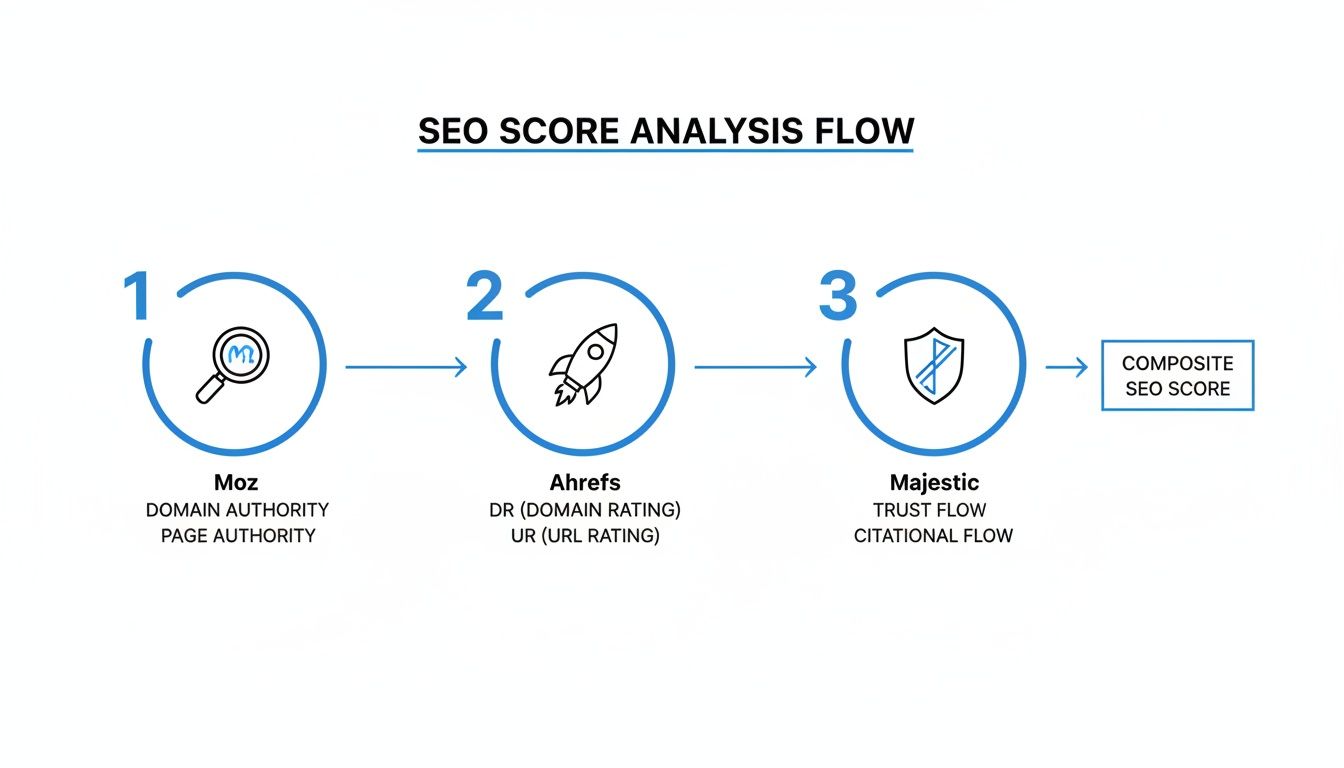
Each tool offers a unique lens, and combining their insights gives you the clearest picture of a domain's true health and potential.
Uncovering Hidden SEO Gold
This detective work naturally leads us to the immense value hidden in expired domains. Why start from scratch, building authority one painful link at a time, when you can acquire a domain that already has a powerful, clean history?
An expired domain with established authority is like taking over a restaurant in a prime location that already has rave reviews. You get to inherit its reputation from day one. In SEO terms, this means you can often rank new content much faster than you could with a brand-new domain. For a deeper dive, our guide on how to check backlink quality is a great next step.
A crucial part of this process involves understanding your competitive landscape. You can learn a lot by finding competitors of a website and seeing what their backlink profiles look like. This gives you a benchmark for what a healthy profile in your niche should be.
The best part? There are two main pools where you can find these gems:
- Available domains: These are high-authority domains that have recently dropped and are ready to be registered right now by anyone. They're like finding a valuable antique at a garage sale.
- Expiring domains: These are domains that have expired but are still in a grace period. They will be dropping soon, giving you a chance to prepare and snag them the moment they become available.
Using the filters on NameSnag, you can zero in on powerful Available domains that just dropped today, or expand your search to see what has become available in the last 7 or 30 days. Similarly, you can scout for high-potential Expiring domains that are set to drop in the next few days. This strategic approach turns a random hunt into a precision search for high-value assets.
Finding High-Authority Domains Without the Hassle

Let's be honest: vetting domains manually is a soul-crushing time sink. Juggling a dozen browser tabs, cross-referencing metrics, and trying to spot hidden red flags can feel like a full-time job. It’s tedious, inefficient, and frankly, there’s a much smarter way to work.
This is where you need a real advantage—a way to cut through the noise and get straight to the domains actually worth your time. Instead of drowning in spreadsheets and fragmented data, imagine having a single, intelligent dashboard that does the heavy lifting for you. That’s the entire idea behind NameSnag.
Meet SnagScore: Your All-in-One Authority Metric
We got tired of flipping between tools just to get a complete picture of a domain's health. It was a mess. That’s why we built our own proprietary metric: SnagScore.
Think of SnagScore as the ultimate consolidated report from your personal domain name authority checker. It boils down the most critical metrics—like Domain Authority, Trust Flow, domain age, and backlink quality—into a single, easy-to-understand number from 1 to 100. No more guesswork or trying to weigh different scores against each other.
A high SnagScore instantly tells you that a domain has a strong, balanced profile with both authority and trust. It’s your shortcut to spotting top-tier assets without burning hours on manual analysis.
This completely changes the game. Instead of asking, "Is this domain any good?" you can immediately see which ones are worth your attention and which are safe to ignore.
Built-in Spam Checks for Total Peace of Mind
One of the biggest risks in buying expired domains is inheriting a messy, spam-filled past. A domain might look great on the surface with a high authority score, but it could be built on a foundation of toxic backlinks that will only cause headaches down the road.
We solve this by automatically running spam checks on the domains we analyze. NameSnag flags potential risks and toxic histories, so you can confidently grab domains with clean, powerful backlink profiles. This built-in protection saves you from making costly mistakes and ensures the assets you get are ready to perform from day one.
Here’s how this streamlined process gives you an edge:
- Instant Previews: Get live analysis for any domain on our list. See its strengths, weaknesses, and potential at a glance.
- Early Access Alerts: Set up notifications for domains that meet your specific criteria. Be the first to know the moment a high-value domain hits the market.
- Laser-Focused Filters: Zero in on exactly what you need. Filter by specific keywords, a minimum SnagScore, certain TLDs, or even hunt for domains with valuable .edu or .gov backlinks.
Find Your Next SEO Powerhouse Today
Whether you're a domain investor looking for your next flip or an SEO pro hunting for a project head start, the right tool makes all the difference. You can stop wasting time and start finding gems.
Ready to see it in action? You can start by exploring high-authority Available domains that have dropped within the last 3 days and can be registered immediately. Or, get a jump on the competition by scouting powerful Expiring domains that are set to drop in the next 7 days. The hassle-free hunt for your next high-authority domain starts now.
Turning Domain Authority into Real-World Wins
Alright, you've made it through domain detective school. You know how to size up the metrics, spot the landmines, and tell a genuine digital asset from a dud. Now for the fun part: turning that know-how into actual results.
A high score from a domain name authority checker is just a number on a screen until you do something with it. For sharp SEOs and site builders, this is where the game really begins. Snagging the right high-authority expired domain is like strapping a jetpack onto a new project. Instead of grinding away from zero, you inherit a ready-made foundation of trust and backlinks that can rocket a new site to the top of the search results in a fraction of the time.
The SEO and Site Builder's Playbook
Think about launching a new affiliate site on a freshly registered domain. You’d be looking at months, if not years, of painstakingly building links just to get Google to give you the time of day. It's a slow, thankless climb.
Now, imagine a different scenario. You find a clean, expired domain with a DA of 35 that used to be a popular blog in your niche. You pick it up for $12, throw a new site on it, and redirect its old, powerful pages to your new content. All of a sudden, you're not starting from scratch. You're standing on the shoulders of years of established authority. This is exactly how a simple $12 investment can become the bedrock of a six-figure affiliate site.
The same logic applies if you're building out a private blog network (PBN). By acquiring several high-authority domains relevant to your main site, you can create your own network of supporting properties. These domains pass serious link equity, giving your primary money site the ranking boost it needs.
The Domain Investor's Angle
If you're a domain investor, your strategy is a little different, but the core principle is the same. You aren't building sites—you're hunting for undervalued assets that can be flipped for a tidy profit. Your job is to spot the gems that everyone else has missed.
The real money is in finding domains with a huge gap between their low price and their high intrinsic SEO value. A clean domain with a solid DA, high Trust Flow, and quality backlinks is an asset that will always be in demand.
Picture this: you’re browsing recently Available domains and you come across one with a DA of 28 and a handful of links from reputable industry sites. You grab it for the standard registration fee. A little outreach to potential buyers in that niche, and you sell it for $2,000 in less than two months. That's not a pipe dream; it’s a repeatable play built on identifying and acquiring undervalued authority.
Whether you're building an online empire or just flipping for quick cash, it all comes back to the same idea. You're using data to make smart acquisitions. By zeroing in on powerful Expiring domains that are about to drop, you can be first in line to grab these assets the moment they become available—turning analysis into action, and action into profit.
Got Questions About Domain Authority?
Let's clear the air and tackle some of the most common questions that pop up around domain authority. It's easy to get lost in the numbers, so think of this as a quick field guide to help you use any domain name authority checker with a bit more confidence.
How Long Does It Take to Increase Domain Authority?
This is a marathon, not a sprint. If you're starting from scratch, you're looking at months—and more realistically, over a year—of consistent, smart work to see a meaningful jump in your DA score. The score only climbs as you earn high-quality backlinks from other reputable websites.
The best strategy? Stop chasing a specific DA number. Instead, pour your energy into creating genuinely valuable content that people want to link to. Build a truly authoritative site, and the score will eventually follow.
Is a Domain Authority Score of 30 Good?
Well, that depends. Is a 30 "good"? It's all relative. If your direct competitors are all hanging out in the 15-20 range, then a DA of 30 makes you the king of the hill. You're in a fantastic spot.
But if you're trying to muscle in on a space dominated by industry giants with scores of 70+, that same 30 means you've got a long climb ahead.
Always—and I mean always—use DA as a comparative tool against the sites you're actually trying to outrank. It's not an absolute grade of quality; it's a measure of your strength in a specific arena. Context is everything.
Can I Trust Free Domain Authority Checkers?
For a quick spot-check? Absolutely. Reputable tools, like the one from Moz, pull from the same core data as their paid versions. You can trust the number you see.
The catch is usually in the limitations. Free tools will cap how many domains you can check per day or won't show you the deeper data behind the score. They're great for a quick look.
But if you're doing serious research—especially if you're hunting for high-value domains to acquire—a dedicated platform is a massive time-saver. You need something that pulls together multiple data points and adds crucial layers like spam checks to give you the full picture.
Ready to stop guessing and start finding high-authority domains with confidence? NameSnag combines all the critical metrics into a single, easy-to-understand SnagScore, so you can spot the winners in seconds. Explore powerful Available domains you can register right now or get ahead of the competition by scouting high-potential Expiring domains before they drop.
Find Your Perfect Domain
Get access to thousands of high-value expired domains with our AI-powered search.
Start Free Trial