
I once came within a routine renewal email of losing a domain I cared about because the card on file had expired. The renewal fee was tiny. The domain was not.
The $12 Mistake That Nearly Cost Me a Fortune
A lot of people treat domain renewal like changing the batteries in a smoke detector. Important, sure, but easy to put off for tomorrow. That mindset is how domains get lost.
I learned that the annoying way. One of my domains was set to renew, I assumed everything was fine, and I ignored the notices because I thought auto-renew had me covered. It didn’t. The payment method had gone stale, the charge failed, and suddenly I was staring at an expiration warning for an asset that had real brand value attached to it.

That moment changes how you think about domains. A domain isn’t just a line item in your registrar account. It’s your storefront, your email identity, your backlinks, your memory in the market, and sometimes the most portable asset in the whole business.
Why renewal matters more than most owners realize
The first renewal is where a lot of domains fail to make it. New domain registries typically see only a 60% first-year renewal rate, and that rises to 80% to 85% in later years, which is a sharp reminder that surviving the first renewal cycle is what starts building long-term value, according to this analysis of domain renewal rates and trust.
That pattern tracks with what investors see in the wild. People register names with enthusiasm, then six months later they forget, pivot, lose interest, or decide the domain “isn’t doing anything.” By the time the expiration email lands, the domain has slipped from strategic asset to background noise.
A domain almost never feels valuable on the day you renew it. It feels valuable on the day you realize you could lose it.
The real shift is mental, not technical
Most guides on how to renew a domain name stop at the button. Click Account. Find Domain. Hit Renew. Done.
That’s useful, but it misses the actual game. Serious owners don’t think in terms of isolated renewals. They build a renewal system.
Here’s the mindset that protects digital assets:
- Treat every important domain like property: If the domain supports a business, redirects qualified traffic, or anchors your email, it should never rely on memory.
- Separate sentimental names from strategic ones: A hobby project domain and your core brand domain do not deserve the same decision process.
- Assume human error will happen: You’ll miss an email. A teammate will leave. A card will expire. Your process has to survive that.
I’ve seen people haggle over a renewal fee, then spend far more trying to buy the name back later. That’s backwards. Renewal is rarely the expensive part. Neglect is.
Your First and Most Important Job Set Up Auto-Renew
If you own a domain you can’t afford to lose, turn on auto-renew today. Not later. Not after lunch. Today.
Manual renewal feels responsible because it looks deliberate. In practice, it’s fragile. It depends on your calendar, your inbox, your memory, your payment method, and your willingness to deal with admin on a random Tuesday. That’s too many moving parts for something this important.
Practical rule: Manual renewal is not a strategy. It’s a gamble.
What auto-renew actually protects you from
It's common to believe auto-renew only protects against forgetfulness. It does more than that.
It protects you from the boring failures that cause real losses:
- Inbox blindness: renewal notices land, but you’re busy
- Staff changes: the person who used to manage domains is gone
- Registrar sprawl: the domain is at a different provider than the rest of your stack
- Routine admin drift: old card, old billing contact, old assumptions
That last one gets more people than they’d like to admit. Auto-renew is only as good as the payment setup behind it, so don’t just flip the toggle and walk away.
The basic auto-renew setup that works
Across registrars, the labels change a little, but the pattern is the same. Log in, open the domain management area, click the domain, and look for an Auto-Renew option. Then check the billing profile attached to that account.
A practical setup looks like this:
- Enable auto-renew on every critical domain: not just the primary website
- Use a monitored payment method: one someone watches
- Confirm billing emails go to a live inbox: not an abandoned founder address from three years ago
- Review the next renewal date: make sure the setting really saved
If you want an extra operational layer, this kind of process pairs well with a broader system of recurring admin checks. A solid reference is this ultimate guide to auto-reminders and task automation, especially if you manage domains as part of a bigger website or client workflow.
Auto-renew still needs one backup
I trust auto-renew. I don’t trust anything blindly.
Set a calendar reminder anyway. A simple expiration review gives you a second chance to catch failed cards, registrar confusion, or domains that should be renewed for multiple years instead of one. If you’re not sure where to verify dates cleanly, this walkthrough on how to check when a domain name expires is worth bookmarking.
If a domain matters, it should have two protections. Automation first, human review second.
That’s the whole philosophy. Don’t rely on heroics. Build boring safety into the process.
The Manual Renewal Dance When You Have To Step In
Sometimes you shouldn’t let auto-renew do all the work. Maybe you want a longer renewal term, maybe you’re cleaning up a portfolio, or maybe you’re changing billing methods and want to watch the transaction yourself. That’s when manual renewal makes sense.
The good news is the mechanics are simple at almost every registrar.
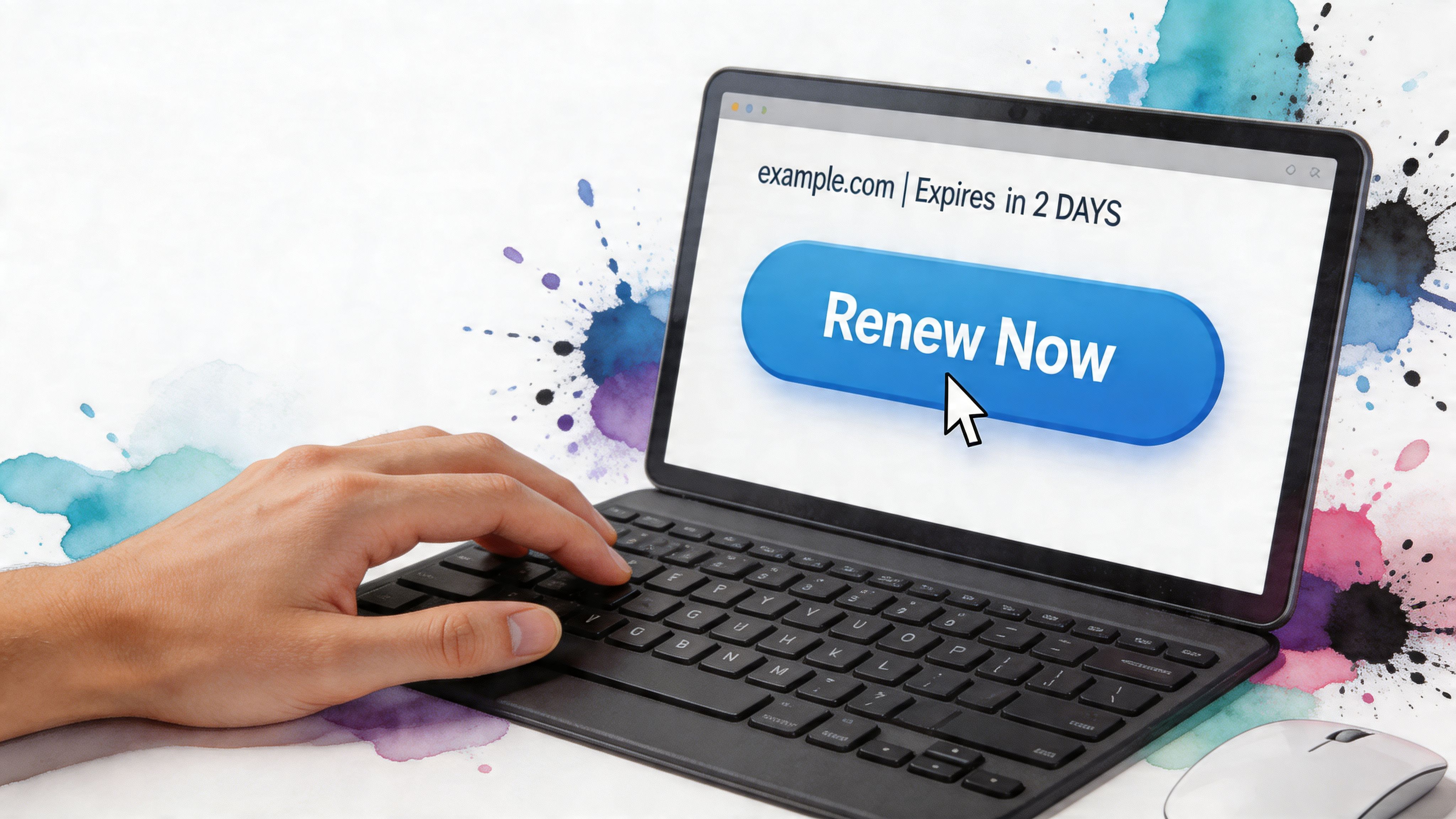
The universal renewal workflow
ICANN sets the broad framework, but registrars still have room to design their own dashboards. In general, you’ll choose a 1 to 10 year term, and if auto-renew is off, your registrar must send renewal reminders 30 days and 7 days before expiration under ICANN’s expired registration recovery policy overview.
In plain English, the process usually goes like this:
Log into the correct registrar account This sounds obvious until you realize half the industry owns domains across several registrars. Start by confirming where the domain lives.
Open your domain list
Look for labels like “My Domains,” “Manage Domains,” or “Domain Portfolio.”Select the domain or domains
Single renewals usually have a button beside the name. Bulk renewals usually use checkboxes.Choose the renewal term
One year is fine for ordinary assets. Longer terms make sense when you know the domain is part of your long-term stack.Review the total and pay
Confirm the renewal completed, then check for the email receipt.
When I prefer manual over automatic
I don’t manually renew everything, but I do step in for certain cases.
Here are the moments where I’m happy to be hands-on:
- Core brand domains: I like confirming those personally
- Price-sensitive renewals: if I want to lock in a multi-year term now
- Partial portfolio cleanup: when I’m renewing some names and dropping others
- Billing changes: new card, new company, new accounting workflow
Manual renewal also forces one useful habit. You evaluate the asset before you pay for another year.
Renewing a domain should answer one question: would I be annoyed if someone else owned this tomorrow?
Bulk renewal without creating chaos
Bulk renewal is easy to mess up because speed makes people sloppy. They click all, renew all, and only later realize they paid for names they meant to drop.
A tighter approach:
| Situation | Better move |
|---|---|
| You’re renewing business-critical names | Do those first, separately |
| You’re reviewing speculative names | Sort them into keep, maybe, drop |
| You’re managing several TLDs | Double-check terms and pricing before checkout |
| You’re near expiration | Prioritize the soonest names instead of cleaning the whole portfolio at once |
If you want a visual walkthrough, this quick explainer is useful before you do your next manual pass:
The confirmation step people skip
After payment, don’t just trust the checkout screen. Open the domain details and confirm the new expiration date appears properly. Then make sure the receipt email arrives.
That little verification habit has saved me from support tickets more than once. The button click is not the finish line. The updated renewal date is.
What Happens When a Domain Expires The Timeline of Doom
Expiration doesn’t usually mean instant deletion. It means you’ve entered a sequence of increasingly worse options.
That matters for two reasons. First, you may still be able to recover your own domain without disaster if you move quickly. Second, if you buy domains, opportunities for acquisition begin to appear.
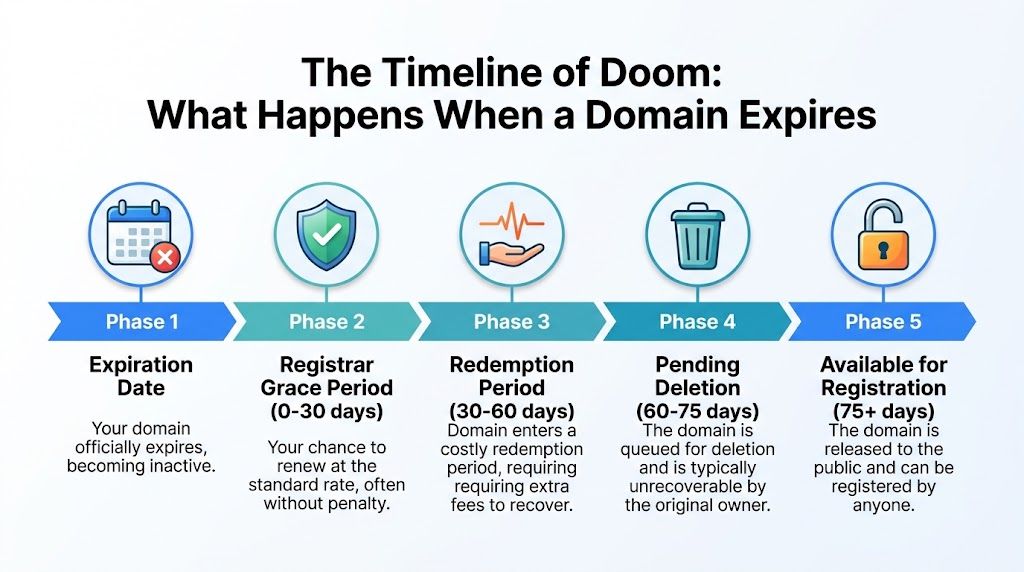
The grace window
For gTLDs, the post-expiration grace period is typically 0 to 45 days, and after that there’s usually a 30-day redemption period where recovery can cost $75 to $100+ on top of the standard renewal fee. The same source also notes that 20% to 30% of domains expire because people forget to renew them, according to Dynadot’s domain renewal process overview.
That first window is your cheap recovery phase. If the domain is yours and you’ve slipped, fix it fast. This is usually where the least painful recovery happens.
If you watch the market for acquisition opportunities, this is also the stage where domains start appearing as near-term possibilities. Many buyers monitor names in the grace window because the owner may still recover them, but the timeline has started. If you want context on how one major registrar handles that stage, this guide to the GoDaddy grace period for expired domains is a useful reference.
Redemption is where regret gets expensive
Once the domain enters redemption, the tone changes. Recovery usually becomes slower, more manual, and more expensive.
This is the phase where domain owners suddenly become very motivated. They were relaxed when the renewal was a small routine fee. They become extremely attentive when support tells them there’s now a restoration charge on top of the renewal.
Expiration feels administrative. Redemption feels emotional.
The hardest part is psychological. Owners think, “I still have time,” right up until they discover the easy option has vanished. By then, they’re no longer choosing between renew or don’t renew. They’re choosing between overpaying or losing the asset.
Pending deletion and the drop
After redemption, the domain moves toward deletion. At that point, recovery by the original owner is effectively slipping out of reach, and the name is heading back to the open market.
For buyers, this is the moment to get organized. There are two broad kinds of opportunities:
- Names that are still expiring: worth monitoring before they fully drop
- Names that have already dropped: available for immediate registration if you’re fast
If you’re hunting domains that are still in that expiring pipeline, browse expiring domains. If you want names that have already fallen back into public registration, check available domains.
The practical lesson
The timeline exists whether you pay attention to it or not. Owners ignore it at their own risk. Buyers study it because timing creates edge.
My rule is simple:
- If I own it and care about it, I renew early
- If I don’t own it but want it, I watch the expiration path closely
- If I’m undecided, I decide before expiration decides for me
That’s the whole game. Delay turns a cheap admin task into a stressful recovery problem, then into a public scramble.
Pro Investor Tactics for Managing a Domain Portfolio
Owning one domain is housekeeping. Owning a portfolio is inventory management.
That’s where renewal gets more interesting, because the right move is not “renew everything forever.” The right move is to know which names deserve protection, which ones deserve another test period, and which ones should be cut loose without drama.
Age changes the renewal math
For professionals, domain age is the most reliable predictor of renewal stability. First-year domains renew 22 percentage points below average rates, while domains older than ten years are the most stable assets in a portfolio, based on CENTR’s analysis of renewal patterns across ccTLDs.
That lines up with how experienced investors behave. Fresh registrations are usually ideas. Older domains are proven survivors.
So when I audit a portfolio, I don’t ask every domain the same question. A first-year speculative brandable gets judged harder than an older domain with established use, inbound links, or clear resale logic.
A simple keep or drop filter
You don’t need a giant spreadsheet model to make better renewal calls. You need honest criteria.
I sort domains into three buckets:
Definite keep
These support a business, protect a brand, redirect useful traffic, or still fit a clear strategy.Conditional keep
These have potential, but they need a reason to stay. Maybe the naming quality is strong, maybe the backlink profile looks useful, maybe the niche still makes sense.Drop without guilt
These were impulse registrations, trend-chasing bets, or names I wouldn’t buy again today.
Good portfolio management is not renewing the most domains. It’s renewing the right ones.
Bulk renewals need discipline
Bulk renewal saves time, but it can also hide lazy decisions. A portfolio owner clicks through one cart and accidentally renews a pile of dead weight.
A better pattern is to review in passes:
First, renew the names you’d fight to keep.
Second, handle names tied to active projects or client work.
Third, review speculative holdings one by one.
That order matters because it protects your best assets even if you run out of time, attention, or patience.
If you manage a lot of names across registrars, some form of domain name monitoring is worth having in your workflow. Not because monitoring is glamorous, but because portfolios fail at the edges. Forgotten names, scattered logins, and quiet expiration dates do the damage.
The transfer trap most people learn too late
One of the sloppiest mistakes in domain management happens during registrar transfers. Owners try to transfer a domain right around renewal time, assume the transfer itself will handle everything neatly, and then get caught in a messy timing gap.
The safer play is usually simple: if the domain is close to expiration, renew it first, then transfer it. That costs a little patience, but it lowers the chance of losing control during an already sensitive window.
What doesn’t work well is trying to be clever with timing while the domain is approaching its deadline. Transfers involve extra moving parts, and extra moving parts are exactly what you don’t want when an asset is at risk.
My portfolio rule is blunt. If a name matters, I don’t combine “needs renewal” and “needs transfer” into the same high-stress week unless I absolutely have to.
Your Foolproof Domain Renewal Master Plan
The best renewal strategy is boring. That’s a compliment.
You don’t want drama around your domains. You want a repeatable system that keeps good assets safe, makes renewal decisions clear, and catches problems before they become support tickets or buyback negotiations.
Here’s the playbook I’d hand to any founder, SEO, or investor:
The three-layer protection system
Auto-renew every domain you can’t afford to lose
Brand domains, money pages, client properties, and anything tied to email should never rely on memory.Add a human backup
Keep a calendar reminder or periodic review so failed cards and account issues don’t slip through.Audit before you bulk renew
Don’t pay another year for names you no longer believe in.
The habits that prevent stupid losses
A few habits do most of the heavy lifting:
- Keep billing current: expired cards are silent saboteurs
- Centralize access: make sure the right people can reach the registrar account
- Review renewals before transfer projects: don’t stack risks
- Use checklists for recurring admin: a broader website maintenance checklist can help fold domain reviews into your normal operating rhythm
Domains rarely get lost because the process is mysterious. They get lost because nobody owned the process.
That’s really the whole lesson. Once you stop treating domain renewal like a tiny admin nuisance and start treating it like asset protection, the decisions get easier. You automate what should be automated, you manually review what deserves thought, and you let weak names go on purpose instead of by accident.
If you want a faster way to spot strong opportunities before everyone else does, explore NameSnag. It helps you track expiring and available domains, cut through junk, and spend your time on names that are worth a closer look.
Find Your Perfect Domain
Get access to thousands of high-value expired domains with our AI-powered search.
Start Free Trial