
You usually notice it at the worst possible time. A client says the site is down. Leads stop hitting your inbox. Or you're browsing expired inventory and spot a name you've wanted for months suddenly looking vulnerable.
That's the moment people start searching what happens when a domain expires.
Most articles treat domain expiry like boring registrar paperwork. That's a mistake. Expiration is a critical juncture. If it's your domain, it's an operational failure that can wreck sales, email, and trust faster than most owners expect. If it's someone else's domain, it can be the opening that lets you grab a branded asset, a clean aged domain, or a name with real SEO value.
I've seen both sides. Owners assume they have plenty of time, then discover their site is parked and their email is dead. Buyers assume an expiring domain is already fair game, then learn the original owner can still claw it back. The money is in understanding the ugly middle, not just the drop.
So Your Domain Expired Now What
The first reaction is usually panic. That's justified if the domain powers a business.
A domain expiry isn't just an admin slip. It can shut off your storefront, break your email, and create confusion with customers who think your company disappeared. If you sell, publish, collect leads, or run branded outreach from that domain, every hour matters.
If you're the owner, your first move is simple. Log in to the registrar immediately and check the exact status. Don't argue with your inbox. Don't assume the reminder went to spam. Check the account, the renewal options, and whether the name is still recoverable at the standard renewal price.
If you're a buyer or investor, your reaction should be the opposite of panic. It should be controlled curiosity. An expired domain is not automatically available. It's an asset moving through a staged process, and each stage creates a different kind of opportunity.
Practical rule: Owners need urgency. Investors need patience. The person who confuses those two loses money.
A lot of bad decisions happen in the first few hours. Owners waste time asking support basic questions instead of renewing. Buyers overpay in auctions without checking whether the owner still has renewal rights. SEOs chase a domain because it looks old, then ignore whether it was abused.
The useful way to think about expiry is this:
- For owners: it's a service continuity problem first, a billing issue second.
- For marketers: it's a risk to rankings, branded search, and email reputation.
- For investors: it's a funnel of opportunities, from pre-drop monitoring to auction plays to public re-registration.
Treat expiration like a critical event. Not a clerical detail.
The Domain Expiration Lifecycle Explained
It is often imagined that a domain expires like a light switch. Paid equals on. Unpaid equals gone. That's not how it works.
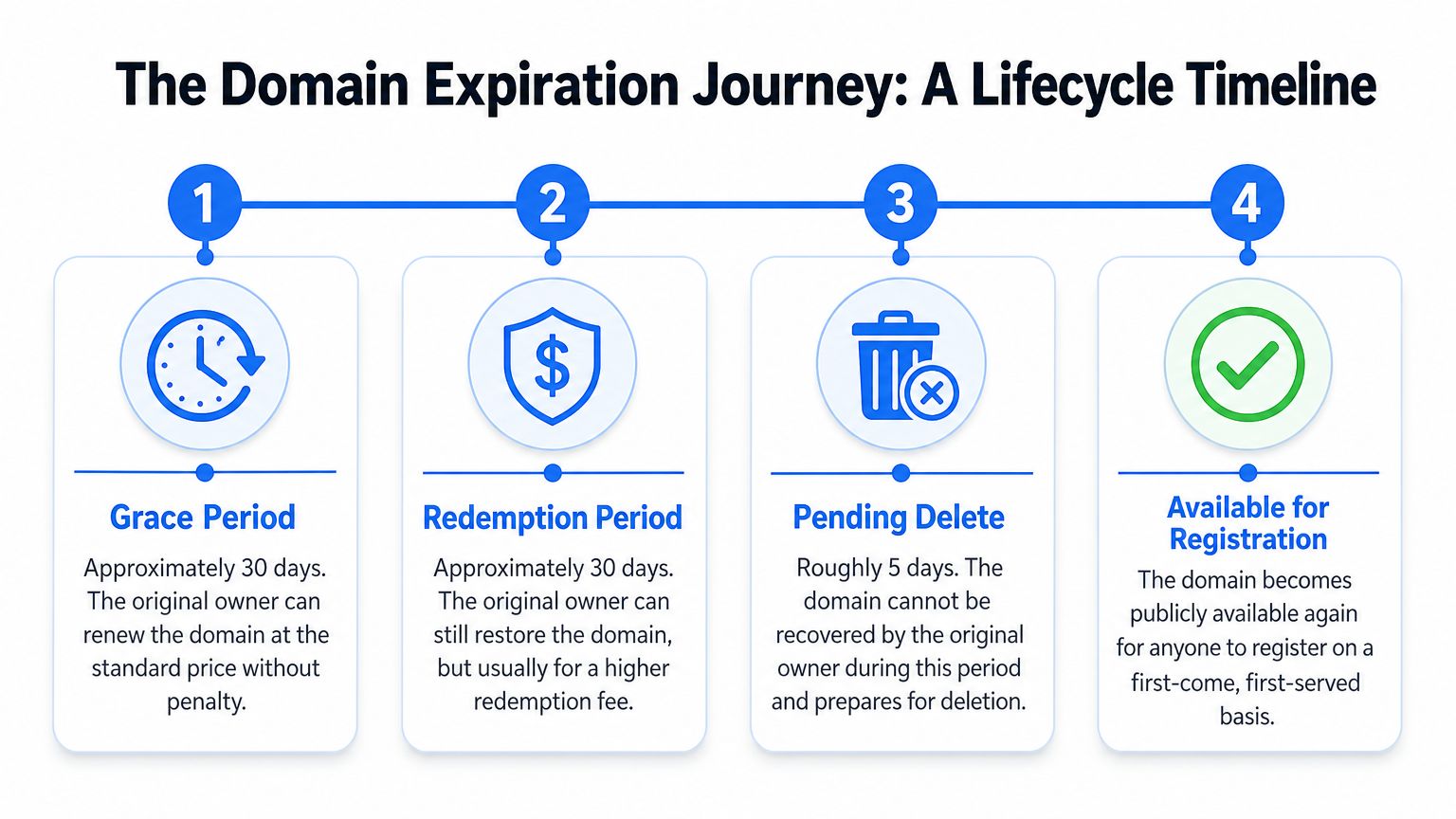
A domain usually moves through a sequence. In common registrar timelines, it enters a grace period of about 30 days, then a redemption period of about 30 to 60 days, and then a pending delete phase of roughly 5 days before public re-registration, according to Lexsynergy's overview of domain expiration timelines.
Grace period
This is the least painful phase. Think of it as the registrar saying, “You messed up, but we'll still let you fix it.”
In many cases, the original owner can still renew at the normal rate during this window. That's why domain owners should move fast the same day they notice a problem. Delay turns a cheap fix into an expensive one.
The key mistake here is emotional procrastination. People see the expiry notice, assume there's a cushion, and put it off until the weekend. That's amateur behavior. Valuable domains deserve the same urgency as payroll or a broken checkout page.
Redemption period
Redemption is where regret gets expensive.
The owner may still be able to restore the domain, but now the registrar can require an extra redemption fee. This phase exists because the name hasn't been fully deleted yet, but it's no longer in the easy-renew lane.
That distinction matters to investors. A domain in redemption can look dead from the outside while still being recoverable by the original owner. If you're tracking names for acquisition, don't mistake “inactive” for “available.”
Good domain buyers watch status changes, not just expiration dates.
Pending delete
Pending delete is the hard stop.
Once a domain reaches this phase, the original owner generally can't recover it. The name is effectively queued for deletion and release. At this point, drop catchers, backorder services, and fast hands become relevant.
For buyers, this phase is where fantasy meets competition. If a domain has real brand value or strong SEO history, you probably won't be the only one watching it.
Release and re-registration
Once the registry releases the name, it can be registered again. First come, first served. At least in theory.
In practice, some names get snapped immediately through backorders or registrar-connected marketplaces. Others limp into availability because nobody wanted them. That difference is where experience pays off. A good investor doesn't just chase drops. They know which names deserve effort and which ones are expired for a reason.
Here's the cleanest way to view the lifecycle:
| Stage | What it means for owners | What it means for buyers |
|---|---|---|
| Grace period | Renew quickly and avoid bigger pain | Watch, but don't assume it's lost |
| Redemption period | Recovery may still be possible, but costlier | Stay alert, owner may still reclaim |
| Pending delete | Recovery window is effectively over | Prepare for drop-catching or registration |
| Public availability | Too late if you owned it | Fair game if you move fast |
The Immediate Carnage When a Domain Expires
The technical explanation is simple. The business fallout is not.
When a domain expires, registrars commonly disable DNS and related services, so the site stops resolving and email stops routing. GoDaddy's published timeline says that by +5 days the domain is parked and any connected website or email will stop working, as noted in OpenSRS's explanation of domain expiration impact.

Your website stops behaving like a business asset
Owners love to say, “The hosting is fine, so we're okay.” No, you're not.
If the registrar disables DNS or parks the domain, visitors can't reliably reach the site even if your server is healthy. To users, your company just vanished. To paid traffic, every click becomes waste. To affiliates and partners, you look sloppy.
That's why I say domain expiry is an outage. It isn't a billing footnote.
Your email breaks faster than people expect
This is the part that hurts mature businesses the most.
When the domain stops routing properly, email can bounce or fail to arrive where it should. Sales inquiries disappear. Customer support messages vanish into the void. Renewal notices from other tools tied to that same email domain can get missed too, which creates a stupid chain reaction.
A lot of owners focus on homepage downtime because it's visible. Email failure is worse because it's often invisible. You don't always know what you missed.
If your domain expires, assume every contact form and every mailbox tied to it is compromised until proven otherwise.
Search performance starts taking hits
Search engines don't care that your accountant forgot a card update.
If crawlers hit repeated failures, your pages become less dependable from the search engine's point of view. Rankings can slide if the domain stays offline. Even if you recover it later, you may spend weeks cleaning up the aftermath.
That's why expired-domain buyers should be careful too. A short interruption may be recoverable. A longer history of downtime, parking pages, abuse, or ownership churn can reduce the value you thought you were buying.
A quick visual explains the operational mess better than most support docs:
Brand risk gets ugly fast
The nightmare scenario isn't just downtime. It's replacement.
If the owner misses the restoration window, the domain may be auctioned or eventually become available to the public. That creates obvious brand risk. A buyer could use it for a competitor site, lead capture, redirects, or something more hostile.
Even without outright abuse, confusion does damage. Customers type your old domain and land somewhere else. Prospects think you rebranded badly. Suppliers question whether the business is stable.
Here's the uncomfortable truth. Companies spend serious money on design, ad campaigns, and SEO, then treat the domain like an auto-renew checkbox. That's backwards. The domain is the front door. If you lose the front door, the rest of the house doesn't matter.
Your Guide to Recovery and Acquisition
Owners and buyers are playing different games here. One is trying to rescue value. The other is trying to capture it.
The big mistake is assuming the process is clean. It isn't. The expired-domain market is built into the lifecycle itself. GoDaddy's timeline shows a domain can be listed in an expired-domain auction around day 26, while still being recoverable by the original owner, which creates a conflict between renewal rights and third-party purchase rights, as shown in GoDaddy's standard expiration timeline.
If you own the domain
The right move depends on where the domain sits in the lifecycle.
| Situation | Best move | Reality check |
|---|---|---|
| You're still in the easy renewal window | Renew immediately | Don't “think about it” |
| You've slipped into redemption | Pay to restore if the domain matters | The price hurts less than losing the name |
| The domain is already too far gone | Prepare for auction or reacquisition attempts | Sentiment won't get it back |
Owners need to be brutally honest here. If the domain powers your brand, your main site, your lead gen, or company email, pay what it takes before it becomes unrecoverable. This is not the place to get cheap.
If you're fuzzy on the costly middle stage, read this breakdown of the domain redemption period. It'll save you from learning the hard way.
If you want to acquire the domain
Buyers have three broad paths, and each one rewards different behavior.
Auction play Impatient buyers often burn money in this scenario. Auctions are effective if the domain is valuable and you've already done your homework. They work badly when ego takes over and you start bidding because “I've already spent time on this.” Time sunk is not value created.
Backorder strategy
This is the disciplined option for names likely to attract competition at drop. You're not buying certainty. You're buying a shot at speed. Use it when the domain has enough upside to justify prep work, but not so much hype that you're entering a feeding frenzy.Public registration after drop
This is the overlooked route. Plenty of useful domains don't end in a cinematic bidding war. They just become available. Good buyers keep watchlists and move quickly when weakly contested names clear the system.
A smart domain investor doesn't ask, “Can I get it?” They ask, “Can I get it at a price that still leaves room for profit?”
The practical edge most people miss
A lot of buyers start looking too late. They wait until a name has already dropped or hit auction headlines. By then, the easy edge is gone.
The better approach is to monitor expiring domains before the final release and build a shortlist of likely targets. Then separate them into three piles:
- Brandable names you'd build on
- SEO plays worth deeper history checks
- Resale candidates with enough commercial appeal to justify competition
That pre-work matters because drop windows are chaotic. If you're evaluating from scratch after the name is already hot, you're behind.
There's also a contrarian point here. Not every expiring domain deserves a rescue bid or a purchase attempt. Some names are all nostalgia and no economics. If you can't explain how the domain makes money, protects a business, or saves significant branding time, let it go.
How to Snag Valuable Expired Domains Without Getting Burned
A dropped domain can be a shortcut. It can also be a landfill with a clean-looking logo.
Beginners often get wrecked. They see age, backlinks, or a decent name and assume they found hidden treasure. Then they inherit spam baggage, irrelevant links, junk anchors, or a history that makes the domain harder to use than starting fresh.
What to check before you buy
You don't need a romantic story about the domain. You need evidence.
- Past use: Was it a real site, a parked shell, a churn-and-burn affiliate project, or obvious spam?
- Backlink quality: A domain with links isn't automatically good. Look at where those links came from and whether they make sense.
- Brand risk: If the name leans too close to an existing brand, skip the headache.
- Topical fit: If you're buying for SEO, relevance matters. Random authority isn't the same as useful authority.
The reason this matters is simple. You're not buying a string of characters. You're buying a history.
Cheap domains can be expensive assets
A lot of investors brag about acquisition price. I care more about cleanup cost.
If you buy a domain that needs link pruning, reputation repair, legal caution, or endless explanation to future buyers, the “deal” wasn't cheap. It was time-consuming. Time is what kills margins in domain investing and SEO projects.
Here's the test I use. Ask whether the domain gives you a head start or a homework assignment. If it's mostly homework, pass.
The best expired domains feel usable on day one. The worst ones come with a detective novel attached.
Drop-catching without due diligence is gambling
If you want to understand the mechanics better, this guide to domain drop catching is worth your time. But mechanics alone won't save you from bad judgment.
A lot of people obsess over being first. Professionals obsess over being right.
That means checking the obvious things first, then asking tougher questions:
| Question | Why it matters |
|---|---|
| Does the name still make sense as a brand? | You may want resale flexibility later |
| Is the backlink profile coherent? | Messy links often signal past abuse |
| Would you build on it yourself? | If not, why assume someone else will pay up? |
| Does the history create risk? | Hidden baggage kills upside |
The expired domain game attracts two bad habits. One is greed. The other is laziness. Greed makes people chase names they can't monetize. Laziness makes them skip research and call it speed.
Don't do either. A domain should earn its way onto your shortlist.
Never Lose a Great Domain Again
A good domain rarely disappears because of bad luck. It disappears because nobody treated it like money.
For owners, the fix is simple. Run a short quarterly check and make sure the registrar, billing, access, and renewal settings are still sane. If the name matters to revenue, lead flow, or company email, document the process and review your domain expiration protection setup before it turns into a recovery problem.
For investors and SEOs, the better lesson is about where the edge is going next. It will not come from faster clicking or joining the same crowded auction feeds as everyone else. It will come from better filters, better historical screening, and better judgment about which names can be monetized quickly.
The next wave of winners will use tooling to cut research time, spot pattern shifts early, and ignore the fake bargains that soak up weeks of cleanup. That matters more than raw volume. A smaller list of clean, usable names will beat a giant watchlist full of legal risk, spam residue, and branding dead ends every time.
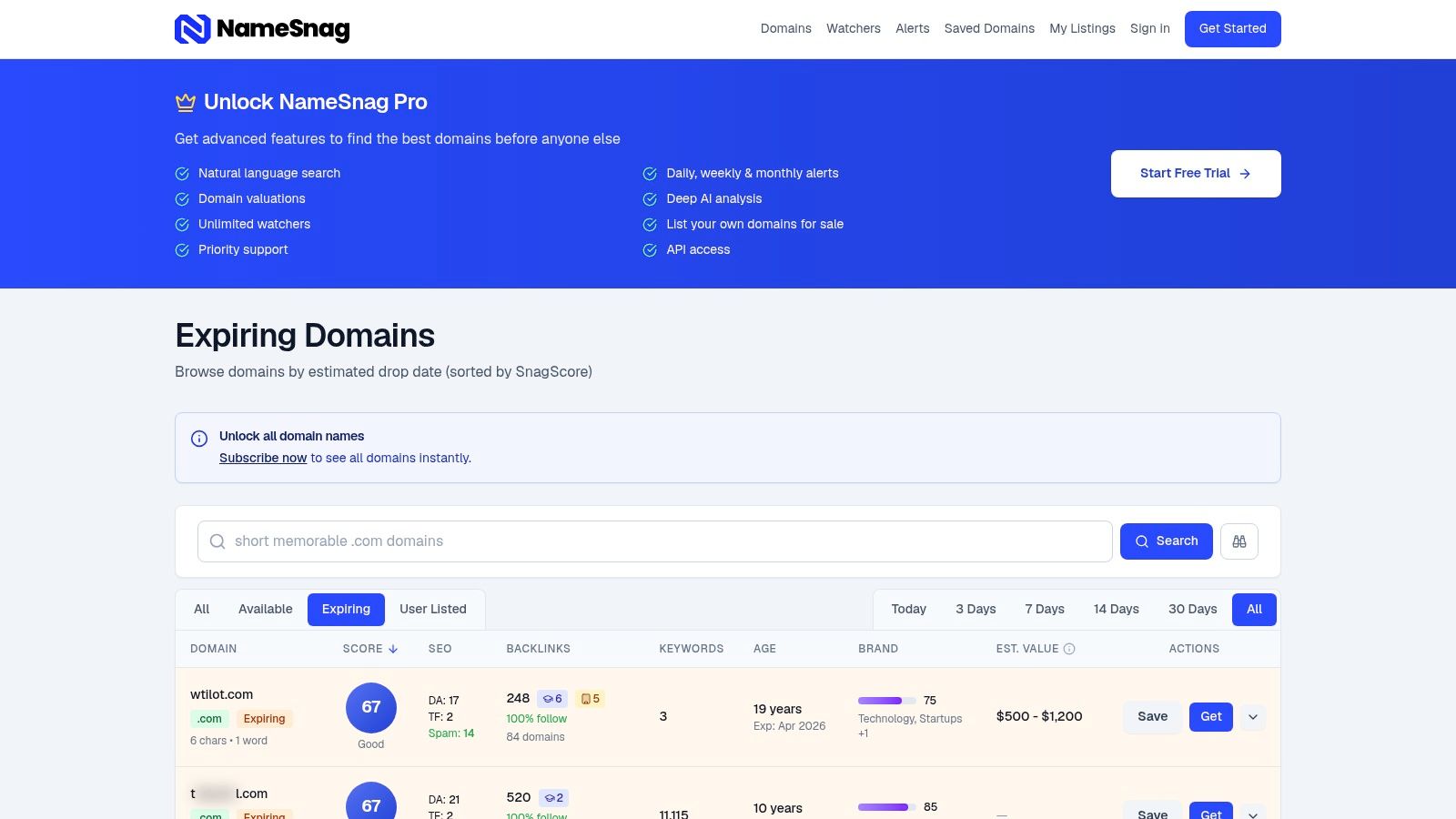
Use platforms that help you sort by timing, quality, and intent, then act only when the upside is obvious. You can try NameSnag, browse available domains that already dropped and can be registered right away, or review expiring domains still moving through the lifecycle.
Expired domains reward discipline. Sloppy owners lose assets. Sloppy buyers inherit problems.
Find Your Perfect Domain
Get access to thousands of high-value expired domains with our AI-powered search.
Start Free Trial