
You've probably done this the hard way already. You brainstorm a pile of names, open a registrar, paste one in, get a result, go back, paste the next one, and slowly feel your will to live leaving your body.
That manual grind is why serious buyers don't treat bulk registration like a convenience feature. They treat it like asset acquisition. If you want to buy domain names in bulk and come out with something valuable, you need a system for sourcing, filtering, buying, and managing names after checkout. Otherwise you're not building a portfolio. You're collecting liabilities.
The good news is that bulk buying is no longer some obscure investor trick. It's standard infrastructure now. The bad news is that easier buying has made it easier for people to acquire a lot of junk very quickly.
So You Want to Buy Domains by the Dozen
A spreadsheet full of ideas feels exciting. A cart full of random registrations feels productive. Neither means you're making good decisions.
The shift that matters is mental. Bulk buying is not faster shopping. It's portfolio management. That means every name needs a role before you register it. Brand protection. Resale. SEO use. Campaign use. Geographic expansion. If you can't explain why a domain belongs in your account, it probably doesn't.
The domain market has been moving in this direction for a long time. The Domain Name System was introduced in 1985, and commercial registration became a major activity by the mid-1990s, which is when faster acquisition workflows started to matter as companies grabbed brand variants, defensive registrations, and campaign domains at scale, as noted in Openprovider's bulk domain registration overview.
Bulk buying changes the rules
When you register one domain, mistakes are annoying.
When you register dozens or hundreds, mistakes become expensive habits. You forget renewals. You buy hard-to-spell names. You mix decent brandables with legal landmines and spam-soaked expired domains. Then a year later you're paying to keep names you don't even remember buying.
Practical rule: If a domain doesn't fit a written acquisition thesis, don't bulk-buy it just because it's available.
Here's the blunt version. Those who buy domain names in bulk are too focused on speed. Professionals focus on selection discipline. They'd rather buy fewer strong names than drag around a bloated portfolio that never earns its keep.
What a real portfolio mindset looks like
A working bulk-buy process usually starts with a short checklist:
- Define the purpose: Are you protecting a brand, building a resale portfolio, or sourcing domains for SEO projects?
- Set naming standards: Shorter, clearer, easier-to-spell names beat awkward cleverness.
- Decide your exit or use case early: Redirect, develop, park, hold, or list for sale.
- Plan management before purchase: Renewals, DNS control, and ownership records matter as much as the buy itself.
That sounds less glamorous than “scoop up digital real estate.” It's also how you avoid ending up with a digital junk drawer.
Your Hunting Grounds for Bulk Domain Deals
Bulk acquisition gets expensive fast when you shop in the wrong venue.
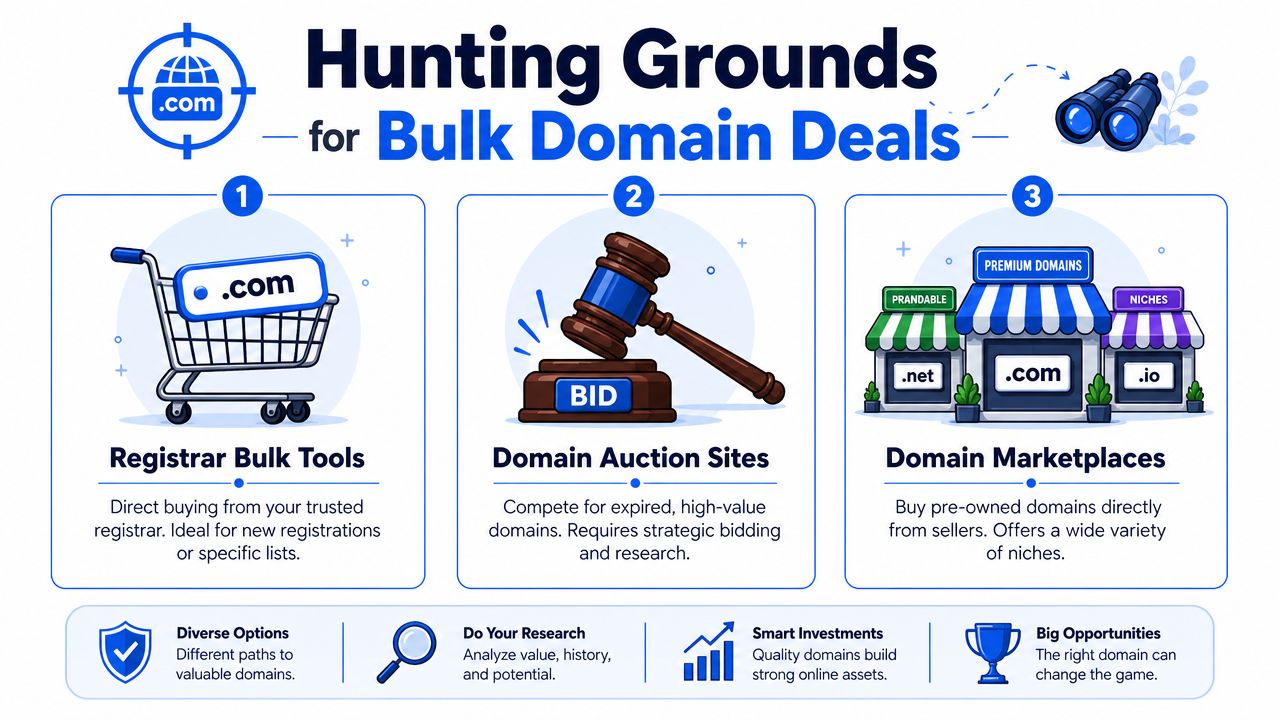
A clean registrar checkout, a noisy expiry auction, and a polished premium marketplace each produce a very different kind of portfolio. Professionals treat these channels like separate supply lines. Each one has its own pricing logic, risk profile, and post-purchase workload.
Registrars are for planned acquisitions
Use registrars when your list is already defined.
This is the right channel for brand protection, campaign support, product launches, geographic variants, and typo coverage. You are buying known inventory at standard pricing, which makes budgeting and account management easier. That matters if your real job starts after checkout, with DNS setup, forwarding, ownership records, and renewal tracking.
Registrar bulk tools are efficient, but they tempt buyers into padding a portfolio with names that were merely available. Availability is not quality. If a name would not survive resale review or internal brand review, do not add it just to make the batch bigger.
Auctions reward preparation and punish sloppy bidding
Auction inventory can produce some of the best buys in bulk, especially when you want aged domains with existing signals, category relevance, or stronger naming quality than hand registrations usually offer.
It also attracts disciplined buyers. If a domain has obvious upside, expect competition. If a domain looks cheap, assume there is a reason and verify it before you chase it. Domain investors who last in this business build shortlists, cap bids early, and pass on more names than they buy.
If you need a grounded primer on expiry buying, Domain Drake's 2026 expired domain strategy is a solid reference. For a broader comparison of platforms, this guide to domain auction sites helps you sort venue by venue.
Marketplaces are useful for targeted upgrades
Marketplaces make sense when you need a specific asset and cannot wait for a drop or auction cycle.
That usually means a stronger brandable, an exact phrase with commercial value, or a domain that fills a clear hole in an existing portfolio. Sellers know this. Many prices are aspirational, and some are detached from reality. Treat marketplace inventory like private deal flow. Buy selectively, negotiate hard, and compare the asking price against your hold costs and likely exit range.
Here is the practical breakdown:
| Channel | Best use | Main advantage | Main risk |
|---|---|---|---|
| Registrars | New registrations from a vetted list | Fast execution and predictable pricing | Overbuilding a weak portfolio |
| Auctions | Expired or dropping domains with upside | Access to better aged inventory | Bidding wars and hidden baggage |
| Marketplaces | Specific premium targets | Precise acquisition | Overpaying for seller optimism |
Channel choice shapes the rest of the asset lifecycle. Fresh registrations are easy to administer but usually weaker on upside. Auction wins can outperform, but they demand more screening and tighter renewal discipline. Marketplace buys can sharpen a portfolio quickly, yet one bad overpay can drag returns for years.
Buy where the inventory matches your thesis. That is how bulk acquisition stays a portfolio strategy instead of turning into a shopping habit.
How to Vet Bulk Domains and Avoid Hidden Lemons
Bulk buying amplifies your mistakes. One weak purchase is recoverable. A batch of weak purchases becomes an annual expense line.
That's why quality control is the essential skill. The main technical risk in bulk domain acquisition is quality control. Buyers should screen for prior ownership baggage, trademark conflicts, weak SEO relevance, and difficult-to-spell names before purchase, because previously owned domains can carry penalties, bad reputation, or legal exposure, as GoDaddy notes in its guidance on buying and selling domain names for profit.
Start with the name itself
Before you get fancy, look at the domain like a buyer, not a metric addict.
Ask simple questions first:
- Can someone spell it after hearing it once?
- Does it look like a real brand or a forced keyword mashup?
- Would you feel comfortable putting it on a business card?
- Does it fit your intended use case?
A lot of bad bulk purchases could be avoided if people just said the names out loud. If the domain feels awkward in conversation, it usually gets worse in the wild.
Then check history and legal risk
People's complacency often leads to them paying more later.
A previously owned domain can carry old baggage. Maybe it was used for spam. Maybe it has a backlink profile that looks good until you inspect the sources. Maybe it walks straight into a trademark problem. None of that shows up in a pretty bulk cart.
Use a repeatable history review process. Check prior snapshots, look for signs of abuse, and inspect whether the domain's earlier use matches your intended use. If you need a practical walkthrough, this guide on how to check domain history covers the basics well.
Reality check: A domain with “authority” but a poisoned history isn't an asset. It's cleanup work.
Vet for SEO fit, not just raw metrics
SEO buyers make a common mistake. They see backlinks and assume value.
That's not enough. You need relevance, cleanliness, and a believable reason the domain earned those links in the first place. A domain that once hosted a legitimate niche site is very different from a domain that was recycled through spammy uses.
Look for signals like:
- Topical fit: The old use should align with the project you have in mind.
- Link quality: A few credible referring links often beat a pile of trash.
- Anchor sanity: If the anchor profile looks manipulated, walk away.
- Archive consistency: Repeated use changes can signal abuse.
Here's a useful explainer if you want to see how experienced buyers think through this process in practice:
Build a rejection habit
New investors ask, “How do I find more domains?”
Experienced investors ask, “How do I reject bad domains faster?”
That's the actual advantage in bulk buying. You need a filter that kills weak candidates quickly so your attention goes to the small group worth paying for.
A practical rejection sequence looks like this:
- Reject confusing names immediately
- Reject domains with obvious trademark exposure
- Reject mismatched or dirty history
- Reject names with weak strategic fit
- Only then compare the survivors
Most expired domains are easy to ignore once you stop trying to rescue every maybe.
The Nuts and Bolts of a Mass Domain Purchase
You already did the hard part. You cut the list down to names worth owning. Now the job is execution, and execution should be disciplined, fast, and boring.
A sloppy checkout process can still wreck a good acquisition batch. Wrong registration terms, duplicate purchases, missing privacy settings, and poor recordkeeping all create problems you pay for later. Treat the purchase like inventory intake, because that is what it is.
Use the registrar workflow as an execution tool
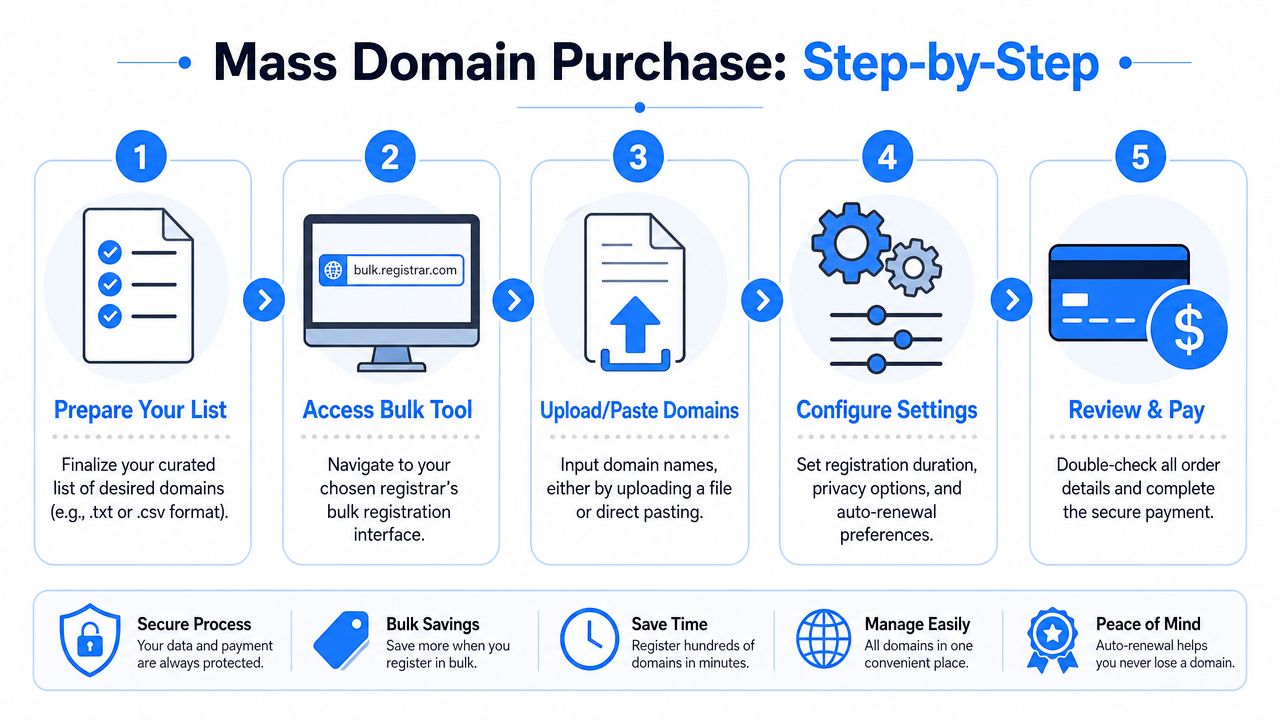
Bulk tools at major registrars are good enough for professional buying. You can paste a list, upload a file, review what is available, and register in one pass. That is all you need.
Run a simple process:
- Prepare the final buy list in a text file or CSV
- Upload or paste the domains into the bulk search tool
- Check availability, extensions, and actual first-year pricing
- Set ownership options such as term length, privacy, and auto-renew rules
- Complete the purchase and export the receipt data
Keep the file clean. Every domain on it should already have a reason to exist in your portfolio. If a name still needs debate, it should not be in the upload.
CSV discipline saves money
Use a spreadsheet as your control sheet, not as a brainstorm pad. Add columns for registrar, purchase date, registration term, intended use, and maximum hold period. That gives you a usable asset register from day one instead of a pile of names you barely remember buying.
Amateur bulk buying typically breaks down. The cart fills up with filler, someone adds extra years to the wrong names, and nobody documents what was purchased. Six months later, the portfolio looks bigger than it is and performs worse than expected.
A blunt rule works well here. If you would not be comfortable explaining a domain's purpose in one sentence, drop it before checkout.
UI for small batches, API for repeatable operations
For a modest portfolio build, the registrar interface is fine. It is easy to audit, easy to screenshot, and hard to misuse if your list is tight.
APIs make sense when buying is part of a larger operating system. Agencies, drop-catching teams, and investors with repeatable acquisition criteria can save time by connecting search, registration, and recordkeeping. That speed only helps if your filters are already solid. Automation multiplies judgment. It does not replace it.
The purchase itself is only the transfer point. From that moment on, each domain becomes a managed asset with a carrying cost, an ownership record, and a job to do.
The Hidden Costs Renewals and Legal Headaches
Amateurs obsess over registration price. Pros obsess over holding cost.
That cheap first-year promo is how people talk themselves into bad bulk buys. They tell themselves the names are inexpensive, then wake up later with a portfolio full of renewals, privacy add-ons, and scattered registrar accounts they barely control.
The underserved angle in bulk buying is renewal economics and lock-in risk. Most public advice focuses on getting domains into the cart, but it rarely compares the long-term cost of holding large portfolios. That matters because headline prices can hide very different renewal policies. Cloudflare says it offers registration “at cost” with no markup, while others emphasize low upfront or bulk-discount pricing, which can still leave buyers exposed to long-run carrying costs, as discussed in this overview of domain name registration pricing.
Acquisition cost is the bait
If you buy domain names in bulk without modeling renewal behavior, you're not investing. You're borrowing trouble from next year.
Here's where portfolios go wrong:
- Intro pricing hides the actual bill: The first term looks attractive, the renewal cycle does not.
- Registrar sprawl adds friction: Managing names across multiple accounts creates admin overhead and increases the chance of mistakes.
- Optional extras become default expenses: Privacy, forwarding, and convenience features can pile up when multiplied across many names.
- Dead inventory lingers: Buyers hold weak domains too long because dropping them feels like admitting a mistake.
Legal problems are worse than overpriced renewals
You can recover from overpaying for a mediocre name. Trademark conflict is uglier.
Before you bulk register brandable or product-adjacent names, do basic trademark screening. Don't buy domains that lean on someone else's brand equity and call it clever. It isn't. It's sloppy, and the likely outcome is losing the name and wasting your money.
A short legal sanity check should cover:
| Check | Why it matters |
|---|---|
| Trademark similarity | Reduces obvious infringement risk |
| Commercial intent | Risk rises when the domain could confuse buyers |
| Name distinctiveness | Generic terms are different from protected brands |
| Planned use | Redirects, resale, and monetized use can raise stakes |
Your cheapest domain can become your most expensive one if it drags you into a legal mess.
Consolidation usually wins
For most investors, keeping a portfolio under one strong registrar or a very small number of registrars is the practical move. Centralized renewals, centralized DNS, and cleaner records beat chasing slightly lower promos across the market.
The point isn't perfection. The point is control. Bulk ownership only works when admin stays boring.
Post-Purchase Your Portfolio Is an Asset Not a List
Actual return on a bulk domain buy shows up after checkout. Once the names hit your account, you're running a portfolio. That means classification, assignments, deadlines, and exit decisions. Buyers who skip that work end up paying renewals on confusion.
The first sort should be by purpose. Keep two buckets and keep them clean.

Split the portfolio by purpose
Defensive names protect an existing business, product, founder brand, or planned launch. These are typo variants, obvious extension grabs, and names you'd rather own than explain later.
Offensive names are intended to produce a return. They might become sites, redirects, lead-gen properties, or resale inventory. They need a thesis, a target buyer, and a time limit.
That distinction sounds simple because it is. It also forces discipline. A defensive name gets low-maintenance protection. An offensive name has to justify its carrying cost.
Give every domain a job
Every domain should have a written role within days of purchase. If you wait, weak names blend in with promising ones and your portfolio turns into a renewal trap.
Use four statuses:
- Build for names tied to a real project, launch, or content plan
- Redirect for names that support an existing property and have a clear destination
- List for sale for names with resale logic and an identified buyer type
- Drop by date for names that do not earn another renewal if nothing changes
Set the drop date now, not next year when sunk cost starts talking.
A good portfolio manager is ruthless here. You are not curating a collection. You are allocating capital.
Build an operating system, not a spreadsheet graveyard
Post-purchase management needs a simple system that answers basic questions fast. Who owns the domain internally. What is it for. Where does it point. When does it renew. Is it listed anywhere. Has legal been checked. Without those fields, even a decent portfolio becomes hard to control.
Centralize DNS and renewal settings where possible. Use tags or folders by asset type. Review the portfolio on a calendar, not when an invoice lands in your inbox. Quarterly is fine for smaller portfolios. Larger portfolios need monthly review because the losers reveal themselves faster than owners like to admit.
Handle migrations carefully
Some bulk acquisitions support a rebrand, a consolidation project, or a move to stronger names. That work can create value fast, but sloppy execution can waste a good domain. Redirect maps, canonical settings, internal links, analytics, and platform settings all need to be cleaned up. If you're planning a site move, this guide with practical advice for WordPress site rebranding is a useful tactical reference.
Strong portfolios are managed like inventory. Each name has a role, a cost, and a deadline.
The investors who make money in bulk buying are usually the ones with fewer excuses and better records. They know why each domain exists. They know which ones deserve development or sales effort. They also know when to cut dead weight and move on.
Find Your Perfect Domain
Get access to thousands of high-value expired domains with our AI-powered search.
Start Free Trial