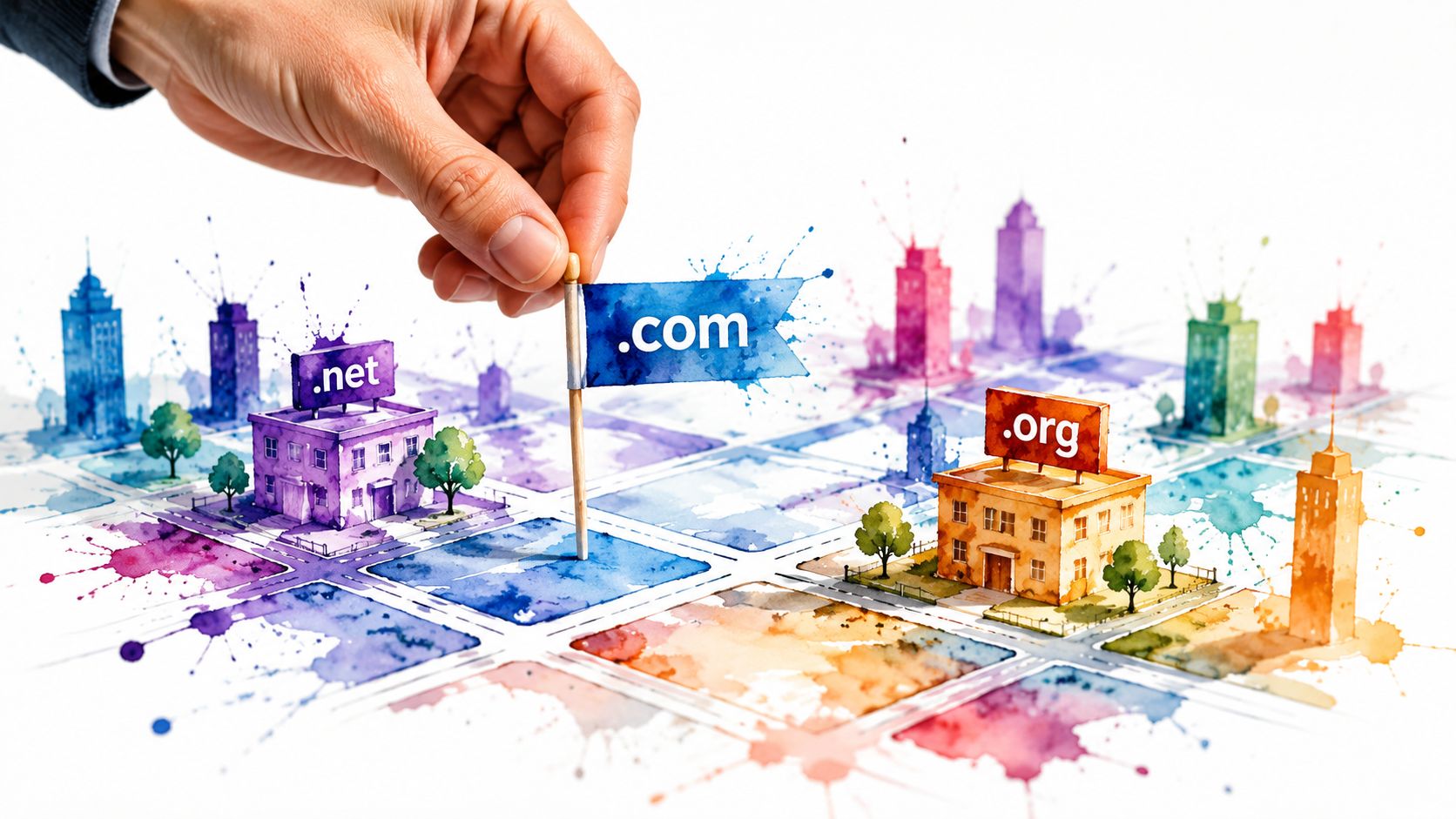
Buying a domain name usually means paying about $10 to $20 per year for the right to use a web address, not buying it forever. It's like leasing a prime piece of digital real estate, not buying the land outright. You get exclusive rights to the address for a set term.
That sounds simple until you're the person staring at a checkout page, thinking you've found the perfect name for a startup, side project, agency, newsletter, or niche site. The button says “buy now,” so many might assume this works like buying a couch or a laptop. It doesn't.
A domain is closer to a lease, a routing credential, and a brand asset rolled into one. If you treat it like a throwaway purchase, you can get burned by renewal costs, trademark trouble, transfer friction, or an expired name that slips out of your hands at the worst possible time.
That matters even more because the namespace is crowded. There were over 368.4 million registered domain names worldwide in Q1 2025, according to domain registration market data. In a space that large, a good name isn't just available or unavailable. It's a strategic choice.
So You Want to Buy a Domain Name
It's a familiar scenario. You've got a name idea. Maybe it's sharp and brandable. Maybe it's keyword-rich. Maybe it came to you in the shower and now you're convinced it's genius. The first instinct is always the same: lock down the domain before someone else does.
That instinct is right. The assumption behind it usually isn't.
When people ask what does it mean to buy a domain name, they're often really asking three different questions at once. What am I purchasing? What control do I get? And what can go wrong after checkout? Those are better questions than “which registrar has the cheapest first-year price?”
The exciting part and the part people skip
The exciting part is obvious. A domain makes the project feel real. Once you've got the address, the idea stops living in your notes app and starts looking like a business, publication, portfolio, or asset.
The skipped part is understanding the rules of the game. A domain isn't a decorative label. It sits inside a tightly controlled global naming system with technical rules, renewal requirements, and legal boundaries. You're not just grabbing a name. You're securing a position in a very crowded digital map.
A good domain feels small when you buy it and important every time you use it after.
That's why experienced buyers don't just ask whether a name is available. They ask whether it's clean, sustainable, transferable, and worth keeping for years.
What beginners usually get wrong
A few patterns show up again and again:
- They focus on the first-year checkout price. The cheap intro offer feels like the whole story. It rarely is.
- They assume availability means safety. A name can be available and still create legal headaches.
- They treat extensions as interchangeable. They're not. The extension affects trust, cost, and how people remember you.
- They ignore lifecycle risk. A missed renewal can break your site, your email, and your brand continuity all at once.
If you only learn how to click “register,” you learn the least important part of the process.
The Big Misconception You Are a Renter Not an Owner
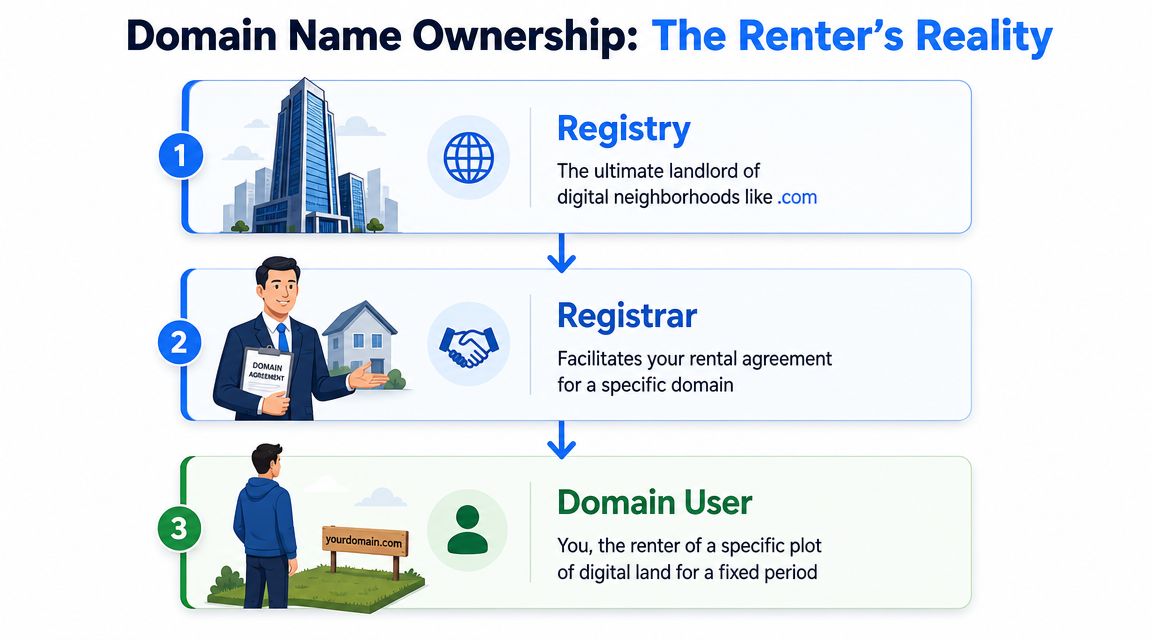
The cleanest way to understand domain buying is this: you're not buying the street forever. You're signing a lease on an address.
When you “buy” a domain, you're registering the exclusive right to use it for a fixed term, typically one to ten years, and your control depends on renewal rather than permanent ownership, as explained in Wix's guide to buying a domain name.
The three players that matter
If domain buying has always felt oddly opaque, it helps to know who does what.
| Player | Role | Analogy |
|---|---|---|
| Registry | Operates the extension namespace such as .com or .org | The landlord of the whole neighborhood |
| Registrar | Sells registrations and manages your account | The property manager or leasing office |
| Registrant | Uses the domain during the registration term | The renter |
You usually interact with the registrar. That's the company where you search, register, renew, transfer, and manage the domain. But the registrar isn't the ultimate owner of the extension. It's handling access to a larger system.
What your payment really buys
Your payment buys control, not absolute ownership. Specifically, it buys the right to keep that exact address assigned to your account for a defined period, assuming you follow the rules and renew it on time.
That distinction matters because a lot of expensive mistakes grow out of sloppy language. Someone says “I own the domain,” then forgets renewal is effectively the gatekeeper. Someone assumes a business name automatically gives them domain rights. It doesn't. Someone thinks they can hold a domain carelessly because it's “theirs now.” That's how names expire and disappear.
If you want a deeper explanation of the forever myth, can you buy a domain name forever breaks down the issue clearly.
Practical rule: Treat a domain like a lease with renewal power, not a trophy you can toss in a drawer.
What works and what doesn't
A smart buyer acts like a careful tenant with a valuable storefront.
What works:
- Choosing a registrar you trust. Clean account controls and straightforward transfer handling matter more than flashy upsells.
- Turning on privacy protection when available. Public registration details can expose personal information if you don't shield them.
- Documenting who controls the account. This saves pain when agencies, founders, or employees change.
What doesn't:
- Registering through a random website builder and forgetting where the domain lives
- Letting one person on the team hold the login with no backup
- Assuming renewal notices will always find you
The phrase “buy a domain” is convenient. It just isn't technically honest.
How a Domain Actually Works Under the Hood
A domain is a DNS label. That's the plain-English version of a routing name computers can use inside the Domain Name System. The syntax is strict. Domain names are case-insensitive, labels are separated by dots, and each label can contain only ASCII letters, digits, and hyphens, with hyphens not allowed at the beginning or end, as summarized in Wikipedia's domain name entry.
If that sounds dry, think of DNS as the internet's address book. Humans remember names. Networks need structured routing data. A domain is the part that makes those two worlds meet cleanly.
What the registration controls
Your registration doesn't build a website. It gives you the right to point that name somewhere.
That “somewhere” could be a hosting account, a landing page tool, an e-commerce platform, or an email provider. The value of the domain depends on whether it's configured properly and whether the account managing it stays under your control.
If you want a basic primer on that registration layer, what is domain name registration is worth reading.
Why renewals and transfers matter more than people think
Beginners obsess over checkout. Experienced buyers obsess over maintenance.
A few habits prevent most avoidable disasters:
- Enable auto-renew immediately. Don't rely on memory for an asset tied to your brand or revenue.
- Use a stable account email. If notices go to an abandoned inbox, you're asking for trouble.
- Keep billing details current. A failed card can start an ugly chain reaction.
- Understand transfers before you need one. Moving a domain between registrars usually involves authorization steps and approval, not a casual handoff.
Miss a renewal on a hobby project and you lose a name. Miss it on your main business and you can lose your front door.
The domain lifecycle is not forgiving
Once a domain expires, recovery can get messy fast. There may be post-expiration phases, grace periods, and eventual release. During that time, your website can stop resolving properly, email can fail, and another buyer may be waiting for the drop.
That's why domain investors watch expirations so closely. A neglected name can re-enter the market, and when it does, someone else may grab it immediately.
Hunting for Treasure in the Domain Aftermarket
Hand-registering a fresh domain is only one lane. The more interesting lane is the aftermarket, where names already have history, age, backlinks, memorability, or brand appeal.
That's where domain buying starts to feel less like online shopping and more like estate sales.
The three kinds of aftermarket opportunity
Not all aftermarket names are the same. They usually fall into three buckets.
Premium domains
These are short, sharp, commercially attractive names. Think clean brand words, strong category terms, or ultra-memorable combinations. The upside is obvious. The downside is also obvious. Somebody usually knows they're valuable.
Premium names can make sense if the domain is central to the business model, investor narrative, or resale plan. They make less sense when a founder is still guessing what the company even is.
Available dropped domains
These are domains that were previously registered, expired, completed their lifecycle, and are now open for immediate registration again. Sometimes they're junk. Sometimes they're overlooked gems with useful history.
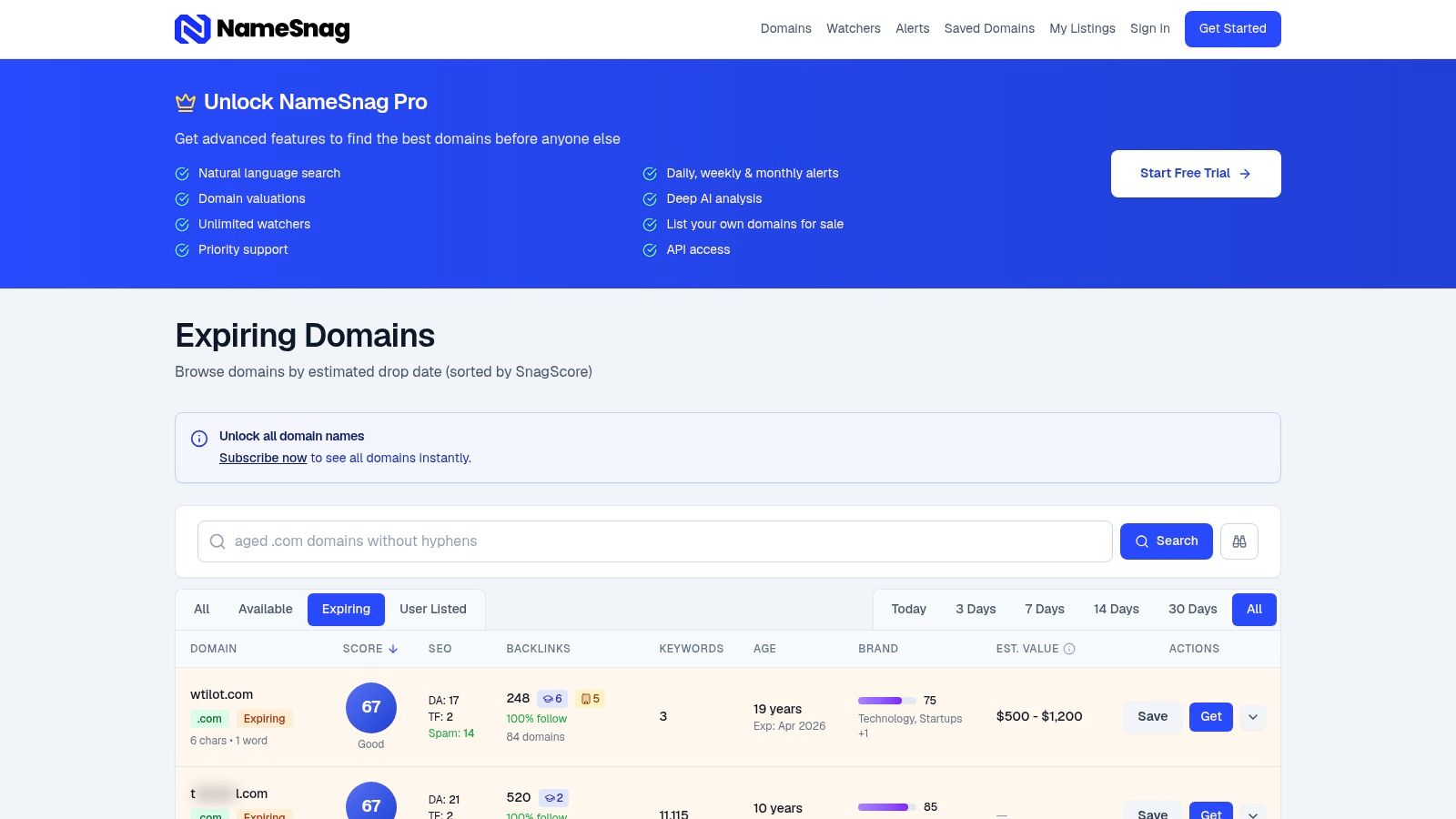
For that kind of hunt, available dropped domains are where things get interesting, especially if you narrow by time filters like Today, 3 Days, 7 Days, 14 Days, 30 Days, or All.
Expiring domains
These are domains in a grace period or close to dropping. They're not freely available yet, but they're on the radar.
If you want to watch names before they fully hit the street, expiring domains help you track what may become available soon, with the same time filters for narrowing the list.
Why expired names can beat fresh registrations
A fresh registration is clean, but empty. An expired domain can come with baggage or value.
Sometimes that value is branding. The name sounds better than anything you'd hand-register today. Sometimes it's age and prior use. Sometimes it's link history from an old site that earned real references over time.
Tools start to matter. Manually combing through drops is tedious and easy to do badly. A platform like NameSnag can help surface available and expiring domains while filtering for cleaner opportunities instead of forcing you to inspect endless junk one by one.
The aftermarket rewards patience. The first available domain is rarely the most useful one.
A practical walkthrough helps if you're new to the hunt:
What works in the aftermarket
Buyers usually get better results when they look for fit, not fantasy.
- Brand-first searches work well for startups, agencies, and creators that need a memorable identity more than legacy SEO signals.
- History-first searches fit SEOs, affiliate builders, and publishers who care whether the name has useful prior trust.
- Watchlist behavior beats impulse buying. The more names you observe over time, the faster you spot patterns and traps.
What fails is chasing every old domain as if age alone makes it valuable. Plenty of expired names are just expired for good reason.
Avoiding Landmines Legal and SEO Risks
The dangerous domains are rarely the ones that look dangerous. The risky ones often look exciting. Good keyword. Nice extension. Available now. Maybe even some old backlinks. That's exactly why buyers walk into avoidable problems.

Legal risk comes before branding excitement
A domain can be available and still be a terrible idea.
Guidance on domain registration considerations notes that buyers should check trademark risk and watch for hidden renewal-cost traps, especially when choosing alternatives like .ai or .io. A clever name that leans too close to another company's mark can create headaches long after checkout.
A practical habit is to search the relevant trademark database before you register anything important. If the brand will matter to your business, spend a few minutes learning the basics of safeguarding your business's IP so you don't build on borrowed ground.
SEO risk hides in the history
Expired domains can have strong pasts. They can also have ugly ones.
Red flags include spammy prior use, irrelevant backlink patterns, obvious language mismatch, and signs the domain was burned in low-quality campaigns. If a domain has been abused, you may inherit the mess along with the name.
One smart precaution is checking whether the domain appears on known problem lists or has signals that suggest prior penalties. This guide on blacklisted domains is a useful starting point if you're vetting old names.
Available doesn't mean safe. It only means nobody currently controls the registration.
TLD choice can create a softer kind of risk
Not every risk ends in a lawsuit or penalty. Some risks are more subtle.
A non-.com extension can be a strong branding move. It can also confuse users, carry different expectations, or cost more to keep over time. That doesn't make .ai, .io, or other alternatives bad choices. It means they deserve deliberate thinking rather than trend-chasing.
When buyers get into trouble, it's usually because they fell in love with availability and skipped due diligence.
Your Safe Domain Buying Checklist
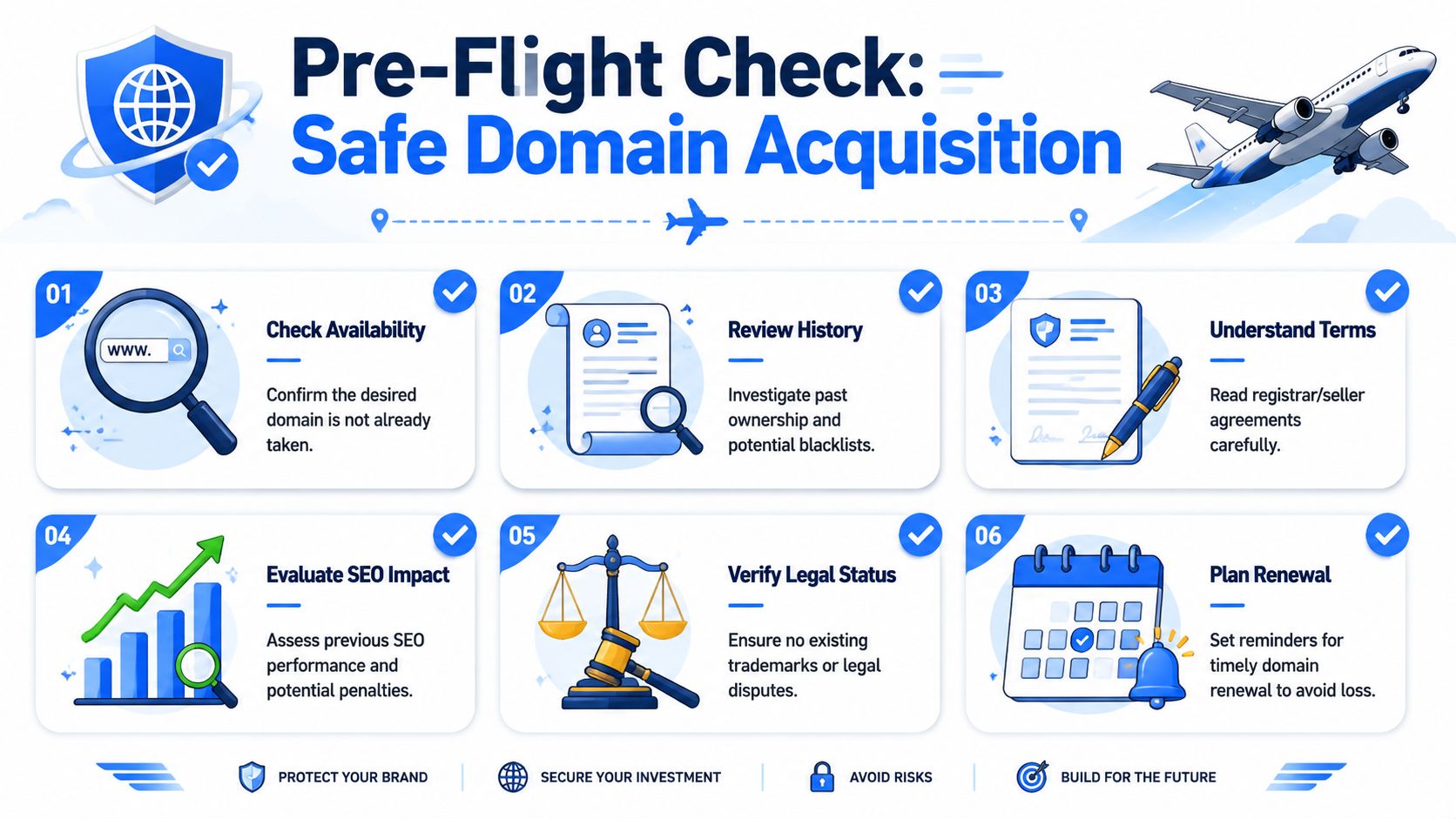
Treat the purchase like signing a lease on a storefront, not grabbing a lottery ticket at checkout. A good name can serve you for years. A sloppy buy can saddle you with avoidable costs, account headaches, and a brand you regret every time you say it out loud.
The pre-flight check
Start with usability, not availability
New buyers often search first and think second. Reverse that. Say the name out loud. Spell it over the phone. Put it in an email signature. If it causes friction in conversation, support calls, or word-of-mouth referrals, the fact that it is available does not make it a good buy.
Check whether the name still fits if the business grows
A domain should survive version two of your company. A cute niche name can box you in later. I prefer names that leave room for a broader product line, new markets, or a future sale.
Price the carrying cost
The first-year promo is bait. The key question is what the domain costs to renew, transfer, and keep under privacy protection. As mentioned earlier, many standard domains renew in the rough range of $10 to $20 per year, but the extension and registrar can change that fast.
Confirm who controls the account
If a freelancer, agency, or former employee is buying the domain for you, stop and fix that first. The registrant account should live under a business email you control, with billing access and recovery methods documented. I have seen companies spend more time recovering a domain than they spent building the site attached to it.
Security and control checks
Buying the name is only half the job. Keeping control is the other half.
- Choose a registrar with clear security settings. Two-factor authentication, clean billing controls, and account recovery that does not feel like a hostage negotiation matter more than a flashy checkout page.
- Turn on auto-renew right away. Expiration mistakes are painfully common, especially when a card expires or the buyer used a personal inbox nobody checks.
- Use WHOIS privacy if it is available and lawful in your region. Less public personal data usually means fewer spam calls, phishing attempts, and headaches.
- Lock the domain against unauthorized transfers. That one setting prevents a lot of stupid problems.
- Record the registrar, login owner, renewal date, and recovery email somewhere your team can access. Domains get lost through bad ops as often as bad intent.
One rule I trust: if losing the domain would hurt the business, protect it on day one like it already matters.
Final gut check
Before you pay, ask four blunt questions:
| Question | Why it matters |
|---|---|
| Would I still be happy to renew this in three years? | Filters out impulse buys and trend names that age badly |
| Can a customer hear it once and type it correctly? | Reduces lost traffic, mistrust, and constant correction |
| Do I understand the ongoing cost, not just the promo price? | Prevents budget surprises and avoidable drops |
| Is there a real plan for this domain after purchase? | A domain with a job is more valuable than one sitting in a drawer |
That last question gets ignored a lot. If the site will need visibility beyond classic search, map that into the purchase decision early, including content structure and Generative Engine Optimization strategies. The smart buy is not just a safe registration. It is a name you can control, afford, and put to work.
You Have a Domain Now What
The domain is the address. Now you need a building.
First, connect it to the platform that will use it. That might be a website host, a store platform, a landing page builder, or a portfolio tool. Then set up email on the domain if the project is serious. A branded email address changes how people perceive you fast.
Turn the name into an asset
A dormant domain isn't useless, but an active one compounds in value because it becomes associated with a real entity, content, and trust over time.
A few smart next moves:
- Launch a simple home page even if the full site isn't ready yet
- Create a professional email address tied to the domain
- Decide the domain's role in your broader brand, SEO, or investment plan
- Start publishing with intent so the domain develops a coherent identity
If the project depends on discoverability in newer search environments, it's also worth learning some practical Generative Engine Optimization strategies so your site is structured for visibility beyond classic blue-link search.
A domain starts as a registration. It becomes valuable when you attach reputation, utility, and consistency to it.
If you're ready to start the search, NameSnag is a practical place to look for domains that are available now or close to dropping, especially when you want to screen opportunities before registering blindly.
Find Your Perfect Domain
Get access to thousands of high-value expired domains with our AI-powered search.
Start Free Trial