
So, you want to figure out when a domain is set to expire? The classic move is a simple WHOIS lookup. This public registration data usually includes the official "Registry Expiry Date," giving you the exact day the current registration runs out. That date is your starting line for tracking a potential digital treasure.
The Hidden Value in Expiring Domains
Ever wonder why some investors and SEO pros are obsessed with domain expiration dates? It’s not just about finding a clever name; it's a strategic hunt for digital real estate with a past. It’s like being an internet archaeologist, searching for buried treasure.
Every year, millions of domains are dropped—often by accident. Many of these aren't just empty plots of land; they come with years of history, established authority, and a backlink profile that would take ages to build from scratch. Snagging one of these is like getting a massive head start in the race for online visibility.
Why the Obsession with Expiration Dates?
The real prize isn't just the name itself, but the history baked into it. An aged domain with a clean track record can deliver an instant SEO boost, helping a new site climb the rankings far faster than one starting from zero. Think of it as buying a house with a mature, beautifully landscaped garden instead of starting with a patch of dirt and a handful of seeds.
Beyond the SEO juice, there's tremendous branding power at play. Grabbing a short, memorable, and authoritative .com that someone else simply forgot to renew can be a total game-changer for a new business.
The entire strategy hinges on understanding a domain's lifecycle and knowing precisely when to make your move. It's a high-stakes game where one person's forgotten domain can become your next major asset. This timeline breaks down the critical stages a domain goes through, from active use to potentially being up for grabs.
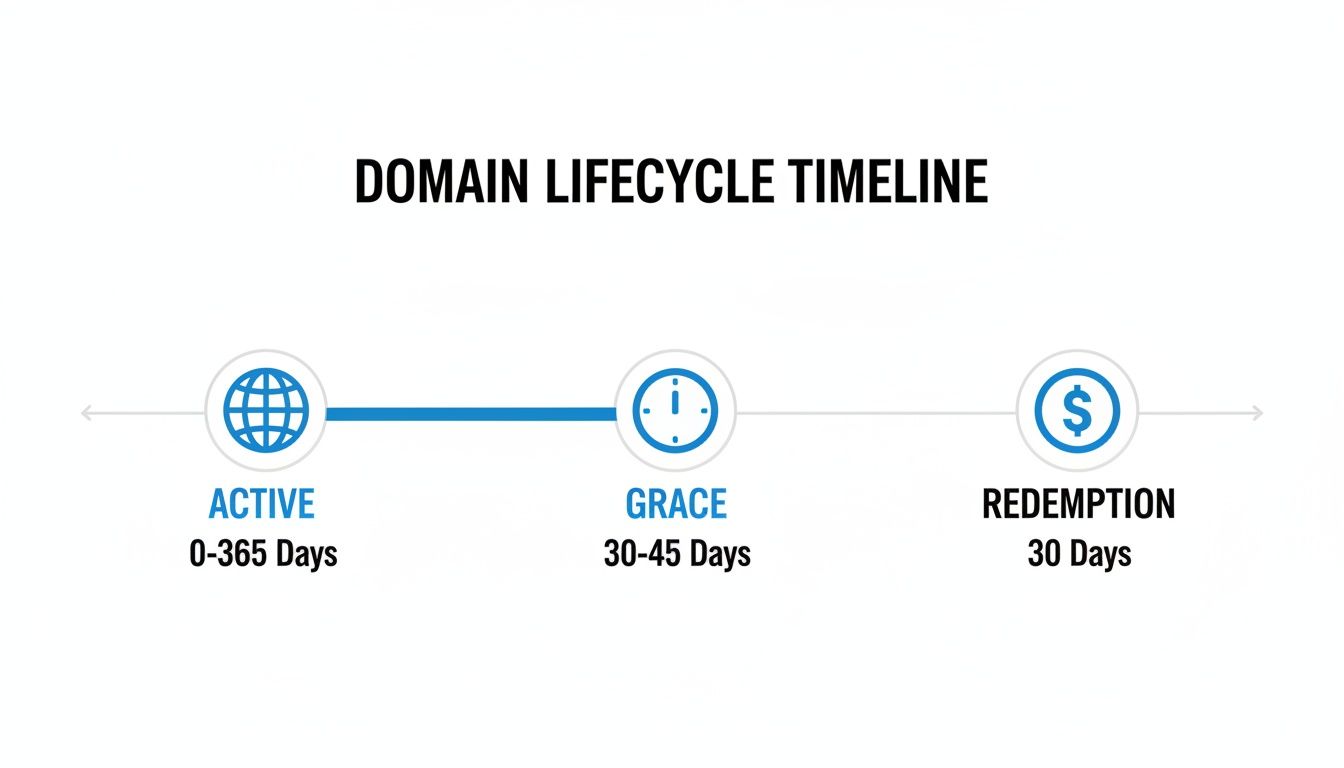
As the graphic shows, there are specific windows of opportunity—the grace and redemption periods—that give you a good idea of when a domain might become available.
A Goldmine of Opportunity
The scale of this opportunity is staggering. With global domain registrations pushing past 370 million, millions of domains are constantly cycling toward their expiration dates. Most owners just rely on automated email reminders from their registrar, which, as we all know, often get lost in a crowded inbox or a spam folder. These simple mistakes lead to countless accidental drops.
For the most common types of domains, ICANN's standardized lifecycle creates a fairly predictable timeline you can follow. Once a domain expires, it typically enters a 30 to 45-day "renewal grace period." After that, it moves into a 30-day "redemption period," where the original owner can still get it back, but usually for a much higher fee.
To give you a clearer picture, here’s a breakdown of what happens after a domain passes its expiration date. This table shows the typical flow for generic top-level domains (like .com or .net) and what each phase means for you as a potential buyer.
Key Stages of a Domain's Expiration Journey
| Stage | Typical Duration | What It Means for You |
|---|---|---|
| Active | Up to 10 years | The domain is registered and in use. You can only acquire it through a direct sale with the owner. |
| Expired / Grace Period | 30-45 Days | The owner failed to renew. They can still reclaim it at the standard renewal price. You can't register it, but you can place a backorder. |
| Redemption Period | 30 Days | The owner can still recover the domain, but it'll cost them a hefty fee (often $100+). This is a strong signal the domain might drop. |
| Pending Delete | 5 Days | The final stage. The domain is locked, and no one can recover it. At the end of this period, it will be released to the public. |
Understanding these windows is key. The period after the grace period ends is when things get really interesting for domain hunters.
The secret to success isn't just finding a cool domain; it's understanding its journey. Knowing the difference between the grace period and the redemption period is what separates amateurs from pros who consistently acquire high-value digital assets.
This process turns what seems like a simple date on a calendar into a calculated strategy. Knowing the stages is one part of the equation, but it's just as important to understand what makes a domain valuable in the first place. For a deeper dive on that, you might find our guide on how to value domain names useful.
Finding Expiration Dates with Manual Lookups
Alright, let's roll up our sleeves and do some old-school detective work. The classic way to find out when a domain expires is through a good old WHOIS lookup. Think of it as the public phonebook for domain names—it holds the registration details that can tell you a lot about a domain's history and current status.

You’ll find dozens of free web-based WHOIS tools online. Just pop in the domain you're curious about, hit search, and the tool will spit out a block of text. The golden nugget you’re looking for is the "Registry Expiry Date." That’s the official date the domain's current registration term is up.
The Privacy Shield Problem
Seems simple enough, right? Well, you'll pretty quickly run into a massive roadblock: domain privacy.
Most domain owners enable privacy protection services, which swap out their personal contact information for generic proxy details from their registrar. It’s a great feature for preventing spam, but it often hides the expiration date, leaving you at a dead end. Bummer.
When you see information from a service like "Domains By Proxy" or "PrivacyProtect.org," you know the real details are masked. It's a huge frustration when you’re trying to track a specific, high-value domain.
The Inefficiency of Manual Checks
Even when the data isn't hidden, trying to hunt for domains at any real scale using manual lookups is just plain impractical. You'll run into some serious real-world limitations.
- You'll Get Blocked: Registries and registrars have strict rate limits on WHOIS lookups to stop abuse. If you query too many domains in a short time, your IP address will get temporarily blocked.
- It's a Time Sink: Can you imagine checking dozens, or even hundreds, of domains one by one? It's a painfully slow, tedious process that just doesn't scale.
Manual lookups are a fantastic starting point for investigating a single domain. But when you want to find multiple expiring domains or hunt for recently available ones, it's like trying to find a needle in a haystack with a pair of tweezers—possible, but incredibly inefficient.
This is exactly why dedicated platforms exist. Instead of burning hours on manual checks that might not even give you an answer, you can jump straight to curated lists. For instance, you could browse a list of Expiring domains that are dropping in the next 7 days, or go straight for the gold with a list of Available domains that you can register right now. It transforms a frustrating manual task into a strategic search.
Smarter Ways to Track Multiple Domains
Manually checking domains one by one is a fast track to burnout. Seriously. If you're trying to find high-value names, you need a system that works for you, not the other way around. It's time to ditch the single lookups and get more efficient.
The good news? You don't have to do all the heavy lifting yourself. A whole ecosystem of services has popped up to solve this exact problem, turning a mind-numbing task into a real strategic advantage.
Building Your Domain Watchlist
Instead of plugging in names at random, the smart move is to build a curated watchlist. Think of it as your personal radar for the domains you actually care about.
Specialized tools and even some registrars offer features that let you compile a list of targets. Once they're on the list, you get automated alerts as their expiration dates get closer. This completely changes the game. You're no longer reacting to a domain drop; you're anticipating it.
Setting up alerts gives you a heads-up 30, 14, or even 7 days before a domain is set to expire. That's plenty of time to get your acquisition strategy in order. A solid system for domain name monitoring is a must for anyone who wants to capitalize on expiring assets without spending all day refreshing WHOIS records.
The real power isn't in knowing a single expiration date. It's having a system that tracks dozens of potential assets at once, pinging you the moment an opportunity pops up. This frees you up to focus on strategy instead of grunt work.
Using Indirect Clues to Gain an Edge
Sometimes, direct data just isn't there, especially when privacy services get in the way. This is where you have to get a little clever and start looking for indirect signals that hint at a domain's status. These methods won't give you a precise expiration date, but they offer invaluable context.
Here are a couple of my favorite detective tactics:
- DNS Record Changes: Has the owner suddenly nuked the DNS records? That's a huge red flag that the domain is no longer in active use. It isn't a direct sign of expiration, but it’s a strong hint the owner has walked away.
- Website Archives: Tools like the Wayback Machine are great for estimating a domain's age and activity. If a site hasn't been updated in years, it’s far more likely to be forgotten about and eventually allowed to expire.
When you start combining direct monitoring with these indirect clues, you get a much fuller picture. While you're waiting for an alert from your watchlist, you can use these other signals to prioritize which domains are most likely to drop. It’s a multi-pronged approach that helps you find when a domain expires with far greater efficiency—and stay ahead of the competition.
Using Automation to Snag Domains First
This is where the game completely changes. Manual lookups and basic watchlists are great for dipping your toes in the water, but if you want to compete with the pros, you need to bring in the big guns. Automation is the secret weapon that turns the frustrating hunt for expired domains into a streamlined, strategic operation.
Instead of spending hours manually trying to figure out when a domain expires, platforms like NameSnag do the heavy lifting for you. We're talking about systems that scan over 170,000 domains every single day, analyzing each one for hidden value. It’s like having a tireless team of researchers working around the clock.
Decoding Value with Smart Metrics
The real magic isn't just in the scanning; it's in the analysis. A domain might be old, but is it actually valuable? An automated platform answers this question instantly using powerful, data-driven metrics.
For example, NameSnag uses a proprietary "SnagScore" that acts like a credit score for domains. It instantly tells you if a domain is a gem or junk by crunching data from multiple sources at once:
- Trust Flow and Citation Flow: These metrics from Majestic measure a domain's trustworthiness and link equity.
- Referring Domains: It counts how many unique websites link to the domain, a key SEO factor.
- Domain Age: Older domains often carry more authority.
- Brandability: The system even assesses how memorable and marketable the name is.
This kind of multi-faceted analysis saves you from falling for a domain that looks good on the surface but has a toxic backlink profile lurking beneath. Our guide on how to automate your due diligence dives deeper into how this process protects your investments.
Filtering Your Way to the Perfect Domain
The sheer volume of expiring domains can be overwhelming. Before you can really take advantage of this flood of data, it helps to understand what is workflow automation is all about and how it can cut through the noise. Once you get the concept, you can use powerful filters to zero in on exactly what you need.
Here’s a look at the NameSnag dashboard, where you can filter for domains that are currently in their grace period and will be dropping soon.

The interface allows you to instantly sort by metrics like SnagScore, age, or referring domains to surface the best opportunities first. A pro-tip tactic is to use the time filters. Are you looking for a quick win? Check the domains dropping 'Today' or in the next '3 Days'. Planning ahead? Set the filter to '14 Days' or '30 Days' to prepare your strategy.
Need a short, memorable name for a new startup? You can filter by character count and keyword. This level of control is just impossible with manual methods.
The goal of automation isn't just speed; it's precision. It lets you define your ideal domain profile and then brings those opportunities directly to you, cutting out 99% of the noise.
You can instantly switch between finding domains that are about to drop or filtering for ones you can register on the spot. With the domain market exploding, automation is no longer a luxury—it’s a necessity. Millions of domains lapse each year, many with untapped SEO value from years of backlinks just sitting there. This massive pool of opportunity is where automation truly shines.
Avoiding Common Pitfalls in the Domain Hunt
Hunting for expiring domains can feel like a thrilling chase, but it’s a field absolutely littered with hidden traps. The biggest danger isn’t missing a drop; it’s snagging a domain with a toxic past that can torpedo your SEO efforts from day one. You have to be a bit of a digital archaeologist, digging into a domain's history before you even think about acquiring it.
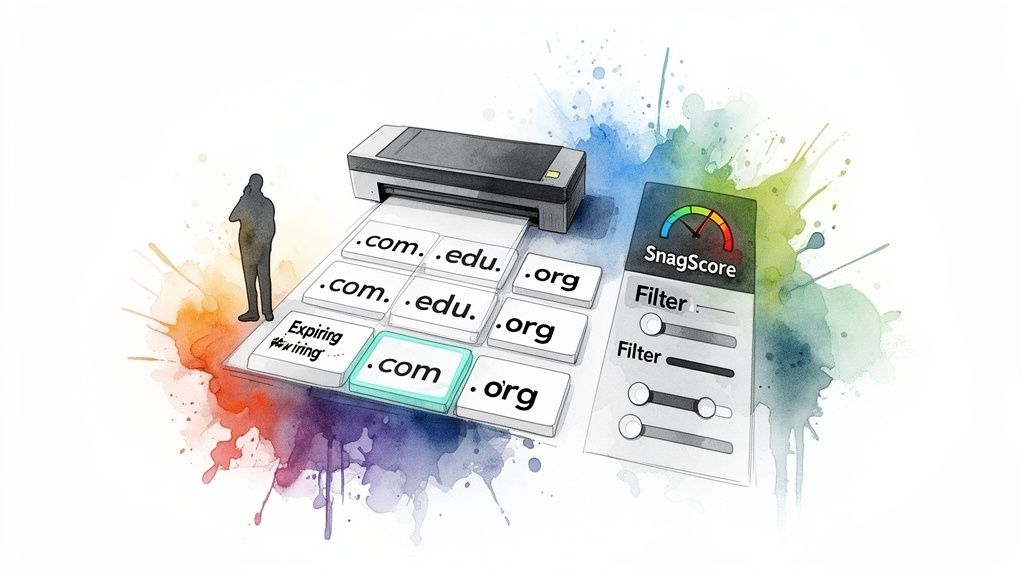
So many newcomers make the same mistake: they fall for a single vanity metric like Domain Authority (DA). While DA can be a useful starting point, it doesn't come close to telling the whole story. A high DA score can easily mask a history of spammy backlinks or even a lingering Google penalty. To figure out if a domain is actually worth your time, you need a much more complete picture.
Look Beyond the Surface-Level Metrics
A truly valuable domain has a clean bill of health across multiple dimensions. This means you’ve got to dig deeper than a single score and look for red flags that could come back to haunt you.
Here are a few critical checks you should never, ever skip:
- Backlink Profile Audit: Was this domain part of a spam network? Look for links from irrelevant, low-quality, or foreign-language sites. A sudden, massive spike in backlinks is also a huge warning sign.
- Historical Content Review: Use the Wayback Machine to see what the site used to be. You need to make sure it wasn't a hub for adult content, gambling, or anything else that might have earned it a penalty.
- Manual Penalty Check: Once you actually own the domain, connect it to Google Search Console immediately. It will tell you flat out if there are any manual actions against the site that need to be addressed.
Tracking domains is more critical than ever, with global registrations hitting 371.7 million by the end of Q2 2025. Millions of these domains lapse every single quarter, often just because owners miss the renewal notices. This is where NameSnag comes in, processing over 170,000 domains daily. Its SnagScore metric blends multiple data points—like Majestic Trust Flow, Ahrefs backlinks, and Moz DA—while running spam checks to help you avoid the estimated 20-30% of dropped domains that carry penalty risks.
Understand the Nuances Between Extensions
Another common pitfall is assuming all domain extensions follow the same rules. They don't. Not even close.
The expiration lifecycle for a .com is a world away from a country-code extension like .co.uk or .de. Some TLDs have much longer redemption periods, while others might have strict residency requirements just for registration.
Before you get your heart set on a specific domain, take a few minutes to research the rules for its particular TLD. Understanding these differences can save you from costly mistakes and ensure the domain you're targeting is one you can actually acquire and use. Before you dive deep into automated tracking, it’s also a good idea to understand the answer to "Is website scraping legal?" to stay on the right side of the law.
The ultimate goal isn't just to find when a domain expires; it's to acquire a valuable asset, not a hidden liability. A few extra minutes of due diligence can be the difference between a massive SEO win and a huge headache.
Still Have Questions? Let's Clear a Few Things Up
Got a few questions still rattling around? You're not the only one. The world of expiring domains has its own quirks and lingo. Here are the straight answers to some of the most common things people ask when they're figuring out how to find when a domain expires and snag the good ones.
What's the Real Difference Between "Expired" and "Expiring"?
This one trips people up constantly, but the distinction is everything.
An "expiring" domain is like a house with a "Coming Soon" sign in the yard. It's getting close to its expiration date and is probably in a grace period where the current owner can still easily renew it. You can't register it just yet, but it’s definitely one to put on your watchlist.
An "expired" domain—often called a "dropped" or "available" domain—is the house that’s officially on the market. It has gone through all the grace and redemption periods, and the "For Sale" sign is up for anyone to make a move. You can register it immediately.
Think of it this way: Expiring is your heads-up. Available is your green light.
This is a crucial piece of the puzzle for your strategy. At NameSnag, we make it simple to separate the two. You can browse our lists of Expiring domains to get a jump on the competition or filter right down to the Available domains you can register this very second.
Can I Find the Exact Moment a Domain Will Drop?
If only it were that easy. Unfortunately, you can't pinpoint the drop to the exact second. The process just isn't perfectly synchronized across the entire internet.
After a domain’s redemption period is over, it enters a "pendingDelete" status for roughly five days. It will become available to the public sometime during that window, but the precise time varies from one registrar to another. This unpredictability is a massive reason why automated monitoring and backordering services are so popular—they do the obsessive refreshing for you.
Is It Legal to Register an Expired Domain?
Absolutely, 100% legal. Once a domain makes its way through all the renewal and grace periods without the original owner stepping in, it goes right back into the public pool of available names.
Registering it is a standard, everyday practice in the domain industry. The only real hiccup you could face is trademark infringement. If the domain name itself is a registered trademark ("cocacola.net" for example), you could find yourself in hot water. A quick trademark search is always a smart move before you decide to build a brand on an expired name.
How Does Domain Privacy Mess Up My Search?
Domain privacy is the bane of anyone doing manual research. These services are designed to mask the owner's personal details—and that often includes the expiration date—in public WHOIS records. They just replace it with generic proxy information.
While it’s great for the owner's privacy, it throws up a brick wall for you. This is another area where automated platforms have a huge advantage; they often use registry-level data or other signals to figure out a domain's status, completely bypassing the limitations of a public WHOIS lookup.
Ready to stop guessing and start finding high-value domains with precision? NameSnag uses AI-powered analysis to surface the best expiring and available domains daily, so you can find gems without the grunt work. Explore our curated domain lists today!
Find Your Perfect Domain
Get access to thousands of high-value expired domains with our AI-powered search.
Start Free Trial