Let's be real: due diligence automation is just a fancy way of saying you're using software to handle the soul-crushing research that comes with vetting domain names. It’s the magic wand that turns hours of tedious manual work—checking domain authority, digging into history, and analyzing backlink quality—into a few satisfying clicks. It's how you stop drowning in spreadsheets and start finding digital gold.
Why Manual Domain Vetting Is a Broken Strategy
Remember the digital gold rush for the perfect domain? For many of us, it was less of a rush and more of a painful slog. You’d spend countless hours glued to a screen, juggling a dozen browser tabs for Moz, Ahrefs, and Majestic. Each potential domain demanded the same painstaking routine: copy, paste, cross-reference, and then make a gut-wrenching guess. It was a treasure hunt where the map was torn, coffee-stained, and mostly useless.

This manual grind wasn't just tedious; it was fundamentally broken. It was a strategy built on wasted time and missed opportunities. Finding just one promising domain could burn an entire afternoon. And even then, you might miss a critical red flag buried deep in its history, turning your treasure into trash.
The Real Cost of Doing It the Hard Way
The true cost of manual vetting goes way beyond the hours you log. It’s about the killer domains that slipped through your fingers while you were busy checking metrics for a dud. It’s the burnout that hits when you're staring at spreadsheets until your eyes glaze over. This old, inefficient approach creates some very specific problems:
- Opportunity Cost: Every minute spent on manual checks is a minute you're not spending on actual strategy. The best domains are often snapped up in seconds, a speed that no manual process can ever hope to match.
- Human Error: Let's be honest—manual data entry is a recipe for disaster. A single typo or a misread metric could lead you to invest in a worthless domain or, even worse, one with a toxic, spam-filled past. Yikes.
- Incomplete Picture: Trying to stitch together data from multiple tools gives you a fragmented, incomplete view. You might see a high Domain Authority on one platform but completely miss the spammy backlink profile that another tool would have revealed. Bad data leads to bad decisions.
The old way forces you to be a data entry clerk, not a strategist. It's a system where you work for the data instead of making the data work for you.
Ultimately, this old-school approach is like trying to build a modern skyscraper with a hammer and a handful of nails. It’s slow, exhausting, and incredibly prone to costly mistakes.
The constant need for domain name monitoring just adds another layer of complexity. It's clear that this broken strategy is crying out for a smarter solution, which is exactly why due diligence automation isn't just a luxury anymore. For anyone serious about success, it's a necessity.
What Exactly Is Due Diligence Automation
So, what are we really talking about with due diligence automation? Let's cut through the jargon.
Imagine hiring a ridiculously smart, lightning-fast research assistant. This person works 24/7, never sleeps, never takes a coffee break, and can tear through a mountain of data in seconds flat. That, in a nutshell, is automation in the world of domaining and SEO.

Think of it like a bouncer at an exclusive club, but for domains. Its only job is to automatically check thousands of potential names against your specific criteria, letting only the true VIPs past the velvet rope. It’s a system built to replace the grueling hours you’d otherwise spend gathering data by hand.
From Manual Grind to Automated Gold
Instead of you manually copy-pasting domains into a dozen different tools, an automated system does all the heavy lifting. It works tirelessly in the background, checking all the vital signs of a domain’s health and potential.
These automated workflows are set up to do things like:
- Check Key Metrics: Instantly pull stats like Domain Authority (DA), Page Authority (PA), and Trust Flow.
- Analyze Backlink Quality: Dig into the backlink profile, looking for high-quality links from trustworthy sources like .edu and .gov sites.
- Flag Spam Signals: Sniff out red flags like a history of spammy tactics or toxic links, keeping your portfolio clean.
- Estimate Potential Value: Use a combination of metrics to give you a quick snapshot of what a domain might be worth.
This shift is more than a simple time-saver; it’s a strategic game-changer. Across all sorts of industries, AI-powered automation is gutting the grunt work. It’s now handling a staggering 70–90% of the data assembly that once chained analysts to their desks. For domain hunters, this turns a multi-hour manual chore into an instant, data-rich report, letting you focus on strategy instead of spreadsheets.
How NameSnag Automates Your Search
NameSnag is a perfect example of this in action. We built our entire platform to solve this exact problem. Every single day, our AI-powered engine analyzes over 170,000 domains, running them through a tough due diligence process so you don’t have to.
Due diligence automation isn't about replacing your expertise—it's about amplifying it. It handles the monotonous data collection, freeing you up to make the smart, strategic decisions that actually drive growth.
For instance, you can effortlessly find Available domains that were just dropped and are ready for registration. Or, if you're planning ahead, you can scout Expiring domains to see what valuable assets are about to hit the market. You can even filter these lists by timeframes like Today, 3 Days, or 7 Days to narrow your focus.
By using a powerful expired domain finder, you’re essentially putting your research on autopilot. You set the rules—like minimum authority scores or specific keywords—and the system brings you a curated list of top-tier opportunities. It turns a once-daunting task into an exciting treasure hunt.
The Five Pillars of Automated Domain Analysis
So, you get it. Automation is the secret weapon. But what actually separates a great automated due diligence system from a mediocre one? It’s not about finding a domain with one shiny metric, like a high Domain Authority. That’s like buying a car just because it has a cool paint job, without ever bothering to check the engine.
A smart automated system gives you a holistic view, looking at the entire picture to separate the digital gold from the digital junk. To do this, it has to evaluate five critical pillars. These are the non-negotiables that platforms like NameSnag bake right into their core logic, giving you a complete report card on every single domain.
Pillar 1: Authority and Trust Metrics
First up are the heavy hitters: authority and trust. Think of these as the SEO world's version of a credit score, telling you how reputable a domain is in the eyes of search engines. Metrics like Moz's Domain Authority (DA) and Majestic's Trust Flow (TF) are the foundation here.
A high DA suggests a domain has the raw potential to rank well, while a strong TF indicates its backlink profile is built on quality, not spam. A good system doesn't just pull these numbers; it uses them as the very first filter to weed out the weak contenders. It saves you from wasting a single second looking at domains with zero clout.
Pillar 2: Backlink Profile Quality
This pillar goes way deeper than just a single score. A domain’s history is written in its backlinks, and an automated analysis digs into the quality and diversity of every single link pointing to it.
It’s programmed to hunt for the good stuff:
- Referring Domains: How many unique websites link to this domain? A high number is a fantastic sign of broad authority.
- High-Value Links: Are there links from powerful .edu or .gov sites? These are like letters of recommendation from the most respected institutions online.
- Link Relevance: Do the links come from websites in a similar niche? Contextually relevant links are pure SEO gold.
This automated check ensures the domain’s authority is the real deal—not just propped up by spammy, irrelevant links that could actually do more harm than good.
Pillar 3: Domain History and Age
A domain's past can be a goldmine or a minefield. An older domain often carries more weight with search engines, but only if its history is clean. This is where automation becomes your own private investigator.
The system will automatically scan for critical historical data points. It looks at the domain's age, how many times it has been dropped and re-registered, and whether it was ever used for shady, spammy purposes. A clean bill of health here is non-negotiable. To really go deep on this, check out our guide on how to evaluate domain name reputation and sidestep those hidden pitfalls.
A great domain is like a vintage wine—its age adds value, but only if it's been stored properly. Automation checks the cellar for you, ensuring you're not buying a bottle of vinegar.
This is a space where automation is making huge waves beyond just domaining. The broader Commercial Due Diligence market is expected to surge from $2.51 billion in 2026 to $5.01 billion by 2035, driven largely by this shift from tedious manual scans to AI-powered insights. This trend directly mirrors how domain investors now filter for gems, as you can see in this detailed report.
Pillar 4: Brandability and Keyword Relevance
Metrics are crucial, but let's be honest, the name itself matters. Is it a jumble of keywords and hyphens, or is it a catchy, memorable brand just waiting to be born? An automated system can analyze a name for key brandability factors.
This includes its length, ease of spelling, and pronunciation. It can also flag the presence of valuable commercial keywords, which can give you a massive head start in ranking for profitable search terms. This pillar makes sure you don't just find a domain that's technically strong, but one that people can actually remember and type into their browser.
Pillar 5: Niche Fit and Commercial Intent
Finally, a domain has to fit your goals. Are you building an affiliate site about coffee? Then a domain with a history of content about pet grooming is a terrible fit, no matter how great its metrics are.
Due diligence automation helps by analyzing the domain's past content and backlink anchors to figure out its topical relevance. This helps you quickly find domains that are already primed for your niche. By combining all five pillars, a tool like NameSnag can generate a proprietary SnagScore, giving you a single, reliable number that reflects the domain's true potential. It's the ultimate shortcut to making a smart, informed decision.
How to Build Your Own Domain-Hunting Machine
Alright, theory is great, but let's get our hands dirty. Building your own due diligence automation workflow is like creating a personalized treasure map where 'X' marks every single high-value domain worth your time. It sounds complicated, but it's actually way more fun—and a lot less work—than you might think.
We're going to walk through a simple, step-by-step strategy to turn your domain hunting from a manual slog into an automated quest for gold. Ready?
Step 1: Define Your Perfect Domain
First things first: you can't find what you're looking for if you don't know what it is. Before you even think about touching a filter, you have to define your "perfect" domain. This isn't about some mythical unicorn; it's about setting clear, realistic criteria that actually match what you're trying to accomplish.
Ask yourself a few honest questions:
- What's the end game? Am I building an SEO powerhouse from the ground up, launching a memorable new brand, or just looking for a quick flip?
- Which metrics really matter? For an SEO play, you'll probably obsess over a high SnagScore and a boatload of referring domains. For a brand, things like catchiness and domain length are king.
- What are my non-negotiables? Maybe you'll only consider domains that are at least five years old or have a squeaky-clean drop history.
Nailing this down upfront is the most critical part of the whole process. It's the blueprint for your entire automation system, making sure you only focus on domains that will actually move the needle.
Step 2: Set Up Your Custom Filters
Once you have your blueprint, it’s time to teach your automated assistant what to hunt for. This is where you translate your ideal domain criteria into a set of powerful, targeted filters. Think of this as your command center in NameSnag for digging up hidden gems.
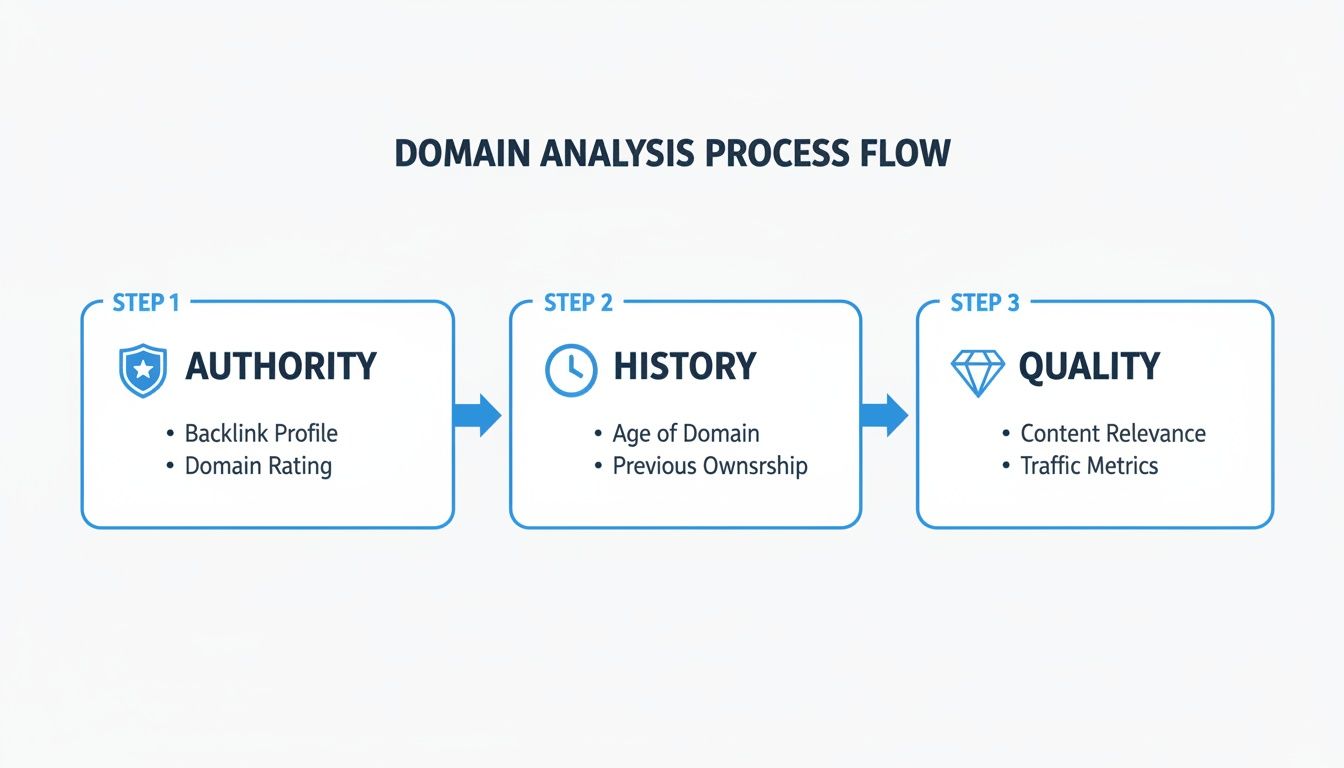
This is where the magic of due diligence automation really comes alive. You can set specific thresholds for metrics like a minimum SnagScore, the domain's age, and the number of referring domains. You can even filter by keywords to find names that are hyper-relevant to your niche. You set the rules once, and the system hunts for you 24/7.
Step 3: Hunt in the Right Places
With your filters locked and loaded, you can now point your system toward two key hunting grounds, each serving a different strategy.
- For Instant Wins: Jump into the Available domains list. These are domains that were recently dropped and are ready for you to register right now at any registrar. No auctions, no backorders, no waiting—just pure, instant gratification.
- For Future Opportunities: Scout the Expiring domains list. These domains are in their grace period and will be dropping soon. This is like having a crystal ball, giving you a heads-up so you can plan ahead and be ready to snatch a monster domain the second it’s released.
You can also use time filters like "Today" or "3 Days" on both lists to see the absolute freshest finds. This is your playground for discovery.
Step 4: Automate Your Alerts
The final, game-changing step is to put the entire workflow on complete autopilot. The best domains get grabbed in a flash, and you can't be chained to your computer all day. That’s where Watchers come in.
Simply set up a Watcher in NameSnag using the exact same criteria you defined back in Step 2. The second a domain matching your filters appears—whether it's available now or expiring soon—you get an instant notification.
This is the ultimate "set it and forget it" strategy. Your automated workflow is no longer just a search tool; it's a vigilant scout that works for you around the clock, ensuring you never miss out on that perfect domain again.
This proactive approach flips the script entirely. You're no longer hunting for domains; the domains are now finding you.
So You Found a Domain… Now What?
Alright, you did it. You set up your automated workflow, unleashed your digital scout, and managed to snag a killer domain with stellar metrics. The question is, what happens now? A great domain is a lot like a perfectly aged piece of lumber—its real value only comes out when you build something amazing with it.
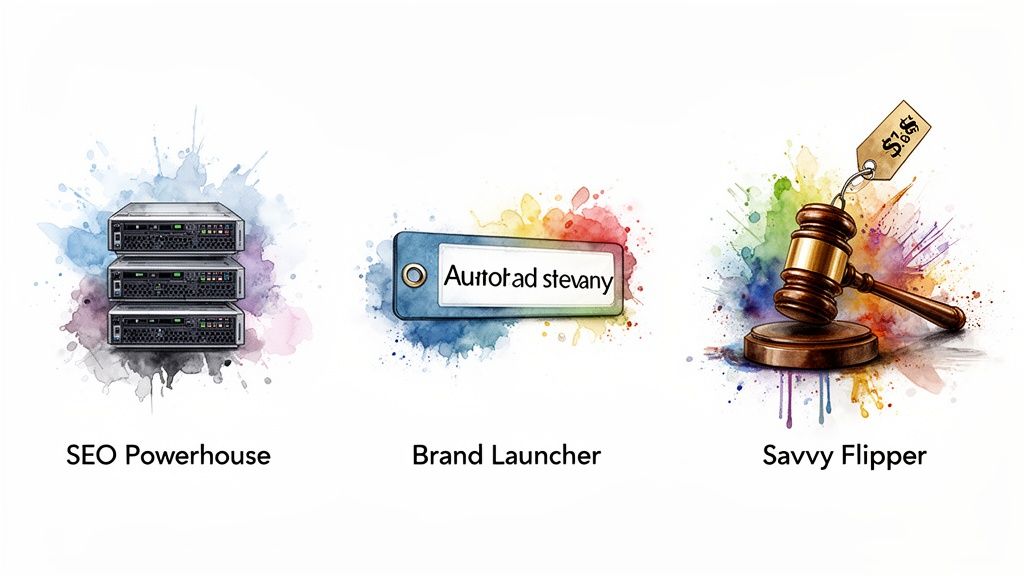
Finding the domain is just the beginning. Let's dig into three of the most powerful ways you can turn those automated finds from lines on a spreadsheet into real, tangible business assets.
Become an SEO Powerhouse
This is the classic play, and for good reason. You find an aged domain with a squeaky-clean backlink profile and some solid authority. This isn't just a blank canvas; it's a launchpad with a rocket already strapped to it.
Imagine grabbing a domain that once belonged to a respected industry blog. It already has dozens of high-quality links from authoritative sites pointing its way. Instead of starting from scratch and begging for links, you inherit all that built-in trust from day one.
Here’s how people put this to work:
- Build a Niche Authority Site: You can build out a brand-new website on this domain and immediately benefit from its existing SEO juice. Your content gets a serious head start in the search results, letting you rank far faster than competitors grinding it out on fresh domains.
- Create a Private Blog Network (PBN): For the more advanced SEO crowd, these domains can become powerful assets in a private network. This is a high-level tactic used to strategically pass authority to your main money sites. It requires care, but the results can be massive.
This whole strategy is about leveraging history. Your automated due diligence is what makes it work, ensuring the domain’s past is a powerful asset, not a hidden liability.
Launch a Memorable Brand
Not every great domain has a sky-high SnagScore. Sometimes, the real gold is in the name itself—something short, catchy, and unforgettable that’s perfect for a new startup, product, or personal brand.
Think about the last time you tried to find a simple, available .com for a new idea. It’s a soul-crushing experience, right? Everything good feels like it's already taken. This is exactly where your automated hunter shines. By setting up filters for things like domain length, character count, or specific keywords, you can spot gems that everyone else misses.
An incredible brand name builds instant credibility and sticks in the minds of your customers. Due diligence automation helps you find that perfect name without manually checking ten thousand terrible options.
You might be looking for Available domains to register this second for a project you're launching next week. Or maybe you're scouting Expiring domains for that perfect brand name about to drop. This approach is less about SEO metrics and all about capturing a piece of premium digital real estate.
Become a Savvy Flipper
Finally, there’s the art of the flip. This is for the domain investors who love the thrill of the hunt and the satisfaction of a profitable sale. The goal here is simple: use due diligence automation to identify undervalued assets, acquire them, and then sell them for a significant profit.
Your automated system acts like a stock market scanner, flagging domains with strong metrics that are priced well below their actual potential. You're hunting for that perfect combination of authority, age, backlink quality, and commercial appeal.
The global Due Diligence Investigation Market is projected to double from $8.5 billion to $16.7 billion by 2034, largely because AI integrations are slashing the time it takes to do manual reviews. For domain flippers, this means automation is no longer just a trend—it's an absolute necessity for spotting high-value assets in a sea of noise and saving countless hours on vetting. You can read more about these market shifts in this detailed analysis.
This approach turns your domain hunting skills into a direct revenue stream. It's pure arbitrage, powered by data.
Your Due Diligence Automation Questions Answered
Alright, we’ve covered a lot of ground. We've talked about why manual vetting is a dead-end street and how to build your own domain-hunting machine. Even so, a few key questions always seem to pop up. Let's tackle them head-on.
Think of this as the final sit-down with your super-smart research assistant. We’ll pull back the curtain on the mechanics, get real about the human element, and point out the one giant pothole you absolutely must avoid.
How Is a Score Like SnagScore Calculated?
This is the big one, and for good reason. It’s natural to look at a single number and wonder, "Okay, but what's really under the hood?" A composite metric like SnagScore isn’t just pulled out of thin air; it’s the result of a complex, multi-layered analysis.
Imagine you're judging a talent show. You wouldn't base your final call on just one skill, right? A great performer needs stage presence, technical ability, creativity, and a connection with the audience. A perfect score in one area doesn't mean much if the others are disasters. SnagScore looks at domains the exact same way.
It’s a proprietary algorithm that blends multiple critical data points into one actionable number. The core ingredients include:
- Authority & Trust: This is the bedrock, pulling in metrics like Domain Authority (DA) and Trust Flow (TF) to gauge a domain's raw power and reputation.
- Backlink Quality: It goes way beyond just counting links. The system analyzes the number of unique referring domains and actively scouts for high-value links from .edu and .gov sources.
- Domain History: The score factors in the domain's age and its drop history, rewarding longevity and stability while penalizing frequent, spammy-looking drops.
- Brandability: The algorithm also considers qualitative factors like the domain's length and keyword relevance—giving a nod to names that are memorable and commercially viable.
By weaving all these elements together, SnagScore gives you a holistic snapshot. It saves you from the classic trap of falling for a "one-hit wonder" domain that looks great at first glance but is hiding some serious flaws.
Can Automation Truly Replace Human Intuition?
This question gets to the heart of the matter. The short answer? No. And it shouldn't. The whole point of due diligence automation isn't to replace your strategic brain; it's to supercharge it by getting all the grunt work out of your way.
Think of a master chef and their kitchen brigade. The prep cooks handle all the tedious, time-sucking tasks—chopping vegetables, measuring ingredients, keeping the stations clean. This doesn't make the chef obsolete. Quite the opposite. It frees them up to focus on the high-level artistry: designing the recipe, balancing flavors, and plating the final dish to perfection.
Automation is your brigade of prep cooks. It handles the mind-numbing data collection, cross-references thousands of metrics in seconds, and serves you a curated list of prime opportunities.
Automation handles the data so you can handle the decisions. It’s not about replacing your gut feeling; it’s about giving your gut feeling much better information to work with.
Your experience, your knowledge of the market, and your creative vision are still the most valuable assets you have. You're the one who can look at a domain and say, "I know exactly how to build this into a killer brand," or "This fits perfectly into the niche I've been researching." The automation just makes sure you're applying that intuition to the very best options instead of wasting it on digital junk.
What Is the Biggest Mistake to Avoid With Automated Tools?
This is probably the most important question of all. The single biggest mistake you can make with any automated tool is relying on a single metric. It's the ultimate rookie error, and it’s a fast track to a bad investment.
It's tempting, isn't it? You see a domain with a Domain Authority of 50 and your eyes light up. But if you don't dig deeper, you might miss that its entire backlink profile is toxic spam from a decade ago. Or you spot a domain with a fantastic Trust Flow but fail to notice the name itself is an unbrandable jumble of hyphens and misspellings.
Focusing on one data point is like trying to navigate a city using only a compass. Sure, it tells you which way is north, but it says nothing about the one-way streets, traffic jams, or construction detours between you and your destination. You need the whole map.
This is precisely why a holistic approach is so crucial. A truly effective due diligence platform is designed to prevent this very mistake by giving you that complete map. It forces you to see the bigger picture by laying out all the key pillars of a domain’s value in one place. Whether you're hunting for Available domains for a project today or scouting Expiring domains for a future gem, the goal is always the same: make a decision based on the full story, not just a flashy headline.
Ready to stop the manual grind and start finding domain gold faster? NameSnag gives you the automated tools you need to vet thousands of domains in seconds. Explore our powerful domain lists and find your next big opportunity today.
Find Your Perfect Domain
Get access to thousands of high-value expired domains with our AI-powered search.
Start Free Trial