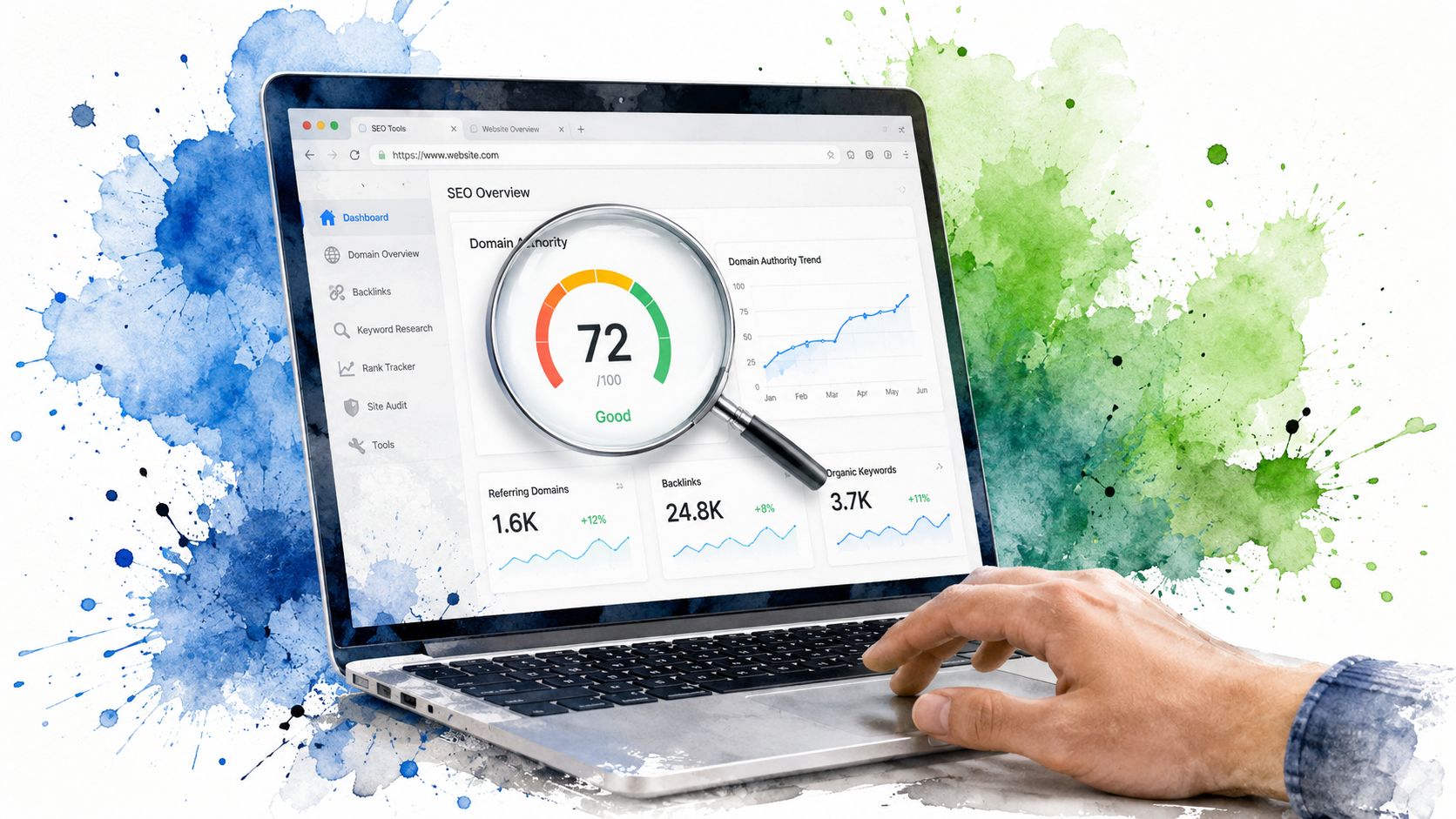
Trying to find Alexa Ranking for a website? Let's get straight to it: you can’t. Amazon pulled the plug on the service back on May 1, 2022, turning the once-dominant metric into a relic of internet history. For over two decades, it was the go-to number for web popularity, but now it's completely offline.
What Happened to Alexa Rank and Why It No Longer Matters
Remember when you could get a quick read on a website's popularity with a single number? For years, that number was its Alexa Rank. It felt like a digital report card, giving domain investors and SEOs a fast way to size up the competition. But if you’re still trying to find it today, you're chasing a ghost.
Let's take a quick trip down memory lane. Launched in 1996, Alexa became the industry benchmark after Amazon snapped it up in 1999 for a cool $250 million in stock. It ranked more than 30 million sites by blending data on daily unique visitors and pageviews. At its height, Alexa.com itself was pulling in over 400 million monthly visitors—a testament to its influence. You can still find echoes of its former glory on pages like SimilarWeb's old profile page.
But even giants can fall, and Alexa’s foundation had some serious cracks.
The Fatal Flaws of a Fallen Metric
The system's biggest weakness was its total reliance on data from users who had the Alexa Toolbar installed. This created a horribly skewed sample that wasn't even close to representing the entire internet.
Here's why it was doomed to become obsolete:
- Desktop Bias: The toolbar was a desktop browser extension. This meant it pretty much ignored the massive, world-eating surge in mobile traffic that now dominates the web.
- Easy to Game: Any savvy (or sneaky) site owner could juice their rank. All they had to do was get their team to install the toolbar and browse their own site all day.
- Inaccurate for Low-Traffic Sites: If a website wasn't in the top 100,000, the rankings were notoriously volatile. They could swing wildly based on the smallest traffic fluctuations, making them almost useless.
The core problem was simple: Alexa Rank measured the browsing habits of a small, specific group of people, not the internet as a whole. Relying on it was like trying to predict a presidential election by only polling people in a single coffee shop.
Understanding these flaws is more than just a history lesson. It's a cautionary tale about the danger of depending on a single, easily manipulated metric. This is a trap for any serious domain investor. The shutdown wasn't just the end of a tool; it was the end of an era, pushing us toward the smarter, multi-faceted metrics we use today. You can learn more about how these old metrics stack up in our article on Alexa Rank, Google PageRank, and domain age.
So, What Replaced Alexa Rank?
If you can't check Alexa Rank anymore, what's a savvy domain investor or SEO to do? You upgrade your toolkit. It's that simple. The game has moved on from chasing a single, notoriously flawed number to interpreting a rich dashboard of data that tells the real story of a domain's worth.
Think of it as trading a blurry, black-and-white photo for a high-definition video. We're no longer guessing; we're analyzing.
This chart neatly sums up the rise and fall of Alexa Rank. It went from the go-to metric for web popularity to a relic of a bygone internet era, all because its foundation was shaky from the start.
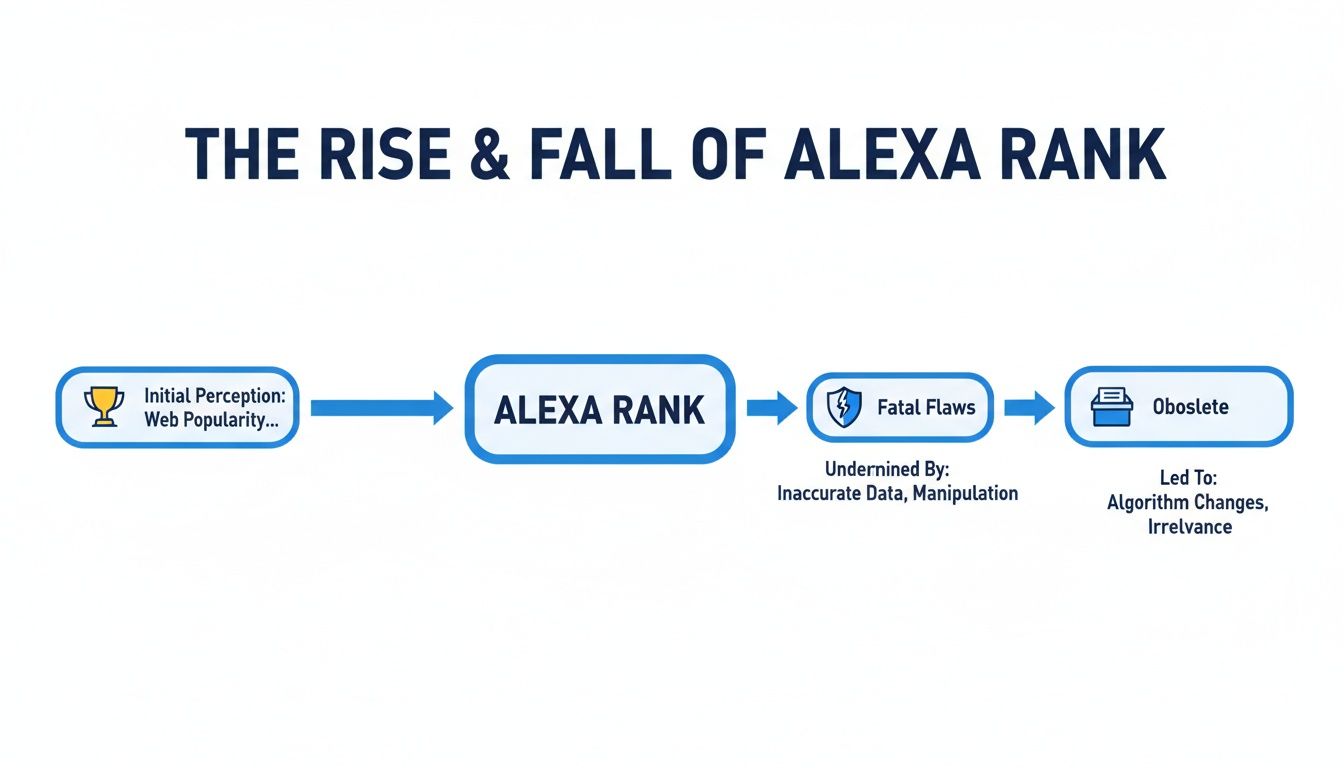
Its fatal flaws—like a sample audience that was easy to game and heavily skewed towards desktop users with a specific toolbar—made its downfall inevitable. Today, we have far more nuanced and reliable metrics at our fingertips.
The New Guard: Modern Authority Metrics
Instead of clinging to one questionable number, the pros now rely on a suite of tools. Each provides a different piece of the puzzle, giving you a 360-degree view of a site’s health and potential. These are the players that matter now.
To give you a quick lay of the land, here’s a breakdown of the top contenders that have effectively taken Alexa's place.
Modern Alexa Rank Alternatives at a Glance
| Metric (Tool) | What It Measures | Best For |
|---|---|---|
| Domain Rating (DR) by Ahrefs | The strength and quality of a site's backlink profile. | Quickly assessing link-based authority and SEO power. |
| Domain Authority (DA) by Moz | A site's likelihood to rank on search engine results pages (SERPs). | Gauging overall ranking potential and comparing with competitors. |
| Authority Score (AS) by Semrush | A composite score measuring link power, traffic, and organic keywords. | Getting a holistic view of a domain's SEO influence and health. |
| Global Rank by Similarweb | A website's total traffic volume compared to all other sites online. | The most direct replacement for Alexa in measuring raw popularity and reach. |
This table is just a starting point. The real expertise comes from knowing how to read these metrics together to uncover the full story.
Here's the quick-and-dirty on each one:
Ahrefs' Domain Rating (DR): This is all about the muscle of a website's backlink profile. It's a logarithmic scale from 0-100, which means jumping from DR 70 to 80 is a much bigger deal than going from 20 to 30. It's my go-to for a fast check on link authority.
Moz's Domain Authority (DA): A long-time industry favorite, DA predicts how well a site will rank in search results. It blends factors like linking root domains and the total number of links into one score. For a deeper dive, our guide on domain name authority checkers is a must-read.
Semrush's Authority Score (AS): This is another link-focused metric, but it also pulls in organic search traffic and keyword data. It gives you a great sense of a domain's overall SEO quality and influence in its niche.
Similarweb's Global Rank: If you're looking for the closest spiritual successor to Alexa Rank, this is it. It's laser-focused on estimating a site's traffic volume relative to every other site on the web. It's perfect for understanding sheer popularity and market reach.
The real power isn't in picking just one of these metrics. It's about synthesis. A site with a high DA but a rock-bottom Trust Flow (a metric from Majestic) probably has a history of spammy links. A high Global Rank from Similarweb but a low DR from Ahrefs might signal tons of social media traffic but very weak SEO footing.
This multi-metric approach is the direct result of Alexa's downfall. Its 20+ year reign ended not with a bang, but a whimper. As far back as 2007, controversies were swirling about its accuracy compared to rivals like comScore. The industry simply got tired of relying on easily manipulated data from an unrepresentative sample.
Today's ecosystem of tools is a healthier, more honest way to value a domain. We've moved from a single, unreliable king to a council of trusted advisors, and with modern top AI data analysis tools, we can process this information faster than ever. It's a better world for it.
How to Analyze Domain Metrics Like an Investor

So you've got the tools. That’s a start. But having a garage full of Snap-on wrenches doesn't make you a master mechanic. The real fun begins when you learn to read the data and connect the dots like a seasoned domain investor. This is where you graduate from collecting numbers to actually spotting opportunities.
It's easy to see a high Domain Authority (DA) and think you've struck gold. But what if that same domain has a Trust Flow in the gutter? That’s a blaring red flag. It’s the equivalent of a business prospect who talks a great game but has a past full of burned bridges and shady deals.
This is precisely the skill that separates the amateurs from serious investors. Anyone can pull a number from a tool. The real value is in interpreting the story those numbers tell when you put them all together.
Decoding the Signals Behind the Scores
Let's get into the guts of it. When you're vetting a domain, you're not just looking for high scores; you're looking for a balanced, healthy profile. A lopsided set of metrics almost always points to trouble.
Think of it like this:
- High Authority, Low Trust: This often screams spam. The domain might have thousands of links propping up its authority score, but a quick look reveals they’re from low-quality, irrelevant, or downright toxic websites. It’s all smoke and mirrors.
- Low Authority, High Trust: Now this could be a hidden gem. It might be a newer domain or one from a niche that doesn’t naturally attract a ton of links. But the links it does have are from highly respected, authoritative sources. This is a diamond in the rough.
- Decent Metrics, Zero Traffic: If Ahrefs and Moz are showing good numbers but Similarweb shows a flatline, be suspicious. The domain was likely used as part of a Private Blog Network (PBN). Its authority is purely artificial, built just to pass link equity, not to attract a single real visitor.
This kind of detective work is the core principle behind our own SnagScore at NameSnag. We built it to do this complex cross-analysis for you, boiling a dozen different data points into one clear score that flags both strengths and weaknesses.
A domain's history is written in its metrics. A clean, powerful backlink profile from relevant, authoritative sites is the holy grail. A profile full of links from foreign-language forums and spammy directories is a clear sign to walk away, no matter how high the DA is.
Your Quick Vetting Checklist
When a promising domain crosses your desk, don't just glance at the headline stats. Run it through this quick mental checklist to get a sense of its real worth.
Check the Authority-to-Trust Ratio: Pull up metrics like Moz's DA and Majestic's Trust Flow (TF). Are they in the same ballpark? A TF that's less than half of the DA is a potential warning that something's off. Dig deeper.
Analyze the Referring Domains: How many unique websites are linking in? More importantly, what's their quality? A domain with 100 links from 10 high-quality, relevant sites is immensely more valuable than one with 1,000 links from 100 spammy ones.
Spot Historical Red Flags: Use a tool to check the domain's history. Has it been dropped multiple times? Do you see sudden, massive spikes and drops in its backlink profile? These patterns can indicate it was used for spam and then abandoned when it got burned.
For domain investors, this level of analysis is non-negotiable. It's how you avoid the duds. You might be searching through recently dropped domains and find one with a killer backlink profile on paper. But a quick check reveals all its links are from a single, low-quality source. That's a lemon.
Smart investors are already using these tactics to find winners. You might uncover promising domains that are available to register right now or spot high-potential names in the list of expiring domains that everyone else has overlooked. It’s all about looking beyond the surface.
Finding High-Value Domains in a Post-Alexa World

So, how do you find the good stuff now that the old, simple method is a thing of the past? You adopt a smarter workflow. The days of manually juggling a dozen metrics across different tools are over. It’s tedious, time-consuming, and frankly, a great way to watch the best opportunities slip through your fingers.
This is where specialized platforms become your unfair advantage for sifting through the digital noise. Instead of chasing ghost data from Alexa, your energy is better spent on a system built for today's market. It’s about turning a frustrating research grind into a streamlined treasure hunt.
Snapping Up Immediately Available Gems
One of the most effective tactics is to hunt for domains that were just dropped. These are names that have gone through their full expiration and grace periods and are now available for anyone to register at a standard price. No auctions, no backorders—just a pure, first-come, first-served opportunity.
This is where a dedicated search tool is invaluable. Imagine being able to filter through thousands of newly available domains based on the exact criteria that actually matter.
For example, a quick search on NameSnag can instantly show you Available domains that are ready to be registered right now.

With a few clicks, you can isolate domains with a high SnagScore, a clean history, and strong backlink profiles, ready for you to secure on the spot.
Instead of just guessing, you can target names based on real data points that signal value:
- SnagScore: A composite score that gives you a quick read on a domain's overall quality.
- Domain Age: Older domains often carry more authority and trust with search engines.
- Backlink Quality: Look for domains with links from reputable .edu or .gov sites.
Using an Available domains filter cuts straight to the chase, helping you find assets you can secure in minutes, not days. This is how smart investors stay ahead of the curve.
The Strategic Advantage of Expiring Domains
While available domains offer instant gratification, there’s another layer to this game: targeting domains that are expiring but not yet dropped. These are domains whose owners have let them go, but they're still lingering in a grace period. This is a golden window of opportunity for the savvy investor.
Think of it like this: available domains are houses on the open market. Expiring domains are like getting a tip from a realtor about a property that’s about to be listed. You get a head start.
By monitoring these soon-to-drop names, you can analyze their metrics, decide on their value, and be ready to pounce the moment they become available. This proactive approach gives you a massive leg up on investors who are just waiting for domains to show up on public lists. Want to see what’s dropping soon? Check out the list of Expiring domains and use the time filters to see what’s coming up in the next 3, 7, or even 30 days.
For those interested in mastering this technique, our complete guide on how to find expiring domain names offers an even deeper look into the strategies that work.
The key is to use filters that let you find high-potential names before they hit the hyper-competitive open market. This shift in mindset—from reactive searching to proactive hunting—is what separates successful domain investing from aimless browsing.
Alright, let's talk about the ghost in the machine. We've gone through the theory and the tools, but nothing drives a point home like a good old-fashioned cautionary tale. And for this lesson, we’re going to look at the very domain that started this whole conversation: alexa.com.
This isn't about dancing on a grave. It's about learning a critical, expensive lesson from the sidelines.
Imagine it's 2026. You, for some reason, decide to find Alexa Ranking for the old king itself. What you'd find is a digital wasteland. It’s a brutal reminder of how fast perceived value can just... vanish. Clinging to a dead metric isn't just a bad habit; it's a recipe for disaster.
The Cold Hard Numbers of a Collapse
The nosedive alexa.com took after its 2022 shutdown is nothing short of staggering. This isn’t a gradual decline; it’s a freefall. It’s the perfect real-world example of what happens when a website loses its entire reason for being.
The traffic data tells a story of total collapse. Its global rank plummeted to #1,085,587 by February 2026, a stomach-churning slide from #915,621 just three months prior. In a single month, traffic dropped by 27.88%.
Even worse, the bounce rate shot up to an abysmal 83.58%. The few visitors who did land on the site stuck around for a pitiful 5 seconds. You can see the full autopsy report for yourself and check out how Semrush now views the former titan.
This isn't just trivia. It's a masterclass in domain decay. What was once a premier digital asset is now a hollow shell with an Authority Score of just 28, propped up only by the ghost of its name.
The Investor’s Takeaway
So, what does this all mean for you? It means that live, relevant data is the only thing that matters. A domain's past glory doesn't pay today's bills, and a high rank from a dead metric is completely, utterly worthless.
Relying on a single, outdated number is like navigating with an old, crumpled map—it won’t just get you lost; it will lead you straight off a cliff. The fall of
alexa.comproves that a domain's value is fluid, demanding constant, multi-faceted evaluation.
This is exactly why your workflow has to be different from the old guard. Stop chasing ghosts.
Your time is far better spent filtering through lists of Available domains you can register right now or strategically watching Expiring domains that carry genuine, present-day authority. Don't invest in history; invest in potential.
Frequently Asked Questions
Alright, let's tackle some of the common questions that always pop up when people start digging into domain metrics, especially after Alexa's departure. Think of this as the "stuff I wish someone had told me" section.
Can I Still Find My Old Alexa Ranking Anywhere?
The short answer is no. When Amazon pulled the plug on May 1, 2022, the entire system and all its historical data went with it. It's a digital ghost.
If you see a site today claiming to show you how to find Alexa ranking data, they're either pulling up ancient, irrelevant numbers or just making things up. It's time to move on. Your focus should be entirely on active, modern tools like Semrush, Ahrefs, or Moz for any real website assessment.
What Is a Good Domain Authority Score to Look For?
This is a great question, and the only honest answer is: "it depends." A 'good' Domain Authority (DA) score is completely relative to the pond you're swimming in.
- A DA of 25 could be phenomenal for a local bakery's website, putting them ahead of every other cake shop in town.
- But that same DA of 25 is barely a blip on the radar for a national e-commerce brand trying to compete with giants.
Instead of getting hung up on a magic number, think of DA as a comparative yardstick. Your goal is to find domains with a higher DA than the sites you're trying to outrank. Always look at it alongside other health signals like spam score and backlink quality. A high DA can be faked with spammy links, so you have to look at the whole picture.
How Do Platforms Like NameSnag Find Good Domains Faster?
It boils down to one thing: brutal efficiency through automation.
Checking a domain's vitals manually is a soul-crushing slog. You're bouncing between different metric sites, running reports, and trying to stitch the data together in your head. That’s easily five minutes burned per domain, if you're quick.
NameSnag automates this whole mess for over 170,000 domains every single day. It pulls key metrics from multiple sources and cooks them down into a single, straightforward 'SnagScore'.
This automation is what lets you apply powerful filters and vet thousands of domains in seconds. You can instantly find domains that meet your exact criteria for backlinks, age, or overall value—all in the time it would take to manually check just a handful. Whether you're hunting for Available domains to register now or watching Expiring domains to catch them before they drop, it's a massive speed advantage.
Ready to stop wasting time and start finding high-value domains? With NameSnag, you get instant access to powerful filtering tools, automated metric analysis, and a treasure trove of domain opportunities. Ditch the manual research and let our platform surface the gems for you. Start your journey with NameSnag today.
Find Your Perfect Domain
Get access to thousands of high-value expired domains with our AI-powered search.
Start Free Trial