
Most advice about PBNs is useless. One camp talks like private blog networks are dead and buried. The other talks like buying expired domains is a cheat code. Both sides skip the part that truly matters: many acquire junk, then build obvious footprints on top of that junk.
That’s why so many PBNs fail. Not because every expired domain is radioactive, but because the average buyer shops by vanity metrics, grabs whatever looks cheap, and hosts the whole mess like they’re trying to get caught. If you want to buy PBN domains and give them a fighting chance, you need a brutal filtering process and the patience to walk away from most candidates.
So You Want to Buy PBN Domains Without Getting Burned
The first myth to kill is that cheap domains are “undervalued opportunities.” Usually they’re just bad buys wearing makeup. Quality PBN domains typically cost between $100-250 per domain, and the practical sweet spot is often domains with Ahrefs Domain Rating in the 10-20 range and at least 10 referring domains. Domains below that threshold are generally not worth buying at any price, while stronger names can climb far above that range, according to Easy Blog Networks on buying PBN domains.

That pricing reality annoys beginners because they want volume. They think ten mediocre domains will outperform three clean ones. In practice, weak domains become maintenance headaches. Toxic domains become liabilities. And “suspiciously cheap” often means somebody else already checked the history and ran away.
Google’s stance on manipulated expired-domain use also matters. If you haven’t read Raven SEO on expired domain abuse, do that before you spend a dime. It’s a useful reality check on where the line sits between reclaiming a domain’s residual value and using it in a way that invites trouble.
What actually gets people burned
The classic mistakes are predictable:
- Buying on one metric: DR, DA, or TF alone tells you almost nothing about whether the domain is usable.
- Ignoring topic drift: A former local charity site turned crypto casino shell isn’t a hidden gem.
- Skipping archive review: If you don’t check historical snapshots, you’re buying blind.
- Trusting marketplace descriptions: Sellers are selling. That’s the job.
Practical rule: Assume every expired domain is guilty until your checks prove it clean.
The cynical truth is simple. Buying PBN domains isn’t about finding a hack. It’s about rejecting garbage faster than everyone else. Most of the work is saying no.
Quality beats inventory
A small stack of believable domains beats a bloated network of obvious throwaways. If a domain has clean history, relevant legacy signals, and enough authority to justify the price, it’s worth your attention. If not, move on. The market is crowded with domains that look decent for five minutes and fall apart under real inspection.
That’s the game. Not magic. Not panic. Just aggressive filtering and discipline.
The Art of the Hunt Sourcing Powerful Domain Candidates
Many waste time at the very start. They scroll giant auction feeds, click whatever looks promising, and drown in junk. A better workflow separates immediate opportunities from watchlist opportunities.
The first bucket is dropped domains you can register right away. The second is domains that are expired, still in a grace window, and likely to become available soon. Those are two different hunting modes, and mixing them up creates sloppy decisions.
Available domains for fast strikes
Freshly dropped domains are attractive because there’s no auction circus. If a domain is available, you can move fast, verify the basics, and register it through your preferred registrar. That’s cleaner than overpaying in a bidding war for a name five other SEOs already noticed.
Use a filtered source of available drops instead of raw lists. Browsing available domains helps narrow the field to names that are already free to register, which is a much better use of time than scraping random registrar pages all morning. If you’re comparing search approaches and want a broader workflow, this guide on how to find expired domains is a solid companion read.
Available names are where you find the occasional overlooked gem. They’re also where you find mountains of nonsense. The trick is speed without recklessness. If the domain checks out, act. If the history feels murky, don’t romanticize it.
Expiring domains for planned plays
Expiring domains are different. They’re not available yet, but they’re close enough that you can start research before everybody piles in. That gives you time to look at archive history, backlink context, and whether the domain even fits the niche you want.
Browsing expiring domains is useful when you want to plan rather than react. This mode suits buyers who’d rather build a shortlist, monitor likely targets, and decide whether a backorder or timed acquisition makes sense.
Here’s the practical difference:
| Domain type | Best use | Main advantage | Main risk |
|---|---|---|---|
| Available | Fast acquisition | Immediate registration if clean | Easy to impulse-buy junk |
| Expiring | Research-heavy targeting | More time to vet before drop | Competition can intensify |
Use time windows like a grown-up
Most hunters default to “today” and miss the bigger pattern. That’s fine if you’re sniping immediate drops, but terrible if you’re trying to build a repeatable sourcing system. Time filters help you move between fresh opportunities and backlog review without losing your place.
A simple way to use them:
- Today when you want quick grabs and have time to inspect domains immediately.
- 3 or 7 days when you want a short working queue with manageable volume.
- 14 or 30 days when you’re hunting by niche and don’t want to miss sleepers.
- All when you’re doing broad pattern research, not active buying.
The best domains rarely announce themselves. They look boring until you inspect the history and backlinks.
Where most sourcing workflows fall apart
People confuse discovery with qualification. Discovery only gives you candidates. It doesn’t give you assets. A list of domains is not progress unless you can kill bad options quickly.
That means you need ruthless triage before you even open Ahrefs, Majestic, or archive snapshots. I usually bin candidates early if the name looks spammy, the topic history is obviously chaotic, or the brand footprint screams “old churn-and-burn project.” There’s no medal for thoroughly analyzing a domain that was never viable.
A high-efficiency hunt looks boring from the outside. You search, shortlist, reject, repeat. That’s normal. The value comes from reducing wasted checks on obvious trash and spending your energy on the handful of domains that survive first contact.
The Pre-Purchase Inspection Vetting Your Domain Target
Finding a candidate is easy. Deciding whether it deserves money is where the job starts. This is the point where a lot of buyers talk themselves into bad purchases because the metrics look “close enough.” Close enough is how you end up owning an expensive problem.
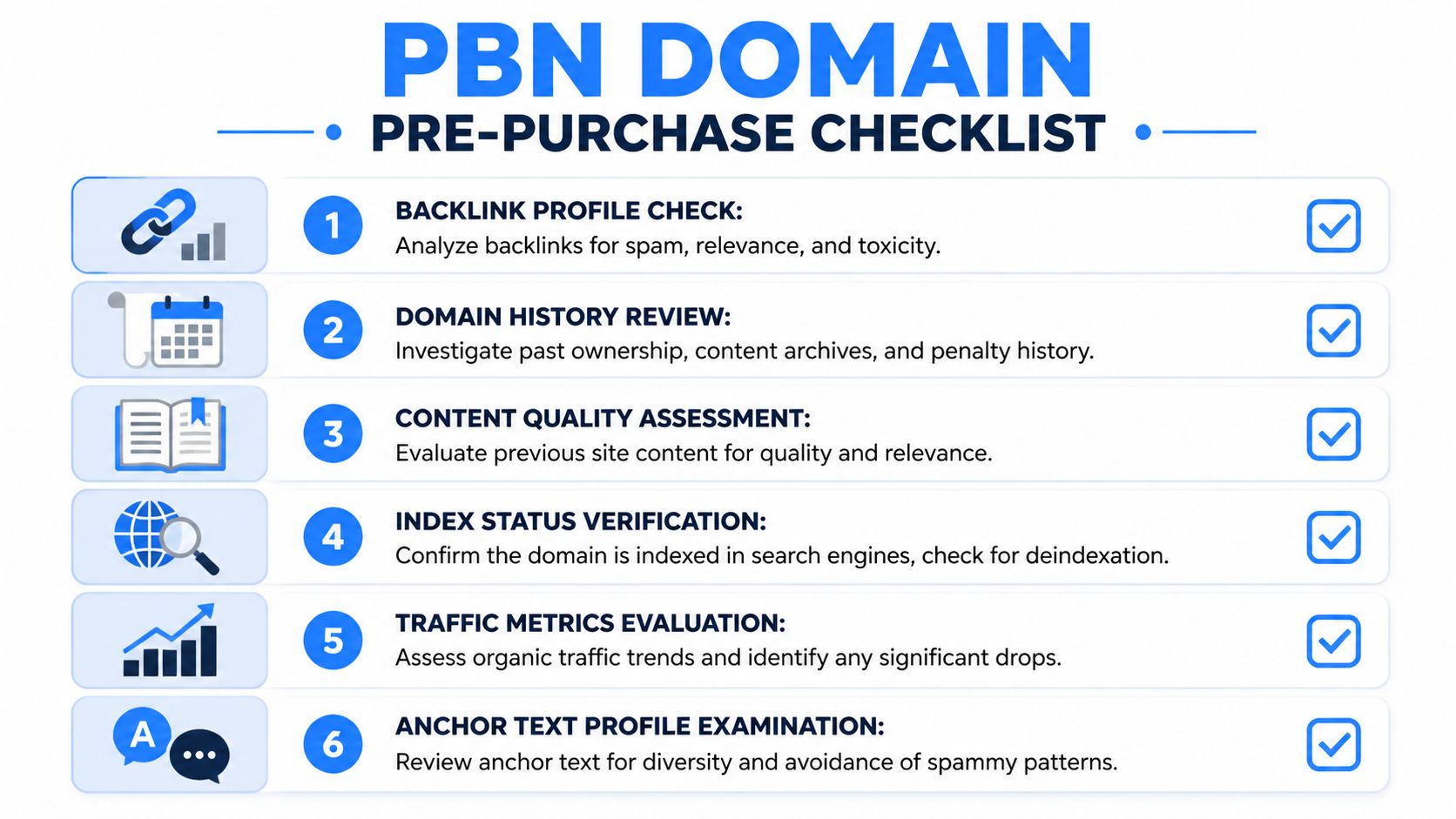
A usable domain needs metric support, historical credibility, and a backlink profile that still makes sense once you zoom in. If one of those pieces breaks, the whole thing gets shaky.
Start with hard thresholds
You need baseline rules, otherwise every halfway decent listing starts to look tempting. For PBN viability, commonly cited benchmarks include Majestic Trust Flow not falling below 15-20, Ahrefs Domain Authority in the 45-70 range, at least 10-20 referring domains, and domain age over 5 years as a preferred signal of a more established profile, according to PBN LTD on PBN domain metrics.
Treat those as screening thresholds, not guarantees. A domain can meet every visible metric benchmark and still be filthy underneath. Metrics help you reject weak inventory fast. They do not replace judgment.
My own order of operations is simple:
- First pass: TF, referring domains, age, obvious brand fit
- Second pass: archive review and backlink context
- Final pass: index clues, anchor profile, and signs of previous abuse
If a domain fails the first pass, I stop there. The mistake many buyers make is trying to rescue domains that already failed basic standards.
Archive history tells you what the metrics won’t
The Wayback Machine is where pretty numbers go to die. A clean-looking domain with a rotten history is still rotten. I want to know what the site used to be, how often it changed topics, whether it went through obvious spam phases, and whether there was a sudden switch from real content to template sludge.
Expired-domain buyers often inherit someone else’s damage. When a domain has bounced from legitimate business to affiliate spam to foreign-language garbage, you’re not buying “authority.” You’re buying baggage.
A domain history workflow should include archived pages, title changes, ownership clues, and topical consistency. If you want a structured process for that part alone, this guide on checking domain history is worth bookmarking.
If archive snapshots make you uncomfortable, trust that reaction. You’re probably seeing the future of the site, not just its past.
Backlinks need context, not just counts
Referring domains matter, but raw counts fool people all the time. I care about what those links are, not just how many exist. Are they from real pages? Are they topically adjacent? Do they look editorial, or do they look like old comment spam and directory sludge held together with wishful thinking?
The anchor text profile usually tells on the domain faster than the seller does. If anchors are loaded with exact-match commercial phrases, pharma junk, casino terms, or language mismatches, the domain goes in the bin.
Here’s a practical review table I use mentally:
| Check | Good sign | Bad sign |
|---|---|---|
| Anchor text | Mostly branded, URL, and natural phrases | Over-optimized money terms and spam anchors |
| Link source type | Real sites and contextual mentions | Sitewide junk, directories, comments |
| Topical fit | Historical links match site theme | Total topic mismatch |
| Link pattern | Diverse and believable | Obvious bursts from low-quality sources |
Verify index status and general site health
I don’t need perfection, but I do need signs the domain hasn’t been nuked. Look for whether the domain appears to have an index presence, whether branded searches show any residue, and whether there are clues of hard drops in visibility. Even a strong backlink profile can be misleading if the domain’s search presence is dead for ugly reasons.
Broader technical sanity checks become particularly useful. A domain can have “good links” and still show enough warning signs to make it a poor buy. If you want a useful framework for spotting site-level issues that often signal deeper trouble, IMADO’s website health diagnostic gives a good outside-in view of what healthy web properties tend to look like.
A simple go or no-go framework
When I’m deciding whether to buy PBN domains, I want four yeses:
- The metrics clear minimum viability.
- The historical topic still makes sense for republishing.
- The backlinks are relevant enough to preserve value.
- Nothing in the archive or anchors screams prior abuse.
If one of those turns into a maybe, the price has to be exceptional. If two break, I’m out.
That discipline matters because bad domains don’t just fail without repercussions. They waste hosting, content, and time. Worse, they tempt people into “fixing” domains that should never have been bought in the first place.
Red flags that usually mean walk away
Some warnings deserve zero debate:
- Foreign-language pivot with no logical explanation
- Past use for spammy affiliate offers
- Archive gaps followed by obvious junk pages
- Anchors dominated by commercial spam
- Backlinks from irrelevant pages that look automated
Buyers get in trouble when they treat every red flag as negotiable. It isn’t. You’re not buying potential. You’re buying residue. The question is whether the residue is useful or toxic.
Good vetting feels slow because it is slow. That’s normal. The money is made in the skips.
Closing the Deal Acquiring and Transferring Your Domain
Once a domain survives inspection, the buying part should be boring. If it gets emotional, you’re probably overpaying. Auction platforms love urgency because urgency makes people stupid.

Auction discipline beats auction excitement
At auction, the only number that matters is your walk-away price. Set it before the bidding gets lively. If the domain crosses that line, let somebody else win the privilege of regretting it later.
A few practical habits help:
- Bid late, not loud: Early bidding only wakes up competitors.
- Keep notes on why you want the domain: If your only reason becomes “I’ve already spent time on it,” step away.
- Avoid revenge bidding: Losing a domain is cheaper than overpaying for one.
Brokered deals and private sales are different. There, the risk isn’t just price. It’s trust. Ask clear questions, verify ownership, and use escrow if the transaction has enough value to justify caution. A seller who resists normal safeguards is doing you a favor by waving a red flag.
The transfer is simple until somebody fumbles it
After payment, the transfer process needs clean coordination. The seller releases the domain. You get the authorization code. You initiate the transfer at your registrar. Then you wait and confirm every step instead of assuming the system will sort itself out.
That sounds basic because it is. Yet people still lose time by using the wrong registrar email, missing transfer approvals, or forgetting to confirm that the domain landed where it was supposed to.
This walkthrough covers the standard mechanics well:
A clean handoff checklist
Use this before you celebrate:
- Ownership verified: Confirm the seller controls the domain they’re selling.
- Registrar details checked: Make sure your receiving account information is correct.
- Transfer code received: Don’t assume it was sent. Confirm it.
- Approval emails monitored: Watch inboxes and spam folders.
- Post-transfer lock reviewed: Secure the domain once it arrives.
Buy the domain like a pessimist. Transfer it like a bureaucrat.
The buying phase shouldn’t feel glamorous. That’s a good sign. The more “exciting” the transaction, the more likely something is off. Good domains are valuable. That doesn’t mean you need to turn the acquisition into a casino session.
Going Undercover Post-Purchase Stealth and Footprint Avoidance
Owning the domain is where lazy operators finally blow themselves up. They spend days hunting the right asset, then they host every site the same way, publish bland filler, and drop links with the subtlety of a brick through a window.
That’s why setup matters as much as selection. According to Vazoola’s overview of private blog networks, Google detects up to 85% of improperly configured networks by spotting patterns like shared hosting, weak content, and unnatural linking behavior. The same source notes that 75% of flagged networks are caught due to hosting and anchor text footprints. Those numbers should kill any temptation to cut corners.
Hosting is where obvious networks expose themselves
Putting your whole network into one neat little hosting box is the classic mistake. It’s convenient, which is exactly why it’s dangerous. Search engines don’t need a confession if your setup already looks like one.
I don’t trust uniformity in PBN operations. Same provider pattern, same install habits, same theme logic, same publishing rhythm. That’s how people create a network that looks coordinated even before the links go live.
You want separation in the things operators usually standardize:
- Hosting providers: Don’t centralize everything because it’s easier.
- Site builds: Themes, plugins, layouts, and basic design choices should vary.
- Publishing behavior: Don’t make every site look like it woke up on the same day.
- Link patterns: If every site links the same way, you’re leaving fingerprints.
Content has to look like somebody cares
Spun sludge is still sludge. Even if it gets indexed, it doesn’t make the domain believable. A decent expired domain deserves content that fits its historical topic or at least its logical neighborhood. If the domain used to belong to a regional nonprofit, don’t turn it into a robotic review blog overnight and expect that to look natural.
What works better is rebuilding the site in a way that respects its past. Restore useful pages where that makes sense. Publish original articles that fit the archive footprint. Link out to real authority sites when appropriate so the site doesn’t exist solely to prop up your money page.
That last part gets ignored a lot. Sites that only exist to link inward are suspicious because no normal publisher behaves like that.
Networks don’t usually die because one site was imperfect. They die because the whole portfolio looks coordinated.
Anchor text greed ruins otherwise decent networks
The fastest way to expose a PBN is to treat every backlink like a chance to force exact-match anchors. That’s amateur behavior. You can take a clean domain and turn it toxic with an ugly anchor strategy.
Natural link profiles tend to look messy in a healthy way. Branded anchors, raw URLs, generic phrases, contextual variation. The moment every PBN post starts sounding like it was written by the same desperate affiliate marketer, the camouflage is gone.
A few habits reduce that risk:
- Write links into content that stands on its own.
- Use anchors that fit the sentence instead of forcing keyword targets.
- Link to authority resources sometimes, not just your own assets.
- Avoid publishing and linking on a machine-like schedule.
If you discover old junk associated with the domain or your name floating around in places it shouldn’t, a service like professional digital cleanup can at least give you a framework for thinking about exposure and cleanup. Different problem, same principle. The less unnecessary residue you leave behind, the better.
Stealth is maintenance, not a one-time trick
People often misunderstand footprint avoidance. They think stealth is a setup task. It isn’t. It’s an operating style. Every new article, plugin update, outbound link, and redesign choice either preserves the illusion or weakens it.
That sounds paranoid because it is paranoid. PBN management rewards paranoia. The sloppier side of this industry keeps proving that every year.
If your post-purchase setup is lazy, the domain quality you paid for won’t save you. A good asset can survive mediocre content for a while. It usually won’t survive obvious footprints.
Your PBN Management and Monitoring Playbook
Most PBNs don’t collapse in one dramatic moment. They erode. A site stops getting crawled. Another gets thin on updates. Someone adds too many outbound links. A once-clean domain starts looking like inventory instead of a website.
The ugly statistic is that 90% of sold PBNs deindex due to shared hosting or outbound spam, and for long-term success operators are advised to limit niche overlap across the network to 20%, monitor sites in Google Search Console for anomalies, and remember that 5-7 sites are often enough for low-competition niches, according to Idea Digital on PBN pros and cons. That should tell you two things. First, maintenance is not optional. Second, bigger is not automatically smarter.

The management rules worth following
Here’s the short version that matters:
- Keep sites alive: Publish enough real content that the domain doesn’t look abandoned.
- Watch indexation and uptime: Quiet failures are still failures.
- Use Search Console carefully: If you’re monitoring, pay attention to changes instead of collecting data for decoration.
- Drive believable activity: A dead-looking site that only exists to link out is a bad actor costume.
On the flip side:
- Don’t cross-link your network casually: That’s an easy pattern to spot.
- Don’t dump sitewide links: They scream manipulation.
- Don’t sell outbound links to everyone with a PayPal account: That’s how decent domains turn into spam heaps.
Use monitoring like an operator, not a collector
People think of domain monitoring as something for acquisitions only. It’s just as useful after purchase. If you’re tracking status changes, history shifts, or other unexpected domain events, build that into your workflow. A domain watch process like domain name monitoring helps create that habit.
I also like keeping a simple internal log for each domain: content updates, outbound links placed, historical niche notes, and any weirdness observed. Not because spreadsheets are fun. Because memory gets sloppy once a network grows.
Treat every PBN site like a small publisher asset. The minute you treat it like inventory, it starts looking like inventory.
The best management playbook is boring, repetitive, and disciplined. That’s exactly why few choose to follow it.
Frequently Asked Questions About Buying PBNs
Are PBN domains still worth buying?
Sometimes. A clean expired domain can still be useful if the history is believable, the backlink profile holds up, and you operate the site carefully. Most available inventory isn’t worth touching, which is why the filtering work matters more than the shopping.
Is buying PBN domains against Google’s guidelines?
Using domains to manipulate rankings creates risk. That risk increases when the site exists mainly to pass link equity instead of serving as a legitimate standalone property. If you’re playing in this space, at least be honest with yourself about what you’re doing.
How many domains do you need?
It depends on competition, your budget, and how well each site is built. More domains do not automatically mean more safety or more impact. A small, disciplined setup is usually more defensible than a sprawling mess.
Should you buy from brokers or hunt domains yourself?
Both can work. Brokers save time but often charge for that convenience. Hunting domains yourself gives you more control and usually teaches you faster what separates a real opportunity from polished junk.
What’s the biggest mistake beginners make?
They buy based on headline metrics, skip archive review, then rush setup. That combination kills more networks than any algorithm update rumor ever will.
Can you repurpose a strong expired domain into a real site instead?
Yes, and that’s often the smarter path. If a domain has clean history and a believable topical lane, rebuilding it as a genuine website can preserve far more value than turning it into an obvious feeder property.
If you're tired of digging through endless junk by hand, NameSnag is one of the more practical ways to speed up domain discovery without skipping due diligence. You can sort through expiring and available domains, cut down the research pile, and spend more time evaluating the few candidates that might deserve your money.
Find Your Perfect Domain
Get access to thousands of high-value expired domains with our AI-powered search.
Start Free Trial