Think of a domain's sale history like a property deed. It's a paper trail that tells you who owned it, what they paid, and what the market thought it was worth at the time. For investors and entrepreneurs, this isn't just trivia; it's a critical piece of intelligence for determining a fair price, avoiding getting fleeced, and sniffing out undervalued digital assets before you pull the trigger.
Why You'd Be a Fool to Ignore a Domain's Sale History

Ever find a domain and wonder if you've stumbled upon a hidden gem or just a pile of digital dust? The answer is almost always buried in its transaction history. This isn't just for domaining history buffs; it's a fundamental due diligence step for any serious investor, SEO, or founder looking for an edge. It's a fun and crucial part of the game!
You wouldn't buy a house without pulling its records—past sales, previous owners, any liens or reported problems. A domain name is no different. It’s a piece of digital real estate, and its past can, and will, have a massive impact on its future value and performance.
Gauge True Market Value
The most immediate benefit of looking at a domain's sale history is getting a real-world feel for its value over time. Did it sell for $50,000 five years ago but just $5,000 last year? That’s a five-alarm fire. On the other hand, a history of steadily climbing prices suggests you’re looking at a strong, desirable asset.
This data gives you an objective baseline. It helps you avoid wildly overpaying for a name with a checkered past or—even better—spot a domain that's seriously undervalued right now.
A domain's transaction history is your crystal ball. It doesn't just tell you where it's been; it gives you powerful clues about where it's going. Ignoring it is like driving blindfolded.
Understanding these market cycles is key. A domain that fetched a huge price during the dot-com bubble might be worthless today unless it has modern, verifiable metrics to justify that valuation.
Uncover Potential Red Flags
A domain's past isn't always rosy. A history packed with frequent ownership changes or sudden, sharp price drops is a huge red flag. It’s often a sign the domain was used for spam, got penalized by search engines, and was then dumped like a hot potato.
Here are just a few landmines a shady history can reveal:
- A Spammy Past: The domain might have been part of a private blog network (PBN), and now it's dragging around a portfolio of toxic backlinks you'll have to clean up.
- Search Engine Penalties: That massive drop in value often lines up perfectly with a Google penalty that completely nuked its organic traffic and authority.
- Brand Disputes: The name could have a history of trademark infringement battles, a legal nightmare you absolutely do not want to inherit.
Digging into this history helps you sidestep these problems. Remember, you're not just buying a string of characters; you're inheriting its entire reputation, for better or worse.
Before you buy any domain, take a moment to review its transaction history. This table breaks down the key data points you'll find and what they can tell you about the asset's quality and potential.
Key Insights from a Domain's Sale History
A quick look at what a domain's transaction history can reveal about its current and future value.
| Data Point | What It Reveals | Why It's Critical for Investors |
|---|---|---|
| Past Sale Prices | The perceived market value over time and price volatility. | Helps establish a valuation baseline and identify potential over or under-pricing. |
| Frequency of Sales | How often the domain has changed hands. | Frequent, rapid sales can be a red flag for spam, penalties, or flipping schemes. |
| Sale Venues | Where the domain was sold (e.g., auction, private sale, marketplace). | Provides context on the nature of the transaction—was it a fire sale or a high-demand auction? |
| Historical Ownership | Who owned the domain in the past. | Reveals if it was held by a reputable company, a known spammer, or a professional investor. |
By analyzing these data points together, you move from guessing about a domain's value to making an informed, data-driven investment decision. It’s the difference between gambling and investing.
The good news is that you don't have to piece this all together manually. While we'll get into specific tools later, platforms like NameSnag automate much of this detective work. For instance, when you’re hunting for domains, you can find Available domains that were just dropped—often because their value tanked. Or, a fantastic tactic is to find promising Expiring domains and vet their history before they even hit the auction, making sure you only bid on clean, valuable assets.
To really get why a domain's sales history matters, you have to take a trip back to the internet's Wild West. The stories from the early days of domaining are legendary—full of bold bets, eye-watering prices, and lessons that are just as sharp today. These aren't just old war stories; they're the foundation of the modern, multi-million dollar domain market.
Looking at these old transactions isn't about gawking at the numbers. It's about pulling out the timeless strategies that still work: brandability, market timing, and the raw power of a premium .com. The first investors had a real knack for spotting gold in simple, memorable names, and their wins (and losses) wrote the playbook on valuation.
The Sales That Defined an Era
Nothing screams dot-com boom quite like the prices paid for category-defining domains. One of the most famous deals was Business.com. In December 1999, it sold for a staggering $7.5 million, a number that blew people's minds and proved domains were ultra-premium digital assets.
That deal wasn't just a simple sale. It was a statement. It shouted that the right .com wasn't just a web address, but the very cornerstone of a brand. You can dig into more of the highest domain sales of all time to see just how high the stakes got back then.
Then there's the classic tale of Men.com. Someone picked it up for a measly $15,000 in 1995. Eight years later, it sold for $1.32 million. That’s an insane 87x return on investment, and it doesn't even count the $350,000 the domain earned in the meantime.
These deals teach you a few things that never get old:
- Brandability is King: Simple, generic, unforgettable names always fetch the highest prices.
- Patience Pays Off: The truly massive returns often come from holding a quality asset for years.
- The .com Still Reigns: Even with hundreds of new TLDs, .com is still the gold standard for trust and authority.
This early history shows that a domain with a clean, strong past is almost always the most valuable.
Decoding the Value of a Landmark Sale
But the story of Business.com didn't end in 1999. Its journey kept going, tracking the highs and lows of the digital economy itself.
Here’s a snapshot from the Wikipedia entry for Business.com, which highlights what happened next.
After that initial $7.5 million sale, the domain and its media company were bought for $345 million in 2007. This monster deal shows that a premium domain can be the central pillar of a much larger, incredibly valuable business.
The lesson here is dead simple: a top-tier domain isn't just a name. It's an anchor asset that can pull in huge investment, support an entire company, and grow in value exponentially.
This is exactly why you should be tracking the sales history of not just your targets, but of the big market leaders too. It gives you a roadmap for what’s possible.
Finding Tomorrow's Legends Today
So, how do you use these lessons to find the next big thing without a time machine? A brilliant tactic is to hunt for domains that have the same DNA as these dot-com legends: brandable, easy to remember, and with a clean history.
The market is always in motion. Every single day, great domains expire and get dropped, making them available for anyone to register. I'm not talking about obscure, long-tail keywords. I'm talking about valuable, aged domains that someone just forgot to renew. This is where the real opportunity is.
A pro strategy is to use a tool that tracks these names so you can get way ahead of the game. For example, you can sift through lists of newly Available domains that were just released and can be registered on the spot. Even better, you can watch Expiring domains that are in their grace period. This gives you time to research their history before they drop, letting you find gems without paying legendary prices.
Ready to play domain detective? Finding a domain's real sale history can feel like hunting for a needle in a digital haystack, but it's entirely doable once you know where to look and what you're looking for. This is where you roll up your sleeves and piece together the story of a name, sale by sale.
Think of it like a puzzle. You'll find auction results, whispers of private sales, and records of ownership changes. Your job is to connect these dots to see the bigger picture. The goal isn't just to find a price tag—it's to understand the context behind that price. Was it a bidding war between two eager buyers or a quick, low-ball flip? That context is everything.
Start with the Big Databases
Your first stop should always be the major sales databases. For this, NameBio is the industry-standard go-to. It pulls public auction results from dozens of marketplaces and is an absolute goldmine for uncovering a domain's sales paper trail.
Just type in the domain. If it has a public sales record, NameBio will almost certainly have it. You'll get the sale price, the date, and the venue—like GoDaddy Auctions or Sedo. This gives you the hard data you need to start building a timeline.
Of course, not every sale is public. A lot of high-value transactions happen behind closed doors. If NameBio comes up empty, don't panic. It just means you need to dig a little deeper.
Use Whois History to Fill in the Gaps
When public sales data is a dead end, a Whois history tool is your next best friend. These tools track changes to a domain's ownership records over time. While they won't give you a price, they will tell you when a domain likely changed hands.
If you see the registrant info switch from one individual or company to another, you know a transaction probably went down. A sudden change from a long-time owner to a known domain investor is a massive clue that a private sale happened. This helps you map out the timeline even without the exact dollar amounts.
A lack of public sales data doesn't mean a domain isn't valuable. Some of the most valuable names have been held by the same company for decades, meaning they have no sales history at all. The absence of a record is just another piece of the puzzle.
Sometimes, a domain's past is so messy that it's just not worth the trouble. If you’re digging into the history of a name that just dropped, a quick check can tell you if it was abandoned for a very good reason.
This simple diagram shows how a relatively small investment in a top-tier domain like Men.com can lead to an incredible return over time.
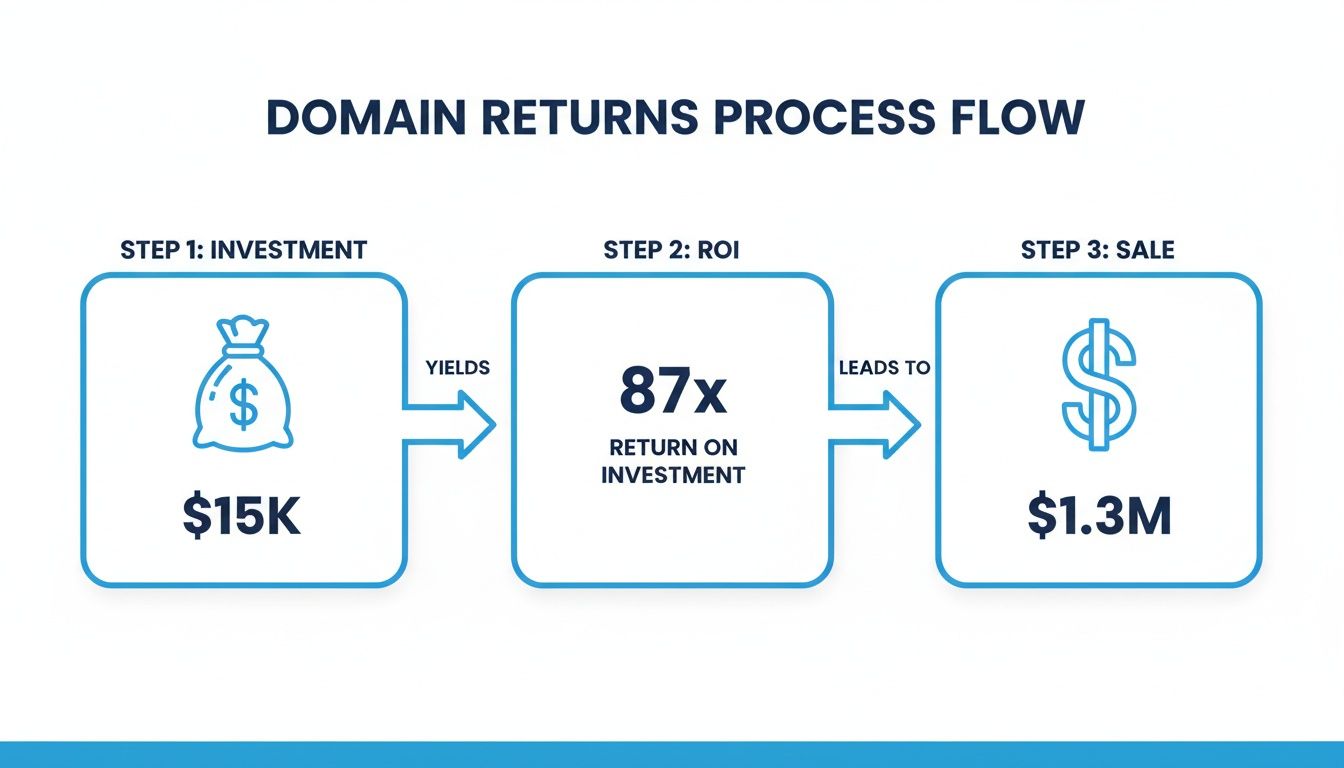
As you can see, an initial $15,000 investment eventually grew into a $1.3 million sale, which is an 87x return on investment.
Cross-Reference and Watch for Red Flags
Now it's time to put all the pieces together. Compare the sale dates from NameBio with the ownership changes from your Whois history search. Do they line up? A consistent, logical timeline is a good sign.
But you have to be on the lookout for red flags. Here are a few I always watch for:
- Frequent Flips: If a domain has changed hands multiple times in a short period, it could be a sign it was used for spammy purposes and passed around like a hot potato.
- Sudden Price Drops: A domain selling for $20,000 one year and $200 the next is screaming that something went wrong. It's often a Google penalty that nuked its value.
- Suspicious Owners: Does the Whois history show ownership by entities known for spam or black-hat SEO? Run away. Fast.
Another fantastic tool for this kind of detective work is the Wayback Machine. You can actually see what the website looked like under previous owners. For a deep dive on how to use it, you can check out our guide on using the Archive.org Wayback Machine for domain research. This helps you confirm if the domain hosted a legitimate business or something... less savory.
By combining these methods, you'll build a pretty robust and reliable picture of any domain's past, letting you make a smart, informed offer.
The Modern Market and The Rise of SEO-Driven Value
The days of valuing a domain just because it sounded cool are long over. Today's market is a sophisticated, data-driven game where a name's real worth is tied directly to its search engine history. Forget catchy phrases; we're talking clean backlink profiles, established authority, and hard SEO numbers.
This isn't some tiny corner of the web, either. The U.S. domain sales market is on track to hit $10.1 billion by 2025. That growth is fueled by a steady 4.2% compound annual growth rate (CAGR) between 2020 and 2025, and there's no sign of it slowing down. You can see the full breakdown on the web domain market's impressive growth on IBISWorld.
What's driving this? A massive demand from SEOs, affiliate site builders, and startups all desperate for authoritative .coms with powerful backlink profiles. They're not buying potential; they're buying a head start.
SEO Metrics Are the New Gold Standard
In 2026, a domain's sale history is useless without its SEO history. The metrics that used to be a secret language for SEO nerds are now standard talking points in high-stakes domain deals. The conversation has shifted from "How brandable is it?" to "What's its backlink profile look like?"
Here’s what savvy investors are actually looking at:
- Domain Authority (DA) and Domain Rating (DR): These scores from Moz and Ahrefs are the quick-and-dirty snapshot of a domain's power. A high score suggests a history of earning good links, not just existing.
- Trust Flow (TF): This metric from Majestic is all about quality. It measures the trustworthiness of a domain based on who links to it. A high TF is a huge green light.
- Backlink Profile Quality: This is the big one. We're not just counting links; we're scrutinizing where they come from. Links from authoritative .edu and .gov domains are like gold dust—they massively inflate a domain's value and credibility.
- Spam Score: A low spam score is non-negotiable. A domain with a history of toxic links is a liability, no matter how great the name sounds.
This is why you see seven-figure sales like BTC.com or Invest.com. It's not just about the keyword. Those deals are backed by years of accumulated SEO equity, making them turn-key assets for dominating a niche from day one.
The modern market doesn't care about what a domain could be; it cares about what it is right now. An aged domain with a strong, clean SEO foundation is a proven asset, not a speculative bet.
From High-Flying Flips to Daily Wins
While we all hear about the multi-million dollar sales, the real action is in the trenches. The four, five, and even six-figure flips are happening every single day. A quick glance at the daily sales data on a site like NameBio shows a buzzing ecosystem.
For instance, recent snapshots from early 2026 showed a .com selling for $42,888, a .xyz hitting a staggering $70,000, and a steady flow of $15,000 to $30,000 .com sales popping up weekly. This is the reality of modern domain investing. Data beats guesswork, every time.
And this data-first approach is only getting more important. The rise of AI is changing how we think about search and, by extension, domain value. Understanding the shifting dynamics of AI Search vs Google Search in 2026 shows just how much the focus has moved to proven SEO performance.
This is exactly why digging into a domain's past is so critical. The trick isn't to find just any domain, but to find the ones with proven SEO value that are slipping through the cracks. For a deeper look into this strategy, check out our guide on finding the best domains for SEO. By focusing on metrics, you can confidently find assets with real, measurable potential.
Automating Your Research to Find Hidden Gems
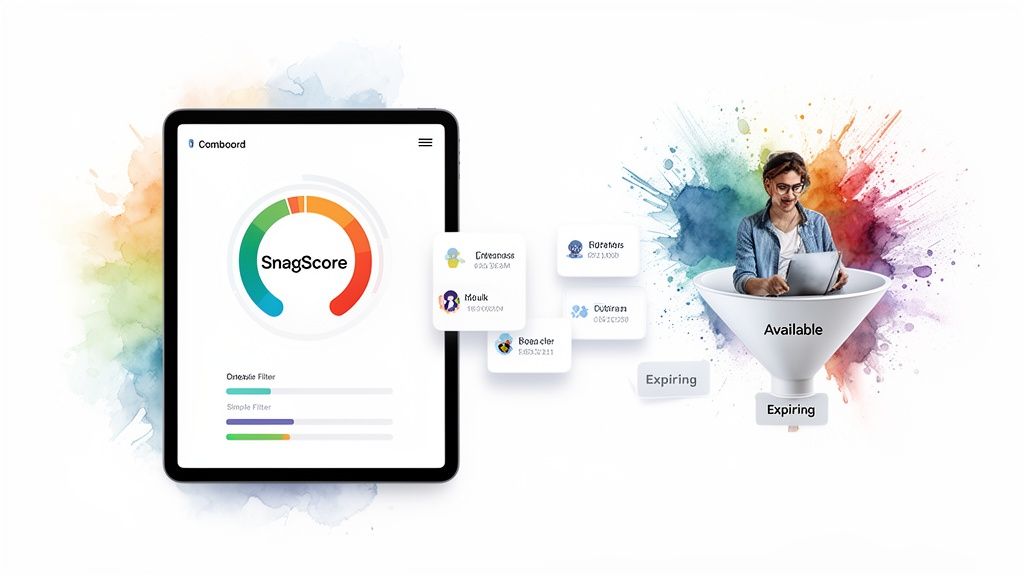
Let’s be honest, manually checking a domain's sale history, backlink profile, and SEO metrics across a dozen different tools is a soul-crushing time sink. Juggling tabs for Moz, Majestic, Ahrefs, and various sales databases for every potential domain just isn't scalable. If you’re serious about finding high-value domains, you need a smarter way to work. This is where the fun really begins!
This is where automation becomes your new best friend. Instead of spending hours digging for data, you can let a system do the heavy lifting, surfacing the crucial metrics you need to make a quick, informed decision. It’s the difference between panning for gold by hand and using a high-powered dredge.
The goal is to stop wasting time on digital junk and focus only on names with real potential. Imagine a process where you could analyze over 170,000 domains daily, with built-in spam verification and backlink quality checks done for you. That’s the power of automating your research.
Centralizing Data with a SnagScore
A major bottleneck in domain research is trying to make sense of data from multiple sources. You get a Domain Authority score from one tool, a Trust Flow from another, and sale history from a third. Trying to weigh these competing metrics in your head is a recipe for analysis paralysis.
A better approach is to use a platform that centralizes this data into a single, easy-to-understand score. At NameSnag, we developed the ‘SnagScore’ for this exact reason. It’s a proprietary algorithm that blends key data points into one number, giving you an at-a-glance assessment of a domain’s quality.
This composite score includes:
- SEO Authority: Combining metrics like Moz’s Domain Authority and Majestic’s Trust Flow.
- Backlink Profile: Analyzing the number and quality of referring domains, with a special focus on powerful
.eduand.govlinks. - Domain Age: Older, continuously registered domains often carry more weight and trust.
- Brandability: Assessing the name's length, memorability, and commercial appeal.
Instead of interpreting raw numbers, you get a simple score that tells you if a domain is worth a closer look. It lets you sift through thousands of options and instantly spot the top 1% of opportunities.
Automating due diligence isn't about cutting corners; it's about amplifying your efforts. It allows you to analyze more domains with greater accuracy, ensuring you never miss out on a hidden gem because you were buried in spreadsheets.
While mastering web scraping best practices can be an invaluable skill for data collection, using a dedicated platform simplifies this process immensely, letting you focus on the insights, not the mechanics.
Finding Instantly Registrable and Expiring Gems
Automation isn’t just about analyzing data; it’s about timing. The domain market moves incredibly fast, and the best opportunities are often fleeting. Two key moments to watch for are when domains are freshly dropped or when they are about to expire.
This is where specialized tools truly shine. For instance, with NameSnag, you can filter for domains that have just passed their redemption period and are now available for immediate registration at any standard registrar. These are prime targets, as you can claim them instantly without going through a competitive auction.
Here's a great tactic: explore a curated list of Available domains and use the time filters to see what dropped Today, in the last 3 Days, or even 7 Days. This gives you a massive head start on everyone else who is manually checking drop lists.
Another powerful strategy is to identify valuable domains before they drop. By monitoring domains that are still in their grace period, you have time to conduct thorough due diligence. You can research their sale history, check their backlink profile for spam, and decide if they’re worth pursuing once they hit the auction market.
A targeted search for Expiring domains lets you create a watchlist of high-potential assets. This proactive approach means you’re prepared to act the moment they become available, rather than reacting to whatever is popular at auction that day. For a deeper look at this process, check out our guide on automating your domain due diligence to build a more effective workflow.
By automating your research, you shift from being a domain chaser to a strategic investor. You let the system find the opportunities, so you can focus on what matters most: acquiring assets that will deliver real value.
Frequently Asked Questions About Domain Sale History
You're not alone if you've got questions about the murky world of domain sales. It’s a field where a little bit of history goes a long way. Let's tackle some of the common things that trip people up, because the answers aren't always what you'd expect.
Where Can I Check Domain Sale History for Free?
Yes, you can absolutely get some data without paying a dime. Your first stop should always be NameBio. It’s a massive, searchable database of public sales and the industry-standard starting point. It’s perfect for getting a quick read on what similar names have sold for and when.
Another move is to check a domain's Whois history. While it won't give you a price tag, it shows you the chain of ownership. If you see a name move from one person to a totally different one, you can be pretty sure a transaction happened, even if the price was kept private.
Just remember, the free tools give you clues, not the full story. You're piecing together a puzzle, and sometimes you need the professional tools to find the missing pieces.
What Is a Major Red Flag in a Domain's Sale History?
The biggest, most glaring red flag is a name that's been dropped and re-registered over and over again in a short time. This is the domain equivalent of a hot potato. It almost always means someone used it for spammy SEO, got it torched by Google, and then dumped it.
The next thing to watch out for is a history of sales to known spammers or people tied to black-hat SEO. These names can come with a toxic backlink profile that's an absolute nightmare to fix. The name's reputation is just as important as its price.
A domain that looks too good to be true probably is. If you see a sudden, massive price drop or a history of being passed around constantly, it's a clear signal to be extremely cautious—or just run.
Does a Lack of Sale History Mean a Domain Is Not Valuable?
Not at all. In fact, some of the most valuable domains out there have zero public sale history. Think of all the giant brands that registered their name in the 90s and just sat on it. There’s no sale on record because it has never once hit the open market.
A clean slate just means you have to change how you evaluate it. Instead of looking at past prices, you judge it based on its raw potential and current metrics.
This is what you should be looking at instead:
- Brandability: Is it short, memorable, and easy to spell? Could you build a business on it?
- Keyword Relevance: Does it contain a keyword that people actually search for with money in their hands?
- SEO Profile: What’s its authority? Does it have quality backlinks? How old is it?
- Commercial Potential: How many different ways could this name make money?
A domain with no sale history but a strong profile can be an absolute goldmine. It's a blank canvas with built-in authority, ready for you to take it and run. It’s about shifting your focus from what was to what is.
Ready to stop guessing and start finding high-value domains with clean histories? NameSnag automates the entire research process, analyzing over 170,000 domains daily to bring you the best expired and expiring names with proven SEO value. Check out our lists of Available domains or get a head start by researching promising Expiring domains today.
Find Your Perfect Domain
Get access to thousands of high-value expired domains with our AI-powered search.
Start Free Trial