The email hits your inbox at the worst possible time. Your domain expired. Your site is down, branded email is acting weird, and suddenly a boring line item you ignored for months feels like the digital version of locking your keys in the car with the engine running.
If that’s where you are right now, breathe. An expired domain usually doesn’t vanish the second the renewal date passes. It enters a process with rules, deadlines, and a few painful price tags. That process gives owners one last shot to recover the asset, and it gives investors a clear window to watch for opportunities.
I’ve always thought of expired domains like abandoned luggage at an airport. Sometimes the owner rushes back before it gets hauled away. Sometimes it sits in the holding area. Sometimes it ends up available to whoever’s fastest when the claim window closes. The trick is knowing which stage you’re looking at, because every stage has different options.
There are really two readers in this story. One is the owner who wants their brand back before real damage sets in. The other is the investor, SEO pro, or niche site builder who knows expired domains can hide serious upside. Both need the same thing first: a clear map of the lifecycle, without registrar jargon turning it into alphabet soup.
If you need the short version of what happens right after expiration, this guide on what it means when a domain is expired is a useful companion read. Then come back, because the most misunderstood part of the whole process is the redemption period for domain name recovery, and that’s where mistakes get expensive.
That Sinking Feeling Your Domain Has Expired
The worst part of domain expiration isn’t technical. It’s emotional. Your brain jumps straight to disaster mode. “Did I lose it?” “Can someone buy it right now?” “How much is this going to cost me?”
For most owners, the first useful shift is simple: stop treating expiration like a cliff. It’s more like a staircase. You can still turn around on the early steps. Later on, the doors start locking behind you.
That matters because people make bad decisions when they panic. They waste time searching random forums, they contact the wrong provider, or they assume the domain is already gone when it’s still recoverable. Investors make a different mistake. They see “expired” and think “available soon,” even though the original owner may still have a final recovery window.
Practical rule: “Expired” does not mean “free for anyone to grab.”
The domain lifecycle exists to protect ownership first, then cleanly release unused names later. That’s good news for the owner who missed a reminder, got a replacement credit card, or had one billing email tied to a former employee. It’s also good news for investors because predictable systems create repeatable opportunities.
A domain can move from active asset to suspended asset to public opportunity. Each stage has its own behavior. Some stages are cheap. One stage is famously not. One stage is the point of no return.
If you understand those transitions, the whole thing gets less scary. It also gets more strategic.
The Full Domain Expiration Lifecycle
The useful question is not “Did it expire?” The useful question is “What stage is it in right now?”
That single distinction changes everything for both sides of this market. An owner wants to know whether a normal renewal is still on the table or whether a painful restore fee is coming. An investor wants to know whether the name is heading toward deletion or still sitting in a protected recovery window. If you blur those stages together, you make bad decisions fast.
For most generic top-level domains, the path runs through five common stages before the name returns to the open market. The exact timing depends on the registrar and extension, but the sequence is consistent: expiration, grace period, redemption period, pending delete, then public release.
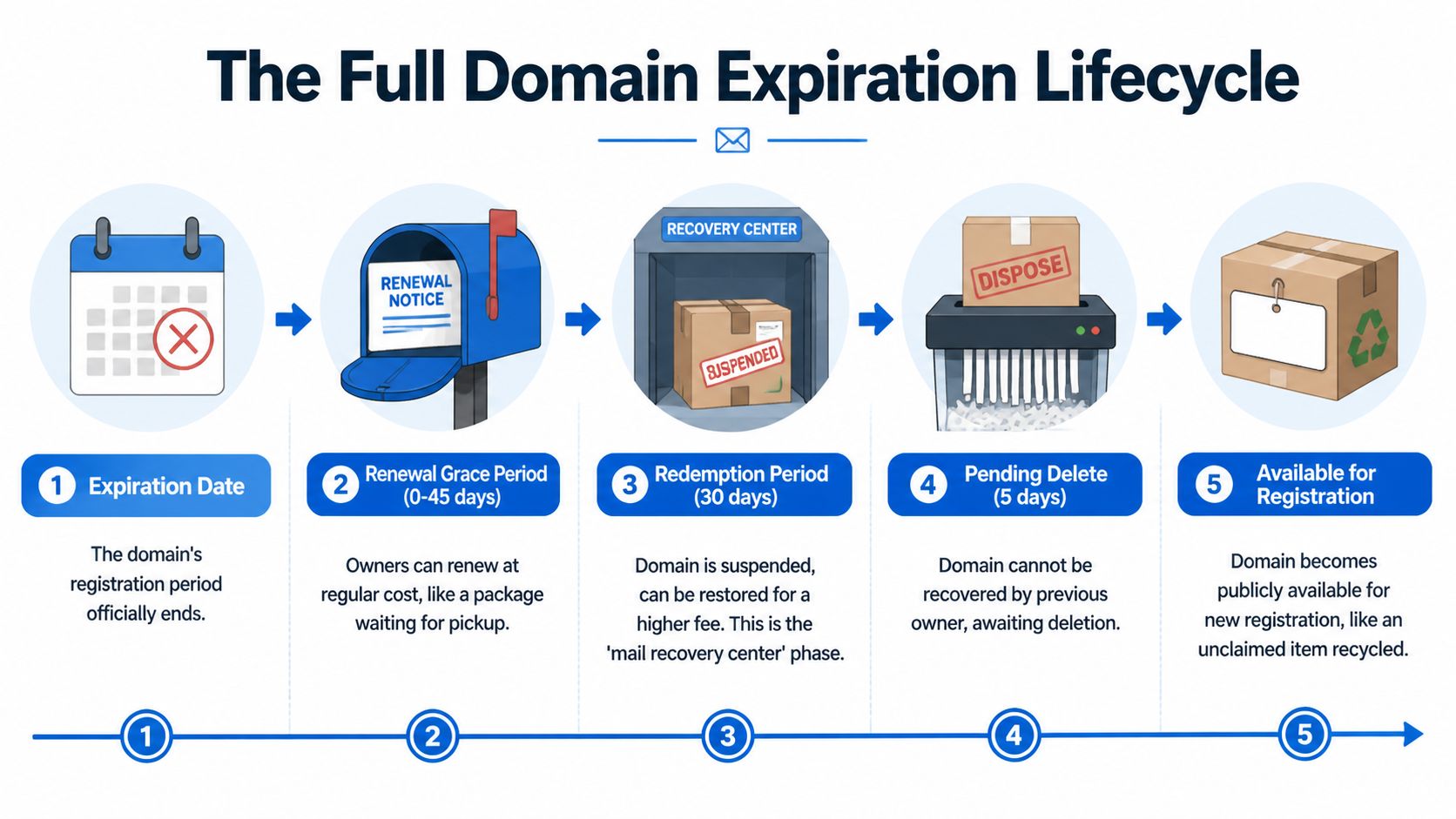
If you want the timing details behind the label on your dashboard, this guide on when a domain actually expires explains the gap between the listed expiration date and the point where control is gone.
Stage one is expiration day
The registration term ends.
That sounds final, but it usually is not. In practice, this is often the point where the registrar starts applying restrictions while still giving the owner a chance to renew. From an owner’s seat, this is the cheapest mistake to fix. From an investor’s seat, it means the domain is still off limits.
Stage two is the grace period
This is the clean-up window. The registrar still treats the domain as recoverable through ordinary renewal methods, even if the website, DNS, or email stops behaving normally.
Owners should move quickly here because the process is still simple. Investors should stay patient because “expired” at this stage does not mean “available soon.” Plenty of domains die here on paper and come right back to life after the owner updates a card, finds the invoice email, or notices that a former employee was the billing contact.
A practical detail gets overlooked a lot. Registrars do not all handle grace periods the same way. Some leave services mostly intact for a while. Others park the domain, interrupt email, or push it into auction channels before the deletion path is complete.
Stage three is the redemption period
Now the tone changes.
The domain has usually moved beyond the easy renewal path and into a formal restore process. Owners still have a shot, but the price goes up and the margin for delay gets thinner. Investors, meanwhile, are still watching from the fence. A good domain can look dead from the outside and still be one expensive restore request away from staying with the original owner.
This stage matters because it separates a temporary billing mistake from a real abandonment signal.
Grace period mistakes are cheap. Redemption mistakes come with a bill.
Stage four is pending delete
Once the domain reaches pending delete, the owner is effectively out of options through the registrar. The name is queued for deletion at the registry level, and the countdown to release is usually short.
For owners, this is the hard stop. For investors, preparation here matters more than optimism. Manual registration is rarely enough on any name with real demand.
Stage five is the drop
The registry deletes the domain and releases it back to the market.
That is the moment investors care about, but it is also the moment panicked former owners often misunderstand. By the time a name drops, the recovery story is over. It has become an acquisition story. If the domain has traffic, backlinks, brand value, or category relevance, multiple buyers may be waiting with backorders, scripts, or drop-catching services ready to fire.
Here is the lifecycle in plain English:
| Stage | What it means | What usually works |
|---|---|---|
| Expired | Registration term ended | Check account status and registrar notices |
| Grace period | Early recovery window | Standard renewal |
| Redemption period | Recovery is still possible, but costly | Restore request plus renewal |
| Pending delete | Final deletion queue | Owner recovery is usually over |
| Available | Public can register it | Fast registration or drop catch |
The mistake I see most often is simple. Owners hear “expired” and assume “gone.” Investors hear “expired” and assume “dropping.” Both assumptions cost money. The lifecycle is predictable, but only if you respect the stage you are in.
Decoding The Domain Redemption Period
A lot of owners first learn what redemption means after logging in, seeing the domain gone from the usual renewal flow, and feeling that little punch in the stomach. From the owner’s seat, redemption is the last paid rescue window. From the investor’s seat, it is the waiting room. The name is off the table for everyone except the current registrant, and that detail matters.
According to Dynadot’s domain life cycle guide, this stage usually runs for a few weeks after the grace period ends, and the restore bill can be far higher than a normal renewal.

That price surprises people because redemption feels like “I still own it, so why am I paying a penalty?” The answer is simple. The domain is no longer sitting in the registrar’s regular checkout lane. It has moved into a registry-level recovery process, and registries charge for putting it back.
I usually describe redemption as the airport baggage room for domains. Your suitcase has not been thrown away, but it is no longer on the carousel. Getting it back takes staff time, paperwork, and extra fees, and nobody processes it for free.
Why redemption costs so much
Part of the fee is behavioral. Registrars and registries want renewals handled before expiration, not after a domain falls into recovery status.
Part of it is operational. A restore request is a special action tied to status changes at the registry, followed by renewal. That is why the bill often feels out of proportion to the mistake.
For owners, that means hesitation gets expensive. For investors, it means patience is required. A good name in redemption is not available yet, no matter how dead the listing looks in a marketplace or search result.
What redemption actually blocks
During redemption, WHOIS often shows status codes that indicate the domain is locked down and restricted. In plain English, the domain is in a penalty box.
Here is what that usually means in practice:
- No bargain transfer. The owner usually cannot move the domain to a cheaper registrar to dodge the restore fee.
- No normal account changes. DNS edits, contact changes, and routine management actions are often restricted.
- No early investor pickup. Outside buyers cannot readily register or buy the name while the owner still has restore rights.
That last point creates the split that matters in this article. The panicked owner still has a narrow path back. The investor has to wait and prepare. Platforms like NameSnag matter because they help both sides handle the timing correctly. Owners can verify where a name sits in the lifecycle, and investors can track names that may become available later without guessing.
One more practical detail. Redemption status also affects how buyers evaluate a domain’s upside. If the name has backlinks, age, or brand search demand, people start watching closely. Domain authority is not the whole story, but it is one signal in the mix, and this important SEO metric explained piece gives the quick version.
Registrar rules before redemption are not perfectly uniform, which is why registrar-specific timelines matter. If you want an example, this breakdown of the GoDaddy grace period for expired domains shows how the earlier stages can differ before a name ever reaches redemption.
The big takeaway is simple. Redemption is still an ownership problem, not a buying opportunity. Owners can recover the asset, but only by acting fast and paying up. Investors should treat this phase as research time, not purchase time.
For Owners How to Rescue Your Domain
If your domain is already in redemption, don’t waste time looking for a clever workaround. This is a “call the front desk, pay the fee, follow instructions exactly” situation.

The good news is that recovery is still possible. The less fun news is that the path is narrow, registrar-specific, and usually more expensive than people expect.
Start with the registrar, not Google
Your registrar is the party that can tell you whether the domain is still recoverable through their process. Go straight to support. Use account chat, phone, or ticketing, whichever gets the fastest response. Don’t assume the checkout page tells the full story.
Ask three questions immediately:
- Is the domain currently in redemption and still restorable?
- What is the total cost today, including redemption and renewal?
- What exact steps must I complete to authorize restoration?
That second question matters because redemption pricing is not uniform. As summarized by Network Solutions’ explanation of expired domain recovery, registrars can vary widely. Network Solutions lists a $99 redemption fee, No-IP mentions figures around $150, and some providers charge much more.
Confirm the real total before you approve anything
Owners often fixate on the redemption fee and forget the renewal fee sitting behind it. The restore charge usually isn’t the whole bill. Treat this like getting your car out of impound. There’s the release fee, then the other fee, then the “while we’re here” fee.
A quick checklist helps:
- Get the number in writing. Support chat transcript or ticket confirmation is better than memory.
- Confirm timing. Ask when payment must be completed and when the restore request will be submitted.
- Check the account email. If the restored domain lands back in an account you can’t access properly, you’ve created a second problem.
Follow the restore procedure exactly
This is not the time to freelance. Some registrars want a support ticket. Others require a specific restoration approval. Some may ask for identity verification or account confirmation before they process the request.
Once you’ve paid and approved the action, waiting becomes part of the job. Restoration isn’t always instant.
Here’s a helpful explainer before you keep refreshing your registrar dashboard:
Don’t expect a lightswitch moment
A lot of owners think the domain will pop back online the second payment clears. Sometimes it doesn’t. The restoration process can involve backend handling, and services may return in stages rather than all at once.
That means your job after payment is part patience, part verification.
- Watch for confirmation emails from the registrar that the restore request was submitted and completed.
- Check site and email behavior after restoration rather than assuming everything instantly normalized.
- Turn on auto-renew once the dust settles, especially for any domain tied to revenue, branded email, or customer trust.
Pay first. Optimize later. In redemption, the only bad move worse than paying a painful fee is losing the domain while debating the painful fee.
If the domain supports a business, this isn’t the moment to bargain with yourself. The fee may sting, but rebranding, rebuilding email trust, and recovering customer confidence usually sting more.
For Investors How to Hunt for Expiring Gems
Investors look at the same lifecycle owners fear and see a scoreboard. That’s not cold-hearted. It’s just how domain markets work. Every lapse creates a potential acquisition, but only if you know when to wait, when to watch, and when to move.
The redemption period for domain name opportunities is interesting mostly because you can’t do much during it. That frustrates beginners. They see a desirable expired name and assume there must be some early-entry trick. Usually there isn’t. The domain is still protected for the prior registrant. Your edge comes from monitoring, not forcing the gate.

The real game starts before the drop
The best investors don’t just wake up on drop day and hope for the best. They build watchlists early, usually while domains are still in grace periods or nearing the later stages of expiration.
That matters because timeline precision can be fuzzy. As noted in eNom’s discussion of domain expiration, redemption, and auction timelines, general timelines exist, but the exact redemption and public release dates can be vague. Waiting for public release avoids redemption fees, but it also means facing backorders, auctions, and faster competitors.
That uncertainty changes investor behavior in a few useful ways:
- You monitor categories, not just single names. One target can get renewed. A good list gives you alternatives.
- You prepare for several outcomes. Renewal by owner, auction path, backorder competition, or clean public drop.
- You stop assuming every expired domain will become available. Many don’t.
What to evaluate before you chase anything
A domain can look attractive for bad reasons. Aged names, keyword names, and old brands pull people in fast. The smarter move is to evaluate what kind of true upside you’re buying.
I usually sort opportunities into a few buckets:
| Type | Why investors care | Main risk |
|---|---|---|
| Brandable names | Useful for startups and resale | Name may sound good but have weak demand |
| SEO rebuild candidates | Possible authority and link value | Dirty history can ruin the thesis |
| Exact-match or niche names | Clear commercial intent | Narrow buyer pool |
| Defensive or portfolio adds | Strategic fit with existing holdings | Easy to overpay for “maybe” value |
If you’re evaluating SEO potential, understanding authority metrics helps separate “looks solid” from “actually useful.” This guide on the important SEO metric explained gives a practical primer on one metric investors often reference alongside backlink quality and domain history.
What works and what doesn’t
What works is boring, which is why it works.
- Track domains before they become obvious. Once everyone sees the same name on drop day, your edge is gone.
- Use backorders when the target justifies the competition. They’re not magic, but they’re often better than hand-registering with crossed fingers.
- Review historical quality, not just the string. A beautiful name with a rotten past is a shiny lemon.
What doesn’t work is the cowboy approach.
- Don’t treat every expired domain like a bargain. Plenty are dead for good reasons.
- Don’t assume “expired” equals “dropping soon.” The owner may still recover it.
- Don’t wait until the final minute to do research. By then, the market has already decided whether the name matters.
Good investors spend more time filtering than buying.
That sentence sounds dull, but it saves money. The domain world has no shortage of names that look rare and act useless. Patience is a competitive advantage here.
Finding Gold After The Drop with NameSnag
After pending delete ends, the safety net is gone. As described by No-IP’s explanation of redemption recovery, redemption restoration is a formal registry process, and once the 5-day Pending Delete phase is over, that option disappears completely. Public release becomes the next event that matters.
This is the moment many people imagine as a treasure chest opening. In reality, it’s more like a giant yard sale in the rain. There may be something valuable on the table, but most of what you see is clutter, old junk, and names that should’ve stayed buried.
That’s why manually scanning dropped domains is such a miserable workflow. You can spend hours checking names one by one, only to discover they’re spammed, awkward, legally uncomfortable, or impossible to brand. Even experienced investors lose time this way because the hard part isn’t access. It’s triage.
Why fresh drops are chaotic
Dropped domains come with noise built in. Some were abandoned because the owner no longer needed them. Some were never useful. Some carry baggage that doesn’t show up until you inspect the history and links carefully.
A practical process after the drop usually looks like this:
- Scan for immediate availability instead of guessing which names might still be tied up.
- Filter hard for quality signals so you don’t waste energy on obvious junk.
- Check for clean history and usable branding before you register out of excitement.
A curated feed beats brute force. Instead of hopping between registrar searches and multiple SEO tools, it’s far more efficient to start with domains that are already surfaced as available now.
You can browse available domains that have already dropped and can be registered immediately, then narrow by time windows like Today, 3 Days, 7 Days, 14 Days, 30 Days, or All. That’s useful when you want fresh inventory instead of a giant undifferentiated pile.
Why the earlier stages still matter to buyers
The best dropped-domain buyers don’t only look at what’s available right now. They also keep an eye on names that are still moving through the expiration pipeline.
That’s where expiring domains that are still in the grace window become useful to watch. Those names haven’t dropped yet, but they tell you where future opportunities may emerge. You can sort by time and monitor what might become contested later rather than discovering everything at the last second.
For practical workflow, I like splitting the hunt into two lanes:
| Lane | Best use |
|---|---|
| Available now | Fast action on domains you can register immediately |
| Expiring soon | Research and watchlisting before the public scramble |
That combination fixes a common investor mistake. Many either obsess over future names and never buy, or they impulsively grab dropped names with almost no review. The better approach is to keep one eye on the board and one hand on the checkout button.
The drop is not where strategy begins. It’s where preparation cashes in.
If you treat dropped domains like a slot machine, you’ll collect weird souvenirs. If you treat them like inventory, patterns show up fast. Clean history, usable branding, and realistic upside matter more than the thrill of being first.
Protect Your Assets and Seize Opportunities
Domain expiration is only scary when you don’t know the rules. For owners, the play is simple: renew early, keep billing details current, and if a domain slips into redemption, act fast and follow the registrar’s process exactly. For investors, the edge comes from patience, filtering, and knowing that not every expired name is a real opportunity.
The system isn’t random. It rewards people who pay attention. Whether you’re defending a business asset or hunting for a strong pickup, understanding the redemption period for domain name recovery gives you better timing, better decisions, and fewer expensive surprises.
If you want a faster way to track the domains worth watching, NameSnag makes the hunt far less messy. You can monitor expiring names before they drop, scan available domains you can register right now, and filter for cleaner opportunities instead of digging through piles of junk by hand.
Find Your Perfect Domain
Get access to thousands of high-value expired domains with our AI-powered search.
Start Free Trial