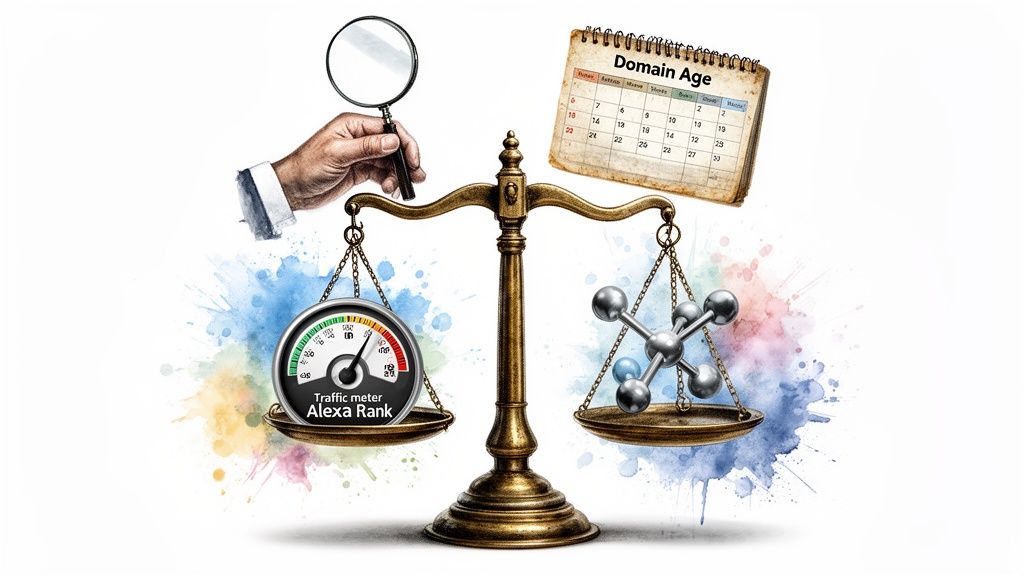
Hunting for the perfect domain can feel like a treasure hunt. But are you using an ancient, tattered map to find your prize? When it comes to judging a domain's value, metrics like Alexa Rank, Google PageRank, and Domain Age are often treated like gospel. The hard truth? These are ghost metrics—lingering echoes from a bygone era of SEO that tell you almost nothing about a domain's real potential today.
Debunking the Ghost Metrics of SEO
Alright, let's talk about the ghosts in the machine. Back in the early days of the internet, these three metrics were the pillars of domain evaluation. They gave us a picture—or what we thought was a clear picture—of a site's authority, popularity, and trustworthiness. An old domain with a high PageRank and a low Alexa Rank was a digital diamond. Simple.
But times have changed. A lot. Sticking to those old rules today is like trying to navigate downtown Manhattan with a map from 2005. You’re going to miss all the new highways, and you're probably going to get very, very lost. Search engine algorithms have become incredibly sophisticated, user behavior is completely different, and the very definition of a "valuable" domain has been rewritten.
So why did these metrics have so much power, and what sent them to the graveyard?
| Metric | What It Was | Why It Mattered Then | The Modern Reality |
|---|---|---|---|
| Google PageRank | A public 0-10 score from Google that measured a site's authority based on its backlink profile. | This was a direct, visible signal from the mothership about a page's importance. It was the gold standard. | Google killed the public score in 2013. The concept of link equity is alive and well, but the metric itself is gone. |
| Alexa Rank | A global ranking system that estimated website traffic, collected from users who had the Alexa Toolbar installed. | It was a quick and dirty way to compare one site's popularity against every other site on the web. | Its reliance on toolbar data became laughably inaccurate with the explosion of mobile browsing. Alexa Rank was officially retired in 2022. |
| Domain Age | Simply the length of time a domain has been registered, pulled from WHOIS records. | The thinking was that older domains were more trustworthy and less likely to be fly-by-night spam operations. | Age alone is meaningless. A 10-year-old domain with a toxic past is worthless compared to a clean, one-year-old domain. |
Trusting these outdated signals is a surefire way to invest in digital dust instead of a high-potential asset. You might find an aged domain with a fantastic historical PageRank, only to discover its backlinks are now so toxic they'd poison any project you build on it.
This isn't just a history lesson. It's the critical first step toward building a modern framework for valuing domains. Before you go hunting for your next project, you have to leave these ghosts behind and start focusing on the metrics that actually drive success today.
The Ghosts of SEO Past: Alexa Rank, PageRank, and Domain Age
To really get why modern metrics are so important, you have to dig into the fossils of SEO. Let's put on our digital archaeologist hats and talk about the old gods of the internet—the metrics that once ruled everything but whose temples have long since crumbled.
We're talking about the big three: Alexa Rank, Google PageRank, and Domain Age.
Each one tells a story about what the web used to value. Understanding their rise and fall is crucial for anyone serious about domain hunting today, because the ghosts of these metrics still haunt the way people (wrongly) evaluate domains.
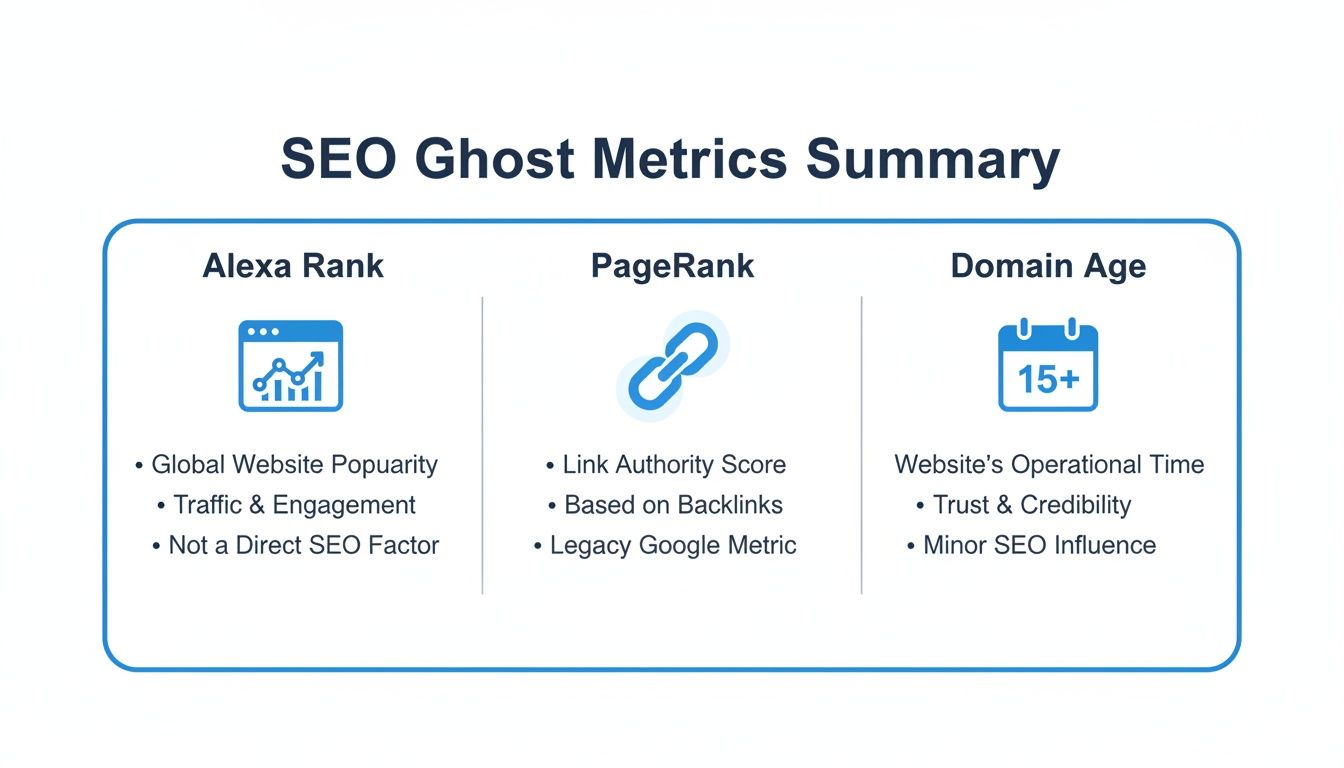
As you can see, each metric was a one-trick pony. They focused on a single concept—raw traffic, link authority, or time—which is exactly why they couldn’t keep up as the internet grew more complex.
Here’s a quick rundown of these legacy metrics and why they're no longer the benchmarks they once were.
Legacy SEO Metrics: A Side-By-Side Comparison
This table breaks down what these old-school metrics were all about, what they were trying to accomplish, and the nail in the coffin for each.
| Metric | What It Measured | Primary Purpose | Reason for Decline |
|---|---|---|---|
| Alexa Rank | Estimated website traffic from a small user sample. | A public-facing "popularity contest" ranking all sites by visitor volume. | Skewed, unreliable data from a shrinking pool of desktop toolbar users; became irrelevant. |
| Google PageRank | The authority of a webpage based on the quality and quantity of incoming links. | Google's core algorithm to determine a page's importance and ranking power. | Public toolbar was discontinued in 2016 after it fueled massive link spam and manipulation. |
| Domain Age | The amount of time since a domain was first registered. | A simple proxy for trustworthiness, based on the assumption that older is better. | Age alone is meaningless; a domain's history and backlink profile are what count. |
Seeing them side-by-side, it's clear they were products of a simpler time. They were easily gamed, offered an incomplete picture, and ultimately couldn't adapt to the sophisticated ways we now measure a domain's true value.
The Rise and Fall of Alexa Rank
Remember Alexa Rank? It was the ultimate vanity metric. From 1996 until its shutdown on May 1, 2022, it ranked every website on the planet based on traffic, from #1 down into the millions.
For years, it was the go-to for a quick-and-dirty traffic estimate. The whole system was powered by data collected from people who installed the Alexa browser toolbar. Think of it as a global popularity contest where the only voters were people who agreed to wear a special pin.
A rank under 100,000 was a sign of a pretty popular site. But its fatal flaw was its data source. The toolbar was almost exclusively used on desktops, so it completely missed the mobile revolution. Its user base got smaller and less representative over time, making the data wildly inaccurate. Fun for bragging rights, but useless for serious SEO analysis.
The Legend of Google PageRank
Ah, PageRank. If Alexa was a popularity contest, Google PageRank was the final verdict from the Supreme Court.
Google gave every page a public score from 0 to 10 via its toolbar. This number was everything. It was based on a simple, brilliant idea: links are votes. A link from an important site was a powerful vote that passed authority—or "link juice"—to another page.
PageRank wasn't just about the number of links; it was about the quality of those links. A single link from a PR8 university page was worth more than thousands of links from PR1 spam blogs.
This concept was the backbone of Google's original algorithm. But putting that score on a public toolbar created chaos. It spawned a massive industry of link selling and manipulation schemes designed solely to inflate PageRank scores. Google fought back, stopped updating the public score around 2013, and eventually killed the toolbar altogether.
The core principle still exists deep within Google's algorithm today, but the public metric is long gone.
The Myth of Domain Age
Finally, there’s Domain Age—the simplest and most misunderstood metric of all. The logic feels intuitive: an older domain must be more trustworthy than a new one, right? After all, spammers churn through new domains, while a site that's been around for a decade has to be legit.
There's a tiny kernel of truth here. A long, clean history can be a positive signal. The problem is that age, by itself, means absolutely nothing.
A 15-year-old domain could have been:
- Parked and unused: It has zero history, good or bad. It’s a blank slate.
- Used for spam: It could have a toxic backlink profile that will poison any project you build on it.
- Dropped and re-registered multiple times: Its history is a messy patchwork of different owners and purposes.
An old domain is not inherently better than a new one. In fact, a one-year-old domain with a handful of high-quality, relevant backlinks is infinitely more valuable than a 10-year-old domain with a history of abuse. The registration date tells you how old the car is, not whether the engine runs. To really understand what matters, you need the right tools; you can learn more about this in our guide to using a domain age checker tool.
Alright, let's get rid of the old guard. Alexa Rank is dead and gone, public PageRank is a ghost story we tell new SEOs, and leaning too hard on Domain Age is a trap. If we're not supposed to be chasing those numbers, what metrics actually move the needle when you're sizing up a domain?
The good news is, our modern toolkit is infinitely more powerful and gives us a much clearer picture. We've moved past single, easily-gamed data points and now have metrics that give a holistic view of a domain's health and raw potential. These are the numbers that have a real, tangible correlation with ranking ability and genuine authority.
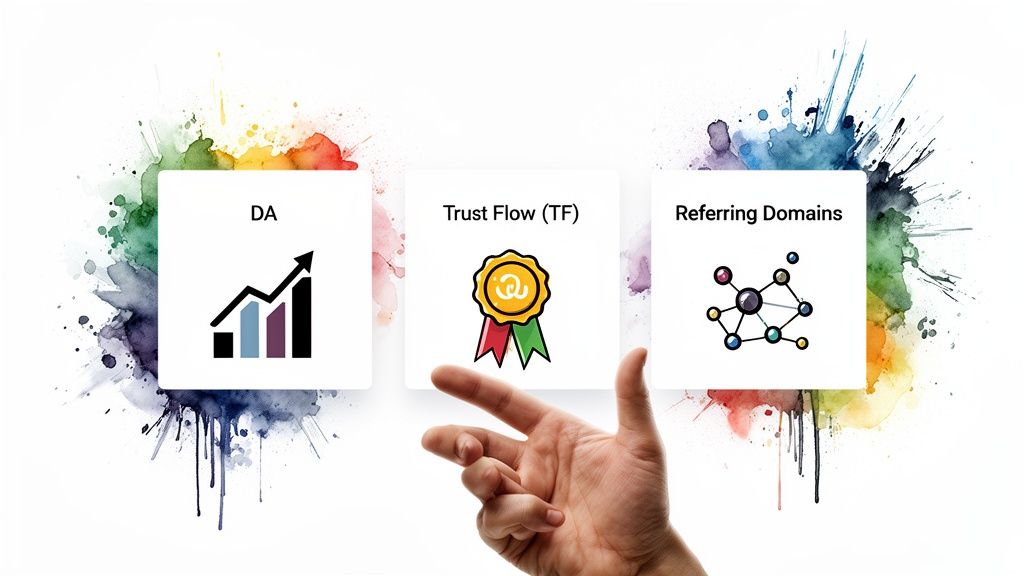
So, let's meet the new power players. These are the stats you should be laser-focused on, whether you're hunting for a gem in the Expiring domains list or grabbing one of the awesome Available domains that just dropped.
Domain Authority: Predicting Ranking Potential
First on the list is Domain Authority (DA), a score cooked up by the folks at Moz. Scored from 1 to 100, DA is designed to predict how well a website will rank on search engine results pages (SERPs). It's purely a comparative tool—a domain with a DA of 50 should, in theory, outrank a site with a DA of 30.
DA is calculated using a whole host of factors, but the big ones are the total number of links and, more importantly, the number of unique root domains linking to the site. You can think of it as the spiritual successor to Google PageRank, but built and maintained by a third party. It gives you a fantastic, at-a-glance idea of a domain's link equity. If you want to go deeper, check out our guide on the Moz Domain Authority score.
A higher DA score points to a greater ability to rank. But remember, it's calculated on a logarithmic scale. That means jumping from DA 70 to 80 is a monumental task compared to going from DA 20 to 30.
Trust Flow: The Quality Control Metric
Next up, we've got Trust Flow (TF), a brilliant metric from Majestic. This one is all about quality over quantity. Trust Flow measures how trustworthy a site is by calculating its proximity to a "seed set" of highly trusted websites.
Picture the internet as a web of trust. A link from a major university, a government institution, or a top-tier news site is a massive vote of confidence. Trust Flow essentially tracks how that "trust" trickles down from those seed sites through the backlink network.
- High Trust Flow: The domain has backlinks from authoritative, trustworthy sources. This is the good stuff.
- Low Trust Flow: The domain might have a boatload of links, but they're coming from spammy directories, PBNs, or other low-quality corners of the web.
This is a critical gut-check. A domain could have a respectable DA from thousands of links, but if its TF is in the single digits, those links are probably toxic junk. A healthy, powerful domain has a balanced profile where Trust Flow isn't miles behind its link volume metrics.
Referring Domains: The Power of Diversity
Finally, we have the simple but incredibly potent metric of Referring Domains. This is just the total count of unique domains linking to your target site. It's a foundational signal of popularity and credibility in Google's eyes.
Why does this matter so much? Because ten links from ten different websites carry infinitely more weight than ten links from the same website. A diverse backlink profile tells search engines that lots of different, independent entities find your content valuable enough to endorse.
It's just common sense, really:
- One Referring Domain: One person keeps telling you a restaurant is amazing.
- Many Referring Domains: One hundred different people all tell you that same restaurant is amazing.
Whose recommendation are you going to trust? A high number of quality referring domains is one of the strongest indicators of a domain's authority. When you combine this with DA and TF, you get a comprehensive, actionable picture of a domain's real value—leaving the ghosts of alexa rank google pagerank domain age to haunt someone else.
How to Evaluate Domains Using Modern Data
Okay, theory is one thing, but let's get down to brass tacks. How do you actually take this knowledge and use it to pick a winner from a long list of expiring domains? It’s time to stop guessing and start thinking like a seasoned domain investor.
The trick is to look at the entire picture. A single impressive metric means almost nothing on its own; in fact, a really lopsided profile is usually a giant red flag telling you to run the other way.
You've got to see how the different numbers work together to get a feel for a domain's real health. A domain with balanced scores, a squeaky-clean history, and backlinks from quality sites is always, always a better bet than one with a single flashy number.
Your Step-by-Step Evaluation Checklist
When you spot a domain that looks promising, don't just glance at the Domain Authority (DA) and move on. You need to dig deeper. This is the exact process that separates the pros who find gems consistently from the amateurs who get burned.
Check the Core Trio (DA, TF, Referring Domains): Start with the big three. A high DA hints at ranking potential, but Trust Flow (TF) is your quality check. A domain with DA 40 and TF 5 is practically screaming, "I'm built on a mountain of junk links!" A much healthier profile is something like DA 30 with TF 25, which suggests its backlinks come from reputable corners of the web.
Analyze the Backlink Profile Manually: This part is non-negotiable. You have to look at the actual websites linking to the domain. Are they relevant to the niche? Are they real, established sites, or just a bunch of spammy blog comments and generic directories? This is where you'll spot the Private Blog Networks (PBNs) and other toxic links that automated tools often miss.
Investigate the History: A domain's past can absolutely come back to haunt you. You need to do a background check to make sure it wasn't used for something sketchy. Our guide on the Archive.org Wayback Machine is the perfect starting point for learning how to dig into a domain's previous lives.
A quick look can tell you if the domain was once a legitimate business, a spam site, or something else entirely. This context is critical for understanding its true value.
Spotting Red Flags
A smart investor knows what to look for—and more importantly, what to run from. A high DA can be incredibly deceiving, so you need to be able to spot the warning signs of a domain that's more trouble than it's worth.
Here are a few common red flags:
- A Massive Gap Between DA and TF: Like we mentioned, if the Domain Authority is high but the Trust Flow is scraping the bottom of the barrel, it’s a classic sign of low-quality, high-quantity link spam.
- Irrelevant or Foreign Backlinks: If you're looking at a domain about dog training and its top links are from Russian gambling sites and Chinese forums, walk away.
- A Sudden Spike in Backlinks: A natural link profile grows over time. A sudden, massive jump usually means someone bought a spammy link package to inflate its stats right before dropping it.
- An Abusive Past: The Wayback Machine shows the domain was previously used for adult content, pharma spam, or other questionable topics. That history sticks, making it tough to rank for anything legitimate.
It's also worth remembering that Google actively targets expired domain abuse. A domain that was manipulated in the past might be carrying a penalty that will sink your project before it even gets started.
Investor's Insight: The goal isn't just to find a domain with good metrics. It's to find one whose authority is clean, relevant, and built on a foundation of genuine trust.
This whole idea of link-based authority isn't new. Back in the early 2000s, Google PageRank was the holy grail. Its toolbar showed a score from 0 to 10 based on backlink juice, and hitting a PR6 or higher meant your site was in the top 1% of the web. But by 2013, Google stopped updating the public data. Turns out, its correlation with actual rankings was far weaker than the metrics we use today. The tools change, but the core principle—quality over quantity—never does.
Alright, theory time is over. Let's stop chasing ghosts like Alexa Rank and Google PageRank and start finding some actual digital gold. I'm going to walk you through how you can use NameSnag’s tools to pinpoint valuable domains, whether you're ready to pounce today or just scouting for a future project.
The entire platform is built to slice through the noise, letting you focus on domains with real potential based on data that's actually actionable today. We’re using a smarter approach here.
Uncovering Gems Available Right Now
Sometimes you need a powerful domain today. This is where the Available domains filter becomes your best friend. These aren't just any domains; they were just dropped and are ready for you to register immediately at any registrar you like.
Here's a pro-level tactic to snag the best ones before anyone else:
- Head over to the Available domains section.
- Set the time filter to Today. This is your secret weapon.
- Use the advanced filters to punch in your minimums for SnagScore, Domain Authority, and Trust Flow.
This instantly surfaces the highest-quality domains that became available in the last 24 hours, saving you from sifting through thousands of duds. It’s the fast track to finding an asset you can put to work right away.
Scouting for Future Opportunities
If you'd rather play the long game and scope out assets before they hit the open market, the Expiring domains section is where you'll want to be. These are domains that have expired but are still in their grace period, which means they'll be dropping soon. This gives you precious time to do your homework and prepare.
Pro Tip: In the Expiring domains section, use the 7 Days or 14 Days time filter. This creates a perfectly manageable watchlist of high-potential domains, giving you plenty of runway for a deep-dive analysis without feeling overwhelmed.
Filtering by What Truly Matters
Domain age was once a hyped-up SEO signal, but its direct link to rankings is far weaker now than metrics like backlink quality. That said, older domains often carry a history of trust that you just can't ignore, especially in the domain flipping market. It's a fact that 10-year-old expired domains can sell for over 3.5x more than one-year-olds. If you want to dig deeper, this insightful analysis breaks down how these metrics have evolved.
NameSnag lets you blend the old with the new. You can filter for domains that are 5+ years old and also have a SnagScore of 60+. This strategic combo ensures you’re not just getting an old domain, but one with a powerful, clean backlink profile to back it up. It’s this combination—not a single outdated metric—that uncovers the true diamonds in the rough.
Domain Metrics FAQ
Jumping into domain metrics feels a lot like learning a new language. You've got acronyms flying around, ghost metrics haunting your research, and a ton of conflicting advice. Let's clear the air and knock out some of the most common questions people have when they're trying to size up a domain.
Think of this as your personal myth-busting guide to making smarter, more confident decisions. We’ll get straight to the point and give you the clear answers you need to separate the real signals from all the noise.
If Google PageRank Is Gone, Why Do SEOs Still Talk About It?
This is a fantastic question that gets right to the heart of the matter. While the public, toolbar-based Google PageRank score (that little 0-10 number we all used to obsess over) is long gone, the idea behind it is still the absolute foundation of Google's algorithm. PageRank was all about measuring a page's importance based on the quality and quantity of its backlinks. That principle is more alive today than ever.
When you hear an SEO pro mention "PageRank" now, they're almost always using it as shorthand for "link equity" or "authority." They're talking about the invisible power that flows from one site to another through a link.
So, while you can't see a score anymore, the entire practice of building high-quality backlinks is an effort to increase your site's internal, invisible PageRank. Modern metrics like Domain Authority are just third-party attempts to guess what Google is calculating behind the scenes.
Is a High Domain Age Useless if the Backlinks Are Bad?
Yes, one hundred percent. A high domain age with a toxic backlink profile isn't just useless—it's a liability.
Think of it like a classic car. A 50-year-old car that's been garage-kept and perfectly maintained is a treasure. A 50-year-old car that’s been sitting in a swamp is a pile of rust you have to pay someone to haul away.
A domain's age only provides a potential advantage if its history is clean. A one-year-old domain with a handful of powerful, relevant backlinks from trusted sites is infinitely more valuable than a 15-year-old domain with thousands of spammy links from irrelevant, low-quality sources. Always, always prioritize the quality of the backlink profile over the registration date.
How Should I Choose Between High DA Versus High Trust Flow?
This is the classic quality vs. quantity dilemma, and it’s where a bit of nuanced analysis really pays off. Domain Authority (DA) from Moz predicts a domain's overall ranking potential based on its entire link profile, while Trust Flow (TF) from Majestic specifically measures the quality and trustworthiness of those links.
Here’s a simple way to think about it:
- High DA, Low TF: This is often a huge red flag. It usually means the domain has a massive number of links, but most of them are junk. It points to potential spam or a history of manipulative link-building that you don't want to inherit.
- Moderate DA, High TF: This is the sweet spot. It suggests the domain has fewer backlinks, but the ones it has come from highly authoritative and trustworthy sources. This is a much healthier, more sustainable profile.
For building a long-term asset, a strong Trust Flow is generally a more reliable indicator of a domain's health and a much safer investment. It tells you the domain has earned endorsements from the right neighborhoods online, which is a powerful signal for search engines. This is the kind of balance you should be looking for when sifting through the noise of legacy metrics like alexa rank google pagerank domain age.
Ready to find domains with metrics that actually matter? NameSnag cuts through the clutter of ghost metrics, providing a powerful SnagScore that analyzes the data points that drive real SEO value. Stop chasing outdated numbers and start discovering high-potential domains today by exploring our lists of Available domains or scouting future gems in the Expiring domains section.
Find Your Perfect Domain
Get access to thousands of high-value expired domains with our AI-powered search.
Start Free Trial