Ever felt like you missed the boat on domain names? That all the good .coms were snapped up back when dial-up was still a thing? It’s a common feeling, but friend, you couldn't be more wrong. There's a massive, churning marketplace where valuable domains are constantly resurfacing: GoDaddy Domain Name Auctions.
Think of it less as a pristine real estate showroom and more like a high-stakes treasure hunt for digital properties. These aren't just random strings of letters; they’re pieces of digital real estate with history, and sometimes, a whole lot of built-in value.
Welcome to the Digital Treasure Hunt
GoDaddy sits at the center of this world for one simple reason: they are the world's largest registrar. When a domain registered there isn't renewed, it often ends up in their auction house. This creates a constant river of opportunities, flowing with forgotten, expired, and premium domains looking for a new owner.
It’s a bustling, chaotic, and often-confusing place. But for SEOs, niche site builders, and entrepreneurs who know what they're doing, it's a gold mine.
The Opportunity in Aged Domains
So why the fuss? Many of these domains aren't starting from zero. They're aged domains—names that have existed for years and, crucially, might come with powerful assets already attached.
It’s like the difference between buying a brand-new car off the lot and acquiring a meticulously maintained classic. The new car has zero miles, sure, but the classic might come with a perfectly tuned, high-performance engine. An aged domain can give you a similar advantage with assets like:
- Existing Backlinks: These are links from other websites, which act like votes of confidence or "street cred" in the eyes of search engines.
- Established Authority: Google and other search engines have a history with the domain, which can translate into trust that's hard to build from scratch.
- Search History: The domain might already be known for and ranked for certain keywords, giving you a pre-built foundation to work from.
Acquiring a domain with this kind of history is a massive shortcut. You can sidestep months, or even years, of grinding away to build credibility from nothing.
The real game isn't just buying any expired domain; it's about finding one with a clean history and powerful SEO equity that others have overlooked. That's where the treasure is buried.
Your Path to Finding Gold
Jumping into GoDaddy domain name auctions can feel like drinking from a firehose. Thousands of domains are listed every single day, and the competition for the truly good ones is fierce. But with the right approach, you can consistently find and win assets that most people miss entirely.
The secret is knowing what to look for and where to find it before the bidding frenzy starts. For instance, the pros don't just browse the public auctions. They use tools to monitor Expiring domains, which are still in their grace period and haven't hit the open market yet. Finding a gem in this phase gives you a critical head start for research and planning.
This guide is your map. Let's get started on the hunt.
Why GoDaddy Rules the Expired Domain Market
When you’re on the hunt for expired domains, you have to go where the inventory is. And in this world, that place is, without a doubt, GoDaddy. Think of it less as a market and more as a force of nature—a massive, gravity-like pull created by their sheer size as the world’s largest registrar.
This isn't a slight edge; it's a near-total lock on the market. That massive scale means they have a firehose of expiring domains that no other platform can even dream of matching. For you, the domain investor or SEO, this all boils down to one thing: opportunity. More domains flowing through the system means more chances to catch that one undervalued gem with a killer backlink profile or a brand name that’s pure gold.
The Numbers Don’t Lie
GoDaddy’s grip on the market isn’t just a feeling; the numbers paint a stark picture, especially in the all-important .com space.
Take 2021, for example. Across all major auction platforms, there were 128,600 total .com sales. GoDaddy Auctions? They handled a whopping 94,900 of them. That’s nearly 74% of the entire market, bringing in $45.6 million in sales. When one player commands that much of the action, you simply can't afford to ignore them.
This creates a marketplace with incredible liquidity and variety. You’re not just picking through the scraps. You’re getting first crack at some of the most valuable .com domains hitting the aftermarket, perfect for flipping, building out a new project, or giving an existing site a serious SEO boost.
A Closer Look at Market Dominance
To really wrap your head around the scale of GoDaddy's operation, let's put some numbers on the table. This isn't a recent trend; they've been the undisputed leader for years.
GoDaddy's .COM Auction Market Share at a Glance
| Year | GoDaddy .COM Sales | Total Market .COM Sales | GoDaddy Market Share (%) | GoDaddy Dollar Volume |
|---|---|---|---|---|
| 2020 | 76,900 | 108,800 | ~71% | $40.5 Million |
| 2021 | 94,900 | 128,600 | ~74% | $45.6 Million |
| H1 2022 | 51,600 | 75,900 | ~68% | $29.5 Million |
The data is pretty conclusive. A huge majority of valuable expired .com domains are going to pass through the GoDaddy ecosystem. Sure, other platforms exist, and you might find a deal there now and then. But ignoring GoDaddy is like trying to be a stock trader while ignoring the New York Stock Exchange.
The bottom line is simple: if you want to find the best expired domains, you have to fish in the biggest pond. GoDaddy's auction house is that pond, and its sheer size gives you the best odds of landing a trophy catch.
From high-stakes bidding wars to scooping up deals in the final moments, the inventory is always churning. This constant flow includes some of the best deals available, often found in their closeout sales. You can learn more about how to specifically target GoDaddy closeout auctions in our detailed guide. By putting your energy where the activity is, you’re not just playing the game—you’re positioning yourself right at its center.
Finding and Vetting Winning Domains
Winning at GoDaddy domain auctions isn't about having the deepest pockets; it’s about having the best intelligence. The real victory is decided long before the final bidding frenzy. It happens in the quiet, methodical work of finding and vetting domains with actual potential—separating the digital gold from the digital junk.
This is where the pros find their edge. Instead of casually browsing the main auction listings with thousands of others, they hunt for domains that haven't even hit the open market yet. It’s a proactive approach that gives them a critical head start on research, letting them make smart moves while everyone else is just starting to notice a name.
This constant flow of opportunity is driven by the sheer scale of GoDaddy's operation. We're talking about a massive engine.
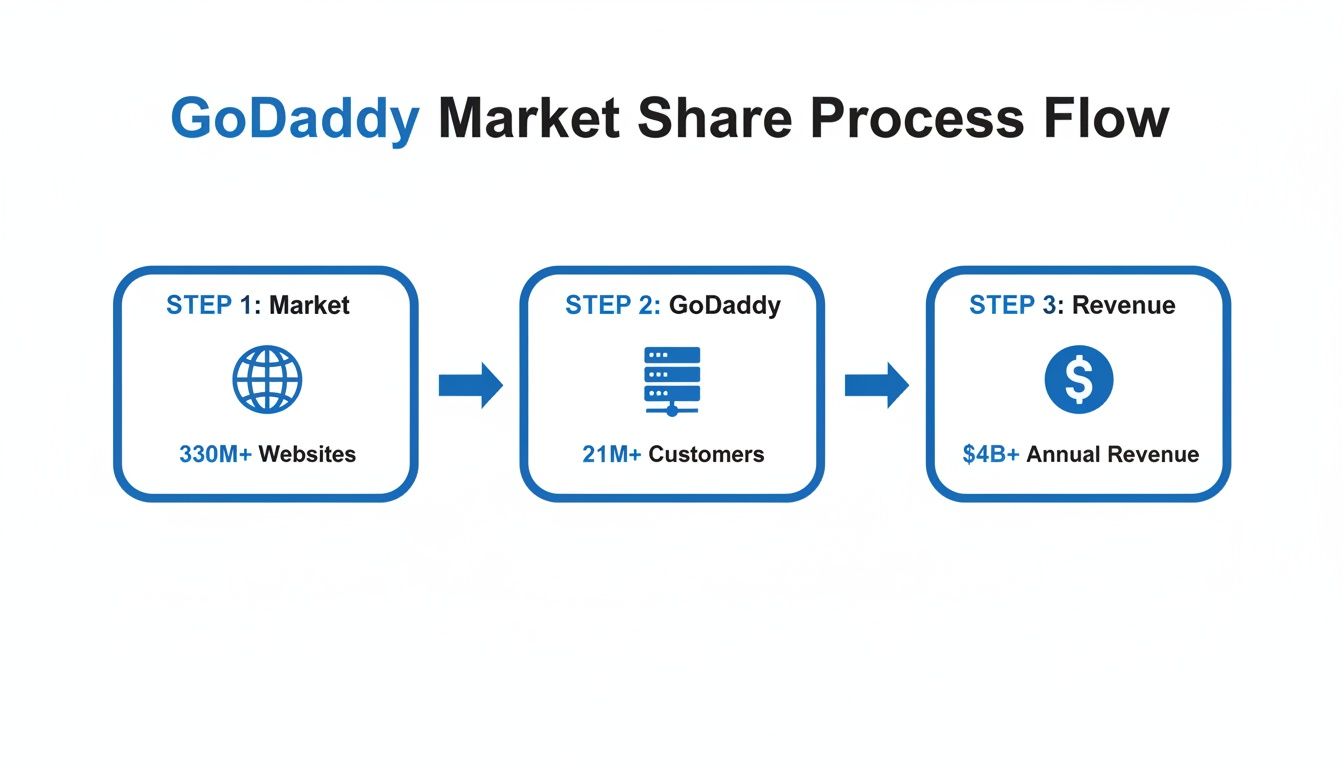
With a customer base and domain volume that large, a steady stream of domains is always moving from active registration toward expiration. That churn creates the inventory we need to sift through.
The Pre-Auction Hunt for Expiring Gems
The secret weapon for many successful domain investors is a laser focus on Expiring domains. These are names that have passed their renewal date but are still floating in a grace period before being thrown into the public auction pit. Think of it as getting a sneak peek at the inventory list before the doors swing open to the masses.
This pre-auction window is your golden opportunity. It’s your time to perform due diligence without the pressure of a ticking clock and rapidly climbing bids. You can dive deep into a domain's history, figure out what it's really worth, and decide if it's something you’re willing to fight for.
Tools like NameSnag are practically built for this strategy. You can zero in on high-potential expiring domains that will be dropping soon, filtering by when they'll become available—like in the next 3 Days or 7 Days—turning a chaotic firehose of names into a curated treasure map. It’s a game-changer.
Your Vetting Checklist: What to Look For
Once you've flagged a promising domain, the real work begins. A great domain is more than a catchy phrase; it's an asset with a history. Your job is to figure out if that history is a powerful tailwind or a toxic anchor that will sink you.
Here’s what you need to scrutinize:
- Backlink Quality Over Quantity: A domain with 10 powerful backlinks from authoritative sites is infinitely more valuable than one with 1,000 spammy links from junk blogs. Look for links from respected sources in the domain's niche.
- Historical Content (The Wayback Machine): What was this site used for before? The Wayback Machine is your personal time machine. You’re looking for any skeletons in the closet: signs of spam, adult content, or anything else that would make Google treat it like a pariah.
- Spam Signals and Penalty Risks: Look for the obvious red flags. A history of hosting pharmaceutical ads, casino content, or using bizarre foreign-language anchor text that doesn’t match the domain are all bad signs. A penalized domain can be utterly worthless.
- Brandability and Memorability: Is the domain easy to say, spell, and remember? A short, catchy .com is the holy grail, but even longer names can be valuable if they are brandable and make sense.
A domain's past dictates its future. A clean, authoritative history is the single most important factor in determining its value. A toxic past can render even the most brandable name useless.
This vetting process used to be a manual, time-sucking slog. It meant juggling multiple expensive tools and spending hours cross-referencing data. Thankfully, modern platforms have centralized most of this. For instance, NameSnag’s "SnagScore" metric crunches these factors for you, giving you an at-a-glance assessment of a domain's health and potential.
For a particularly high-value acquisition, you might need even more hands-on help. That’s where you might consider how a GoDaddy domain broker service could assist with the heavy lifting of negotiation and acquisition. By building a repeatable workflow for finding and vetting domains, you stop gambling and start making strategic investments.
Mastering Your Bidding Strategy and Psychology
Welcome to the digital coliseum. A GoDaddy auction isn’t just a transaction—it’s a battle of wits, timing, and pure nerve. You’re not just bidding against other people; you’re often up against sophisticated bidding bots run by giants who treat domain auctions like a hard science. Figuring out this dynamic is the first step to not getting steamrolled.
To win here, a big budget isn't enough. You need a strategy grounded in psychology and a clear-eyed view of the automated players you're facing.
The Rise of the Machines
The competition at GoDaddy auctions is notoriously fierce. It’s a cutthroat environment for individual investors, and that’s largely because a few heavyweight players with deep pockets and automated systems are cleaning up. This isn't just a rumor; the data paints a pretty stark picture.
A deep dive by Digiventures Media Group into 150 lost GoDaddy auctions found that HugeDomains won a staggering 47.3% of them. PerfectDomain snapped up another 16.6%. Between just the two of them, these automated giants scooped up nearly 64% of the contested domains. Their dominance, once supercharged by special API access, allows them to systematically outbid human competitors with machinelike precision. You can dig into the full breakdown of who wins the domains you lose and see just how systematic it is.
Facing opponents who win almost two-thirds of the time can feel demoralizing, but it's also clarifying. It proves that trying to win by simply throwing more money at the problem is a losing game. You have to be smarter.
Proven Bidding Tactics for The Human Touch
Since you can't beat the bots at their own game of brute-force bidding, you have to play to your own strengths: patience, psychology, and precision. While domain auctions have their own unique quirks, the core principles of bidding apply across many online arenas. You can see similar strategic thinking in discussions around PPC bidding strategies, for instance.
Here are two core tactics to add to your arsenal:
Proxy Bidding Your Anchor: Think of this as your first line of defense. Instead of nudging your bid up manually, you tell GoDaddy the absolute maximum price you’re willing to pay for a domain. Their system then automatically bids for you up to that ceiling. This is crucial for stopping yourself from getting swept up in the heat of the moment and overpaying. It sets your "walk away" price in stone.
The Last-Second Snipe: This is a classic move for a good reason. Bid sniping is all about placing your bid in the final seconds of an auction. The idea is to give your opponents—human or bot—zero time to react. Now, GoDaddy does extend the auction timer after a last-minute bid, but a perfectly timed snipe can still cause confusion and pressure a competitor who thought they had it in the bag. It’s your psychological trump card.
The best approach often combines the two. Set a firm proxy bid as your anchor. If you get outbid near the end, you can then decide if a manual snipe is worth it to try and reclaim the lead without blowing past your budget. The fee structure can sometimes be a bit tricky, so it’s a good idea to get familiar with how GoDaddy's auction fees are structured beforehand.
The Ultimate Strategy: Bypassing the War
The smartest move in any battle is often to avoid the fight altogether. Why get into a costly war against automated bidders when you can find incredible domains before they even hit the auction block?
This is the real counter-strategy. While everyone else is laser-focused on those expiring auction countdowns, you can be sifting through a different, more valuable list. With NameSnag, you can tap into a curated feed of freshly dropped and Available domains. These are gems that have already gone through the entire expiration cycle and are now free to be registered immediately, by anyone, at any registrar for a standard fee.
No bidding. No bots. No war. Just you, a great domain, and a simple registration. This is how you truly level the playing field and build your portfolio without all the auction-day stress.
Real-World Wins: From Jackpots to Profitable Flips
It’s easy to get bogged down in bidding tactics and backlink reports, so let's pull back for a moment and look at what’s actually at stake. What kind of wins are possible when you play the GoDaddy domain auctions game? The answer covers everything from lottery-ticket jackpots to the steady, repeatable profits that can fuel a serious side hustle.
First, let's talk about the headline-grabbers. Everybody loves a good success story, and these are the sales that make you realize just how much a single string of characters can be worth.
The Multi-Million Dollar Club
While not every massive sale happens at a public auction, GoDaddy's ecosystem has been the machinery behind some of the most expensive domain sales in history. These are the kinds of deals that prove the absolute ceiling for domain value is astronomically high.
GoDaddy’s channels, for instance, helped facilitate blockbusters like Voice.com for $30 million and Crypto.com for a cool $12 million. The legendary Sex.com was even sold through GoDaddy twice, fetching $14 million in 2006 and another $13 million in 2010. You can see how these stack up against the most expensive domain names ever sold and just marvel at the numbers.
These are the digital lottery wins. But let’s be real—most of us aren’t hunting for eight-figure domains.
The real magic happens in the everyday trenches.
The Consistent Four and Five-Figure Flips
This is where the game gets fun and, more importantly, accessible. For every seven-figure sale, there are thousands of smaller but still incredibly profitable flips happening every single week. You don't need a massive budget to play here; you just need to be smart.
Recent data from 2024 shows a steady river of these "everyday wins." Just looking at a short window of time reveals how consistent the opportunities are:
- June to August 2024: Over 203 domains sold for more than $2,000 each.
- September 2024: Another 70 domains sold for over $2,000, with the total value of these sales hitting almost $300,000 for that month alone.
These aren't lottery tickets. They're the result of savvy investors finding undervalued assets and connecting them with the right buyers. This is the sweet spot where a $50 investment can realistically turn into $2,500.
The goal isn't to just chase jackpots. It's to build a system for finding consistent, profitable flips. The four-figure wins are what build a portfolio and prove your strategy works.
While it’s a thrill to see the huge sales, the real opportunity for most of us lies in these smaller, more frequent victories. A key part of nailing this is finding valuable domains before they hit the chaotic public auction floor. Using a tool like NameSnag lets you filter for Expiring domains that are still in their grace period, giving you a huge head start on your research. This is how you find those thousand-dollar flips that everyone else misses.
Your Four-Step Playbook for Auction Success
Alright, let's take what we've learned and build a repeatable playbook for winning at GoDaddy auctions. We've waded through the muck of market dynamics and bidding psychology. Now, let's distill it into a system you can actually use.
Winning here isn’t about dumb luck. It’s about having a better process than the next guy. It’s about being more prepared, more disciplined, and smarter about where you spend your time and money.
The whole thing boils down to four key principles. Think of this as your pre-flight checklist before you even think about placing a bid. Internalize these, and you’ll stop gambling and start making calculated investments.
The Four Pillars of Domain Auction Success
If you want to move from being a novice bidder to a pro investor, you need to build your strategy on this foundation.
Early Discovery: The best deals are found long before they hit the main stage. The real winners are hunting for Expiring domains while they're still in the grace period. This gives you precious time for research, away from the frantic, last-minute bidding frenzy.
Thorough Vetting: Never, ever bid on a domain you haven't inspected under the hood. A clean history is the only thing that matters. You have to check its past lives, scrutinize its backlink profile for garbage, and scan for any spam signals. A toxic history can make an otherwise great name completely worthless.
Strategic Bidding: You aren't going to outspend the bots, so don't even try. You have to out-think them. Use proxy bidding to set your hard maximum and never exceed it. Think about using a last-minute bid snipe as a tactical move. Most importantly, know your walk-away price before the fight starts, and have the discipline to stick to it.
Leveraging the Right Tools: Let's be honest, the days of juggling spreadsheets and a dozen browser tabs are over. You can't compete effectively that way anymore. Using a single platform that consolidates historical data, SEO metrics, and spam checks isn't a luxury; it's a basic requirement to play the game seriously.
The most powerful strategy is a unified one. When you combine early discovery with deep vetting and intelligent bidding, you stop gambling on domain names and start making calculated investments.
Your Action Plan for Winning
Ready to actually do this? Here’s a simple framework for your next move. It’s time to stop guessing and start building a portfolio with a process that actually works.
First, change where you start your search. Don't begin in the crowded, noisy auction house. Start with tools that give you an early look. Using a platform like NameSnag, you can sift through thousands of expiring names and pinpoint the few with genuine potential, using metrics that actually matter. Set up alerts for domains matching your criteria—specific keywords, domain age, or backlink quality.
Next, once a target is on your radar, do your homework. Dive deep into its history and SEO profile. Your goal is to be 100% confident in a domain's value and cleanliness before the auction bell even rings.
Finally, you get to choose your battle. If the name does go to auction, you'll walk in armed with a clear strategy and a firm budget. Or, even better, you might discover it was dropped and is now on a list of freshly Available domains. Then you can just register it instantly, skipping the competition entirely. That’s how you actually win in 2026.
A Few Questions About GoDaddy Auctions
Diving into GoDaddy's domain auctions can feel like learning a new, slightly odd language. You hear terms like "expired," "sniping," and "value priced" tossed around, and it's easy to feel like you've missed a key meeting. Let's clear the air and tackle some of the most common questions. The goal is to get you bidding with a bit of earned confidence.
What Is an Expired Auction vs. a Value Priced Domain?
Think of it as the difference between a high-stakes poker game and buying a candy bar at the store.
An Expired Auction is for a domain the previous owner didn't renew. These kick off a 7-day bidding war, and the highest bidder at the end takes home the prize. This is where the real action is, and where you can snag domains with incredible history and SEO value if you know what you're doing.
A Value Priced (or "Buy Now") domain, on the other hand, is just listed for a set price. You see the tag, you pay it, and the domain is yours. No drama. It’s convenient, for sure, but the truly undervalued gems are almost always hiding in the expired auctions, waiting for a savvy hunter to do a little homework.
How Can I Avoid Buying a Spammed Domain?
This is probably the most important question you can ask. Buying a domain with a toxic history is like buying a car that looks great but has a seized engine. It's a money pit that's going nowhere. The only way to protect yourself is to play detective and investigate a domain’s past life before you even think about bidding.
Here’s your basic forensics checklist:
- Check Past Content: Use the Wayback Machine to see what the site used to look like. You're hunting for red flags—online pharmacies, gambling sites, spammy-looking affiliate pages, or anything else that makes you cringe.
- Analyze the Backlinks: A domain’s backlink profile tells you who it was hanging out with. A few strong, relevant links are a great sign. Thousands of garbage links from Russian forums and sketchy directories? That's a story you don't want to be a part of.
This is absolutely critical, but let's be honest, it's a huge time sink. This is why a service like NameSnag is so useful; it runs these history and spam checks for you, giving you a quick health report before you get financially attached to a bad-news domain.
A domain's history is its resume. If it’s full of red flags and questionable associations, it doesn't matter how good the name is—you should walk away.
What Is Bid Sniping and Does It Really Work?
Bid sniping is the art of placing your winning bid in the absolute final seconds of an auction. The idea is to give your competitors no time to react and outbid you. And yes, it can be brutally effective.
However, GoDaddy knows this game. Any bid placed in the last few minutes adds more time to the auction clock, which prevents a pure, last-second knockout. A savvier approach is to use proxy bidding first. Set the absolute maximum price you're willing to pay and let the system bid for you. If someone else's proxy outbids you, you can then come in with a final, manual "snipe" to try and catch them off guard. It's a psychological move to make them think they've won, only to snatch it away.
Can I Really Find Good Domains Before They Hit Auction?
Absolutely. And honestly, this is the secret weapon of people who do this for a living. Before a domain goes to a public bidding war, it sits in an expiration grace period. Finding names in this "pre-auction" window is a golden opportunity.
Instead of slugging it out with a dozen other bidders, you can spot these gems early. Pro investors use platforms that monitor domains as they expire, pulling out high-potential names before the chaos starts. For example, a tool like NameSnag lets you browse Expiring domains that are about to drop. Even better, you can sometimes find ones that slipped through the cracks and are now Available to be registered by hand for a few bucks, letting you bypass the auction process entirely.
Ready to stop guessing and start finding high-value domains with a clean history? NameSnag gives you the data-driven tools you need to discover, vet, and secure winning domains before the competition even knows they exist. Sign up and start your treasure hunt today at https://namesnag.com.
Find Your Perfect Domain
Get access to thousands of high-value expired domains with our AI-powered search.
Start Free Trial