Choosing the right domain for SEO isn't just about picking a catchy name; it's a strategic move that can slingshot you past the competition. A good, aged domain with existing authority is like an express pass at an amusement park. You get to skip the painfully long line that every new website has to wait in just to get noticed by Google.
Ready to learn how to find, vet, and use these powerful digital assets to your advantage? Let's dive in.
Your Domain Is Your SEO Foundation
Think of your website's domain as a piece of digital real estate.
When you register a brand-new domain, you're buying an empty plot of land in the middle of nowhere. It has potential, sure, but you have to build everything from scratch. You'll need to pave your own roads (backlinks), build a reputation from zero (authority), and hope people eventually find their way to you. It’s a slow, grueling, but sometimes necessary, grind.
Now, imagine buying a property in a bustling, established neighborhood. It already has paved roads, a good reputation, and connections to the rest of the city. That's what acquiring a powerful aged or expired domain is like. You're not starting from zero; you're inheriting a history of trust and authority that can save you months, or even years, of tedious SEO work.
Why an Aged Domain Gives You an Unfair Advantage
So, what's the secret sauce here? An aged domain often comes with a pre-existing backlink profile, established authority, and a history that search engines already recognize and, more importantly, trust. Instead of being the new kid on the block shouting for attention, you're stepping into a role with immediate credibility.
This strategy is only getting more critical as SEO gets more crowded. With the global SEO market projected to hit $106.15 billion by 2030, every single advantage counts. A domain's history is one of the most significant ones you can get. You can explore a full breakdown of how SEO market growth impacts domain strategy on SearchAtlas.com.
The core idea is simple: Why build authority from scratch when you can acquire it? A domain with a clean, relevant history gives you a foundation of trust that is incredibly difficult and expensive to replicate.
Choosing between a new or aged domain really comes down to your timeline, budget, and appetite for risk. A new domain offers a completely clean slate, while an aged one can provide a massive shortcut if you do your homework.
New vs Aged Domains At a Glance
| Factor | New Domain (Brand New Registration) | Aged/Expired Domain (Acquired) |
|---|---|---|
| Authority | Starts at zero. Must be built from scratch. | Inherits existing authority (DA, Trust Flow, etc.). |
| Backlinks | No existing backlinks. All links must be earned. | Comes with a pre-existing backlink profile (good or bad). |
| Indexing | Can take time for Google to discover and index pages. | Often indexed quickly due to existing history and trust. |
| Cost | Low initial cost (typically $10-$20 per year). | Can range from $100 to $100,000+ depending on quality. |
| Risk | Minimal risk of past penalties or spam. | Higher risk; requires thorough vetting for past issues. |
| Time to Rank | Slower. Subject to the "Google Sandbox" effect. | Can be much faster, bypassing the initial waiting period. |
Ultimately, both paths can lead to success, but acquiring an aged domain is about buying time and momentum—two of the most valuable resources in SEO.
Understanding the Types of SEO-Friendly Domains
When you're out hunting for these digital assets, you'll run into two main categories. Both can be treasure troves for a savvy marketer.
- Available Domains: These are domains that have expired, passed through all the grace periods, and were just "dropped" back into the public pool. They are now available for anyone to register immediately. It's like finding a valuable antique at a thrift store—if you're the first one to spot it, it's yours. You can often find some real gems by searching for Available domains that dropped today.
- Expiring Domains: These domains have expired but are still in a redemption or grace period. The original owner can still renew them, but if they don't, the domain will soon drop and become available. Watching Expiring domains is like getting a sneak peek at an upcoming auction, giving you time to do your research and prepare your bid.
What Makes a Domain an SEO Goldmine?
Not all aged domains are created equal. Far from it. Some are digital treasure chests, practically overflowing with the kind of authority that can jumpstart an SEO campaign. Others? They're toxic money pits, just waiting to drag your project down with them.
The most critical skill you can develop is learning to tell the difference. It’s about looking beyond the surface-level stats and understanding what search engines actually care about.
Think of it like being an expert appraiser. A novice might just see a big, shiny rock and get excited. But the seasoned pro knows to pull out their loupe and check for clarity, cut, and internal flaws. That's exactly what we're going to do, but for domains.

The Power of a Clean Backlink Profile
The single most important asset any domain has is its backlink profile. This is simply the collection of all the links pointing to it from other websites. But here’s the secret every veteran SEO knows: it’s not about the quantity of links; it’s about their quality.
Imagine each backlink as a vote of confidence. A single link from a powerhouse like a major university or a top-tier industry publication is worth infinitely more than hundreds of links from spammy, no-name blogs.
A strong backlink profile is like having influential friends vouch for you. It tells Google that your domain is trustworthy and authoritative, giving you an immediate credibility boost that new domains can only dream of.
When you're digging into a domain, you need to become a backlink detective. You're looking for links that are:
- Topically Relevant: A domain about pet care with links from veterinary sites and popular pet blogs? That's pure gold. But if that same pet care domain has links from online casinos and payday loan sites, that's a massive red flag.
- From Authoritative Sources: Are the links coming from websites you've actually heard of? Respected players in their field? Links from
.eduand.govsites are especially powerful because they're hard to get and signal a high level of trust. - Natural and Diverse: A healthy profile has links from all over the web—blogs, forums, news sites, directories—that were acquired gradually over time. If you see thousands of links that all appeared on the same day, something fishy is going on.
Decoding Authority and Trust Metrics
To get a quick, quantifiable snapshot of a domain's power, we lean on third-party metrics like Domain Authority (DA) and Trust Flow (TF). These aren't official scores from Google, but they are incredibly useful industry proxies for estimating a domain's strength and reputation.
- Domain Authority (DA): Developed by Moz, this score (from 1-100) predicts how well a website will rank on search engine results pages. A higher DA suggests a stronger potential to rank.
- Trust Flow (TF): A metric from Majestic, this score (from 0-100) zeroes in on the quality and trustworthiness of the sites linking to a domain. A high Trust Flow means the domain is getting its links from a clean, authoritative neighborhood.
A simple way to think about it is that DA is a domain's overall popularity, while TF is its reputation. You're looking for a domain that's both popular and reputable. If you want to go deeper, you can check out our complete guide on understanding Moz's Domain Rating and its importance.
Why Domain Age Is a Sign of Trust
In the eyes of a search engine, age often translates to stability and trust. A domain that has been registered and active for many years has simply had more time to prove it's not a fly-by-night operation. It’s like a business that’s been on the same street corner for a decade versus a pop-up shop that appeared overnight. Which one do you trust more?
This history matters a great deal in a world where Google handles over 8.3 billion searches daily. With Google commanding roughly 81.95% of the global search market share, earning its trust is the entire game. You can discover more insights about SEO trends and statistics on ExplodingTopics.com. An older domain has a longer track record, making it a much less risky bet for Google to rank.
How to Find and Acquire Powerful SEO Domains
So, you get what makes a domain valuable. Now for the fun part—the treasure hunt. This is where you get your hands dirty, sifting through the digital equivalent of a flea market to find gems that others have carelessly let slip away.
And this market is massive. With over 368.4 million registered domain names floating around, according to Wix.com, just knowing where to even start looking is half the battle.
The first step is understanding the two main types of domains you’ll be hunting for. Getting this right will save you a ton of time and focus your search.
Expiring vs. Available Domains: The Key Difference
Think of it like real estate. Expiring domains are like houses that are "pending sale." The original owner missed their renewal date, and the property is now in a grace period. They still have a chance to get it back, but if they don’t, it’ll eventually hit an auction or be released back into the wild. This is your chance to get a head start, do your research, and prepare to pounce.
On the other hand, Available domains are like houses officially "on the market." The grace periods are over, the previous owner is long gone, and the domain has been "dropped" back into the public pool. It’s fair game for immediate, standard-fee registration by the first person who finds it. This is a game of speed.
The biggest advantage of targeting expiring domains is time. You get a window to perform your due diligence without the pressure of someone else snagging it first. For available domains, the advantage is immediacy—you can own it in minutes.
A Strategic Approach to Finding Gems
Wading through hundreds of thousands of domains dropping daily is a fool's errand without a smart system. You need a process and the right tools to filter out the junk and make the good stuff float to the top. This is where a platform like NameSnag becomes your secret weapon, turning an overwhelming task into a targeted search.
Here’s a simple workflow you can follow:
Define Your Goal: First, what are you trying to do? Are you looking for a high-authority domain to 301 redirect for a quick SEO boost? Or a brandable, relevant name for a new niche site? Your end goal dictates your search criteria.
Choose Your Hunting Ground: Next, decide if you're looking for an immediate win or playing the long game.
- For speed: Filter for Available domains on NameSnag. You can even set the time filter to "Today" to see the freshest drops that no one else has grabbed yet.
- For strategy: Filter for Expiring domains. This gives you a list of high-value domains that are about to become available, letting you vet them thoroughly before the mad dash begins.
Apply Your Filters: This is where you separate the wheat from the chaff. Start layering on filters for the metrics we discussed earlier—minimum Domain Authority (DA), Trust Flow (TF), domain age, and the number of referring domains. Be realistic but firm with your criteria.
Using Advanced Filters to Your Advantage
Don't just stop at the basics. The real power comes from combining filters to find domains that perfectly match your project's DNA. This is how you unearth opportunities your competitors completely miss.
Try a few of these filter combos:
- For Niche Authority: Combine a keyword filter (like "fitness" or "solar") with a minimum DA of 20+ and at least 50+ referring domains. This helps you find domains that are not just powerful, but also topically relevant right out of the box.
- For Redirect Power: Filter for a high Trust Flow (15+) and then manually check for
.eduor.govbacklinks in the domain's profile. These are signals of immense trust that can provide a serious boost when redirected. - For Brandability: Search for short domains (max 10-12 characters) that contain your main keyword, but then filter out any with hyphens or numbers. This helps you find clean, memorable names that already have some SEO equity built in.
By using a methodical approach, you transform the search from a random lottery into a calculated process. You can learn more about this in our guide on how to find expiring domains with high potential.
Once you've flagged a handful of promising candidates, you're ready for the most critical step of all—the vetting process.
The Essential Vetting Process to Avoid Red Flags
So you’ve found it—a domain with killer metrics that looks like pure SEO gold. But hold on a second. Before you rush to the checkout, it’s time to put on your detective hat. A domain that looks perfect on paper could be hiding a toxic past, and buying it would be like purchasing a beautiful house built on a sinkhole.
This vetting process is non-negotiable. It’s the final, crucial step that separates savvy investors from those who get burned. A few minutes of due diligence now can save you from months of headaches, a wasted budget, and a potential Google penalty.
This visual guide can help you decide where to start your hunt. Are you looking for a domain that's ready to register right now, or one that's about to drop?
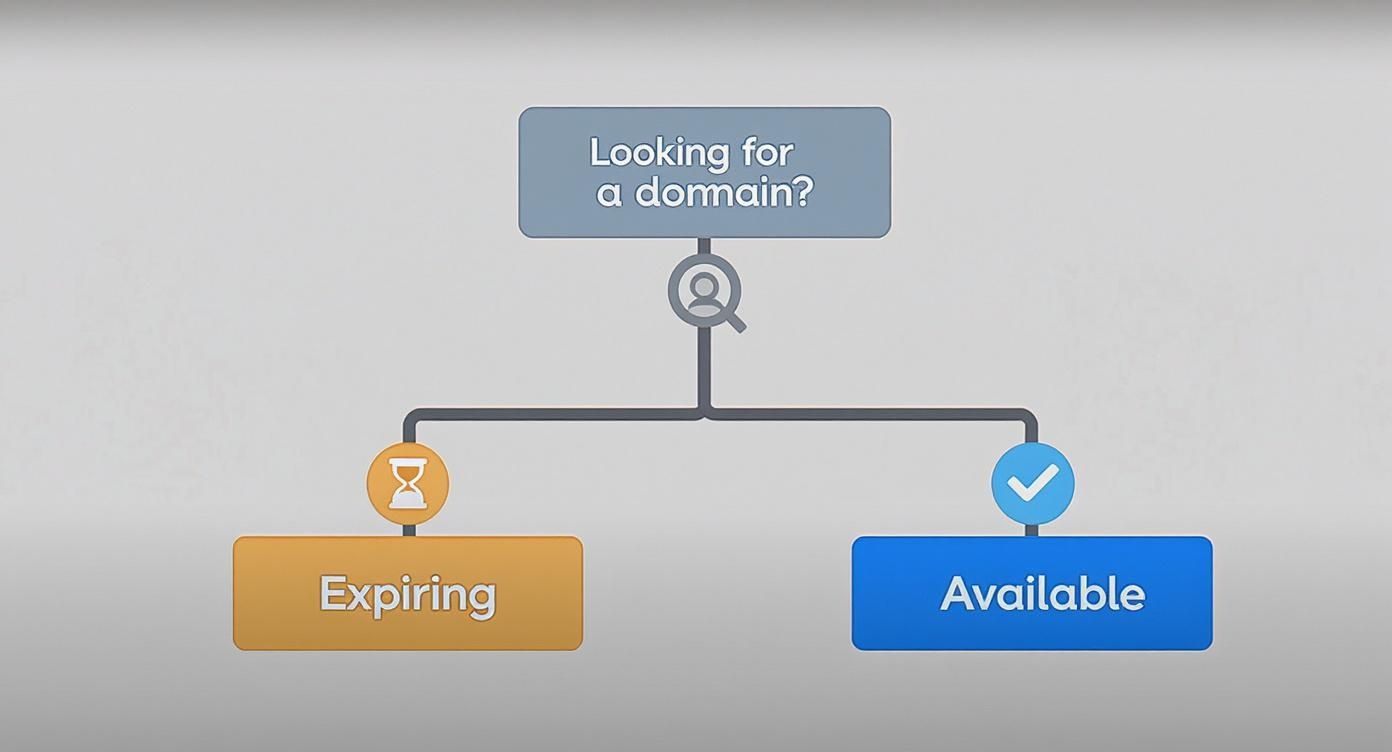
Whether you choose an immediately available domain or a soon-to-be-released expiring one, the vetting process that follows is exactly the same.
Uncovering the Domain's Past Life
Your first stop should always be the Wayback Machine at Archive.org. This incredible free tool is like a time machine for the internet, showing you snapshots of what a website looked like in its past.
This step is critical for a few reasons:
- Checking for Spammy Content: You need to see what the site was used for. Was it a legitimate business, a personal blog, or something more sinister? Click through several different years of archives to check for red flags like pharma ads, adult content, or foreign-language spam.
- Ensuring Topical Relevance: A domain's history creates a topical footprint in Google's mind. If you're building a site about dog training, a domain that was previously a blog about pets is a perfect match. A domain that was a Chinese-language casino? Not so much.
- Spotting PBNs: Look for signs of a Private Blog Network (PBN). These are networks of sites created solely to build links. Telltale signs include generic themes, low-quality "spun" articles, and an "About Us" page with fake author profiles.
If anything looks suspicious, walk away. There are plenty of other domains out there.
Think of the Wayback Machine as a background check for your domain. You wouldn't hire someone without checking their references; don't buy a domain without checking its history.
Analyzing the Backlink Profile for Toxicity
Just because a domain has a lot of backlinks doesn't mean they're good backlinks. A toxic backlink profile is one of the fastest ways to inherit a Google penalty and torpedo your SEO efforts before they even begin.
You’re looking for signs of manipulation. This could be thousands of links from low-quality foreign directories, spammy blog comments, or links with over-optimized, exact-match anchor text like "best payday loans online." These are clear footprints of black-hat SEO tactics that Google actively penalizes.
If you're unsure where to start, our in-depth guide explains how to check backlink quality and spot toxic links.
Checking for Penalties and Trademarks
Finally, you need to cover your legal and technical bases. A manual penalty from Google can render a domain completely worthless, as it will be suppressed in search results. You can check for this by plugging the domain into a "Google penalty checker" tool or by simply searching site:domain.com in Google. If nothing shows up for an old, established domain, it might be de-indexed—a huge red flag.
Lastly, do a quick trademark search. Is the domain name a registered trademark of another company? Using a trademarked name can land you in serious legal trouble down the road. A simple search on the U.S. Patent and Trademark Office (USPTO) website can prevent a very expensive mistake. This entire vetting process gives you the confidence to invest in a true asset, not a hidden liability.
Smart Ways to Use Your Newly Acquired Domain
So, you did it. You vetted, negotiated, and finally snagged a high-value domain with some real SEO history. It's like finding a perfectly restored classic car—it has power, a story, and it's ready to go. The only question is, where are you going to drive it?
Just like that classic car, you’ve got options. You can make it your new daily driver, merge its powerful engine into a car you already own, or use it to launch a brand-new project with a full tank of credibility from day one. Figuring out which path to take is the most important strategic choice you'll make, because each one unlocks a different kind of SEO advantage.
Let's break down the three main plays for putting your new asset to work.
Strategy 1: Build a New Authority Site
This is the most ambitious play, but it can also be the most rewarding. Building a brand-new website on an aged domain is like constructing a skyscraper on a pre-built, deep foundation. You get to skip that agonizing "Google Sandbox" period where new sites fight for every last scrap of attention.
Because the domain already has trust and a backlink profile, your content gets indexed faster and can start ranking for competitive keywords in a fraction of the time a fresh domain would take. This is the go-to strategy for affiliate marketers and niche site builders who want to hit the ground running with immediate momentum.
The key to making this work is maintaining topical relevance. If the domain's history was in "organic gardening," your new site should focus on something similar, like "sustainable living" or "urban farming." A hard pivot to something totally unrelated, like "cryptocurrency trading," will just confuse search engines and torch the very authority you paid for.
Strategy 2: Execute a 301 Redirect
What if you already have a primary website you want to pump up? This is where the 301 redirect comes in. A 301 is a permanent signal that tells search engines a piece of content—or an entire domain—has moved to a new address.
Think of it as forwarding your mail. When you move, you tell the post office to send everything from your old address to your new one. A 301 redirect does the same for "link juice," passing a huge chunk of the old domain's authority and backlink power over to your target site.
This is a killer tactic in a few scenarios:
- Consolidating Assets: If you acquire a competitor's old domain or a smaller site in your niche, you can redirect it to your main site and essentially absorb its SEO power.
- Supercharging a Specific Page: You can redirect a highly relevant domain straight to a specific service or product page on your site, giving it a concentrated shot of SEO adrenaline.
Warning: This is a power tool, not a toy. Redirecting a domain from a completely unrelated niche looks manipulative to Google and can land you in hot water. The domains must share a strong topical connection for the redirect to be safe and effective.
Strategy 3: Launch a New Brand or Microsite
Sometimes, you need to launch a new brand, a product, or a specialized microsite without starting from absolute zero. Using an aged domain lets you enter the market with a name that already has an SEO pulse.
For instance, a big book publisher could launch a microsite on an aged domain to target a niche audience, like young adult readers. This lets them rank for specific keywords like "YA book recommendations" without cluttering up their main corporate site.
This strategy is a bit of a hybrid. You're building something new, but you're doing it on a foundation that gives you an immediate head start in search. It’s perfect for creating a focused, targeted web presence that can stand on its own while still complementing your primary brand.
Choosing the right path really comes down to your goals, your resources, and what you've already got online.
Domain Usage Strategy Breakdown
To help you decide, here’s a quick comparison of the three main approaches. Each one has its place, but picking the wrong one can be a costly mistake.
| Strategy | Best For | Key Benefit | Potential Challenge |
|---|---|---|---|
| Build New Authority Site | Niche site builders and affiliate marketers starting a new project. | Bypassing the "Google Sandbox" and ranking content much faster. | Requires significant content creation and effort to build out a full site. |
| 301 Redirect | Businesses with an existing website looking for a fast authority boost. | Quickly passing link equity and authority to a target "money site." | High risk of penalty if the domains are not topically relevant. |
| Launch Microsite/Brand | Established companies launching a new product line or targeted campaign. | Instant credibility and search presence for a new venture. | Managing a separate brand and content strategy can be resource-intensive. |
At the end of the day, no matter which path you choose, the principle is the same: you're using a domain's history as a strategic asset. By understanding these options, you can turn your smart domain acquisition into a powerful, tangible SEO victory that leaves your competitors wondering how you did it.
Common Questions About Using Domains for SEO
Jumping into the world of aged and expired domains can feel like you're learning a new language. You get the big ideas, but a handful of specific questions always seem to pop up. Don't sweat it—that's part of the process.
Let's walk through some of the most common questions people ask. My goal here is to give you straight, no-fluff answers so you can move forward and make smart decisions.
Is Buying an Expired Domain Risky?
Yes, there's some risk involved, but it’s completely manageable if you do your homework. The best analogy is buying a used car. You wouldn't just hand over a stack of cash without popping the hood and running a history report, would you? Same thing here.
The biggest landmines are unknowingly buying a domain with a Google penalty or a sketchy history packed with spam. By following a solid vetting process—like the one we've covered—you can spot these red flags from a mile away.
Your due diligence is your shield. By digging into a domain's backlink profile, checking its past life with the Wayback Machine, and looking for any manual actions, you turn a potential risk into a calculated investment. It's the difference between buying a valuable asset and a hidden liability.
So while nothing is ever 100% guaranteed, a smart, systematic approach makes this a calculated move that often pays off big time.
How Long Until I See SEO Results?
Ah, the million-dollar question. The honest answer is: it depends. But what I can tell you is that it's almost always faster than starting a website from absolute zero. The timeline really hinges on how you plan to use the domain.
- If you 301 redirect the domain: You can often feel a lift in your main site's authority and rankings in just a few weeks to a couple of months. It takes Google a bit of time to crawl the redirect, process the change, and pass along that sweet, sweet link equity.
- If you build a new site on the domain: You're essentially starting on third base. It's not uncommon to see the new site start ranking for competitive keywords in 3-6 months, which is a world away from the 12+ months it can take for a brand-new domain to get any real traction.
The bottom line? You’re buying yourself a massive head start.
Should My New Content Match the Old Topic?
Yes. A thousand times, yes. This is non-negotiable and probably the most important rule of the game. You have to maintain topical relevance if you want to hang on to the domain's SEO power.
Put yourself in Google's shoes. For years, its algorithms have understood that a domain is an authority on a certain topic because of its content and the kinds of sites linking to it. If a domain all about "organic dog food" suddenly becomes a blog about "cryptocurrency trading," it sends a confusing signal. That disconnect is a surefire way to devalue the very signals you paid for.
That said, you don't have to be a perfect clone of the old site. You can absolutely pivot to a closely related "shoulder niche." For instance:
- Old Topic: Organic dog food
- Good New Topics: Pet health supplements, positive reinforcement dog training, holistic pet care, premium pet supplies.
- Bad New Topic: Fantasy football advice.
Staying in the same topical neighborhood ensures that the domain's history and authority work for you, not against you.
Where Should I Look for Available Domains?
Finding these gems used to be a real chore, involving a mess of different tools and a ton of manual work. Thankfully, it's gotten a lot easier. The most efficient way is to use a dedicated platform that gathers all the domain data in one place and gives you powerful filters to sort through it.
A good place to start your hunt is with domains that were just dropped and are available for anyone to register immediately. These are often listed as Available domains, and you can find killer options that became free as recently as today.
If you like to plan ahead and want more time for vetting, you can look through lists of Expiring domains. These are domains scheduled to drop soon, which gives you a nice window to do your research before they're released to the public.
Ready to find your next SEO powerhouse? NameSnag uses AI to analyze over 170,000 domains daily, filtering out the junk to show you only the highest-potential assets. Start your search and discover your next winning domain at https://namesnag.com.
Find Your Perfect Domain
Get access to thousands of high-value expired domains with our AI-powered search.
Start Free Trial