Ever see a simple website address and wonder how it could be worth thousands, or even millions, of dollars? Congrats, you've just stumbled into the wild world of domain flipping! This isn't just some techy hobby; it's a booming industry where savvy investors buy and sell digital real estate for substantial profits every single day.
Think of it as digital real estate investing. You're scooping up valuable online property with the goal of flipping it, and the real trick is spotting domains with hidden potential that businesses will happily pay a premium for.
Welcome to the Digital Real Estate Gold Rush
The core idea is refreshingly simple: find an undervalued domain name, recognize its potential, and then sell it for a significant return. It's all about spotting the perfect name for a new startup, a memorable keyword-rich domain for an established brand, or even a recently dropped name that still has a powerful history attached to it.

Why Is This Market Exploding Right Now?
To put it bluntly, the demand for high-quality domains is relentless. The US Web Domain Name Sales industry is a testament to this, projected to rocket to a $10.1 billion valuation by 2025. This market has been growing at a steady 4.2% each year, fueled by one simple fact: more and more business is moving online.
Back in 2020, just 25.6% of business was digital. That figure has already jumped to nearly 30%, creating a constant stream of new entrepreneurs hungry for the perfect online address. You can explore more data on this industry growth to see the full picture.
This trend creates a massive opportunity. Every new company, product, or personal brand needs a digital home, and a premium domain is the foundation.
The best domains are like prime beachfront property. They are scarce, in high demand, and their value tends to appreciate over time. Your job as an investor is to find those properties before everyone else does.
The Different Flavors of Domains
Before you dive in, it helps to know what you're looking for. Not all domains are created equal, and they generally fall into a few key categories that we'll be digging into.
- Available Domains: These are domains that were recently dropped or never registered in the first place. Think of them as undiscovered land, ready to be claimed immediately. You can often find great ones by checking for Available domains that dropped today.
- Expiring Domains: These are names a previous owner failed to renew. They're sitting in a grace period before they become available to the public. Scouting for Expiring domains can land you a gem that already has some authority built up.
Getting a handle on these types is your first step. In the sections ahead, we’ll move from theory to action, giving you the exact strategies to find, evaluate, and flip these digital assets for a profit.
Hunting for Hidden Gems: Where to Find Valuable Domains
The first rule of successful domain flipping is knowing where to look. While most beginners get lost scrolling through endless lists of digital junk, the pros know exactly where the treasure is buried. Think of this section as your personal treasure map, guiding you straight to the domains worth fighting for.
Forget sifting through millions of already-registered names. Your best opportunities are hiding in two specific pools: freshly available (or 'dropped') domains and expiring domains. These are the hunting grounds where you'll find undervalued assets before the rest of the market catches on.
Understanding Available vs. Expiring Domains
So, what’s the real difference here? It all comes down to timing and opportunity.
An available domain is one that has gone through its entire expiration cycle and has been "dropped" back into the public pool. It’s essentially a free agent, ready for anyone to register instantly. This is the fastest way to acquire a domain; you see it, you like it, and you buy it for a standard registration fee.
An expiring domain, on the other hand, is still stuck in its grace period. The previous owner failed to renew it, but it hasn't been officially released yet. This gives you a heads-up on a potentially valuable name that's about to become available. You can't register it immediately, but you can prepare to pounce the moment it drops.
Pro Tip: Time is your biggest advantage. I often filter my searches to see only domains that became available Today or in the last 3 Days. This simple trick cuts out the noise and lets you analyze the freshest, highest-potential names before they get snapped up by other investors.
Trying to track these domains manually is like trying to catch fish with your bare hands—frustrating and wildly inefficient. This is where a specialized tool becomes your secret weapon for buying domain names to resell. Instead of drowning in data, you can use a platform like NameSnag to instantly find Available domains that just dropped or get a jump on Expiring domains that are about to hit the market.
This automated approach lets you focus your energy on evaluation, not just endless searching. We've got a detailed breakdown of the whole process in our guide on how to find expired domains.
Available vs. Expiring Domains: Which Is Right for You?
Choosing where to focus your efforts really depends on your strategy. Are you looking for a quick registration, or are you willing to play the long game for a bigger prize? Let's break down the key differences to help you decide.
| Characteristic | Available (Dropped) Domains | Expiring Domains |
|---|---|---|
| Acquisition Speed | Instant. You can register it immediately. | Delayed. Requires waiting through a grace period and potential auction. |
| Cost | Low. Standard registration fee (usually $10-$20). | Variable. Can be low, but high-value domains often go to auction. |
| Competition | High. It's a race to see who registers it first. | Structured. Competition is managed through backorders or auctions. |
| Best For | Finding hidden gems quickly and building a portfolio on a budget. | Securing high-value domains that already have a history and authority. |
Ultimately, a balanced approach is often the smartest play. Spend time hunting for those quick-win available domains, but also keep an eye on high-potential expiring names that could become major assets in your portfolio. By leveraging both sources, you dramatically increase your odds of finding the hidden gems that lead to profitable flips.
Evaluating a Domain's True Potential
Alright, so you’ve got your eye on a promising domain. Maybe it’s a fresh Available domain you just dug up, or a juicy Expiring domain about to drop. Finding it is often the easy part. The real work starts now: figuring out if you've found a digital diamond or just another piece of digital dust.
This is where you switch from domain hunter to domain detective. Forget guesswork. Seasoned investors use a data-driven process, blending hard SEO metrics with the softer, more intuitive art of branding. Nailing this evaluation is what separates the hobbyists from the pros who consistently turn a profit.
This decision tree gives you a quick visual on the two main acquisition paths.
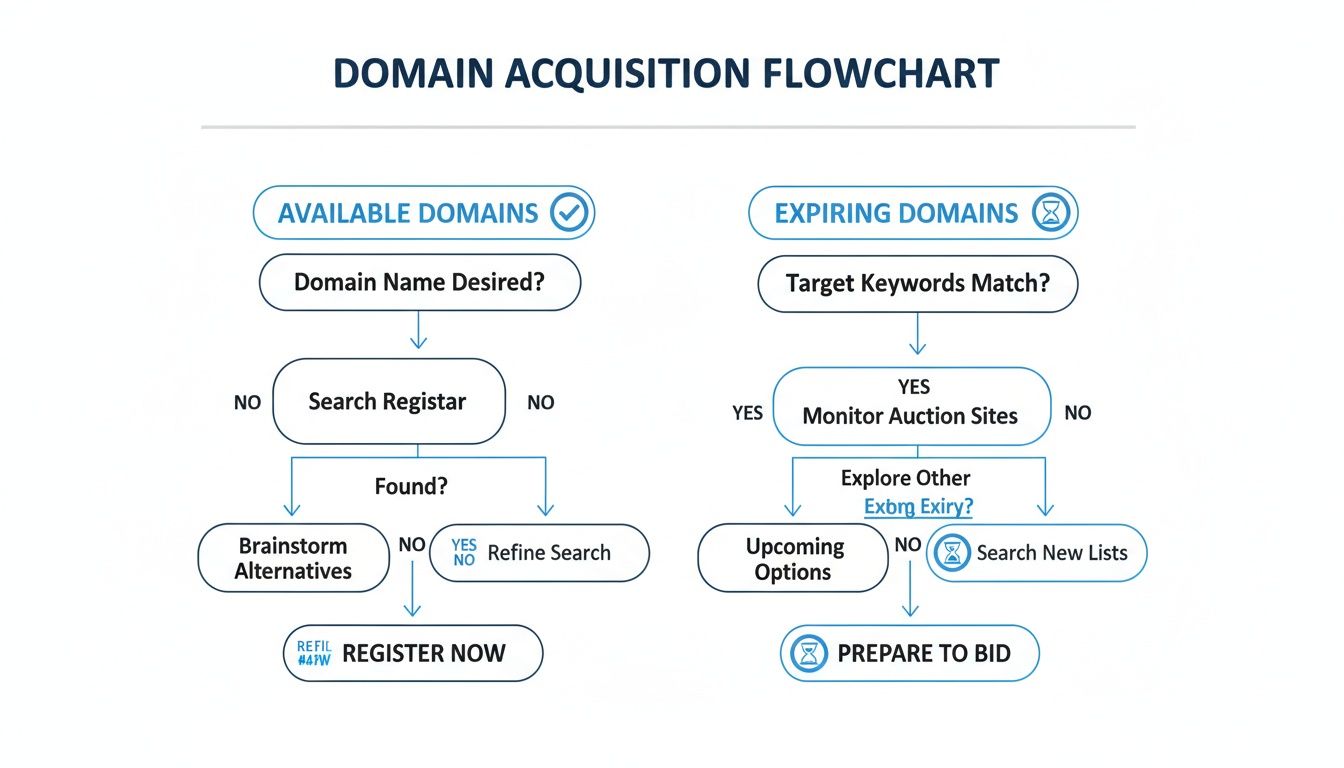
You’re either grabbing something available right now or you're playing the long game for an expiring name. Each route demands a different strategy, but the core evaluation checklist stays the same.
Diving into the SEO Metrics
A domain's history is etched into its SEO profile. A name that already has some authority is like buying a house with good bones—it has intrinsic value from day one. You need to get familiar with a few key numbers that tell this story.
Domain Authority (DA) and Page Authority (PA): These are Moz's scores for predicting ranking potential. While they aren't official Google metrics, a domain with a DA over 20 suggests it has a respectable history and is seen as trustworthy by search engines.
Backlink Profile: This one's a big deal. Who is linking to this domain? A few links from authoritative sites like universities (.edu) or government agencies (.gov) are worth far more than hundreds of links from spammy directories. Quality over quantity is the mantra here.
Referring Domains: This metric tallies the unique websites linking back to the domain. A domain with 100 links from 100 different sites is exponentially more valuable than one with 100 links from a single site. It signals widespread recognition.
Don't overlook domain age, either. An older domain (5+ years) with a consistent, active history is generally viewed more favorably. It’s got a track record and doesn’t look like a fly-by-night operation to search engines.
The Unmistakable Power of Brandability
Numbers are critical, but they aren't the whole picture. A domain's brandability—its raw potential to become a memorable brand—can be its most valuable asset. This is definitely more art than science, but there are clear signals of a winner.
A great brandable domain is short, simple, and easy to spell. If you have to spell it out for someone over the phone, it’s already failed a crucial test. Think about names like Mint.com or Slack.com. They're punchy and instantly gettable.
The classic litmus test for brandability is the "radio test." If you heard the domain name on the radio, could you type it into your browser without a single doubt? If the answer is yes, you might just have a winner on your hands.
When you're judging brandability, ask yourself:
- Is it memorable? Does it stick in your head?
- Is it easy to pronounce? Stay away from hyphens and numbers at all costs.
- Is it relevant? Does it hint at the industry or service?
Cars.comis the gold standard of relevance for a reason.
When you find that sweet spot where SEO power meets brand appeal, you’ve found a truly premium domain. To go even deeper on this, check out our complete guide on how to value domain names for a more detailed framework.
The Non-Negotiable Spam Check
Before you even think about pulling out your credit card, you have to run a thorough spam check. A domain with a toxic past isn't just worthless—it's a liability. You need absolute certainty it hasn't been torched by Google penalties or used for shady activities.
Use tools like the Wayback Machine to see what the site looked like in previous lives. Was it a legit business or a spam-riddled link farm? Scrutinize its backlink profile for any suspicious links coming from irrelevant, low-quality, or foreign-language sites. A sudden spike in junky links is a massive red flag.
For anyone serious about buying domain names to resell, a clean history is non-negotiable. Period.
Acquiring and Pricing Your Domain Like a Pro
You’ve done the detective work, evaluated the metrics, and found a domain that screams potential. Now for the fun part—making it yours and slapping a price tag on it. This is where strategy meets the thrill of the chase. The path you take to acquire your digital real estate depends entirely on whether it’s a freshly dropped gem or an expiring prize.
If you've spotted a name on the list of Available domains, your mission is simple. It's a straightforward registration. Think of it like an open house—first one to put in an offer (which in this case is just the standard registration fee) gets the keys. Speed is your best friend here.
Things get more interesting when you’re targeting valuable Expiring domains. Now you’re stepping into an auction. This is less like an open house and more like a high-stakes bidding war. Instead of directly registering, you'll use a backordering service. You're essentially placing a bet that their system will be the fastest to grab the domain the second it drops.
Playing the Auction Game Smartly
When a highly sought-after domain expires, it’s almost a guarantee that multiple people will backorder it, triggering an auction. This is where you need serious discipline. It’s incredibly easy to get swept up in the excitement and bid far more than the domain is actually worth.
Here’s how to stay grounded and bid like a pro:
- Set a Max Bid and Stick to It: Before the auction even starts, decide on the absolute maximum you're willing to pay based on your earlier evaluation. Write it down. Do not, under any circumstances, go over this number.
- Don't Bid in Round Numbers: Amateurs bid $500. Pros bid $512. That slightly awkward number can be just enough to outbid someone else who set a nice, round psychological limit for themselves.
- Bid Late, Not Early: Placing bids early only drives the price up for everyone. The real action happens in the final minutes (or even seconds) of the auction. This tactic, known as "sniping," prevents emotional, drawn-out bidding wars that just inflate the final price.
Once the dust settles and you've secured the domain, the million-dollar question (sometimes literally) is: what's it worth?
The Science and Art of Domain Valuation
Pricing a domain is a delicate balance. Go too high, and it will sit on the shelf gathering digital dust. Go too low, and you're leaving a pile of cash on the table. There's no single magic formula, but there is a framework for getting it right.
Start by looking at comparable sales, or "comps." Just like in real estate, you need to see what similar properties have sold for. Websites like DNJournal and NameBio are goldmines for this data. If a similar two-word .com in the finance niche sold for $5,000, you have a solid benchmark for your domain.
Automated valuation tools can offer a rough starting point, but treat them with a healthy dose of skepticism. They often can't grasp the nuances of brandability or niche relevance. A tool might undervalue CryptoWallet.com because it's two words, while a human investor knows it's a category-defining name worth a fortune.
My personal framework for pricing boils down to a few core factors:
- Keyword Value: Does it contain a high-value search keyword?
- Extension: A
.comis the gold standard, but trendy TLDs like.aior.iocan command huge prices in the tech space. - Length & Memorability: The shorter and catchier, the better. No contest.
- Commercial Appeal: Can you easily picture a large company building a brand on this name? That’s the real gut check.
The market for buying domain names to resell is hotter than ever. We're seeing jaw-dropping figures, with premium .com names like solutions.com fetching $415,000 and AI-related gems like twin.ai commanding up to $95,000. In 2024, the average resale price for .ai domains hit $6,525, and by 2025, the median price across all TLDs climbed 7% to $549. You can discover more insights about domain name trends to see just how lucrative this market has become.
Final Takeaway: Your acquisition strategy dictates your entry cost, but your pricing strategy determines your profit. Combine hard data from comps with a deep understanding of market trends to set a price that is both ambitious and realistic.
Flipping for Profit How to Market and Sell Your Finds
So you did it. You put in the legwork, sifted through the noise, and landed a domain with solid metrics and real brand potential. It feels great to own a valuable piece of digital real estate, but that's only half the battle. Now it’s time to cash in, and that means getting your domain in front of the right buyers.
Selling a domain isn't about just listing it and crossing your fingers. The real money is made with a smart, multi-pronged sales strategy. It’s a game of knowing where to list, how to pitch, and when you need to be the one making the first move. Let's get into the art of turning that domain into a successful flip.
Choosing Your Sales Arena
Where you list your domain has a massive impact on its visibility and, ultimately, the final sale price. Think of it this way: you wouldn't try to sell a luxury watch at a local flea market. The same logic applies here. You need a platform teeming with serious, motivated buyers.
These are the heavy hitters in the domain marketplace world:
- GoDaddy Auctions: As one of the world's largest registrars, GoDaddy's auction platform gives you access to a huge audience. Its sheer volume makes it a go-to for many investors.
- Sedo: A global powerhouse in domain sales. Sedo offers a massive distribution network and flexible listing options, from "Buy Now" to "Make Offer."
- Afternic: Now part of the GoDaddy family, Afternic syndicates your listing across a network of over 100 top partners. This massively boosts your domain's exposure without you lifting a finger.
Listing on these major platforms is a solid strategy for passive sales. But to really maximize your returns, you often have to get a little more direct.
Crafting a Listing That Sells
Your listing is your sales pitch. A lazy, one-line description just isn't going to cut it. You have to create a compelling story that clearly spells out the domain’s value to a potential buyer. Put on your marketer hat and highlight its biggest strengths.
Does it have a history of strong SEO metrics? Mention its Domain Authority and quality backlinks. Is it a fantastic brandable name? Explain why it's memorable, easy to spell, and perfect for a startup in a hot niche. For example, instead of just listing GreenLeaf.com, you'd write something like: "A premium, two-word brandable .com perfect for the booming eco-friendly, cannabis, or landscaping industries. Short, memorable, and passes the radio test with flying colors."
Your listing description should answer the buyer's unspoken question: "Why is this domain worth the price?" Connect the dots for them by outlining its potential uses and commercial appeal.
The Power of Proactive Outreach
Waiting for a buyer to find you can take months, sometimes years. The biggest sales often come from outbound marketing—actively identifying and contacting potential end-users yourself. This is where your research skills come back into play.
Who would benefit most from owning your domain? If you're holding DenverPlumber.com, your target list is pretty clear: every plumbing company in Denver with a weaker or hyphenated domain. A quick Google search will give you a list of prospects to start with.
From there, it's all about crafting a brief, professional, and personalized email. Don't be spammy. The goal is to start a conversation, not to force a sale. Briefly introduce the domain, explain why you think it's a perfect fit for their business, and ask if they’d be open to discussing an acquisition. This hands-on method often leads to much higher sale prices because you're selling directly to the person who needs it most. For a more detailed breakdown of these tactics, check out our complete guide on how to flip domains for profit.
Securing the Deal With Escrow
Once you’ve agreed on a price, the final step is to ensure the transaction is safe and smooth for everyone. Never—and I mean never—handle a large domain sale through direct payment methods like PayPal or a wire transfer. The risk of fraud is just too high for both you and the buyer.
This is where a trusted escrow service is absolutely non-negotiable. Companies like Escrow.com act as a neutral third party. The buyer sends the money to them, you transfer the domain, and once the buyer confirms they have it, the escrow service releases the funds to you. It's a simple process that protects everyone involved and guarantees a professional, secure close to your profitable flip.
A Few Lingering Questions About Domain Reselling
Jumping into domain flipping feels a bit like learning a new language. You've got the basic strategy, but a few nagging questions are probably still rattling around in your head. Let's tackle some of the most common ones that always come up when people start looking to buy and sell domain names.
Think of this as your go-to FAQ for quick, no-nonsense answers that will help you sidestep common hurdles and get straight to what matters: turning a profit.
How Much Money Do I Actually Need to Start?
You might be surprised to hear this, but you don't need a massive bankroll to get your start. The absolute cheapest way in is by hand-registering a freshly Available domain that just dropped. This can cost as little as $10-$15 from any standard registrar. It's the perfect way to dip your toes in the water without much skin in the game.
Now, if you're aiming for the more competitive Expiring domains, you're almost certainly looking at auctions. Here, prices can swing from under $100 to many thousands, all depending on the name's quality. A realistic budget to build a small but solid portfolio of 5-10 promising domains would be somewhere in the $200-$500 range.
The secret isn't a huge upfront investment; it's investing smarter. Pour your initial cash into a few domains with obvious value instead of hoarding dozens of low-quality names. A strategic start gives you a much better shot at a profitable flip, even with a modest budget.
What Are the Classic Mistakes Newbies Make?
The road to successful domain flipping is littered with a few common, easily avoidable blunders. Knowing what they are from day one puts you miles ahead of the pack.
The single biggest mistake is "domain hoarding." New investors get a rush of excitement and register dozens of mediocre domains, hoping one hits like a lottery ticket. This strategy just drains your wallet on renewal fees for assets that will almost certainly never sell.
Another classic error is skipping the spam check. It's a non-negotiable step. A domain with a penalized or toxic past is often unsellable, making it a complete waste of money. New flippers also have a habit of overvaluing their domains based on personal feelings rather than cold, hard market data.
Finally, a lot of beginners forget the "sell" part of the equation. They list a domain on a marketplace and just… wait. Proactively reaching out to potential buyers and setting up professional sales pages can dramatically boost both your sale price and how fast you get it. Be selective, do your homework, and actively market your best names.
How Long Does It Really Take to Flip a Domain?
This is the ultimate "it depends" question. The timeline for reselling a domain is all over the map, driven by its quality, your price, and your sales strategy. A highly desirable, keyword-rich, brandable .com could sell within days—even hours—of being listed. Those are the home runs, but they aren't the norm.
For most good-to-great domains, you need to be prepared to play the long game. It's not at all unusual to hold a name for anywhere from six months to a few years before the right buyer shows up.
- Think Like a Real Estate Investor: You're not day-trading stocks; you're holding valuable digital property. The right buyer—the end-user who needs that specific name—has to find it when they're ready to buy.
- Patience is a Virtue (and Profitable): Rushing to sell often means caving to a lowball offer just to get a quick win. Holding costs are low, so don't be afraid to wait for an offer that reflects the domain's real value.
- A Portfolio Approach Helps: This is why building a small portfolio is so smart. While you're waiting for a big sale on a premium name, you can make several smaller, faster flips on others to keep cash flowing.
Which Domain Extensions Are Best for Reselling?
When it comes to value, not all extensions are created equal. The hierarchy is pretty clear, and knowing it is crucial for anyone buying domain names to resell.
Without a doubt, .com remains the undisputed king. It's the most recognized, trusted, and valuable extension on the planet. For any serious brand or business with global ambitions, a .com is the gold standard. It should always be your main focus. If you find a killer name in .com, grab it.
But that doesn't mean other TLDs (Top-Level Domains) aren't incredibly profitable. There are fantastic opportunities if you know where to look:
- Country-Code TLDs (ccTLDs): Extensions like .io, .co, and .ai are on fire in the tech and startup scenes. They're seen as modern and highly relevant, often fetching prices that rival premium
.comdomains. - New Generic TLDs (gTLDs): Newer extensions like .app, .shop, or .xyz can be goldmines if the domain is a perfect keyword match for an industry. Think about it:
vegan.shopis a fantastic, category-defining name.
The best strategy is to match the extension to its natural habitat. A global e-commerce brand needs the .com. A hot new artificial intelligence startup is a perfect fit for .ai. Don't sleep on the potential in non-.com extensions, but always understand their specific market appeal.
Ready to stop guessing and start finding high-value domains with real potential? NameSnag uses AI to analyze over 170,000 domains daily, cutting through the junk to surface gems with powerful SEO and branding value. Find your next profitable flip with NameSnag today!
Find Your Perfect Domain
Get access to thousands of high-value expired domains with our AI-powered search.
Start Free Trial