A founder I know spent weeks polishing a local automotive site. Nice logo, clean layout, solid copy. The problem was the domain had the online equivalent of a lawn chair engine, while competitors were driving restored classics.
That’s the trap with olney car care style projects. People obsess over the storefront and ignore the chassis underneath.
Your Business Needs More Than a New Coat of Paint
The easiest mistake in niche SEO is treating the domain like the least important part of the build. It isn’t. If you’re launching a site around olney car care, the domain isn’t just an address. It’s the engine block, the service history, and half the resale value rolled together.
A fresh domain can work. Sometimes it’s the right call. But starting from zero means you’re asking Google to trust a brand-new garage with no customer history, no reputation, and no roads leading to the front door. That’s a slower climb, especially in local service niches where established players already own attention.
The classic car lesson
Buying a good aged domain feels a lot like buying a classic truck that already runs. You still need maintenance. You still need to inspect it. But you’re not welding the frame together in your driveway.
I’ve seen founders sink energy into cosmetic decisions first. They debate fonts, rewrite the hero headline ten times, and fuss over icons. Meanwhile, they choose a domain with no history and then wonder why the site sits invisible for months. That’s like detailing a car with no transmission.
A pretty website on a weak domain can still struggle. A solid domain gives the rest of your work something to push against.
There’s another wrinkle with olney car care as a keyword space. The underlying business facts are thin. There isn’t enough verifiable public data to build a numbers-heavy authority piece around a distinct “Olney Car Care” business, outside references like the Walmart Auto Care Center in Olney, Illinois. That matters because when the market data is fuzzy, your domain quality and topical positioning matter even more.
For a good example of how automotive niches often need smarter positioning, not just prettier branding, this breakdown of Saticoy Auto Center site strategy is worth reading.
What actually moves the needle
Three things usually matter more than the initial paint job:
- Relevant history: If a domain already lived in the automotive, local services, or transportation universe, the transition is often more natural.
- Clean reputation: A shiny name with a spammed-out past is a lemon.
- Brand fit: If the domain sounds clunky, forgettable, or weirdly generic, it’s harder to build trust around it.
A good domain doesn’t replace execution. It just stops you from starting uphill in second gear.
Why an Aged Domain Is Your Secret V8 Engine
An aged domain gives you something every new site lacks. Inherited momentum. That doesn’t mean magic. It means the web has seen this asset before, and that prior life can make your next move faster, cleaner, and more believable.
Horsepower, torque, and trust
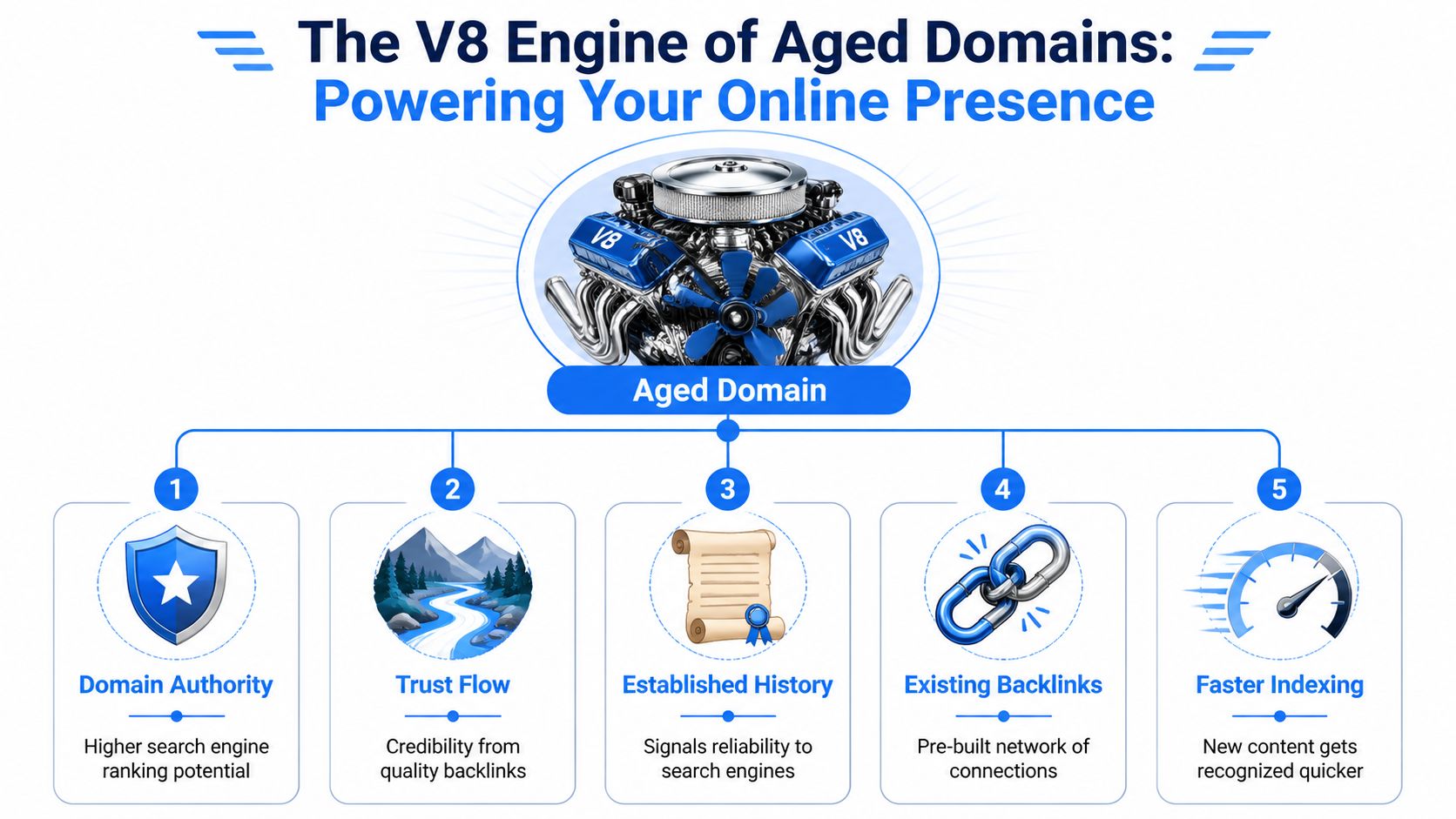
Think of domain authority as horsepower. Not perfect, not the only metric, but useful as a shorthand. It tells you whether the car can pull when you hit the gas. If you want a clear primer on how SEOs use it for predicting search rankings with domain authority, Netco Design LLC has a practical overview.
Trust Flow is closer to torque. It tells you whether the power comes from a healthy engine or a lot of noise. A domain with a modest profile but trustworthy backlinks often outperforms a louder-looking one built on junk links.
Roads that already lead somewhere
Backlinks are prebuilt roads to your garage. If reputable sites already point to the domain, you don’t start with an empty map. You inherit pathways. That can help search engines discover and evaluate your new content more quickly, assuming the topic match still makes sense.
Here’s the trade-off in plain English:
| Domain trait | Car equivalent | What it tells you |
|---|---|---|
| Authority signals | Engine output | Whether the domain has ranking potential |
| Trust signals | Drivetrain quality | Whether the power is dependable |
| Historical use | Service records | Whether the asset has a believable past |
| Backlink profile | Road network | Whether people and crawlers can find it |
| Indexing behavior | Cold-start reliability | Whether new pages get recognized efficiently |
Service history matters
Age by itself doesn’t impress me. A bad old domain is still bad. What matters is whether the age comes with a sane history. If the domain spent years on-topic, accumulated natural mentions, and avoided obvious spam patterns, it behaves like a well-kept classic with receipts in the glove box.
Practical rule: Buy history, not just age.
That’s especially useful for a local-topic site like olney car care. The phrase is broad enough to support service pages, informational content, comparisons, and neighborhood-specific pages. But broad niches attract lazy builds. The aged domain advantage only works if the old footprint supports the new direction.
What doesn’t work
A lot of buyers get fooled by one flashy metric. They see age, or a single authority score, and stop digging. That’s like buying a vintage Mustang because the paint pops under parking lot lights.
It’s better to think in combinations:
- Strong authority with irrelevant history can mislead you.
- Good backlinks with obvious spam anchors can create cleanup work.
- Great brandability with no trust signals may still be worth it, but that’s a branding play, not an SEO head start.
The V8 matters. So does the rest of the car.
Your Domain Pre-Purchase Inspection Checklist
A domain can look clean in the auction listing and still be a salvage title underneath. I have seen buyers grab a name for an olney car care project because the wording felt right, then spend months cleaning up old spam, broken backlinks, and index problems they could have spotted in 20 minutes.
That is why I inspect aged domains the same way I would inspect a classic car before wiring the money. Paint matters last. First I want to know whether the frame is straight, whether the engine was maintained, and whether someone covered the rust with a glossy listing description.
Start with the history, not the headline metric
For a local service site, old baggage matters more than people admit. A domain that used to host coupon spam, foreign-language doorway pages, or auto-generated junk can drag that history into your rebuild. You may still recover it, but now you are buying cleanup work instead of momentum.
Archived screenshots and index checks do the heavy lifting here. This guide on how to check domain history before buying lays out the order I use before I even glance at authority scores.
Look for a believable service record:
- Topic consistency: The site should have stayed in one general lane.
- Language stability: Sudden switches often point to abuse or reselling.
- Index quality: Thin, duplicate, or irrelevant indexed pages are a bad sign.
- Old brand traces: Citations, business names, and directory listings can help or complicate a rebrand.
Check the engine bay
Backlinks are the engine. A domain with strong links from relevant sites can pull harder from day one. A domain with messy anchors, dead referring pages, or obvious paid-link footprints is the online version of an engine that idles rough and leaks oil.
I do not trust summary scores on their own. I open the referring domains. I read the anchor text. I click through to see whether the links still live on real pages that make sense. That manual pass catches a lot of bad buys.
For agencies that review domains in batches, a repeatable process for optimizing technical SEO for agencies helps keep inspections consistent. The expensive mistakes usually happen when someone skips the boring checks.
If explaining the backlink profile sounds like making excuses for a noisy transmission, pass.
Check whether the car fits the job
A solid domain still needs to match a real business angle. For olney car care, that means asking whether the old domain can credibly support the services, content, and local intent you plan to publish next.
One practical angle is EV-related maintenance content. More suburban drivers now need shops that can explain battery care, charging habits, brake wear differences, and routine service in plain English. If an aged automotive domain already has relevant trust signals, that can support service pages and educational content without feeling forced. If the old history points somewhere unrelated, the fit is weak even if the metrics look attractive.
My short inspection list
- Check ownership patterns. Constant flipping can signal churn, not value.
- Review archived versions carefully. I want a stable business or content history.
- Inspect referring domains by hand. Ten credible links beat a hundred junk ones.
- Read anchor text closely. It often exposes spam faster than a dashboard score.
- Test the name in practical scenarios. Say it out loud. Put it on a mock invoice. If it feels awkward, customers will feel it too.
A good aged domain gives you a head start. A bad one gives you a repair bill.
Where to Find Your Next Great Domain
A few years ago, I watched a founder spend a weekend chasing what looked like the perfect automotive domain. Great name. Decent age. Cheap price. By Monday, the archive history showed a past life that had nothing to do with cars, and the backlink profile looked like a trunk full of random spare parts. He did not buy an asset. He almost bought someone else’s repair bill.
That is why source quality matters. Hunting in the wrong places creates work, not opportunity.
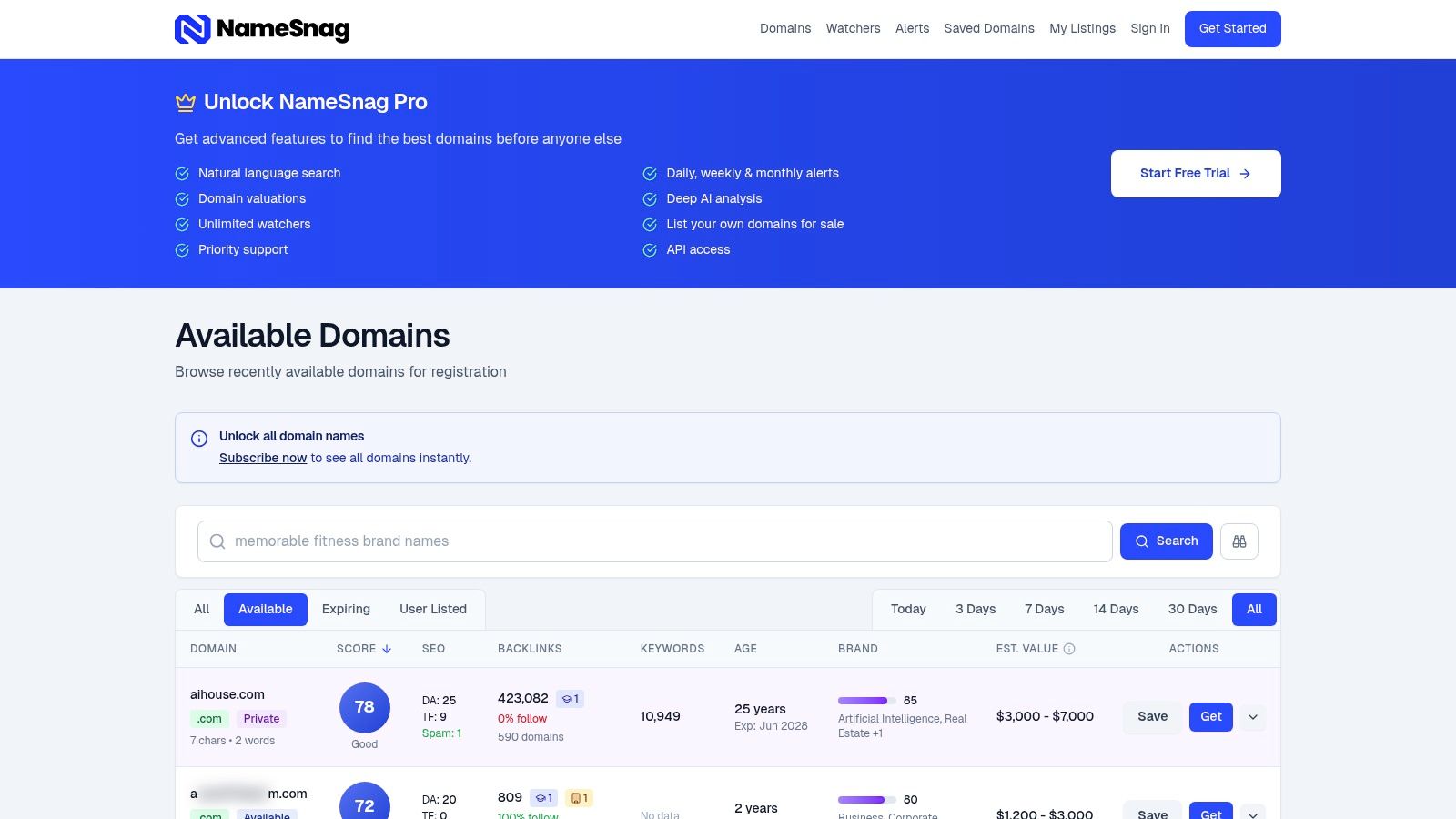
Some marketplaces feel like a muddy salvage yard. Inventory is everywhere, but so is junk. You can still find a winner there if you know how to inspect quickly and you have time to burn. If you are building an olney car care site while also running a business, that extra sorting cost is real.
Raw drop lists and public feeds usually create three problems:
- Too much noise: weak names, dead history, and domains that look better in a spreadsheet than in a browser
- Too much context switching: backlinks in one tab, archives in another, trademark checks somewhere else
- Too many late-stage failures: a domain can survive the first screen, then fail on history or relevance after an hour of work
A cleaner approach is to shop in places that already help you narrow the field. If you want a broader view of the market first, this guide to domain auction sites and buyer hunting grounds is a useful starting point.
I like to separate opportunities into two groups.
The first group is domains you can buy right away. That works like finding a classic car on a dealer lot with the paperwork ready. If the name, history, and links check out, you can move fast.
The second group is domains that are expiring soon. Those are closer to cars scheduled for auction next week. You are not buying yet. You are building a watchlist, checking the service history, and deciding which ones deserve serious attention before everyone else notices.
That timing changes how you search. A narrow window helps when you are ready to act now. A wider window helps when you are mapping the local automotive niche, collecting candidates, and waiting for the few that fit the business.
For olney car care, fit still beats speed. A domain tied to auto repair, maintenance advice, local driving, or related vehicle topics gives you a much smoother start than a flashy name with unrelated history. Buyers who win in this market do not chase every old domain with “car” in it. They wait for the one where the engine, chassis, and paperwork all match.
The Post-Purchase Tune-Up for Your New Domain
Buying the domain is the easy dopamine hit. The challenging work starts after checkout.
A newly acquired domain needs a careful tune-up, not a demolition job. Too many buyers grab an aged asset and immediately strip everything down, change the topic too aggressively, or redirect half the old URLs to the homepage like they’re sweeping parts into a closet.
The first stretch matters
Your first job is continuity. If the old domain had meaningful pages, preserve what deserves preserving. Recreate useful URLs when appropriate. Redirect with intent, not laziness. A redirect should explain where the old value now lives.
That means:
- Map old pages to relevant new destinations: Don’t dump everything onto one generic page.
- Keep topic alignment tight: If the old domain had automotive relevance, stay close to that neighborhood.
- Retain useful context: Old mentions and backlinks make more sense when the new site respects the prior shape of the asset.
Build like a restorer, not a flipper
The smart move is to publish a small number of strong pages first. For an olney car care site, that could mean service-area pages, well-written maintenance guides, EV-specific service explainers, and transparent local comparison content.
What doesn’t work is blasting out thin pages just to “activate” the domain. Search engines can tell the difference between a careful restoration and a cheap respray.
Treat the inherited authority like borrowed trust. If your new content doesn’t earn it, you waste the asset.
Watch for signs the engine is healthy
I look for simple operational signals. Are important pages getting indexed normally? Are legacy links landing on sensible destinations? Does the site feel coherent, or like two unrelated businesses duct-taped together?
Aged domains reward patience. The buyers who win usually resist the urge to over-modify too quickly. They let the chassis do its job, then add power with content and internal linking.
Drive Your Business to the Next Level
Most domain advice is weirdly abstract. That’s why the car metaphor sticks. It matches reality.
If you’re building in a niche like olney car care, the domain isn’t decoration. It’s infrastructure. A strong aged domain gives you a better engine, a usable service record, and roads that already point in your direction. But only if you inspect it properly, buy in the right places, and tune it after purchase with some restraint.
A simple maintenance mindset goes a long way. The same way a mechanic relies on a repeatable inspection routine, domain buyers need a consistent evaluation process. If you like practical frameworks, this 8-point car service checklist is a nice reminder that good results usually come from disciplined basics, not heroics.
Here’s the short version:
- Don’t overpay for paint. Brand alone won’t rescue a bad asset.
- Check the history. Old problems follow you home.
- Buy for fit. The right domain supports the business you want to build.
- Restore carefully. Preserve what gives the asset value.
The founders who get ahead don’t always work harder. Often, they just stop insisting on building from absolute zero.
If you want a faster way to spot clean, high-potential domains without swimming through junk, take a look at NameSnag. You can browse available domains for names you can register right away, or monitor expiring domains before they drop. For niche projects like olney car care, that’s often the difference between starting with a real engine and pushing the car uphill yourself.
Find Your Perfect Domain
Get access to thousands of high-value expired domains with our AI-powered search.
Start Free Trial