You’re probably here because you searched for a domain, found the obvious version gone, tried a few awkward alternatives, and felt that sinking “everything good is taken” feeling.
That feeling is real. It’s also misleading.
People don’t just register domains and keep them forever. Projects die. Startups rebrand. Affiliate sites get abandoned. Agencies forget renewals. Asset portfolios get liquidated. Good names cycle back into the market every day, and the people who consistently win a domain aren’t the luckiest. They’re the ones running a system.
That’s the mindset shift that matters. Stop treating domain hunting like a brainstorm. Treat it like sourcing undervalued inventory. When you do that, you stop asking, “Is there anything left?” and start asking, “Where is the churn, and how do I get there before everyone else?”
The Myth of "All The Good Domains Are Taken"
Most beginners make the same mistake. They sit at a registrar search box, type in a clean two-word brand, watch it come back unavailable, then repeat that ritual until the ideas get worse and the names get longer.
That’s not domain investing. That’s fishing in the most crowded pond on the internet.
Significant activity resides in the secondary flow of domains that expire, drop, and re-enter circulation. That market is far larger than often perceived. One historical tracking database alone covers 897,445,693 active and deleted domains and stretches back to 2000, which makes it possible to trace ownership changes and spot patterns over a very long period through HosterStats historical domain tracking.
That scale changes how you should think.
Why the public search box fools people
A standard registrar search gives you a snapshot. Domain hunting requires a moving feed.
Good domains don’t disappear forever. They move through stages:
- Registered and active
- Expired but not yet dropped
- Dropped and available again
- Auctioned or privately transferred
If you only check whether a name is available right now, you miss the entire game happening around those transitions.
Practical rule: The domain you want is often not available today. But it may be obtainable if you track expiry, history, and competition better than the next buyer.
The hidden inventory most people never watch
Entrepreneurs tend to think in terms of ideas first, domains second. Investors do the opposite. They watch supply first.
That’s why seasoned buyers rarely panic when a perfect name is taken. They know another strong option is coming back into circulation, or that an overlooked domain with real authority and decent branding potential is sitting in an expired list waiting for someone patient enough to evaluate it properly.
Winning a domain isn’t about stumbling into a miracle one-word .com. Sometimes it means grabbing a clean aged niche name with a credible backlink profile before the crowd notices. Sometimes it means buying a brandable domain everyone skipped because they were distracted by vanity names.
The point is simple. The market churns constantly. If you learn to read that churn, “all the good domains are taken” stops sounding like reality and starts sounding like something people say when they aren’t watching the right lists.
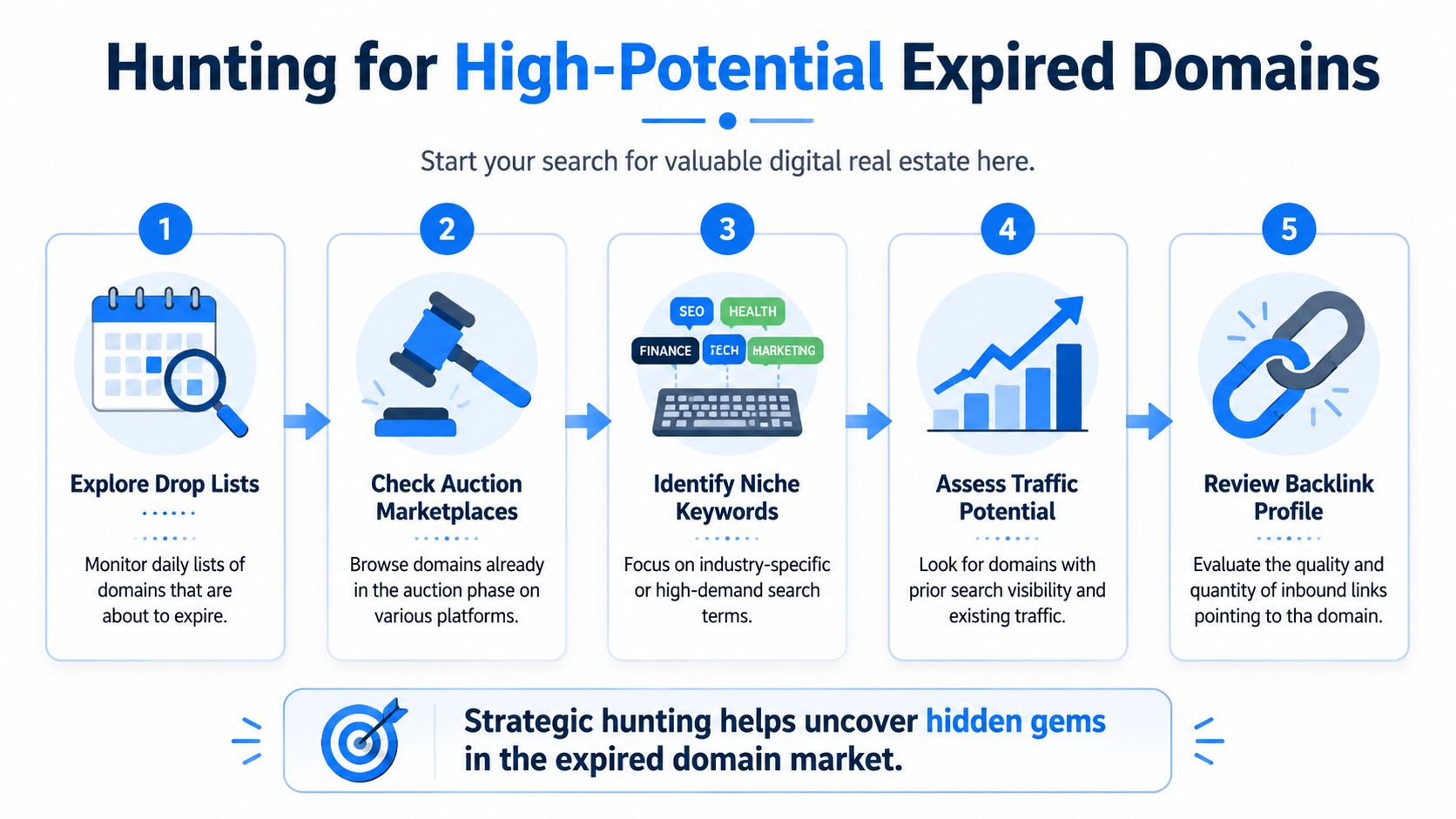
Hunting for High-Potential Expired Domains
The fastest way to waste time is to dump thousands of expired domains into a spreadsheet and scroll until your eyes glaze over. A better approach is to separate your hunt into two buckets: domains you can register now, and domains that haven’t dropped yet but are likely to become available soon.
Start your search for valuable digital real estate here.
Available names for immediate action
The first bucket is simple. These are dropped domains that can be registered immediately if nobody else has taken them yet.
When I’m in a speed-first mode, I look at available domains ready to register. From these, you can move without waiting for auction outcomes or drop timing. If the domain is clean and the fit is obvious, hesitation costs more than action.
This bucket works well for:
- Brand builders who want a launch-ready name now
- SEO operators who know exactly what metrics and topical signals they want
- Buyers on a budget who’d rather register than bid
The trade-off is competition by discovery. If a good name is sitting there unclaimed, you need to ask why. Sometimes you’ve found a genuine miss by the market. Sometimes everyone else saw a problem.
Expiring names for planned attacks
The second bucket is where strategy starts to matter. Expiring domains dropping soon let you prepare before the rest of the market reacts. You’re not just browsing inventory. You’re building a watchlist and deciding where to spend attention.
This is the better path when:
- You want time to inspect history and backlinks.
- You expect competition and need a plan.
- You’re trying to win a domain that won’t sit around once it drops.
Time filters help here. Today is useful when you want fresh movement. 3 Days and 7 Days are better if you’re setting up a short pipeline of candidates. Longer windows are useful when you’re researching themes, niches, or brand patterns instead of chasing a single name.
A practical workflow that stays sane
Here’s the workflow I recommend for most buyers:
Start narrow
Filter by keyword, niche, age, or authority indicators. Broad lists create false confidence because everything looks possible at once.Split by action type
Register-now names go in one list. Watch-and-prepare names go in another. Different timing, different tactics.Review trends, not snapshots
Historic authority matters because a single current metric can flatter a domain that’s been sliding for a while. As noted in this explanation of domain authority history, historic DA tracking helps reveal year-over-year trends, while Moz limits historic access to a one-year range.Save only candidates with a clear use case
If you can’t explain whether the domain is for branding, a content project, a redirect, or resale, skip it.
For a broader walk-through of list research, this expired listings guide from NameSnag is worth a look.
If a domain only makes sense when you start inventing future upside, it probably isn’t a buy. Good domains usually have an obvious first use.
A lot of people lose because they treat discovery like entertainment. They browse. They favorite. They “keep an eye on it.” The buyers who win a domain repeatedly build a repeatable intake process and work the same routine every day.
Vetting Your Domain's History and Health
A domain can look gorgeous on the surface and still be toxic underneath. Strong metrics, old registration dates, even good anchor text can hide a very ugly past.
That’s why due diligence matters more than discovery. Buying an expired domain without checking history is like buying a house because the paint looks fresh.

Start with the old content trail
The first thing to inspect is prior usage. Pull old snapshots and look for content pivots that don’t make sense.
A healthy history usually has some continuity. A gardening blog that became a landscaping service is one thing. A local nonprofit that turned into casino content, then crypto spam, then a Japanese coupon page is another.
Here’s what I look for first:
- Topic consistency across archived versions of the site
- Language shifts that suggest repurposed spam
- Thin doorway pages built only for search manipulation
- Obvious parasite content stuffed with affiliate intent
- Long dead periods followed by sudden junk publishing
The reason this matters is simple. Search engines don’t forget as quickly as buyers do.
Metrics don’t protect you from penalties
Beginners get trapped. They see authority, backlinks, age, maybe a decent-looking referring domain profile, and assume the domain is safe.
It isn’t.
One analysis notes that approximately 15-20% of expired domains in bulk marketplaces contain manual penalties or spam associations that need verification before purchase, according to this breakdown of domain selection pitfalls.
That number should make you more suspicious, not more scared. Suspicion is useful. It keeps you from paying for someone else’s cleanup job.
What a clean backlink profile usually looks like
You’re not hunting for perfection. You’re looking for coherence.
A promising domain usually has:
- backlinks from sites that make topical sense
- anchor text that isn’t stuffed or bizarre
- link sources that look editorial rather than mass-generated
- a pattern that suggests the site earned links by existing, not by gaming a loophole
A risky domain often shows the opposite. Foreign language spam anchors on an English business name. Weird surges from junk directories. Links from irrelevant pages with no reason to mention the domain. Those patterns don’t always mean automatic failure, but they should force a harder review.
A powerful metric can be real and still be useless if the domain earned it through behavior you don’t want to inherit.
Don’t ignore trademark landmines
A domain can be clean from an SEO perspective and still create legal headaches.
If the name leans too close to an existing brand, or if it includes a protected mark with some clever modifier attached, stop and verify before you buy. A useful primer is LA Law Group's guide to brand protection, which helps explain what trademark infringement looks like in practice.
Trademark risk kills deals because it turns a seemingly smart buy into a liability you can’t safely build on or resell.
A simple forensic checklist
When I’m evaluating a domain, I want answers to these questions before I spend money:
| Check | What you want to see | What should worry you |
|---|---|---|
| Archive history | Consistent topic or believable evolution | Repeated pivots into spam or unrelated niches |
| Backlinks | Relevant, editorial-looking sources | Junk clusters, irrelevant anchors, obvious manipulation |
| Branding risk | Generic or defensible naming | Close similarity to established brands |
| Use-case fit | Clear reason to own it | You’re forcing a use case because metrics look pretty |
If you want a more detailed process, this guide to checking domain history is a solid companion resource.
Most bad buys happen because the buyer falls in love too early. Don’t admire the domain until the inspection is done.
Accurately Valuing an Expired Domain
Once a domain clears history checks, the next question isn’t “Do I like it?” It’s “What is this worth to me, in this use case, under real conditions?”
That distinction matters. A domain’s value is not the same as its price, and it definitely isn’t the same as some automated appraisal widget at a registrar.

The three-part valuation model
I use a simple lens with three parts.
SEO value
This is the domain’s practical utility as a search asset. Backlink quality matters. Age can matter. Topical relevance matters more than people think. A clunky name with a clean, relevant history can be useful for a content project even if nobody would call it pretty.
This is also where niche strategy changes the math. According to this overview of domain investing outcomes, generic single-word .com domains may appreciate 8-15% annually, while aged niche domains with relevant backlink profiles can show 20-40% appreciation potential within 12-18 months when used effectively.
That doesn’t mean every niche domain is gold. It means context drives value.
Brandability
Can someone remember it after hearing it once? Can a founder say it out loud without spelling it? Does it sound like a business or like a leftover keyword experiment from another era?
Brandability often saves a domain with modest SEO value. It also limits domains with strong metrics. If the name looks awkward in a logo, sounds confusing in a podcast ad, or creates trust issues at first glance, the market narrows fast.
Market value
This is the reality check. What kinds of buyers want this asset?
A domain can be excellent for your portfolio and weak for resale. Another can be broadly attractive but overpriced for your use case. Good valuation means separating personal excitement from transferable demand.
How I weigh trade-offs
Here’s a simple comparison:
| Domain type | Strength | Weakness |
|---|---|---|
| Short generic .com | Broad buyer appeal | Usually expensive and heavily contested |
| Aged niche domain | Useful for SEO-focused builds | Buyer pool may be narrower |
| Clever brandable | Strong startup potential | May have little inherited search value |
| Metric-heavy ugly name | Functional in the right project | Harder to resell cleanly |
A lot of buyers overpay for authority and underpay for usability. That’s backwards if your plan depends on someone else wanting the asset later.
Field note: The best values often sit where branding and utility overlap. Not perfect in either category. Strong enough in both.
This short video gives a useful framing for thinking about domain value in practical terms.
The question that protects your budget
Before bidding or registering, ask one blunt question:
If I couldn’t resell this for a while, would I still be happy owning it?
If the answer is no, you’re probably buying a story, not an asset.
That question has saved more money than any spreadsheet ever will.
Mastering Backorders, Auctions, and Negotiations
Finding a strong domain is only half the job. Acquisition is where people get emotional, sloppy, and expensive.
To win a domain, you need to know which game you’re playing before the game starts. Backorders, auctions, and private negotiations each reward different behavior.

Backorders when timing beats swagger
A backorder is the cleanest tactic when a domain is about to drop and you don’t want to sit there refreshing like a maniac.
Think of it as a positioning move. You’re telling a service to try to catch the domain the moment it becomes registerable. If the name has obvious value, other buyers may do the same. If not, you might capture it without any public drama.
Backorders work best when:
- the domain is strong but not flashy
- you expect informed competition, not a bidding circus
- you’ve already done your due diligence and know your ceiling
If you want a primer on how these services work, this backorder domain service guide covers the basics well.
Auctions reward discipline, not excitement
Auctions are where sensible buyers suddenly act like they’re defending family honor.
Don’t do that.
The right auction strategy is boring:
- Decide your max price before the auction gets interesting.
- Write down why the domain is worth that amount.
- Refuse to improvise just because another bidder wakes up.
The psychology is predictable. Once you’ve spent time researching a domain, it starts to feel like yours. Then another bidder appears and your brain switches from valuation to combat. That’s how people overpay for names they didn’t even like that much yesterday.
A few practical rules help:
- Bid from a thesis. “Clean niche asset for a content build” is a thesis. “I’ve already spent time on this” is not.
- Stay detached from ego. Another bidder isn’t insulting you. They just want the same inventory.
- Let bad deals go. Missing one domain hurts less than inheriting a price you’ll regret every renewal cycle.
The cleanest auction win is not the one you celebrate. It’s the one you’d make again a week later with a clear head.
Negotiation is a different sport
When the domain is owned but undeveloped, the job changes. Now you’re dealing with a person, not a timer.
The biggest mistake here is exposing your enthusiasm. If your first message sounds like the domain is perfect for your company, your advantage is lost. Keep outreach calm, short, and businesslike.
A workable structure:
- Say you’re interested in acquiring the domain.
- Ask whether the owner is open to discussing a sale.
- Don’t explain your grand vision.
- Don’t anchor too aggressively unless you know the market well.
- Don’t insult the owner with a unserious number on a clearly valuable name.
One tool, one system, less clutter
Most buyers lose speed by jumping between too many tabs, too many metric tools, and too many half-saved notes. One option is to use NameSnag, which analyzes daily expired and expiring domains, applies a composite SnagScore, and lets buyers set filters and alerts around qualities like age, backlink strength, and brandability. That kind of workflow matters because acquisition gets messy when your research process is messy.
A good operator doesn’t just find a domain. They decide early whether the play is a snipe, a bid, or a conversation.
Your Post-Acquisition First 30 Days
You got the domain. Good. Don’t coast now.
The first month matters because this is when ownership gets secured, records get cleaned up, and the asset stops feeling “newly won” and starts becoming usable property.
Week one needs clean ownership
First, make sure the domain is under an account you control fully. Registrar access, billing access, and recovery options should all be yours. If there was any intermediary involved in the purchase, confirm that the handoff is complete.
Then lock down the basics:
- Enable registrar lock so the domain can’t be moved casually
- Turn on privacy options where appropriate
- Confirm renewal settings so you don’t lose a good acquisition to a silly admin miss
That sounds obvious. It gets missed all the time.
Put the domain to work quickly
A domain sitting idle with no plan tends to stay idle.
During the first month, choose one immediate role:
- Launch asset for a new brand
- Holding page that establishes legitimacy
- Content project under development
- Redirect candidate if it fits a larger strategy
- Sale asset if your intent is to flip rather than build
Even a simple coming-soon page is better than letting the domain sit without direction. It creates a clear operational next step and gives you a reason to keep moving.
Keep a written record of why you bought it
This sounds small, but it matters later.
Write down:
- why you bought the domain
- what made it valuable
- what risks you accepted
- what the next milestone is
That note protects you from revisionist thinking. Six months later, you’ll know whether the purchase thesis is working or whether you just got attached to the name.
Own the asset deliberately. Domains become dead weight when buyers stop making decisions after the purchase.
A good domain win isn’t finished at checkout. It’s finished when the asset is secured, documented, and pointed toward a clear outcome.
If you want a more operational way to win a domain instead of browsing random lists and hoping for luck, NameSnag is built for that workflow. You can monitor available and expiring domains, filter by the signals that matter to your strategy, and work from a real pipeline instead of a registrar search box.
Find Your Perfect Domain
Get access to thousands of high-value expired domains with our AI-powered search.
Start Free Trial