Ever feel like every single good domain name is already taken? You're not wrong, but you're also not looking in the right place. A backorder domain service is the closest thing our industry has to a secret weapon, letting you call dibs on a great, already-registered domain. If the current owner lets it slip, the service tries to automatically snatch it for you the very millisecond it drops.
Your Secret Weapon for Finding Dream Domains

We've all been there. You nail down the perfect name for a new project, you're excited, you go to register it, and... poof, it's gone. But here’s the inside baseball: that's not the end of the story. Thousands of genuinely valuable domains expire every single day, creating a hidden goldmine for people who know how to play the game.
Think of it like a digital treasure hunt. Placing a backorder is like hiring a seasoned guide who knows exactly where a shipwreck full of gold is about to surface. While everyone else is just scanning the beach hoping to get lucky, you've set a net in the precise spot where the prize is about to appear. It's a powerful strategy that savvy domain investors and SEO pros use to consistently land incredible names before they ever hit the public market.
Why Backordering Gives You an Edge
So, what makes this so much better than just hitting refresh on your browser? It’s all about timing and automation. When a domain expires, it runs through a whole lifecycle before the registry deletes it and releases it back into the wild. A backorder service plugs directly into the system, using high-speed connections to fire off a registration attempt within milliseconds of the domain becoming available.
This automated "catch" is something a human can never, ever replicate. It’s the difference between trying to catch a hummingbird with your bare hands and using a specialized, high-speed net. In the fiercely competitive world of expiring domains, that speed is everything.
Every day, tens of thousands of domains expire, but only a tiny fraction—around 1-2%, based on industry estimates—actually get backordered. These are the premium ones with history, backlinks, and authority. The rest is mostly junk.
From Discovery to Acquisition
The real magic, though, happens when you stop guessing and start using data. Pairing a discovery tool with a backorder service is what separates the pros from the amateurs. Instead of just backordering names that sound good, you can strategically find high-potential targets first.
For example, you can use a platform to find Expiring domains that are about to drop. By filtering for names that are dropping in the next 3 Days or 7 Days, you're no longer playing the lottery; you're making calculated investments.
This two-step process—finding the gold, then setting the trap—transforms domain hunting from a game of chance into a repeatable, data-driven strategy. Of course, once you've secured the perfect domain, the work is just beginning. To make that new asset truly shine, you need to enhance your digital visibility and growth through effective SEO.
Backorders, Drop Catching, and Auctions: What's the Real Difference?
If you've spent any time hunting for valuable expired domains, you've probably run into a wall of jargon. Terms like "backorder," "drop catching," and "auctions" get tossed around, and it's easy to assume they're all just different words for the same thing. They're not.
Getting these terms straight is critical. Each represents a different strategy with its own timing, cost, and chance of success. Think of it like trying to grab a hot new stock—you could place a limit order, a market order at open, or get into a bidding war for a block of shares. Let's break down the playbook so you know exactly which move to make.
The Backorder: Your 'Dibs' on a Domain
A backorder is the simplest concept of the three. It’s you telling a service, "Hey, if that specific domain ever expires and gets deleted, I want you to grab it for me." You're essentially putting your name on a waitlist, calling 'dibs' before the domain is even available.
This is the "set it and forget it" play. You find a domain you want—maybe one you flagged in a list of Expiring domains—and you place your backorder. The service then does the waiting and watching for you.
A backorder is a reservation you place on a currently registered domain. If the domain expires and is deleted by the registry, the service you hired will attempt to automatically register it for you the moment it becomes available.
The Drop Catch: The High-Speed Snag
So, if a backorder is the request, drop catching is the action. This is the brute-force, high-speed, automated process the service uses to actually snatch the domain for you.
The "drop" is the exact millisecond the central registry deletes an expired domain name, making it available for public registration. "Catching" is what the backorder service's powerful systems do—blasting the registry with registration requests at an inhuman speed. Trying to do this by hand is like trying to outrun a race car on foot. You just can't compete.
In short, when you place a backorder, what you're really paying for is a professional drop catching service to do the dirty work.
The Auction: The Inevitable Bidding War
Here’s the curveball: sometimes, a domain never even makes it to the public drop. Even if you have a backorder placed, you can still find yourself in a bidding war. This usually happens in two ways:
- Multiple Backorders: This is the most common scenario. If you and I both place a backorder on the same domain at the same service (DropCatch, for example), they're not going to just flip a coin. They’ll put the domain into a private auction just for those of us who placed a backorder. The highest bidder takes it home.
- Registrar Pre-Release: Some registrars, most notably GoDaddy, have a habit of identifying their most valuable expiring domains and pulling them from the deletion queue. Instead of letting them drop, they list them in their own "closeout" auctions to maximize their profit. We've written a whole guide on how a GoDaddy closeout auction works if you want to dive deeper.
This means a backorder is never a guarantee. It’s just your ticket to the show. You might get the domain for a flat fee, or you might have to fight for it.
Domain Acquisition Method Comparison
To make this crystal clear, here’s a quick table breaking down the core differences between these methods.
| Method | What It Is | When It Happens | Typical Cost | Best For |
|---|---|---|---|---|
| Backorder | Placing a reservation on a domain before it drops. | Weeks or months before a domain's potential drop date. | A flat fee ($60-$100) if you're the only bidder. | Securing a specific, desired domain with a hands-off approach. |
| Drop Catching | The high-speed, automated attempt to register a domain. | The exact millisecond a domain is deleted by the registry. | Included in the backorder fee. | The technical process used by all backorder services. |
| Registrar/Public Auction | A competitive bidding process to win a domain. | After a drop (if multiple backorders) or before (registrar auctions). | Varies from the backorder fee to thousands of dollars. | Acquiring high-value, competitive domains that you're willing to fight for. |
Understanding these distinctions is the first step. A backorder gets you in the game, drop catching is how the game is played, and an auction is what happens when you’re not the only one playing. Now you can choose your strategy wisely.
A Proven Workflow for Backordering Domains
Knowing the lingo is one thing. Actually winning domains is another. If you want to move past wishful thinking and start building a real portfolio, you need a repeatable process. A real playbook.
This isn't about throwing darts at a board and hoping you hit something valuable. It's a two-step dance: first, you find the gold, then you stake your claim. It involves using smart tools to spot high-potential domains before they drop, then lining up a top-tier service to grab them the second they become available.
Let's walk through the exact process you can start using today.
Phase 1: Find the Perfect Expiring Domain
Your journey starts with discovery. Every single day, tens of thousands of domains expire. Most of them are junk. Your job is to find the handful that are actually worth your time and money. This is where a dedicated discovery platform like NameSnag becomes your secret weapon.
Instead of guessing what might drop, you can zero in on domains that are already in their grace period and set to be deleted soon. These are the prime targets for a backorder.
You can get incredibly specific. The Expiring domains filter, for instance, shows you names that have already expired but haven't been deleted yet. This is your pipeline of upcoming opportunities. From there, you can use time filters to see what’s dropping Today, in the next 3 days, or even over the next month.
Here’s a look at what that expiring domain list looks like in practice.
This view gives you the critical data at a glance, letting you quickly size up potential targets based on metrics like age and authority before you even think about spending a dime on a backorder.
Vet Your Targets Like a Pro
Once you've got a shortlist of interesting names, it's time to do your homework. Never, ever backorder a domain just because the name sounds cool. You have to look under the hood.
- Check the Metrics: Use scores like SnagScore to get a quick, all-in-one picture of a domain's health. This isn't some fuzzy number; it combines real factors like domain authority, backlinks, and age into a single, easy-to-digest score.
- Verify It's Clean: A domain with a spammy history is toxic waste. You're not looking for a fixer-upper. Look for a built-in spam-free verification to make sure you aren't inheriting someone else's Google penalty.
- Analyze the Backlinks: Let's be honest, a strong backlink profile is often the main reason an expired domain is valuable. You're hunting for links from reputable sources, and a link from a .edu or .gov site is pure gold.
This vetting process is absolutely non-negotiable. It’s what separates the pros from the people who waste backorder fees on worthless domains. You'll also want to keep a close eye on your top picks; for more tips on this, check out our guide on effective domain name monitoring.
Phase 2: Place the Backorder and Prepare for Auction
Okay, you’ve found a clean, high-potential domain. Now it's time to act. This is where you switch hats, moving from the discovery platform to a dedicated backorder domain service like DropCatch or SnapNames.
The process itself is dead simple: you give them the domain name and pay the backorder fee.
And now, you wait. The service will do the heavy lifting, monitoring the domain and executing a high-speed "drop catch" on your behalf the millisecond it becomes available.
So what happens next? This is where it gets interesting. If you’re the only person who placed a backorder, congratulations! You’ve likely just snagged a great domain for the standard fee, usually around $60-$70. But if even one other person, anywhere in the world, backordered that same name, it's headed to a private auction.
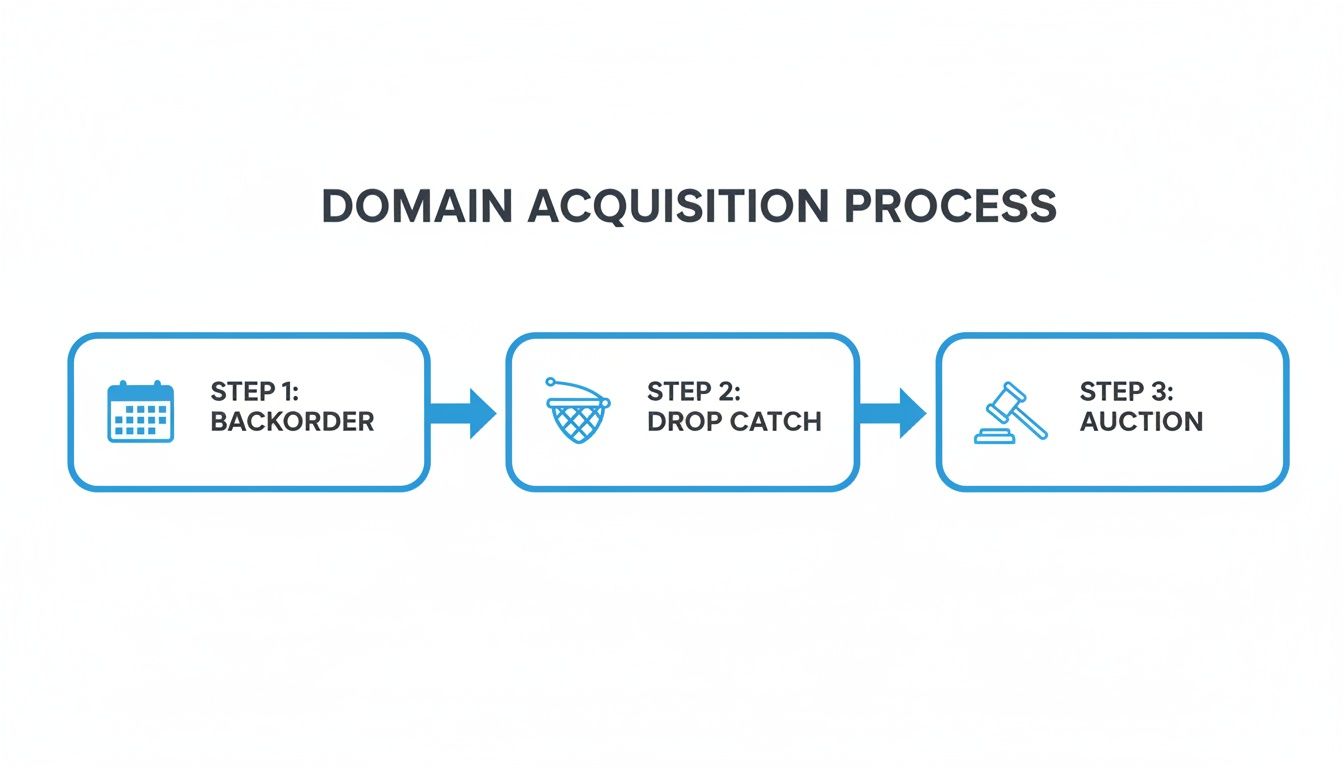
This flowchart maps out the typical path from backorder to a potential auction.
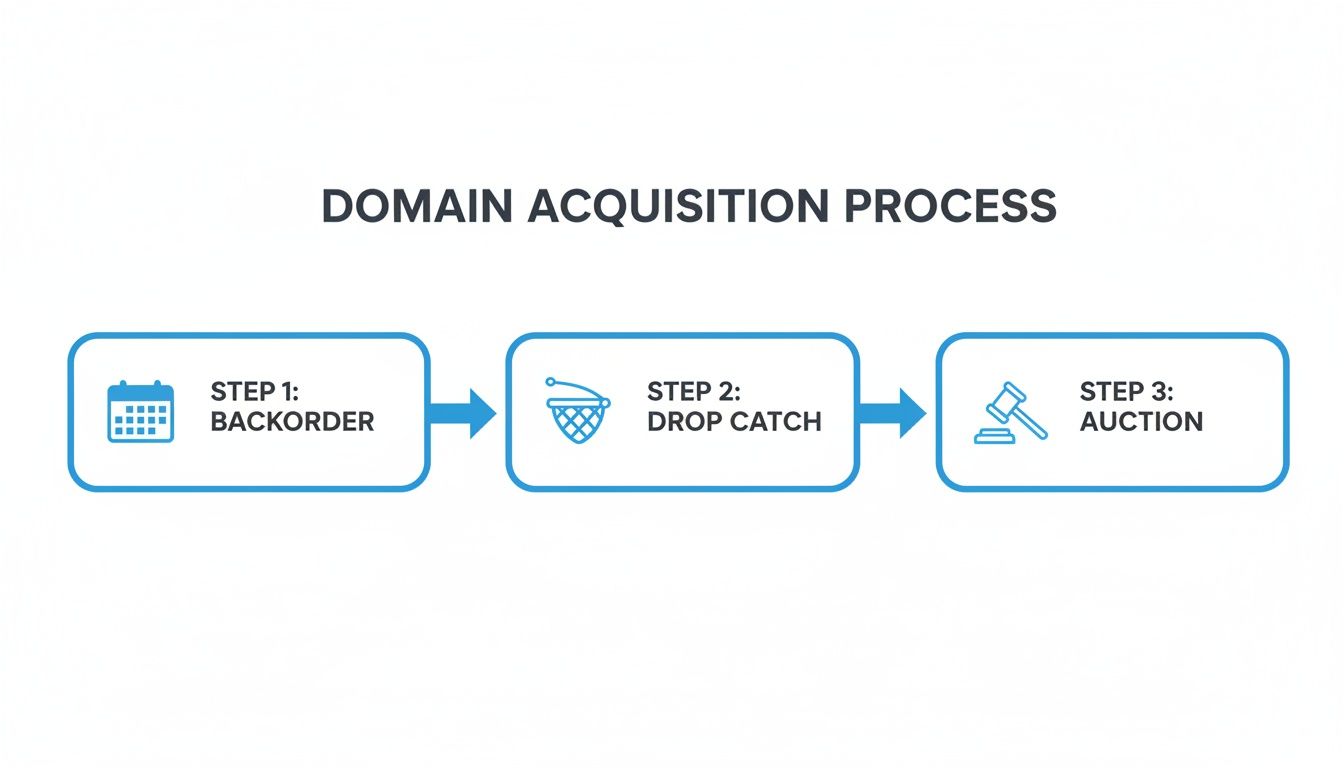
The key insight here is that placing a backorder isn't a guarantee—it's your ticket to the show. For any domain worth having, that ticket gets you a seat at the auction table where the real value is decided.
Why Backorders Fail and How to Improve Your Odds
So you've found the perfect domain, placed a backorder, and you're already picturing the launch. Then... nothing. It’s a gut punch. You did everything right, but the name slipped through your fingers. It feels like the system is rigged.
Here’s the thing: it’s not. But thinking a backorder is a sure thing is like buying a single ticket to a lottery with a hundred other people who also think they have the winner. Understanding why a backorder domain service doesn't always deliver isn't about blaming the service; it's about understanding the brutal realities of the game you're playing.
The Three Big Reasons Your Backorder Didn't Hit
When you lose a domain you've backordered, it almost always boils down to one of three things. Get to know them, and you can stop getting frustrated and start getting smarter.
- The Owner Renewed at the Last Second: This is the most common buzzkill. The original owner can ignore dozens of renewal reminders, but they have up until the final moments of the Redemption Grace Period to wake up and pay the bill. That final "your domain is about to be deleted forever" notice is a surprisingly effective motivator.
- It Went to a Private Registrar Auction: Big registrars like GoDaddy aren't just going to let a high-value domain drop into the public pool. Their systems scan expiring inventory for valuable names, pull them aside, and toss them into their own private auctions. Why? Because it makes them more money than the standard drop process.
- You Were Outbid or Out-Caught: If you and just one other person put in a backorder, you're headed to a private auction. If they want it more—and have the budget to prove it—they'll win. It’s also a game of milliseconds; a competing service might have had a faster connection to the registry and snagged the domain for their client just before yours could.
The sheer volume of this chaos is why backorder services exist in the first place. There are over 359 million domains registered globally, but only 52.3% actually have active websites. Millions expire every year. Success is a function of speed and access, and for a hotly contested name, win rates can plummet below 10% once it hits a private auction. You can dig into more of these intriguing domain name statistics.
Smart Tactics to Boost Your Success Rate
Now for the part that matters: tipping the odds in your favor. You can't force an owner to let a domain go, but you can absolutely play the field with more skill. Here are a few strategies that separate the amateurs from the pros.
Spread Your Bets with Multiple Services
This is the single most important move you can make for a domain you can't afford to lose. Relying on one service is a rookie mistake. To get serious, you need to place backorders across multiple top-tier platforms like DropCatch, SnapNames, and NameJet all at once.
Each service runs its own network and has unique connections to different registries. Using several at once is like casting a wider net. You only ever pay the service that actually catches the name for you, so for a must-have domain, it's a low-risk way to dramatically increase your chances.
Set a Realistic Auction Budget and Stick to It
Assume any domain with real value will go to auction. It’s just the cost of doing business. Before you even click "backorder," you need to decide the absolute maximum you're willing to pay and have the discipline to walk away.
A domain's value is what it's worth to you and your project, not what someone else is willing to bid in a frenzy. Getting caught in a bidding war is an easy way to burn cash. The person who keeps a cool head is the one who builds a sustainable portfolio.
Look for Diamonds in the Rough
While everyone else is duking it out for the obvious one-word .coms, you can find incredible deals by hunting for less-contested names. This is where a discovery tool like NameSnag becomes your secret weapon. Filter for Expiring domains with solid SEO history but maybe a less obvious commercial keyword. Think about brandables, geo-targeted names, or domains in alternative TLDs.
These are the names that often have few, if any, other bidders. That means you can frequently snag them for the base backorder fee without ever seeing an auction. This is how you build a valuable collection of domains over time, not by winning every thousand-dollar auction.
Spotting Red Flags in Expired Domains
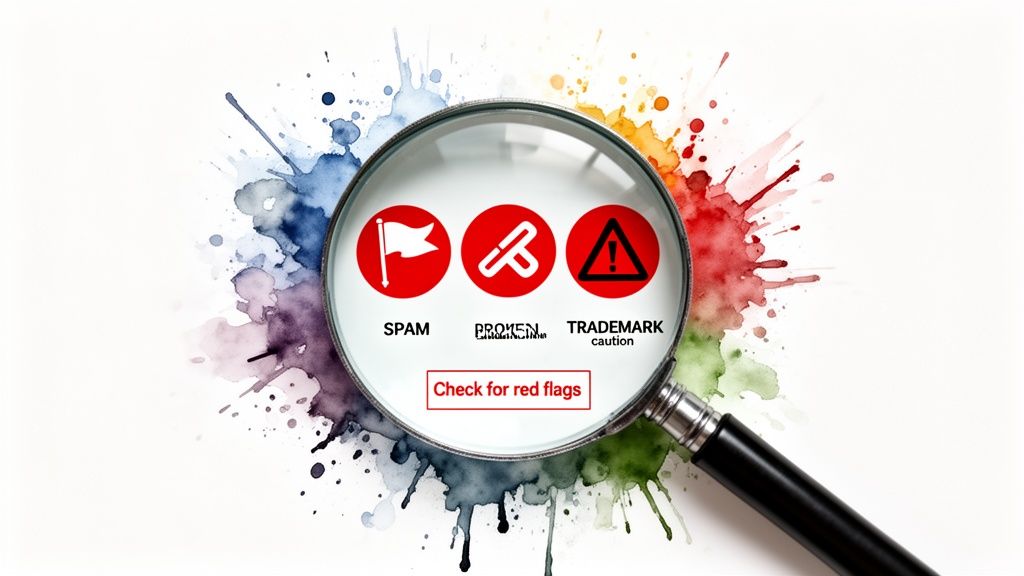
The hunt for a great expired domain can feel like a treasure hunt. The problem is, some of those treasure chests are full of junk—or worse, booby-trapped. Landing a toxic domain can poison your brand and wreck your SEO before you even get started.
Using a backorder domain service is just the mechanism to get the name. The real skill is knowing which names to avoid in the first place.
Think of it as your pre-flight check. Before you commit money and hope to a backorder, you absolutely must inspect the domain for hidden damage. Skipping this step is like buying a used car without popping the hood. You might just be inheriting someone else's expensive, engine-sized problems.
The Problem with Spammy Histories
The single most dangerous red flag is a spammy history. If a domain’s previous life involved being a shady link farm, a phishing operation, or a purveyor of questionable pills, search engines like Google will remember. Snagging a domain with that kind of baggage means you’re starting out in a penalty box you didn’t create.
This is precisely why a built-in spam check, like the one in NameSnag, is so valuable. It’s an instant background check that flags domains with known spam associations, so you can just walk away.
A backorder gets you the domain, but due diligence is what makes it a smart investment. The numbers game of domain backordering is powerful, but with risks like abuse and phishing on the rise, verification is not optional. Consider that only about 52.3% of expired domains ever hosted a real website—you’re sifting through a lot of garbage to find the gems. For more on these trends, check out the latest domain name insights from Abion.
Decoding a Toxic Backlink Profile
A domain's backlink profile can be its biggest asset or its most crippling liability. A handful of quality links from respected sites are pure gold. On the other hand, a profile bloated with thousands of low-quality, irrelevant, or downright toxic links from spam directories is a giant red flag.
Those toxic links are a signal to search engines that the domain is untrustworthy. Cleaning up that kind of mess is a long, painful, and often fruitless task. Before you even think about placing a backorder, ask yourself a few questions:
- Where are the links from? Respected blogs in your niche, or sketchy-looking sites you wouldn't touch with a ten-foot pole?
- What’s the anchor text look like? Does it feel natural and relevant, or is it stuffed with spammy, exact-match keywords?
- Was there a sudden spike in links? An unnatural surge is a classic sign the previous owner bought links, which is a major foul.
Running this analysis is non-negotiable. To get deeper into the weeds on this, you can learn more about how to thoroughly check a domain's history before you commit.
Avoiding Trademark Tangles
Finally, there’s a less obvious but equally dangerous red flag: trademark infringement. It might seem clever to snag an expired domain like "MyAwesomeNikeStore.com," but in reality, it’s a legal time bomb.
Using someone else’s trademark in your domain name is a fast track to a cease-and-desist letter, or worse, a lawsuit. Always run a quick trademark search to make sure the name you’re after isn’t stepping on a registered brand. A few minutes of caution upfront will save you a mountain of legal headaches down the road.
Finding Great Domains You Can Register Today
Placing a backorder is a great long-term play, but sometimes you just need a solid domain right now. The strategic waiting game of a backorder domain service is powerful, no doubt. But what if you could snag a hidden gem that you could register today for the standard $10 fee?
This is where the instant gratification side of domain hunting comes in. It's a totally different tactic, but one that works beautifully alongside backordering. Instead of waiting for a name to crawl through the whole expiration cycle, you're pouncing on it the very second it hits the open market. These are domains that just dropped, are no longer tied to anyone, and are up for grabs at any registrar.
The 'Just Dropped' Gold Rush
Think of it like this: backordering is setting a trap and waiting patiently for the prize to walk into it. Hunting for "just-dropped" domains is like being the first person in line when a store opens with a surprise fifty-percent-off sale. You don't have to wait for weeks. The opportunity is right there, right now.
This approach is perfect if you’re working with a tighter budget and want to sidestep the whole auction scene, or if you've got a project on your desk that needs a domain yesterday. The whole trick is having a tool that can show you these freshly available names the moment they exist.
Here’s a quick look at what that feels like on the NameSnag platform, using the Available domains filter.
This view is a direct pipeline to domains that just hit the public registry, complete with the metrics you need to make a fast decision. You can instantly see which ones have a valuable history—a high SnagScore, a respectable age—letting you cut through the junk and spot the winners.
From Available to Acquired in Minutes
The beauty of this method is its speed. You're not wrestling with auctions, pre-release holds, or any of that anxious waiting. You find a name you like, you go register it. Simple as that.
But just because it’s fast doesn’t mean it’s careless. The same rules of due diligence apply here. You still want a domain with a clean history and good metrics. The only thing that's changed is your timeline—it’s now measured in minutes, not weeks.
Here's how to turn this into a quick, effective workflow:
- Filter for Freshly Dropped Domains: Head over to a discovery tool and hit the filter for Available domains. To really zero in, use the time filters to see what dropped Today or in the last 3 Days. This is where the newest, shiniest opportunities are.
- Scan for Quality Signals: Don't just stare at the names. Your eyes should be scanning for high SnagScores, decent domain age, and a good number of referring domains. These are the breadcrumbs telling you a domain had a valuable past life.
- Act Immediately: Good domains, even when they drop without a backorder, don't stay available for long. Other hunters are looking, too. Once you find a name that passes your quick check, go to your favorite registrar and lock it down. Don't wait.
This lightning-fast approach is the perfect counterpart to the more patient game of backordering. By combining both, you cover all your bases—placing smart bets on future drops while simultaneously scanning for immediate wins.
Some Common Questions About Backordering
Alright, let's get into the nitty-gritty. When you start dabbling in domain backordering, a few questions pop up again and again. Think of this as the straight-talk guide to navigating the process, minus the usual fluff.
What Happens if I’m the Only Person to Backorder a Domain?
This is the best-case scenario, the one you hope for. If you’re the only person who raised their hand for a specific domain, the service will try to snag it for you the second it drops. If they succeed, the domain is yours for the standard backorder fee—usually somewhere in the $60-$100 range.
There’s no auction, no bidding war, no drama. Just a clean win. You’ve basically picked up an asset that, for whatever reason, everyone else completely missed.
Can I Backorder a Domain with Multiple Services?
Yes, and for any domain you really want, you absolutely should. This is a classic pro move.
Placing backorders with a few of the heavy hitters like DropCatch, SnapNames, and NameJet is like casting a wider net. Each service runs on its own infrastructure and has its own quirks and speed advantages. By using several, you’re just playing the odds and dramatically increasing the chances that one of them will catch the domain for you. The best part? You only pay the single service that actually wins. It’s a low-risk, high-reward strategy for competitive names.
How Do I Set a Budget for a Backorder Auction?
This is where you need to be disciplined. Your budget should be tied directly to what that domain is actually worth to you and your project. It's incredibly easy to get swept up in the heat of an auction. Don't.
For a solid, brandable name, it's not unusual to see auctions close between $100 and $500. But for premium one-word .coms or hot three-letter acronyms, the bidding can fly into the thousands, or even tens of thousands, in a hurry.
Before you even think about placing a backorder, do your homework. Use a platform like NameSnag to get a feel for the domain's vital signs. Looking at metrics like its SnagScore, backlink profile, and age gives you a foundation for setting a realistic maximum bid. Whether you're sifting through the Expiring domains list for names that might head to auction or hunting for gems in the Available domains filter, you need a hard ceiling. Know your walk-away price and stick to it, no matter what. That discipline is what separates the people who profit from domaining and those who just end up overpaying.
Ready to stop guessing and start finding high-value domains? NameSnag uses AI-powered analysis to score over 170,000 domains daily, helping you discover clean, brandable names with real SEO potential. Find your next winning domain with NameSnag today.
Find Your Perfect Domain
Get access to thousands of high-value expired domains with our AI-powered search.
Start Free Trial