
Most advice on how to find expired listings is aimed at real estate agents digging through the MLS. That’s fine if you’re trying to win homeowners.
It’s useless if you’re trying to buy undervalued digital assets before somebody else does.
The better opportunity sits in expired domain listings. That’s where affiliate builders, SEOs, flippers, and startup founders can pick up domains with existing authority, clean branding, and enough history to give a new project a serious head start. The catch is that most of what drops is garbage. Existing content on this topic overwhelmingly ignores domains, even though 80-90% of expired domains carry SEO risks from past spam according to Highnote’s analysis of the gap in expired listings content.
That mismatch is why this game is still worth playing. Many either chase anything with big-looking metrics or give up after scrolling a few ugly drop lists. The money is in doing neither.
The Expired Listings Secret Nobody Talks About

Search this topic and you’ll drown in articles about seller motivation, stale houses, and expired MLS records. That’s not the expired listing market I care about.
I care about domains that used to host real businesses, publications, communities, software products, local service brands, or niche sites. When those owners let a domain lapse, the listing expires in a very different sense. It becomes a potential shortcut for SEO, branding, or resale.
Why domain hunters have a better angle
A domain can be more than a name. It can carry backlink history, topical relevance, brand memory, and in some cases type-in value. That makes expired domains a very different hunt from hand-registering random names.
The mistake beginners make is assuming every old domain has value. It doesn’t.
What usually shows up on expired lists:
- Spam wrecks: domains that were used for junk content, parasite pages, fake stores, or link schemes
- Trademark traps: names that look exciting until you realize they belong to somebody else’s brand
- Metric mirages: domains that show flashy numbers but have trash links underneath
- Dead brands: names tied to businesses nobody should revive
Practical rule: The expired domain market rewards skepticism first, excitement second.
The hidden edge is filtration
The secret isn’t finding lists. Lists are easy.
The edge comes from filtering faster than other buyers and rejecting bad inventory without wasting your whole afternoon. That’s why AI-assisted scoring matters here. If most domains on a list are risky, the person who can eliminate junk fastest gets more shots at the rare clean asset.
I’ve learned this the expensive way. The domains that look “cheap” often cost the most later because you inherit cleanup work, weak rankings, or a name you can’t build on. The quiet winners usually look boring at first glance. A clean old local business domain can beat a louder domain with ugly link baggage every day of the week.
Spotting Digital Gold in a Landfill of Junk Domains
Most expired domains die for a reason. Some were abandoned. Some were neglected. Some were burned to the ground by spam.
A small slice are worth buying.
What separates a gem from a trap
When I scan an expired domain, I’m not asking whether it has metrics. I’m asking whether it has usable history.
A valuable domain usually has some mix of these traits:
- Clean past use: it was a legitimate site, not a churn-and-burn spam property
- High-quality backlinks: links from reputable sites matter more than piles of junk links
- Topical continuity: the old site’s topic can support the new project
- Brandability: the name sounds like something a human would trust, click, or remember
- Rebuild potential: you can picture a real business, content site, or asset on it
Domains with high-quality backlinks from authoritative sources like .edu or .gov can pass on link equity, which can reduce the time to rank a new site by as much as 6-12 months compared with starting on a fresh domain, according to this Search Engine Journal analysis.
That doesn’t mean every .edu-linked domain is a winner. It means the right backlink history can make a real difference.
The metrics that matter, and the ones that fool people
If you’re still fuzzy on the basics, this guide on what a domain is gives a clean foundation before you start evaluating expired ones.
Once you’re past the basics, don’t obsess over a single metric. That’s how people overpay for junk.
Here’s the practical lens I use:
| Signal | What it can tell you | What can go wrong |
|---|---|---|
| Trust Flow | Whether backlinks appear trustworthy | Can still look decent on a manipulated profile |
| Domain Authority | General strength estimate | Often treated as gospel when it’s only directional |
| Referring domains | Link breadth | Large counts can be inflated by low-quality sites |
| Age | Long-term history and legitimacy | Old doesn’t mean clean |
| Anchor text | Link intent and relevance | Over-optimized anchors often expose spam |
| Brandability | Resale and build potential | Hard to measure, easy to ignore, expensive to miss |
What works better than chasing huge numbers
I’d rather buy a domain that belonged to a normal business for years than one with a giant backlink count from sketchy blogs in unrelated languages.
That’s because useful authority is usually boring. A local bakery, a niche nonprofit, a dormant software tool, or a retired hobby site can leave behind a cleaner footprint than a domain somebody pushed through aggressive SEO campaigns.
A domain that looks modest on paper can be far more usable than one stuffed with noisy links and zero trust.
When you’re hunting, ask simple questions:
- Would I build on this name myself?
- Do the backlinks look like votes from real sites?
- Does the old topic match what I want to do next?
- Would a buyer understand the name instantly?
If the answer gets shaky, move on. Good expired domain investing depends less on heroic salvage jobs and more on saying no quickly.
The Two Main Hunting Grounds Available vs Expiring
There are two lists that matter most in this game. They look similar at a glance, but they reward completely different behavior.
Available domains are a speed game
Available domains have already dropped. They’re open for immediate registration.
That means if you find something clean and useful, you don’t need to wait around. You act.
A fast way to monitor that pool is by checking available domains and narrowing by the time filter that fits your workflow. If you like catching fresh drops, the short time windows are where the action is. If you prefer browsing patterns and niches, wider windows help.
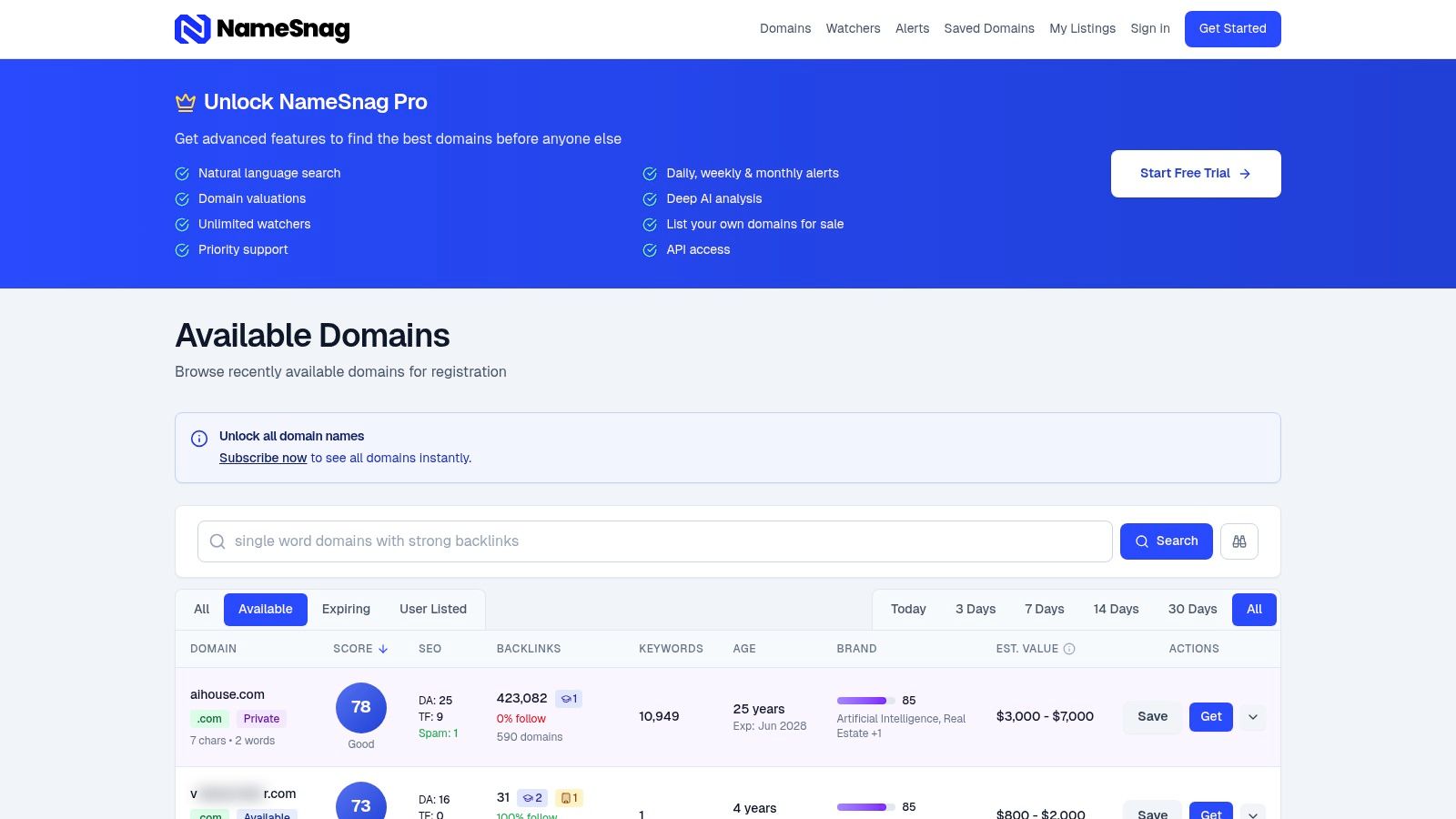
Available domains are good for buyers who:
- Decide quickly: hesitation costs names
- Know their niches: they can recognize value without endless research
- Want simple execution: register now, analyze deeper after the short list is formed
The downside is obvious. Other people can see the same domain and take it before you do.
Expiring domains are a planning game
Expiring domains haven’t fully dropped yet. They’re in the period where the prior owner may still renew.
That changes the strategy. Instead of a speed-only scramble, you get time to evaluate, shortlist, and prepare a backorder or watchlist.
If you want a deeper walk-through of timing and drop behavior, this guide on how to find expiring domain names is worth reading before you start placing bets on future drops.
A good expiring workflow usually looks like this:
- Filter first: start with extension, topic, or brand pattern
- Review history: check whether the domain was ever something real
- Watch likely winners: not every candidate deserves a backorder
- Expect attrition: some names won’t drop because the owner renews
Side-by-side trade-offs
| Hunting ground | Best for | Main advantage | Main risk |
|---|---|---|---|
| Available | Fast operators | Immediate registration | Good names disappear fast |
| Expiring | Patient researchers | More time to vet and plan | Some domains never become available |
The mistake people make with both
A lot of buyers use the same mindset for both lists. That’s sloppy.
On available lists, over-analysis can make you miss the name.
On expiring lists, under-analysis makes you chase domains that won’t drop cleanly or won’t be worth the effort anyway.
I treat available names like flash opportunities. I treat expiring names like a watchlist portfolio. Different tempo, different discipline.
The people who consistently find wins in expired listings usually aren’t searching harder. They’re matching the right buying behavior to the right stage of the domain lifecycle.
Your Ultimate Vetting Playbook Spam Checks and Red Flags
A domain can look fantastic in a list and still be unusable. Here, most beginners get punished.
The hardest lesson in this business is that surface metrics don’t protect you. A domain can have strong authority signals and still hide a spam history, a weird redirect past, or a backlink profile that belongs in the trash.
Start with this checklist view before you spend money.
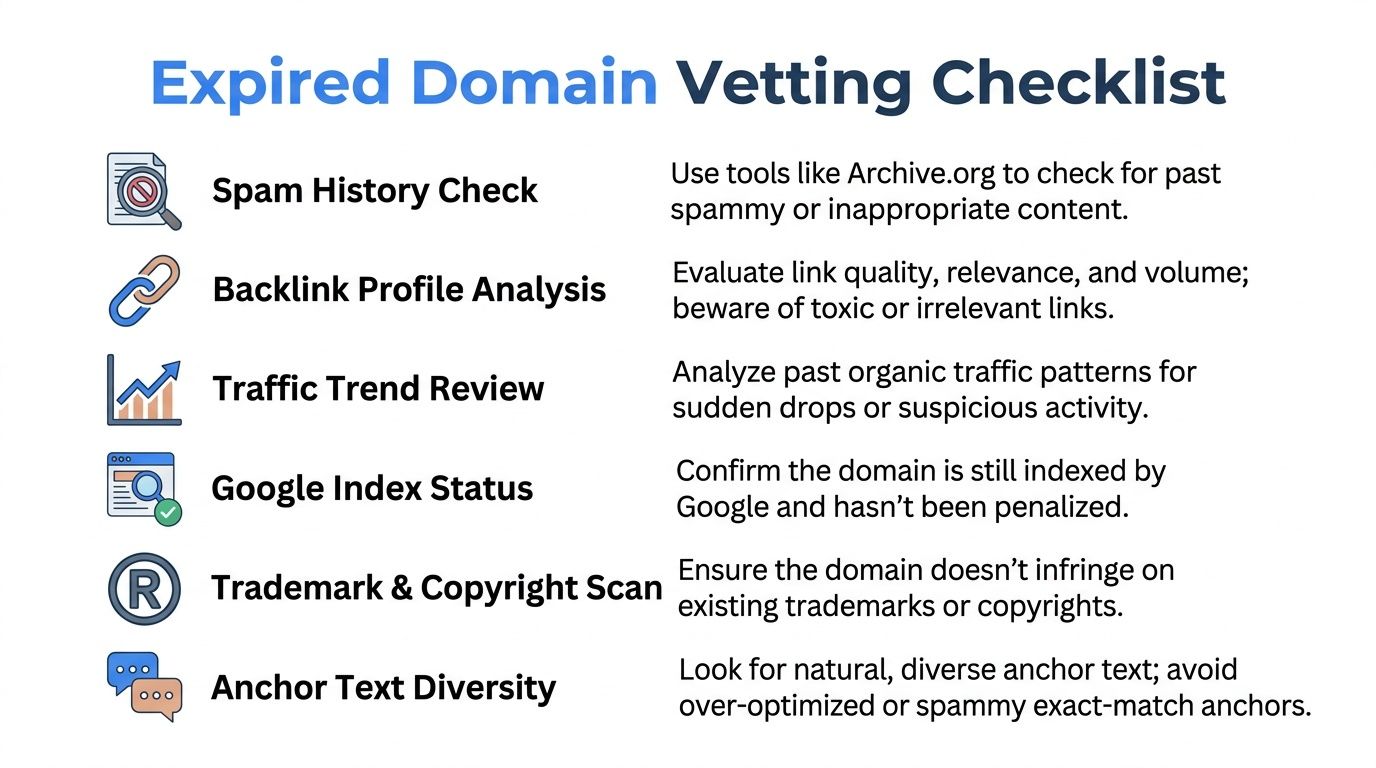
Check the old site before you check the score
Open the Wayback Machine. Don’t skip this.
You want to know what used to live on the domain. A real business site, software homepage, blog, association, or local service brand can be workable. A hacked casino page, fake pharmacy archive, spun foreign-language content, or rotating doorway pages should kill the deal fast.
Here’s what I look for in archives:
- Consistency: did the site stay on one topic over time?
- Legitimacy: did it look like a real organization or site people used?
- Clean transitions: was there a sudden switch into junk content later?
- Language match: random language changes can signal abuse
If the archive tells a messy story, the backlinks usually do too.
Read the backlink profile like a detective
A backlink profile is where expired domains expose themselves.
According to Ahrefs’ expired domain analysis, a thorough backlink review for one domain can take 30-45 minutes, while AI-powered platforms can reduce that process to under 5 minutes by automating checks against spam indicators and historical data. That time gap is exactly why experienced buyers rely on triage before deep review.
The patterns I trust least:
Commercial spam anchors
If anchor text leans into payday, pills, adult, crypto spam, or other aggressive terms, I’m usually out.Irrelevant topical drift
A gardening domain with links from casino pages and random tech directories isn’t “diverse.” It’s contaminated.Suspicious source clusters
Too many links from obviously linked sites, low-grade blogs, or empty pages is a warning sign.Homepage illusion
Sometimes the homepage looks fine, but all the strength came from deep pages that no longer exist or from manipulative links.
A tool that helps centralize this review can save a lot of clicking. If you want a practical look at what to screen for, this post on a domain spam score checker lays out the red flags in plain language.
A short explainer helps if you prefer a visual walkthrough:
Use a pass fail framework
Don’t make every domain earn a dissertation. Make it survive a sequence.
Pass one history
Ask whether the archived site was real, coherent, and clean.
Pass two links
Ask whether the strongest backlinks look editorial, relevant, and likely to matter.
Pass three index and viability
Check whether the domain still seems viable for a rebuild, redirect, holding play, or brand launch.
Pass four legal sanity
Search for obvious trademark problems before you get emotionally attached.
What I reject immediately
Some domains don’t deserve “maybe.”
- Hard spam history: repeated junk content or known spam themes
- Anchor text manipulation: obvious exact-match abuse
- Trademark collision: someone else clearly owns the brand
- Nonsense naming: impossible to trust, pronounce, or resell
- Broken thesis: no clear reason to buy besides vanity metrics
What a keeper usually looks like
Good expired domains rarely scream. They signal subtly.
They tend to have a believable past, backlinks from places that make sense, a name that can hold a project, and no obvious stain you’ll have to explain away later. If I can see a legitimate rebuild path within minutes, that domain moves to the short list. If I’m already arguing with myself, it goes back into the pile.
From Manual Searching to an Automated Discovery Engine
Manual searching teaches judgment. It doesn’t scale.
If you keep checking lists by hand, opening twenty tabs, and repeating the same filters every morning, you’re building a job for yourself instead of a system. Serious buyers turn the hunt into a repeatable feed.
Build filters that match your style
The easiest upgrade is to stop browsing broadly and start filtering narrowly.
Instead of “show me expired domains,” think in combinations:
- Extension first: maybe you only want .com names
- Theme next: a keyword, niche, or commercial category
- Quality gate: score threshold, link quality, or brand feel
- Timing window: immediate drops versus names likely to drop soon
An automated discovery engine mindset helps here.io/free-email-extractor-online/) mindset helps. Different tool category, same lesson. You get better results when the system pulls likely opportunities to you instead of forcing you to re-run the same search manually.
Turn searches into watchers
When I know what I’m hunting, I save the pattern, not just the domains.
For example, I might watch for clean brandable .coms in a niche I already understand, then review only those that match my threshold. That keeps me from getting distracted by random names that look interesting but don’t fit my buying strategy.
If you want to automate more of the due diligence side, this article on due diligence automation is a useful companion because it focuses on reducing repetitive checks instead of adding more of them.
One practical workflow that actually works
Here’s a setup I recommend:
| Stage | What you do | Why it matters |
|---|---|---|
| Scout | Review fresh available and expiring lists by niche | Keeps the pool relevant |
| Filter | Narrow by extension, keywords, and quality signals | Cuts junk before analysis |
| Shortlist | Save only domains with believable use cases | Prevents vanity buying |
| Vet | Check archive, backlinks, and legal issues | Protects your capital |
| Watch | Track candidates that aren’t ready yet | Lets you act when timing changes |
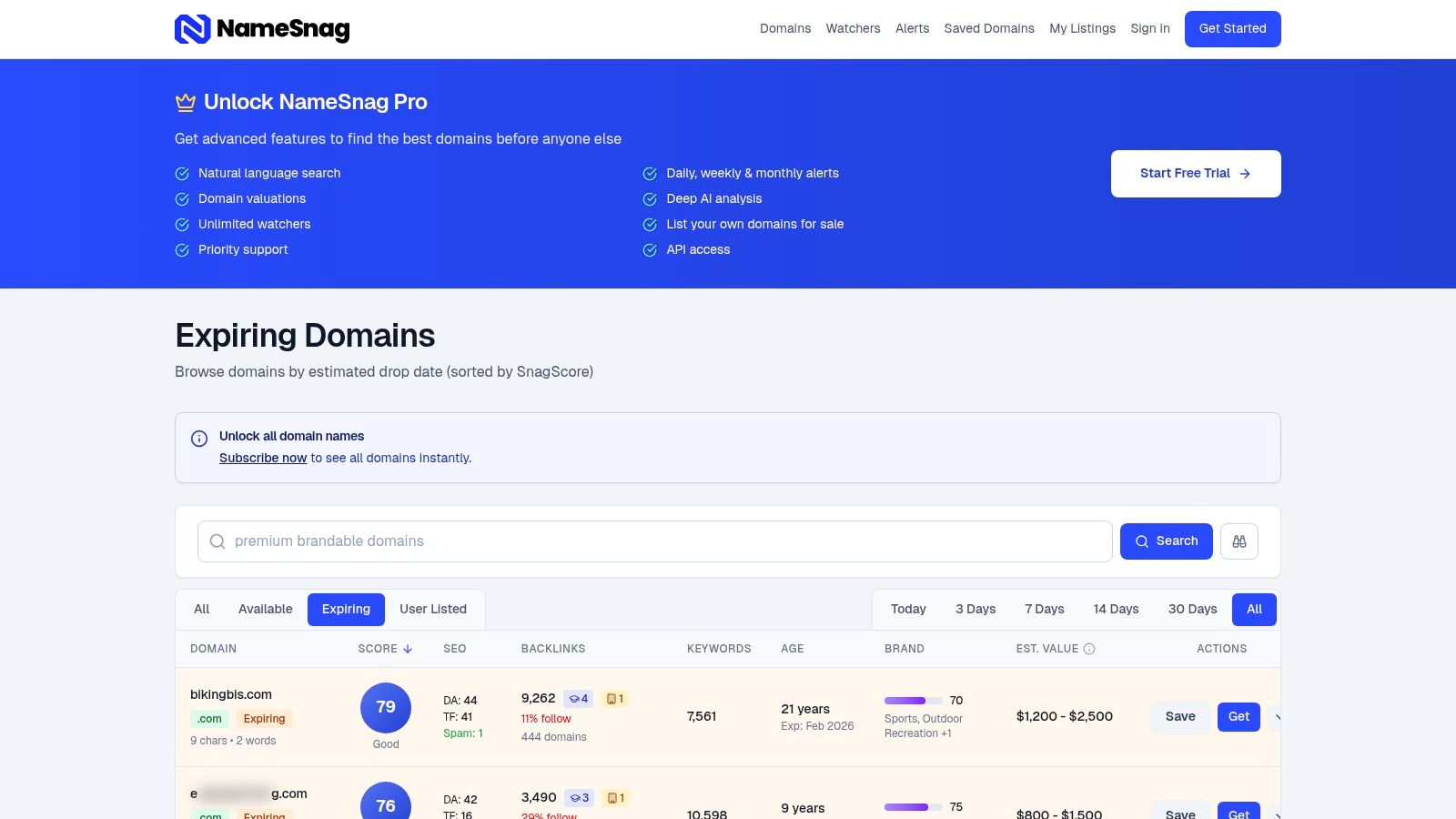
One option in this category is NameSnag, which surfaces available and expiring domains, applies AI-based scoring, and lets you monitor filtered sets rather than reviewing every raw listing manually. Used that way, it functions less like a giant list and more like a ranked queue.
The goal isn’t more domains. The goal is fewer, better domains delivered with less noise.
What stops most people from automating well
They set filters that are too loose.
Then they get overwhelmed, start second-guessing everything, and drift back into browsing mode. Tight filters create better buying conditions. Loose filters create entertainment.
Good automation should leave you with a manageable set of candidates you’d buy, not a giant pile of “interesting” names you’ll never touch.
Putting It All Together Your First Domain Snag
Finding expired listings in the domain world isn’t about luck. It’s about building a cleaner decision process than the person bidding against you.
That process is simple when you strip away the noise. Look in the right pools. Know the difference between available and expiring. Reject junk fast. Vet thoroughly before spending. Save your best searches. Let alerts do the repetitive work.
That’s how you stop acting like a browser and start acting like an investor.
I’d keep your first pass narrow. Pick one lane. Maybe brandable .coms, local business domains, affiliate-friendly names, or topical rebuild candidates. Learn what clean history looks like in that lane. You’ll get sharper much faster than if you chase every domain that flashes a pretty metric.
Inexperienced buyers lose money in expired domains because they buy the story they want to be true. The better move is to buy the domain whose history already proves it deserves another life.
Start small. Be picky. Skip the junk without regret.
Then when you finally snag one that’s clean, relevant, and buildable, you’ll understand why this corner of “expired listings” is so much more interesting than the estate version.
If you want a faster way to search both dropped and soon-to-drop domains, take a look at NameSnag. You can browse available domains that can be registered right away, track expiring domains before they drop, and tighten your workflow around filters instead of sifting through raw junk by hand.
Find Your Perfect Domain
Get access to thousands of high-value expired domains with our AI-powered search.
Start Free Trial