Ever stumbled upon the perfect domain name, only to discover it’s already taken? Bummer, right? But here's a little secret: the question "when do domains expire" is less about a date on a calendar and more about spotting a massive opportunity.
Sure, a domain officially expires on its listed expiry date, but it won’t be up for grabs for at least 75 days after that. First, it has to navigate a winding, slightly dramatic path of grace periods and redemption phases that most people don't even know exist. Think of it as a digital obstacle course.
Why Domain Expiration Dates Are a Big Deal
Think of a domain name as your plot of digital real estate. It's the address where your brand lives, the foundation of your email, and a quiet powerhouse for your search engine rankings. When that lease runs out, it's a high-stakes moment for everyone.
For the owner, it's a critical deadline. Miss it, and you risk losing a priceless asset. For a savvy entrepreneur or investor, it's the starting pistol for a race to snatch up a piece of digital property that might be packed with history, authority, and SEO juice.
Understanding this whole process isn't just administrative busywork; it's a real strategic advantage. It lets you:
- Protect Your Assets: Once you know the timeline inside and out, you can build a safety net to prevent the accidental loss of your own domains. (Don't be that person!)
- Spot Opportunities: You can track and plan to acquire high-value domains that others let slip through the cracks. Their mistake is your gain.
- Get an SEO Edge: Picking up an aged domain with a solid backlink profile can give you an incredible head start that would otherwise take years to build. It's like buying a house that already has amazing landscaping.
The Foundation of Digital Identity
Before we dive into the nitty-gritty of expiration, it’s worth remembering what we're talking about here. A domain is so much more than a name; it’s the unique handle that gives your business or project its own dedicated space online. For a great primer on this, check out this resource on What Is a Custom Domain Name. The moment you really grasp a domain's value, you start to see why its expiration is such a big deal.
Every single day, thousands of domains expire, and each one tells a story. It might be a forgotten side project, a business that closed its doors, or just a simple billing mistake. For those who are prepared, it’s a field of untapped potential.
This guide is here to pull back the curtain on that entire journey. We'll break down the lifecycle step-by-step, from the first missed payment to the final, frantic moments when a domain "drops" and becomes available again.
Whether you're trying to safeguard your own portfolio or learn how to snag that perfect name you’ve been watching, you're in the right place. We’re handing you the playbook to turn expiration dates from a source of stress into a source of massive opportunity.
The Full Domain Expiration Lifecycle: A Guided Tour
A domain's life feels pretty simple when you own it. Everything just works—your website's up, emails land where they should, and business is good. But the moment it expires, things get complicated fast. It’s not an on/off switch; it’s more like a multi-stage gauntlet that every lapsed domain has to run.
Once that expiration date passes, your website might vanish and your emails could stop dead. This is the start of a journey with its own distinct phases, timelines, and costs. Understanding this process is crucial, whether you’re trying to save your own domain or strategically snatch up someone else’s.
This timeline gives you a bird's-eye view of what happens after the clock strikes midnight on expiration day.
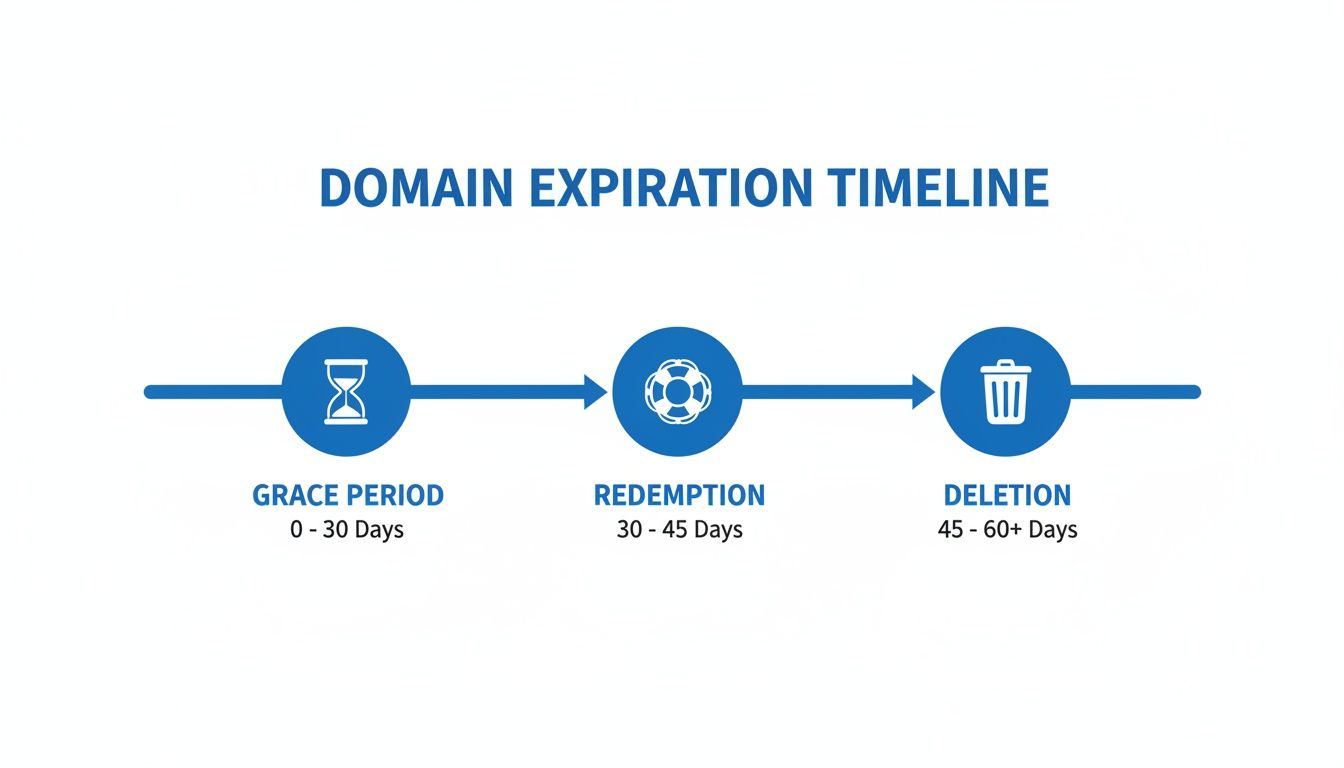
As you can see, the expiration date isn't the final word. It's just the start of a few recovery windows before a domain is truly gone for good.
The Registrar Grace Period: Your "Oops" Window
First up is the Registrar Grace Period. Think of this as the safety net for "life happens" moments. It's a window right after expiration where the original owner can renew their domain at the normal price, no questions asked and no penalties applied. It’s your chance to fix the mistake.
The length of this period can vary wildly depending on the registrar and the domain extension (TLD), but for most common TLDs like .com, you're typically looking at anywhere from 0 to 45 days. During this time, the registrar usually "parks" the domain, swapping your website for a page full of ads or a renewal reminder. It’s their way of giving you a nudge to pay up.
If you're a domain hunter, this phase is a waiting game. You can't register the domain yet, but it’s the perfect time to get it on your radar.
The Redemption Grace Period: Welcome to the Penalty Box
Miss the grace period, and things get serious. The domain now enters the Redemption Grace Period (RGP), which is basically the penalty box of the domain world. At this point, the domain is technically deleted by the registrar but is put on hold at the central registry.
This phase is almost always a strict 30 days. You can still get your domain back, but it's going to cost you. Expect to pay a hefty redemption fee on top of the standard renewal cost—anywhere from $75 to over $250, depending on your registrar.
Why so expensive? That fee covers the administrative hassle for the registrar to pull the domain back from the registry's grasp. It’s a painful price designed to make sure you don't let valuable domains lapse this far ever again.
For domain investors, the start of RGP is a huge green flag. The high cost and extra steps dramatically reduce the chances of the original owner reclaiming it, making the domain a prime candidate for a backorder.
Pending Deletion: The Point of No Return
Once the 30-day RGP is over, the domain enters its final, brief stage before being released into the wild: Pending Deletion. This is a short, 5-day period where the domain is completely locked down. For the original owner, it's game over. No renewals, no redemptions, no last-minute saves.
During these five days, the central registry schedules the domain for deletion from its database. Once that happens, it's released and becomes public property, available for anyone to register on a first-come, first-served basis. This is where savvy investors and businesses are waiting to pounce. Getting a handle on how server updates spread across the internet, a process known as DNS propagation, can really clarify why this final drop is such a critical and time-sensitive event.
The moment a domain is officially dropped, it's an all-out sprint to register it, often fueled by automated "drop catching" services. This is when the real action begins.
Timing Your Move and Understanding the Domain Drop
So, you’ve patiently waited through the grace and redemption periods. Now for the million-dollar question: when does a domain actually become available again? This is where the real fun—and the real challenge—begins. The "domain drop" isn't some predictable event you can circle on your calendar.
Instead, it's a chaotic, brutally competitive process. The exact moment a name is released for public registration depends on the registry (the rules for a .com differ wildly from a .org), the original registrar, and the powerful automated systems all fighting for the same prize.
Think of it like trying to buy tickets for the hottest concert of the year. The second they go on sale, thousands of people (and bots) are hammering the refresh button, all trying to be the first one to click "buy." In the domain world, this frantic digital dash happens in milliseconds.
The Backorder and Auction Gauntlet
To get a real edge, serious domain investors almost never try to register a dropping domain by hand. It’s a losing game. Instead, they use backorder services—think of them as professional line-sitters for the digital world. You pay a service to unleash their high-speed, automated systems to snatch the domain the very instant it drops.
If you're the only person who backordered a name, congratulations! The service will likely grab it and hand it over to you. But what happens when a valuable domain has more than one suitor?
When multiple people place a backorder on the same domain through the same service, it almost always heads to a private auction. Your backorder is just your ticket to get in the door. The domain then goes to the highest bidder, and the final price can be anything from the base registration fee to thousands of dollars for a premium name. Learning how to buy expiring domains is a skill in itself, combining research, timing, and a bit of auction strategy.
From Guesswork to a Game Plan
Rather than staring at a WHOIS record and guessing when a domain might drop, you can take a much smarter approach. This is where modern domain hunting tools completely change the game. You no longer have to rely on luck and manual refreshes.
A fantastic strategy is to use a platform like NameSnag to browse lists of Expiring domains that are currently in their grace or redemption periods. This gives you a clear view of what’s coming down the pipeline, allowing you to:
- Spot Targets Early: Find promising domains long before they hit the open market.
- Do Your Homework: Analyze a domain's history, backlink profile, and SEO value.
- Plan Your Backorders: Decide which names are worth pursuing and place backorders with plenty of time to spare.
- Budget for Auctions: If you spot a high-value name, you can anticipate an auction and get your bidding strategy ready.
This proactive method transforms domain hunting from a reactive scramble into a calculated business decision. It's the difference between blindly chasing opportunities and creating them yourself.
Pro Tip: The core strategy of successful domain investing isn't just about speed; it's about preparation. Knowing what's set to expire in the next 7, 14, or 30 days gives you the time to properly vet a domain's history and value, ensuring you're not just buying a name, but a genuine asset.
This kind of foresight is more critical than ever. Legacy TLDs like .com and .net are seeing historic declines in new registrations as the market gets saturated. In the fourth quarter of 2024, .com and .net registrations dropped by 2.1% year-over-year—a rare dip—even as renewal rates remained strong at 73.8%. This signals that the supply of "good" short names is simply drying up. This scarcity only pushes the value of quality expiring domains higher.
Ultimately, by the time a domain has fully dropped and is listed as Available, the race has often already been won. The real winners were the ones watching it long before it ever hit the starting line. The key is to get ahead of the drop, not just react to it.
Building Your Toolkit for Finding Expired Domain Gold
Manually tracking thousands of domains as they expire is like trying to pan for gold with a teaspoon. It's painfully slow, you’re guaranteed to miss the biggest nuggets, and it's just not how the pros do it. To succeed in this game, you need the right tools.
Your goal isn't just to find a cool-sounding name. It's to hunt down digital real estate that already has a clean history, valuable backlinks, and established authority with search engines.

This is where a specialized platform becomes your secret weapon. Instead of juggling a dozen different SEO tools and messy spreadsheets, you need a system that pulls all the key metrics together and does the heavy lifting for you. It’s the only realistic way to cut through the noise and spot the true gems.
Beyond the Name: A Data-Driven Approach
The most successful domain hunters look far beyond the name itself. They're more like analysts, searching for specific signals that tell them a domain already has SEO power baked in. This is a game of data, not just creativity.
A modern domain hunting toolkit should give you instant answers to the most important questions:
- What's its authority? You need to know metrics like Domain Authority and Trust Flow without having to pull separate reports for every single domain.
- What does its backlink profile look like? Are the links from spammy directories or powerful, authoritative sites? Being able to filter for coveted .edu/.gov backlinks is a massive shortcut.
- How old is the domain? An older domain often carries more weight with search engines, giving you a head start.
- Is its history clean? A domain that was previously used for spam can be toxic, no matter how good its metrics look on the surface.
This is exactly why NameSnag developed the SnagScore. It’s a single, composite metric that rolls all this analysis into one easy-to-understand score. It instantly tells you if a domain is a potential goldmine or a worthless piece of digital junk, saving you countless hours of manual research.
Of course, if you need to dig deeper into the specifics of a particular domain's timeline, you might want to learn more about a dedicated domain expiration date checker to verify all the details.
Building Your Strategy with the Right Lists
Knowing when domains expire is one thing; knowing how to act on that information is what makes you money. A smart toolkit should break down opportunities into two distinct categories, because each one requires a totally different strategy.
First, you have the Expiring domains. These are domains that have passed their expiration date but are still locked up in the grace or redemption period. You can't register them just yet, but you can see them coming down the pipeline.
This is your planning phase. On this list, you identify high-potential targets, set up 'Watchers' to monitor their status, and place backorders to get in line before they ever hit the open market.
This proactive approach is where the real advantage is. You aren’t competing in the frantic, bot-filled dash the second the domain drops; you're setting yourself up for success days or even weeks in advance.
Capturing What Has Already Dropped
The second category is the Available domains. These are the domains that have gone through the entire expiration lifecycle and have officially been released. They are available for anyone to register right now at any registrar.
This list is all about speed and immediate opportunity. It cuts through the noise of domains that are still locked up and shows you only what is actionable at this very moment. You can filter by timeframe—like what just became available Today or in the last 3 Days—to find freshly dropped domains with valuable SEO history before anyone else scoops them up.
By using both lists, you create a comprehensive strategy. You can plan for the future with the expiring list while simultaneously capitalizing on immediate opportunities from the available list. This two-pronged approach ensures you never miss a chance to snag a high-value domain.
Avoiding Common Myths and Costly Mistakes
Diving into the world of expired domains can feel like walking through a minefield. It's littered with half-truths and bad advice. One wrong step, guided by a popular myth, can mean losing a golden opportunity or, worse, getting stuck with a totally worthless asset. Let's bust a few of the biggest myths and sidestep the nastiest mistakes so you can hunt for domains with confidence.
The sheer number of domains expiring every single day is staggering, which creates a massive field of opportunity. But that volume also cranks up the risk of making a bad call. To give you a sense of scale, on February 19, 2025, alone, records showed over 150,000 domains hitting expired status. That's a tidal wave of domains hitting the market daily, and you can get a better sense of the numbers from these insights on domain registration trends.
With that much churn, it's no wonder bad information spreads like wildfire.
Myth 1: The Expiration Date Is the Drop Date
This is, without a doubt, the most common and dangerous myth out there. Newcomers pull up a WHOIS record, see an expiration date, and circle it on their calendar. They think they can just log in the next morning and snag the domain. As we've already covered, that's completely wrong.
Think of the expiration date as the starting pistol for a very long race. That domain has to run a gauntlet of up to 75-80 days, navigating through grace periods and a redemption phase, before it even has a chance of becoming available to the public. If you believe this myth, you're guaranteed to miss the real opportunity by a country mile.
Mistake 1: Ignoring a Domain's History
Finding a domain with a fantastic name and solid metrics feels like striking gold, but that's only half the story. That domain might have a killer backlink profile, but it could be poisoned by Google penalties from its past life as a spam farm. Registering it is like buying a beautiful used car, only to find out the engine is shot.
The most expensive mistake isn't overpaying for a domain; it's paying anything for a toxic one. A tainted history can poison your SEO efforts before you even begin, making recovery nearly impossible.
This is exactly why a thorough background check is non-negotiable. It's absolutely crucial to check the domain history for red flags before you even think about placing a bid. A clean past is every bit as valuable as a strong backlink profile.
Myth 2: All Domain Extensions Play by the Same Rules
Assuming a .co.uk domain follows the same expiration lifecycle as a .com is a recipe for disaster. Many country-code top-level domains (ccTLDs) march to the beat of their own drum. Some have shorter grace periods, others have no redemption period at all, and many have specific residency requirements just to register them. Do your homework and always verify the rules for the specific TLD you're chasing.
Mistake 2: Forgetting About Trademarks
This is the mistake that can land you in serious legal trouble. Just because a domain name is available to register doesn't mean it's legally safe to use. If the name is a registered trademark, you're setting yourself up for a cease-and-desist letter or even a lawsuit. A quick search on the U.S. Patent and Trademark Office (USPTO) database can save you a world of hurt down the road.
The biggest mistake of all, though, is simply waiting around for a great domain to become publicly available. By the time it actually drops, you're fighting against thousands of automated bots. The smart move is to find Expiring domains before they drop, place your backorders, and get yourself to the front of the line.
A Few Questions You Probably Have About Domain Expiration
If you're diving into the world of expiring domains, you've probably got a few questions rattling around your head. It's a confusing space, whether you're trying to snag a diamond in the rough or just keep your own digital real estate from slipping through your fingers. Let's clear up some of the most common points of confusion, without any of the usual fluff.
How Can I Find the Exact Expiration Date of a Domain?
The quickest, most direct way is to run a WHOIS lookup. Just search for "WHOIS" online, pop in the domain name, and you'll get a firehose of data. Buried in that text will be the registrar, the original creation date, and the one you really care about: the "Registry Expiry Date."
But here's the catch: that date isn't the finish line, it's the starting gun. It just marks the official beginning of the expiration process. The domain still has to survive the grace period and redemption period before it has any chance of hitting the open market.
What's the Difference Between an Expiring and an Available Domain?
Getting this right is absolutely fundamental if you want to hunt for domains. These two terms describe totally different stages of the game and demand completely different tactics.
- An Expiring domain has blown past its listed expiration date but is still stuck in the grace or redemption period. The original owner can still swoop in and renew it, which means you can't register it. Your job here is to watch, wait, and maybe place a backorder.
- An Available domain (often called a "dropped" domain) has run the entire gauntlet. It survived grace and redemption, got deleted from the registry, and is now fair game for anyone to register, first-come, first-served. This is where you need to be fast.
This is why a tool like NameSnag splits them up. You can see a pipeline of domains that will be dropping soon versus a list of names that you can register right now. It keeps you focused on the right strategy for the right moment.
Is Buying an Expired Domain a Good SEO Strategy?
It can be a game-changer for SEO, but it comes with a massive "if." You absolutely must do your homework. A killer expired domain comes pre-loaded with a strong backlink profile and established domain authority—basically, a huge head start that could take years to build from scratch.
The flip side? A domain with a spammy, toxic history is a liability. It’s like buying a used car that was previously owned by a bank robber; it comes with a bad reputation you didn't earn but now have to deal with. That's why using a platform with a built-in analysis, like a SnagScore, is so important. It helps you tell the difference between a hidden gem and a ticking time bomb.
How Do I Protect My Own Domain from Expiring Accidentally?
The single best thing you can do is turn on "auto-renewal" with your registrar. It’s a simple checkbox that prevents your domain from ever lapsing. Think of it as cheap insurance against a catastrophic mistake.
Beyond that, make sure your contact info and credit card on file are always current. An expired credit card is the number one reason valuable domains get lost. And if a domain is truly mission-critical to your business, register it for a few years in advance. It creates a buffer that can save you from any future billing headaches.
Ready to stop guessing and start finding high-value domains? NameSnag uses AI-powered analysis to cut through the junk and surface domains with real SEO power. Find your next asset today by exploring our lists of Expiring and Available domains.
Find Your Perfect Domain
Get access to thousands of high-value expired domains with our AI-powered search.
Start Free Trial