So, you’ve probably heard the warnings about hyphenated domain names. They get a bad rap—often dismissed as spammy, unprofessional, or the consolation prize you get when the "real" domain is already taken. Let’s be honest, they’re not the cool kids at the domain name party.
And yet, you still see them out there. Sometimes, they even belong to successful businesses. What's the real story behind that little dash? Is it a total dealbreaker or a secret weapon in disguise?
Spoiler alert: this isn’t a simple yes-or-no question. The debate is full of nuance, and the right answer hangs entirely on what you’re trying to achieve.
Are you an SEO pro hunting for an aged domain with some authority baked in? An investor sniffing out an undervalued digital asset? Or a founder who just needs a clear, available name for your new thing? Your goals completely change the math.
A Tale of Two Domains
Think about it like this: choosing a domain is a bit like choosing a brand name. A sleek, single word is snappy and memorable, but a more descriptive multi-word name tells people exactly what you do. Hyphenated domains just add another layer to that decision.
Take bestsite.com—it's clean, easy to say, and feels premium. But what if it's gone? Suddenly, best-site.com is on the table, and you have to weigh the pros and cons.
The heart of the debate really circles around a few key questions:
- Trust and Perception: Do people instinctively distrust a domain with a hyphen?
- Memorability: How many people will forget the hyphen when they try to type your URL or tell a friend about it?
- SEO Value: Does that dash actually help or hurt your visibility in search engines?
- Availability: Is it a clever workaround or just a cheap alternative?
To give you a clearer picture, here’s a quick rundown of how hyphenated and non-hyphenated domains stack up against each other.
Hyphenated vs Non-Hyphenated Domains at a Glance
| Attribute | Hyphenated Domains | Non-Hyphenated Domains |
|---|---|---|
| Availability | Generally high, easier to find desired keywords. | Extremely low for common keywords, especially in .com. |
| Memorability | Lower. Prone to being forgotten or mistyped. | Higher. Easier to recall and communicate verbally. |
| User Perception | Can be seen as less professional or more spammy. | Generally perceived as more professional and trustworthy. |
| SEO Impact | Historically used for keyword matching, now a weaker signal. | Considered the standard; no inherent negative signals. |
| Cost | Often much cheaper to acquire. | Premium names can cost thousands or millions. |
| Branding | Can be clunky and hard to build a strong brand around. | Clean, strong, and ideal for premium branding. |
As you can see, there’s a clear trade-off. The best choice depends entirely on your specific goals and what you're willing to compromise on.
Setting the Stage for a Strategic Choice
Instead of giving you a blanket "good" or "bad" verdict, we’re going to break this down from every angle. We'll touch on the history—how these domains were once a go-to for exact-match SEO and why that strategy isn't what it used to be.
More importantly, we’ll look at where they fit in today, a time when the perfect .com is a rare and expensive beast. A big piece of this puzzle is understanding what makes a good brand name in the first place, as that context is crucial.
This guide is designed to give you a solid framework for deciding if a hyphenated domain is a hidden gem or a potential landmine for your project. By the end, you'll be able to make a strategic choice, not just a gut reaction.
The Real SEO Impact of Hyphenated Domains
Let's cut to the chase and answer the million-dollar question: do hyphens kill your SEO? The short answer is no, not directly. But the real story is a lot more nuanced and has some serious implications for your strategy.
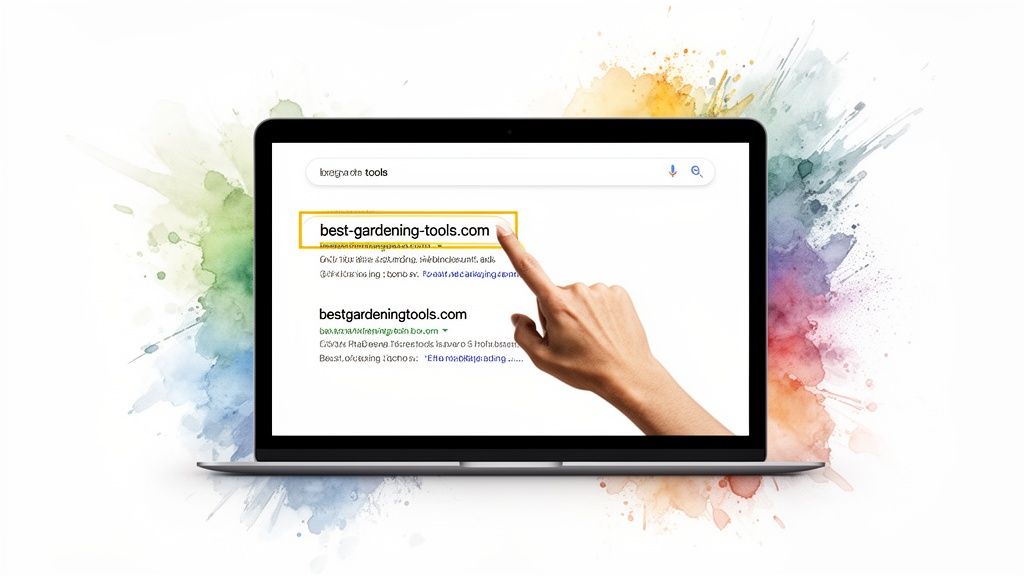
From a pure machine perspective, Google and other search engines are perfectly happy with hyphens. They’ve said for years that they see a hyphen as a simple word separator. To their algorithms, best-gardening-tools.com is just as readable as bestgardeningtools.com.
This can even be a small advantage. The hyphen makes the keyword separation crystal clear, leaving no room for a crawler to misinterpret what you're targeting. So if you're worried about some kind of technical penalty for using a hyphen, you can breathe easy. That's a myth.
The Human Factor in SEO
But modern SEO is about so much more than pleasing algorithms. It's about people. The true impact of hyphenated domain names boils down to how humans perceive and interact with them, and this is where the trouble can start. If you're not already familiar, it's worth brushing up on the basics of SEO and its importance for business websites.
Here’s how the human element can indirectly chip away at your SEO wins:
- Trust and Click-Through Rate (CTR): People have spent decades seeing clean, non-hyphenated domains as the standard for professional sites. If your
best-gardening-tools.comshows up next tobestgardeningtools.comin the search results, some users will instinctively click the cleaner-looking one, hurting your CTR. A lower CTR can signal to Google that your result is less relevant, which might ding your rankings over time. - Memorability and Direct Traffic: Think about a radio ad for "best-gardening-tools-dot-com." How many listeners will actually remember to type the hyphens? Most will just smash the words together, sending valuable direct traffic—a powerful branding signal for SEO—straight to your competitor.
- Link Building and Mentions: When other people link to your site, they might forget the hyphen, too. This "link leakage" can lead to broken links or, even worse, links pointing to the wrong website. You end up missing out on the authority signals that are crucial for ranking.
The SEO Bottom Line: Google won’t penalize you for using hyphens, but your users might. A domain's technical clarity to a search engine often takes a backseat to its clarity and trustworthiness for a human.
Weighing the SEO Trade-Offs
So, you’re looking at a classic trade-off. On one hand, you get clear keyword targeting and a better chance of finding an available name. On the other, you risk lower user trust, leaky traffic, and general branding friction.
How do you make the right call? You need data, not just a gut feeling. Before you even think about registering a hyphenated domain, you have to dig into its history. A name that looks great on the surface could be hiding a toxic backlink profile left by a previous owner who used it for spam.
This is exactly where a tool like NameSnag becomes essential. It helps you vet a domain’s past by checking for spam signals and analyzing the quality of its existing backlinks. For example, you can search for Available domains that were just dropped, giving you a completely fresh start without any old baggage. Knowing a domain's history is a non-negotiable step in making a smart SEO decision. Also, getting a handle on the dynamics of keyword domain names will give you a much richer context for your strategy.
By checking these metrics, you can make an informed choice about whether a hyphenated domain's keyword benefits are worth the potential user-perception headaches. It's about turning a blind gamble into a calculated risk.
The Good, The Bad, and The Profitable
So what's the real story with hyphenated domain names? Are they a secret weapon or just a rookie mistake? The truth is, they’re neither. They're a tool, and like any tool, their value comes down to how and why you use them.
Let's break down the good, the bad, and the surprisingly profitable angles.
The Good: Availability and Clarity
The most obvious win for hyphenated domains is sheer availability. That perfect, snappy .com you dreamed up was probably registered back when dial-up was still a thing. Adding a hyphen can feel like finding a secret door to a room you thought was locked for good. Suddenly, your ideal name is back on the table.
This is a huge deal for niche site builders and marketers who need a very specific, keyword-rich domain. For example, if bestlawncare.com is taken, best-lawn-care.com is a crystal-clear alternative that might just be sitting there, ready to grab. You can even filter for these gems by searching for Available domains on NameSnag to see what was just dropped and is ready for immediate registration.
Plus, that little dash can bring some much-needed clarity, telling search engines and humans exactly where one word ends and the next begins.
The Bad: The Friction of Real-World Use
Now for the flip side. The biggest drawback of a hyphenated domain is human friction. It all boils down to memorability and word-of-mouth.
Imagine telling someone your website over the phone or on a podcast: "Visit my site at best dash lawn dash care dot com." It’s awkward, clunky, and just asking for mistakes. Way too many people will forget the hyphens entirely and type bestlawncare.com into their browser, sending your hard-earned traffic straight to a competitor.
This "traffic leakage" is a serious problem. It’s the main reason why big brands almost always stick to clean, non-hyphenated names—they want a smooth user experience and a brand that’s easy to remember and share.
The Profitable: An Investor's Diamond in the Rough
This is where things get really interesting, especially for domain investors and savvy SEOs. While founders are chasing brandable, easy-to-say names, a completely different game is being played with undervalued assets. So many investors completely ignore hyphenated domains, and that creates an incredible opportunity.
The pros hunt for domains that have a hyphen but also a stellar history—think aged domains with powerful backlinks from .edu or .gov sites. These names are often overlooked but carry immense SEO authority that can be repurposed for a new project or flipped for a hefty profit. The hyphen becomes a total non-issue when the backlink profile is strong enough.
This strategy involves sifting through Expiring domains to find these diamonds in the rough. These are domains others let drop, not realizing the hidden value disguised by a simple dash. Historical data shows that while most hyphenated domains sell for less, there are some massively profitable outliers. Data from over a million sales reveals that while the average sale is around $1,240, some geo-targeted or acronym-based names like TN-I.com have sold for over $60,000. You can find more detailed data about these domain name sale trends.
The key is knowing what to look for. For investors, that means focusing on metrics over branding. Understanding how to value domain names based on these deeper metrics is crucial to spotting a profitable opportunity that everyone else missed.
When to Strategically Use a Hyphenated Domain
Knowing the pros and cons is one thing, but that just scratches the surface. The real question is, when should you actually pull the trigger on a hyphenated domain? It's almost never the first choice, but in a few specific situations, it’s not just a compromise—it's a calculated, even brilliant, move.
The right answer depends entirely on who you are and what you're trying to achieve. A domain that’s a branding nightmare for a startup founder could be a goldmine for an SEO pro. Let’s break down the playbook for each scenario.
A Playbook for SEOs and Niche Site Builders
For SEOs, the game often isn't about building a household name. It’s about scooping up authority and ranking power as efficiently as possible. This is exactly where hyphenated domain names can be a secret weapon.
A killer tactic is to hunt for aged, expired domains that have a clean history and a potent backlink profile. So many competitors automatically filter out hyphenated domains, which means you can often find incredible assets for a fraction of the cost. These domains are perfect for:
- Building a Private Blog Network (PBN): An old, hyphenated domain with solid authority can become a powerful node in your network, passing valuable link equity to your money sites.
- Creating Niche Affiliate Sites: For a project like
best-pressure-washers-review.com, brand memorability takes a backseat to search visibility. The hyphen provides keyword clarity, and if the domain comes with pre-existing authority, you get a massive head start in the SERPs.
The goal here isn't to build a memorable brand; it's to acquire a tool that drives rankings. The domain's authority and relevance trump any awkwardness in its name.
A Playbook for Founders and Startups
Founders live and die by their brand. They need a domain that’s clean, memorable, and easy to type. In 99% of cases, that means avoiding hyphens like the plague.
But there are those rare exceptions where a hyphen can solve a serious problem.
A hyphen might be your best bet when your brand name accidentally forms an awkward or inappropriate word mashup. Think of the classic cautionary tale: ExpertsExchange.com versus Experts-Exchange.com. In this case, the hyphen isn't just a separator; it’s a critical tool for clarity and saving your brand from becoming a punchline.
Before you commit, though, ask yourself if a slightly different, non-hyphenated name would be a better long-term asset. It's also critical to see this choice within the broader context of your overall web design strategy to ensure everything feels cohesive.
This decision tree breaks down the strategic angles—the good, the bad, and the profitable.
As you can see, while founders should proceed with extreme caution, SEOs and investors can find serious value by focusing on the metrics over the brand appeal.
A Playbook for Domain Investors
For domain investors, hyphenated domains represent a market inefficiency just waiting to be exploited. While everyone else is chasing premium, one-word .coms, savvy investors are digging for undervalued assets with hidden strength.
Investor's Edge: The profitability of a hyphenated domain has almost nothing to do with the hyphen itself and everything to do with its underlying metrics—age, backlink profile, and commercial keyword value.
The strategy is simple: find domains whose SEO value far exceeds their low market price. You're looking for a few key indicators:
- Aged Domains: A domain registered over 10 years ago is often seen as more trustworthy by search engines.
- High-Quality Backlinks: Hunt for domains with
.eduand.govlinks. They're incredibly powerful and almost impossible to acquire legitimately. - Commercial Intent Keywords: A domain like
dallas-plumbing-services.comhas obvious commercial value and is an easy flip to a local marketing agency.
The perfect place to find these gems is in lists of Expiring domains. With a tool like NameSnag, you can filter these lists for domains that contain a hyphen and meet your strict criteria for age, backlink quality, and authority. This turns the search from a random gamble into a precise, data-driven treasure hunt for opportunities everyone else is ignoring.
How to Find and Vet High-Value Hyphenated Domains
Ready to go treasure hunting? While most people dismiss hyphenated domain names out of hand, smart investors and SEOs know that the real gems are often hiding where no one else is looking. This isn't about blind luck; it's a methodical process of filtering, digging, and vetting to find high-value assets that others missed.
Let's walk through the exact steps to find and qualify these domains.

Step 1: Start with a Laser-Focused Search
The first step isn't just to search—it's to search with intent. The real challenge is cutting through the noise of hundreds of thousands of domains that drop every single day. Using a platform built for this, like NameSnag, lets you set up incredibly specific filters that zero in on what you actually want.
Instead of a broad, hopeful search, you can layer your criteria. For example, you might look for domains that:
- Must contain a hyphen to tap into this specific market.
- Include a high-value commercial keyword like "solar" or "kitchen."
- Have a minimum Trust Flow of 10 to ensure some existing authority.
- Are at least 5 years old, which adds a layer of trust in the eyes of search engines.
This level of precision immediately weeds out 99% of the junk, leaving you with a clean, manageable list of promising candidates. You can apply these filters to both Available domains for instant registration and Expiring domains to get a jump on what's coming.
Step 2: Separate the Treasure from the Trash
Once you have your shortlist, the real work begins. A hyphenated domain's value is almost entirely based on its history and metrics, not its catchy name. You need to become a digital detective and start looking for red flags.
The most profitable hyphenated domains are those with a clean, powerful history that the competition overlooked. Your job is to analyze the story behind the domain, not just the name itself.
A comprehensive dashboard is your best friend here. It saves you from juggling half a dozen different tools just to get a basic picture. With a tool like NameSnag, you can see all the critical metrics in one place.
This consolidated view lets you quickly assess a domain's health by looking at its backlink profile, age, and authority scores without ever leaving the page.
Step 3: Conduct a Deep-Dive Analysis
For the domains that pass the initial sniff test, it's time to put on your forensics hat. This is where you separate the good from the great.
Analyze Backlink Quality: Don't get fooled by the number of backlinks; check their quality. Are they from spammy blog comments or authoritative sources like university sites (
.edu) or government pages (.gov)? A single link from a trusted.edusite is worth more than a thousand junk links.Check Historical Content: Use the Wayback Machine on Archive.org to see what the site used to be. Was it a legitimate business? A spammy affiliate site? Something in a foreign language that doesn't match your niche? A clean history is non-negotiable.
Look for Spam Signals: Check for signs of previous abuse. An unnaturally high number of links from a single IP address or anchor text that's stuffed with spammy keywords are huge red flags.
This deep analysis helps you avoid domains with toxic baggage that could sabotage your SEO efforts before you even start.
Finding clean, powerful expired domains is where the real value lies. A two-year study on aftermarket sales found that only 1.8% of sales over $500 involved hyphenated names. This highlights just how much opportunity there is in finding these undervalued assets before they hit the premium market. You can read more about the trends in hyphenated domain sales.
By following this process, you turn what looks like a high-risk gamble into a calculated investment.
So, what’s the real story with hyphenated domain names? After wading through all the pros, cons, and decade-old arguments, the answer is pretty clear: they aren't good or bad. They're a tool. And like any tool, its value is all about how you plan to use it, not what some outdated forum post from 2008 says.
For a founder trying to build a brand people can remember and easily type into a browser, that hyphen is almost always a problem. It creates friction. The non-hyphenated version is the stronger long-term play for brand equity, period. But for an SEO or a domain investor? That same hyphen can be a blinking neon sign pointing to a massive, overlooked opportunity.
Ditch the Old Rules, Follow the Data
The smart move here is to completely throw out the blanket "avoid hyphens at all costs" rule. It’s a relic. Instead, you need to adopt a modern, data-first mindset. Vet every single domain on its own merits. The hyphen itself has a neutral technical SEO impact; the real gold—or the real garbage—is buried in the domain's history and metrics.
This is where being precise pays off. When you have the right data in front of you, you can see the trade-offs clearly.
- For brand builders: The cost is almost always brand simplicity and word-of-mouth memorability.
- For investors: The opportunity is scooping up high-authority assets that everyone else is trained to ignore.
- For SEOs: The goal is to acquire ranking power, even if the name itself is clunky and unbrandable.
The question isn't, "Are hyphenated domains good?" It's, "Does this specific hyphenated domain have the metrics to justify using it for my goal?"
Finding Buried Treasure
Instead of writing these domains off, the winning strategy is to analyze them with surgical precision. When you focus on what actually matters—backlink quality, domain age, historical use—you can uncover incredibly powerful digital assets that your competitors are conditioned to scroll right past.
This is exactly what a platform like NameSnag was built for. It lets you sift through thousands of just-dropped Available domains or hunt through soon-to-expire lists for that perfect, high-authority name. By arming yourself with the right tools, you can turn what most people see as a fatal flaw into your own strategic advantage, confidently snapping up powerful domains that others simply don’t even see.
Got a few questions still rattling around about hyphenated domains? Good. It's smart to be skeptical. Let's tackle the common ones we hear from founders, SEO pros, and investors all the time.
Does Google Penalize Hyphenated Domain Names?
Straight answer: No, Google doesn't have an automatic penalty just for having a hyphen. In fact, folks high up at Google have said for years that their systems just see hyphens as word separators. Sometimes, this can even help them figure out what your domain is about.
The real danger isn't a direct penalty. It's the baggage a domain might carry. The risk comes from how users see it, or worse, accidentally buying a domain a previous owner used for spammy tactics. That's why you absolutely have to do your homework on any domain's history before you even think about buying it.
Are Hyphenated Domains Ever Good for Branding?
It's a tough sell, but there are some very specific, niche cases where they make sense. A hyphen can be a readability lifesaver if your brand name mashes words together in an awkward way. Think of the classic Experts-Exchange versus ExpertsExchange mess—the hyphen clears things right up.
They can also just be a practical choice. If the clean version is already taken and you've got a killer marketing plan to overcome the "how do you spell that again?" problem, it can work. For most new ventures, though, the non-hyphenated version is the much safer bet for building a brand that sticks.
Should I Buy Both Hyphenated and Non-Hyphenated Versions?
Yes. If you're just starting out and both are available, grab them. It's a small price to pay for some serious brand protection down the road.
Pro Tip: Register both versions, then set up a 301 redirect pointing the hyphenated one to your main, non-hyphenated site. This simple move catches any traffic from people who type it in wrong and, more importantly, stops a competitor or typosquatter from snagging it themselves.
It’s a smart, defensive play that makes sure all roads lead back to your primary website.
Finding the right domain—hyphen or not—comes down to having the best intel. NameSnag helps you cut through the static, finding high-value domains with metrics that actually matter. Whether you're hunting for freshly Available domains or scouting high-authority Expiring domains, our platform gives you the insights to make better decisions, faster.
Find Your Perfect Domain
Get access to thousands of high-value expired domains with our AI-powered search.
Start Free Trial