That "domain is expired" message can feel like a digital eviction notice. It's a gut-punch moment for sure, but don't panic! It's not the end of the world.
It simply means the registration period you paid for has come and gone. Think of it less like a final sale and more like the start of a countdown—one with several chances to get your digital property back.
The Digital Eviction Notice You Can Ignore (For Now)
When your domain expires, it’s like you’ve missed a rent payment on your digital storefront. Your landlord (the registrar) doesn’t kick you out immediately. Instead, they give you a heads-up and a window of time to pay up and stay put.
This initial window is called the grace period. It’s your easiest and cheapest shot at renewing the domain and getting your website and emails back online with no long-term damage. For a little while, everything is just on pause, waiting for you to act.
Turning Panic Into Opportunity
While that grace period is a lifeline for the owner, an expired domain is a blinking neon sign for everyone else. Savvy investors and SEO pros are always on the lookout for good domains to drop, hoping to snag a valuable digital asset. This creates a fascinating tug-of-war where one person's oversight becomes another's strategic win.
Understanding this initial phase is critical, whether you're:
- A business owner scrambling to rescue your online identity without paying a fortune.
- An SEO professional hunting for domains with established authority.
- An investor looking for the next great brandable name.
An expired domain isn't just a technical status; it's the beginning of a journey. It can lead to recovery for the original owner or acquisition by a new one, transforming a forgotten asset into a powerful tool.
This lifecycle is a big part of what makes the expired domain market so exciting. But it's also where some serious security risks pop up. Attackers can exploit expired domains tied to user emails to take over accounts—a problem that major platforms are constantly battling.
Proactively securing domain names is the best way to avoid the headache and brand damage that comes with a lapse. But if you're on the other side of the coin, finding domains that are ripe for the picking can be a goldmine. You can start exploring freshly dropped Available domains on NameSnag to see what treasures can be registered right now.
It's also worth reading up on how to protect your domain name reputation to keep your digital assets safe and sound.
The Lifecycle of an Expired Domain
When you hear "domain is expired," it's easy to picture an on/off switch. One second it works, the next it’s gone forever. The reality is much more forgiving—and far more interesting. It’s less of a sudden event and more like a slow, predictable journey with multiple stops along the way.
This journey is the domain expiration lifecycle, a standardized process that gives owners plenty of chances to recover their digital property. For investors, it provides clear signals for when to swoop in and acquire it. Getting a handle on these phases is the key to both protecting your assets and spotting new opportunities.
The Grace Period
The first stop is the Renewal Grace Period. Think of this as the friendly reminder stage. Immediately after the expiration date passes, the domain enters this phase, which typically lasts from 0 to 45 days, depending on the registrar.
During this time, your website and email might stop working, but you can still renew the domain at the normal price. It’s a low-stress, low-cost window to fix the oversight. No penalties, no hoops to jump through—just log in and renew.
The Redemption Gauntlet
If you ignore the grace period, things get more serious. The domain then tumbles into the Redemption Period, a last-ditch recovery phase that usually lasts for about 30 days. At this point, the domain is pulled from your account and held by the central registry.
Recovering your domain now is still possible, but it’s going to hurt your wallet. You’ll face a hefty redemption fee on top of the standard renewal cost. This fee can be anywhere from $75 to $250 or more, serving as a powerful incentive not to let things get this far.
A domain in redemption is like a car that's been towed. You can still get it back, but you're going to pay a steep price for the inconvenience, and the clock is ticking before it's gone for good.
The Final Countdown
After the Redemption Period ends, there’s no turning back for the original owner. The domain enters the Pending Deletion phase. This is a short, irreversible countdown, usually lasting about 5 days.
During this time, the domain is locked. It cannot be renewed, recovered, or transferred. It’s effectively on death row, waiting for the registry’s system to purge it and release it back into the wild for public registration. For anyone watching and waiting, this is the moment of truth.
This whole cycle isn't just bureaucratic red tape; it’s the engine of a massive secondary market. The numbers are staggering—over 150,000 domains expire every single day, with renewal rates for popular extensions like .com and .net sitting around 73.9%. This means more than a quarter of these domains are released, creating a constant flow of digital real estate.
Understanding this timeline is a core skill for any digital operator. And if you're ever unsure about a domain's current status, a good domain expiration date checker can quickly tell you where it is in its lifecycle. It's the perfect tool for tracking a domain you want to save—or one you want to snag.
The SEO Catastrophe of a Lapsed Domain
Letting a domain expire feels like a small administrative hiccup, but it's more like setting off a digital bomb under your business. It’s an SEO catastrophe waiting to happen. The immediate fallout is obvious and painful: your website vanishes, replaced by an error page that tells customers you’re gone.
All your company emails instantly go dead. Inquiries from potential clients, support requests, and critical communications all bounce back, leaving people with the impression your business has shuttered. But the silent, long-term damage is far worse.
When Your SEO Equity Disappears
Years of hard work—building domain authority, earning valuable backlinks, and grinding for top search rankings—can evaporate almost overnight. When your domain is expired, search engines like Google don’t wait around. Their crawlers will visit your site, find it’s gone, and quickly begin the de-indexing process.
It’s like your digital storefront has been boarded up. All the signposts (backlinks) you built across the web now lead to a dead end. The "SEO juice" that once flowed to your site, boosting your rankings, now goes nowhere.
Your domain authority doesn't just get paused; it gets deleted. Rebuilding that trust with Google from scratch is a slow, expensive, and often soul-crushing battle that can take years.
Worse still, your lapsed domain becomes a prime target. A competitor could snatch it up, redirecting all that hard-earned authority and traffic to their own website. Imagine every link you ever built now benefiting your direct rival.
The Hijacking Nightmare
The scariest scenario is a bad actor registering your expired domain. They can fill it with spam, malicious software, or content that permanently poisons your brand's reputation. If your business name is suddenly associated with a shady or illegal operation, the reputational damage can be impossible to undo.
This timeline shows how quickly an expired domain moves from a personal problem to a public opportunity, highlighting the grace, redemption, and deletion phases.
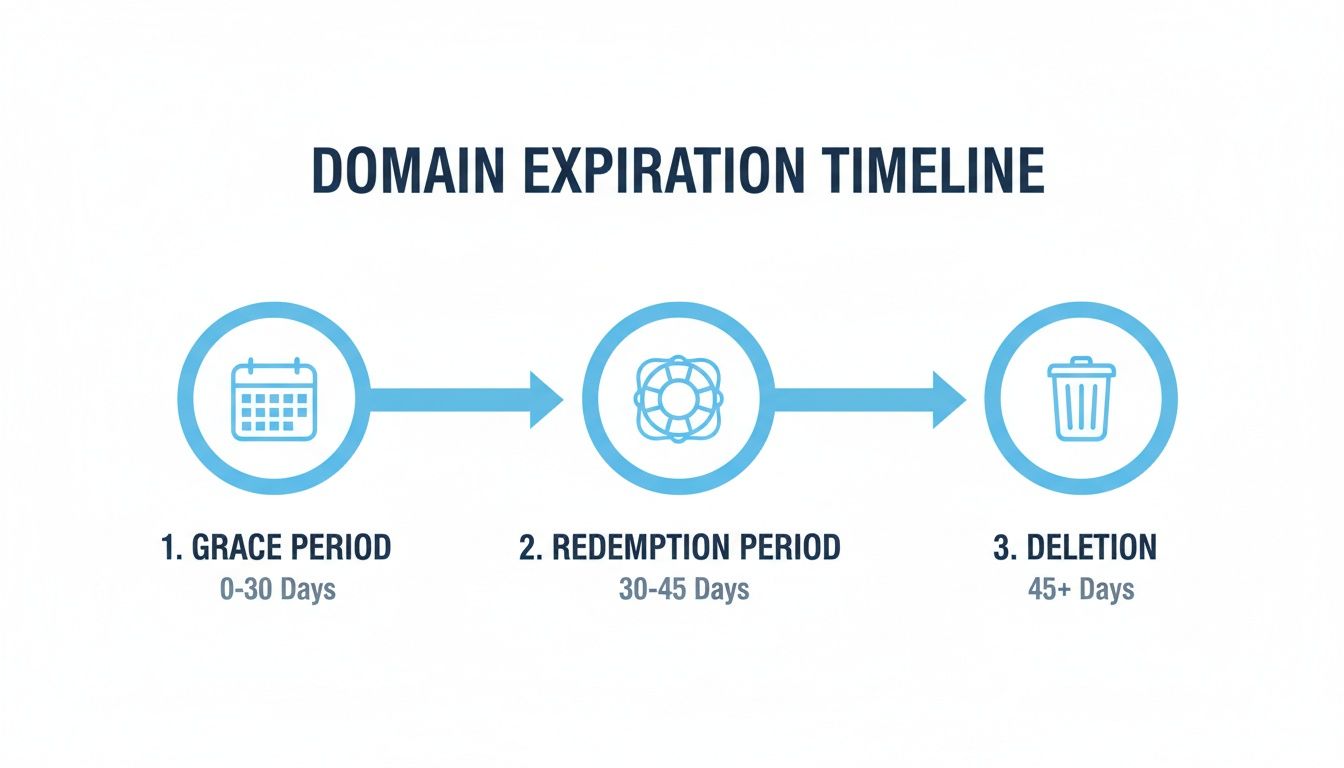
The visualization makes it clear that you have a limited window to act before losing control entirely, with each stage bringing escalating costs and risks.
This isn't just a theoretical threat. Attackers actively seek expired domains tied to developer or admin emails to hijack software packages and user accounts. It's a known security vulnerability that can lead to widespread supply-chain attacks. And if the expired domain had a history of spam, you could inherit a Google penalty right out of the gate. For a deeper dive into this, it’s worth understanding what are toxic backlinks and the damage they can cause.
Forgetting to renew your domain isn't just an inconvenience; it's an open invitation for disaster.
How to Find Gold in the Expired Domain Market
While the phrase "domain is expired" spells disaster for one person, it signals pure opportunity for another. Welcome to the thrilling, sometimes grimy, world of expired domain hunting, where one person's digital scraps are another's strategic assets. For SEOs, marketers, and investors, this isn't about picking up leftovers; it’s a modern-day gold rush.
You're not just buying a name; you're acquiring a history. Snagging an aged domain with an established backlink profile is like buying a house with a solid foundation already poured. Starting with a brand-new domain? That’s just an empty plot of land. You get to skip years of grinding for authority and get a serious head start.
The aftermarket for expired domains isn't some niche hobby anymore; it's a massive industry. Currently valued at $0.64 billion, it's on track to hit $1.17 billion by 2033. This growth is fueled by a simple truth: as the internet gets more crowded, aged, authoritative domains become increasingly rare and valuable. You can read more about the aftermarket's explosive growth and see why these digital assets are in such high demand.
Thinking Like a Domain Prospector
To find the gold, you need to think like a professional prospector. Not all expired domains are created equal. In fact, most of them are junk. A select few, however, are digital diamonds hiding in the rough. The key is knowing what to look for.
A savvy prospector evaluates a domain on a few core metrics that signal its actual value. These are the non-negotiables that separate a winning investment from a costly mistake.
Focus on these three pillars of value:
- Strong Backlink Profile: This is the big one. You're hunting for high-quality, relevant links from authoritative sites. A few links from .edu or .gov domains are worth a hundred times more than a pile of low-quality spam links.
- Established Domain Age: Older domains are generally seen as more trustworthy by search engines. An age of three years or more is a great starting point. It shows stability and a history of being indexed.
- Existing Authority Metrics: Metrics like Domain Authority (DA) or Trust Flow (TF) give you a quick snapshot of a domain's SEO power. A high score suggests it already has the link equity needed to rank.
Two Paths to Acquiring Your Treasure
Once you know what you’re looking for, you need a plan to actually get your hands on these domains. There are two main ways to go about it, each with its own timing and tactics. The method you choose depends on your goals and how quickly you need the asset.
Think of it like real estate. You can either buy a house that’s officially on the market or try to get a property that's about to be foreclosed on. Both can be great deals, but they require different approaches.
The first strategy is all about speed and immediate action. You can hunt for Available domains. These are domains that have gone through the entire expiration lifecycle and were just dropped by the registry. They're up for grabs, first-come, first-served. It’s a fast-paced game where you can use a time filter for domains that dropped Today and snag them instantly.
The second strategy is for playing the long game. You can target Expiring domains—the ones still in their grace or redemption period. They aren't public yet, but you know they're on their way out. By spotting these gems early, you can place a backorder, which is a service that tries to register the domain for you the very millisecond it becomes available. This is how the pros catch the best names before they ever hit the public market.
A Tactical Guide to Acquiring Expired Domains
Alright, you see the opportunity. Now it’s time to get your hands dirty and actually hunt for expired domains. This isn't about blind luck; it's a game of strategy, data, and timing. Think of this as the playbook that walks you through the entire process, from figuring out your mission to making your first snag.
First things first: you need a mission. Why are you even looking for an expired domain? Your goal dictates everything—the kind of domain you search for, the metrics that matter, and what you’re willing to pay.
- Building a Niche Authority Site: Here, you want a domain with a squeaky-clean history and strong, topically relevant backlinks. You're buying a launchpad for your content, not a fixer-upper.
- Creating a Private Blog Network (PBN): The game here is raw SEO power. You're hunting for domains with high authority metrics (like DR or DA) to pass link equity to your main money sites. It's a different beast entirely.
- Flipping for Profit: This requires an eye for what's brandable and valuable. Short, catchy, and keyword-rich .com domains are usually the easiest to flip for a quick profit.
Defining Your Ideal Target
With your mission clear, the search begins. This is where a specialized tool becomes non-negotiable. Manually sifting through the hundreds of thousands of domains that drop daily is a fool's errand. A platform like NameSnag does the heavy lifting, filtering the mountains of junk to surface the potential gems.
You'll use a variety of filters to cut through the noise. The key metrics to focus on are:
- SnagScore: A composite score that gives you a quick, at-a-glance read on a domain's overall quality.
- Domain Age: Older domains often carry a bit more trust and weight with search engines.
- Backlink Quality: This is huge. Prioritize domains with links from trusted, authoritative sources like .edu and .gov sites.
- Topical Relevance: The domain's past life, visible through its backlink profile and archive history, should align with what you plan to do.
Even the most popular domain extensions see massive churn. For legacy TLDs like .com and .net, renewal rates hover between 73.8% and 75.3%. That means roughly a quarter of them drop off every single year. This floods the market with low-quality names, but it also means rare, high-value domains regularly become available for those who know where to look. You can see more global domain trends here to get a sense of the scale.
The Two Core Acquisition Methods
Once you've zeroed in on a promising target, you have two main ways to grab it. The path you take depends entirely on where the domain is in its expiration lifecycle.
1. Place a Strategic Backorder on an 'Expiring' Domain
An Expiring domain has passed its renewal date but isn't available for public registration yet. It's stuck in the grace or redemption period. Placing a backorder is like calling "dibs." You use a service that will attempt to register the domain for you the millisecond it becomes available.
This view on NameSnag is your crystal ball, letting you spot high-potential domains before they hit the open market. It gives you a serious strategic edge.
This method is hyper-competitive, especially for valuable domains. If multiple people place a backorder, it usually triggers a private auction. But for premium names, it's often the only way to get a shot.
2. Instantly Register a Newly 'Available' Domain
An Available domain has gone through the entire lifecycle—grace, redemption, pending delete—and has been released back into the wild. It's first-come, first-served. On NameSnag, you can use time filters like Today or 3 Days to find domains that just dropped and register them immediately at any standard registrar. This is the faster, more direct approach, perfect for finding solid domains without the hassle and uncertainty of an auction.
The Final, Non-Negotiable Step: Spam Checking
Before you pull the trigger on any expired domain, you absolutely must do a thorough spam check. A domain can have incredible metrics on paper but be hiding a toxic history of spammy links, sketchy content, or a Google penalty.
Acquiring it would be like buying a beautiful house built on a toxic waste dump—you inherit all the problems.
Use tools to check its history on the Wayback Machine. Scrutinize its backlink profile for any red flags. This one step will save you from a world of SEO headaches down the road. With your mission defined, your filters set, and your due diligence done, you're ready to make your move.
A Few Common Questions About Expired Domains
Still got some questions kicking around in your head? You're not the only one. The world of expired domains is full of little details and "gotchas," so let's clear up some of the most common ones with straight, no-fluff answers. Think of this as your final briefing before you start the treasure hunt.
Can I Get My Domain Back After It Expires?
Yes, you absolutely can—but only if you act fast. The moment your domain is expired, the clock starts ticking. It first lands in a Renewal Grace Period, which usually gives you somewhere between 30 and 45 days. In this window, you can renew it at the normal price, no questions asked. This is your best and cheapest shot at getting it back.
Miss that deadline? It then tumbles into the Redemption Period for another 30 days. You can still reclaim it here, but it's going to hurt. The registrar will tack on a hefty penalty fee, often $100 or more, on top of the regular renewal cost. Once redemption is over, it's game over. The domain gets slated for deletion and is thrown back into the public pool for anyone to grab.
Is Buying an Expired Domain a Good Idea?
It can be an unbelievably powerful SEO strategy, but it comes with a huge asterisk: you have to do your homework. The single biggest landmine is accidentally buying a domain Google has already blacklisted because of a sketchy past filled with spam links or questionable content. It's the digital version of buying a gorgeous-looking car, only to find out the engine is shot.
A clean, aged domain with real authority is an absolute goldmine that can shave years off your growth curve. On the flip side, a spammy one is a boat anchor that will drag your projects down before they even set sail. Using a tool with built-in spam checking isn't just a nice-to-have; it's essential for not torching your money.
The real currency of an expired domain is its history. A good history fast-forwards your growth, while a bad one can sabotage you from day one. Diligent research is the only thing that tells you which one you're buying.
What Is the Difference Between Expiring and Available Domains?
This distinction is all about timing, and it's critical to your buying strategy. Understanding the difference tells you whether you should be playing the long game with a backorder or going for a quick, immediate win.
Expiring Domains: These have already passed their renewal date but are still locked up in the grace or redemption periods. The public can't register them yet, but you know they're headed for the chopping block. On NameSnag, you can find these by filtering for Expiring domains and place a backorder. This is like putting your name on a waiting list to try and snatch it the second it drops.
Available Domains: These domains have run the entire gauntlet—grace, redemption, deletion—and have been officially released by the registry. They're now back in the wild, ready for anyone to register on a first-come, first-served basis. You can filter for Available domains on NameSnag and register them on the spot.
How Is an Expired Domain's Value Determined?
The price can swing wildly from a standard $10 registration fee to tens of thousands of dollars. It isn't just one thing; it's a mix of several factors that all add up to its market price. The real gems are the ones that tick multiple boxes.
Ultimately, a domain's worth boils down to a few key things:
- Brandability: Is it short? Memorable? Easy to spell? A catchy
.comwill almost always beat out a clunky, hyphenated.info. No question. - SEO Metrics: This is where the real power is. High Domain Authority (DA), a strong backlink profile (especially from powerhouse .edu/.gov sites), and a clean history all send the value soaring.
- Domain Age: An older domain has been around the block. Search engines often see this longevity as a signal of stability and trust.
- Existing Traffic: Believe it or not, some expired domains still get a trickle of direct or referral traffic. That's an immediate, free audience for the new owner.
A short, brandable name with a strong, clean SEO profile is the holy grail. It gives you instant credibility and a massive head start on whatever project you have in mind.
Ready to find your own piece of digital real estate? Stop wasting time sifting through junk and let NameSnag do the heavy lifting. Our platform chews through over 170,000 domains every day, using smart metrics to bubble up the high-value gems you're actually looking for. Find your next winning domain on NameSnag today!
Find Your Perfect Domain
Get access to thousands of high-value expired domains with our AI-powered search.
Start Free Trial