
So, when does a domain actually expire? The simple answer is on its anniversary of registration, but trust me, that’s just the start of the story. A domain doesn't just blink out of existence. Instead, it kicks off a surprisingly long and structured process, giving the original owner multiple chances to get it back before it’s finally released to the public.
The Real Story of a Domain's Expiration
It's a common myth that the moment a domain's registration ends, it's a free-for-all. The reality is far more predictable—a multi-stage journey every domain owner and investor needs to get straight.
Think of it like a library book you forgot to return.
First, the book becomes 'overdue.' This is the grace period. The original owner can waltz back in and renew the domain, usually for the standard fee. It's a low-stress window, designed to forgive simple oversights like an expired credit card on file.
If they don't show up, the book moves to a dusty 'lost and found' shelf behind the counter. This is the redemption period. Getting the domain back now is still possible, but it comes with a steep penalty fee. This is the last real chance for the original owner to reclaim their digital property before it's gone for good.
The Key Players in This Little Drama
To really get what's happening behind the scenes, you need to know who's involved. There are three main characters in this expiration game:
- The Domain Owner: That's you (or whoever currently holds the registration). Your job is to keep that registration current.
- The Registrar: This is the company where you bought the domain, like GoDaddy or Namecheap. They're the retail storefront, managing your purchase and hopefully sending you a flood of renewal reminders.
- The Registry: Think of this as the wholesale warehouse that manages all the domains for a specific extension (like Verisign does for .com). The registrar is the one talking to the registry to update the domain's official status.
Only after a domain makes it all the way through this gauntlet—grace and then redemption—does it finally return to the public 'shelf' for someone new to pick up. This whole structured process is precisely why you can't just swoop in and register an amazing domain the day after it "expires."
This entire cycle creates a constant flow of digital real estate back onto the market. It's a massive opportunity for those who know where to look.
And this churn is happening on a colossal scale. With over 364 million total domains out there, the constant turnover from people who simply don't renew is staggering. To put it in perspective, on a single day in February 2025, one service tracked over 150,000 domains hitting the expired list. Thousands of domains are dropping every single day, creating a treasure trove for savvy investors and SEO pros. You can find more domain registration trends and insights here.
Understanding this flow is the first step. The next is learning how to work it, whether you're hunting for high-value names that are about to drop using an Expiring domains filter or grabbing freshly dropped names from an Available domains list.
The Full Domain Expiration Lifecycle, Demystified
So, you're on a mission. Whether you're trying to rescue your own domain or strategically capture a new one, you need a map. The domain expiration process isn't a single event; it's more like a multi-act play with a clear, predictable timeline.
Understanding these stages is your key to acting at the perfect moment. To really get a handle on it, it's worth mastering domain and DNS management as a whole, but for now, let’s focus on the timeline.
Think of it as a rescue operation. Your domain is the asset, and the clock is ticking.
Act I: The Expiration Date and Grace Period
The first domino falls on the expiration date. This is the day your domain registration officially ends. But don't panic! This isn't the point of no return. Instead, it’s when the clock starts on the Registrar Grace Period.
This is your first and best chance to save the day. The grace period typically lasts anywhere from 0 to 45 days, depending on your registrar and the domain extension (.com, .net, etc.). During this time, the domain is essentially "on hold." Your website and emails will stop working, but the domain is still yours to reclaim.
All you have to do is log into your registrar and renew it, usually for the standard annual fee. It’s a simple, low-cost fix for what could become a huge problem.
Act II: The Redemption Gauntlet
If you miss the grace period window, the mission gets harder and a lot more expensive. The domain now enters the Redemption Period, sometimes called the Redemption Grace Period or RGP.
This is the domain's last stop before it's gone for good. The redemption period is an additional 30 days tacked on after the grace period ends. You can still get your domain back, but it will come with a hefty penalty. Registrars charge a redemption fee on top of the regular renewal fee, which can easily be $100 to $200 or more.
Why the high fee? This isn't just your registrar being greedy. They have to pay their own fee to the central registry (the organization that manages the TLD) to pull the domain out of a deletion queue. This phase is designed as a last-ditch recovery option, not a standard renewal process.
For domain hunters, this period is a waiting game. The domain is locked down; it cannot be registered by anyone else. You can only watch and wait to see if the original owner pays the price to rescue it.
Act III: Pending Deletion and The Drop
Once the 30-day redemption period is over and the domain remains unclaimed, it enters its final phase: Pending Deletion. There's no coming back from this for the original owner.
This stage is brief, usually lasting around 5 days. During this time, the central registry schedules the domain to be completely wiped from its records. The original owner can no longer redeem it, and no one else can register it yet. It's in a digital limbo.
Then comes the moment everyone has been waiting for: the "drop." The domain is officially deleted and becomes publicly available for registration again on a first-come, first-served basis. This is where domain hunters can finally strike.
This visual timeline breaks down the journey from expiration to public availability, showing you exactly when you can act at each stage.
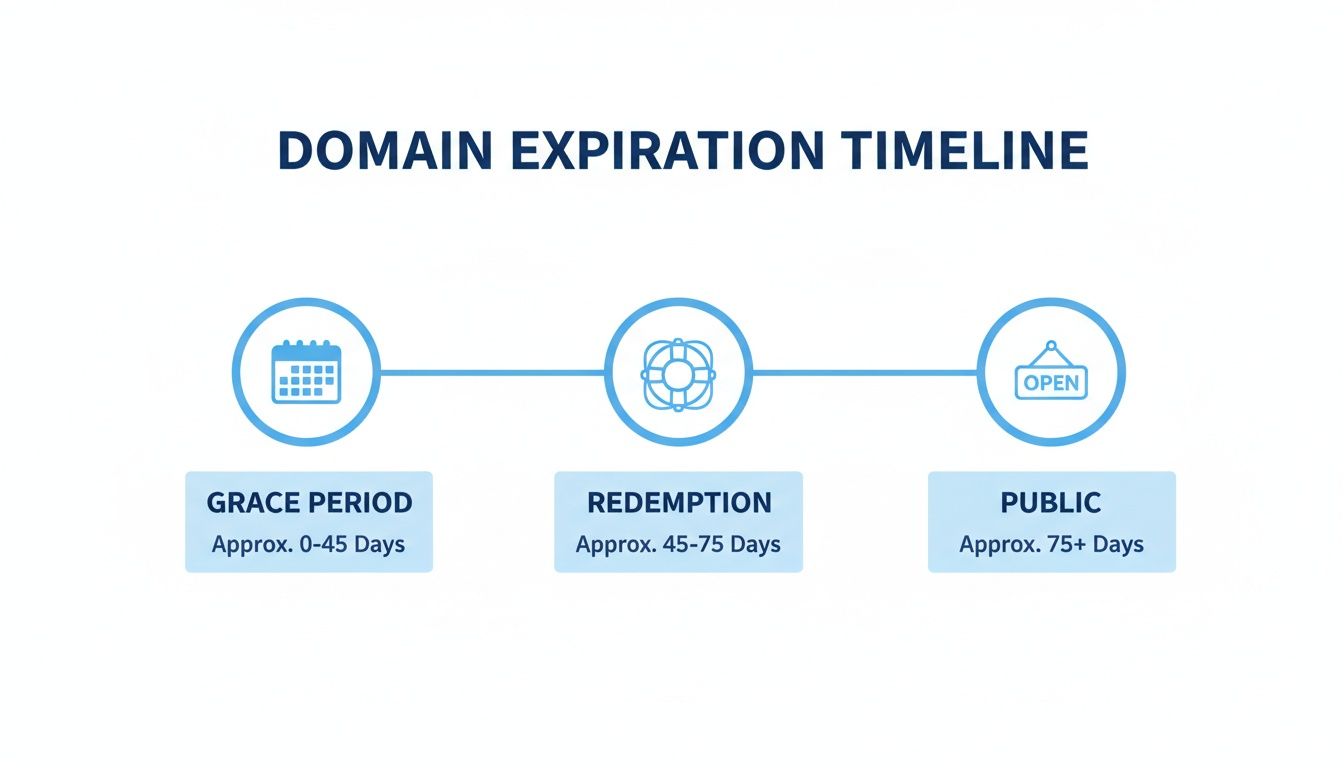
As the infographic shows, the entire process provides multiple windows of opportunity, but the costs and risks shoot up dramatically after that initial grace period.
To make it even clearer, here's a simple breakdown of the entire timeline.
The Domain Expiration Timeline at a Glance
This table maps out each stage of the domain lifecycle after the expiration date hits. It shows you who can do what, and when.
| Lifecycle Stage | Typical Duration | What the Original Owner Can Do | What Others Can Do |
|---|---|---|---|
| Grace Period | 0–45 days | Renew the domain at the standard price. | Nothing. Can only place a backorder or monitor. |
| Redemption Period | 30 days | Redeem the domain for a high fee (renewal + penalty). | Nothing. The domain is locked. |
| Pending Deletion | ~5 days | Nothing. The domain is now lost to the original owner. | Nothing. The domain is queued for deletion. |
| Publicly Available | Ongoing | Register the domain like anyone else (if it's not taken). | Register the domain immediately on a first-come, first-served basis. |
This predictable cycle is what fuels the entire expired domain market. It’s a timeline you can count on.
How to Check Any Domain's Expiration Date
Knowing when a domain expires is like knowing when your rival's castle guard is on a lunch break. It's critical information, whether you're defending your own turf or planning an offensive move. Let's pull back the curtain on how to find this key date for any domain, be it one you own or one you've got your eye on.
Uncovering Secrets with a WHOIS Lookup
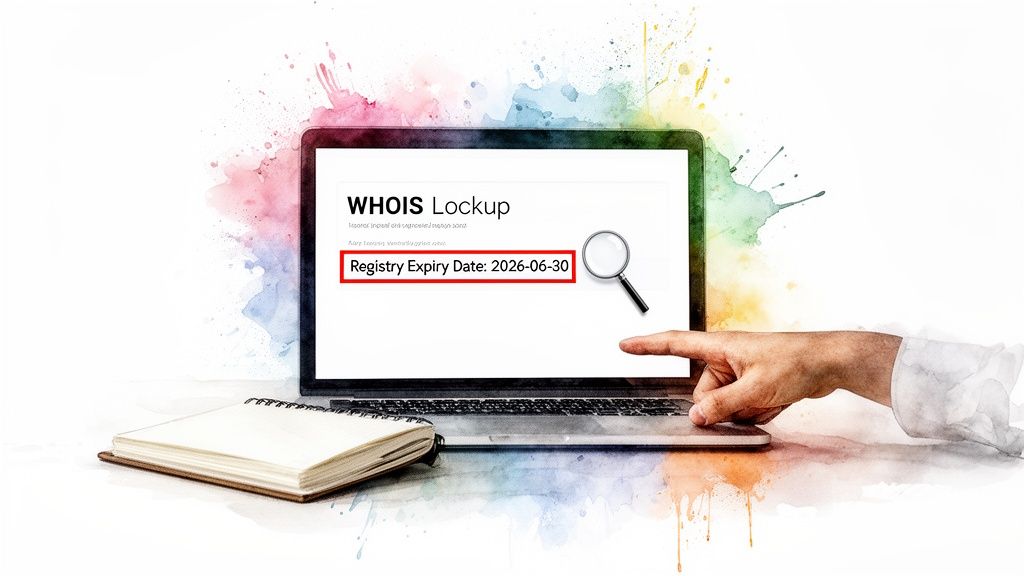
The simplest, most direct way to find an expiration date is a WHOIS lookup. Think of WHOIS as the internet's public land registry. It’s a massive database holding the key details for every registered domain: who owns it, their contact info, and—most importantly for us—all the crucial registration dates.
Using an online WHOIS tool is a piece of cake. Just pop the domain name in, hit enter, and you'll get a flood of data back. The line you’re hunting for is the "Registry Expiry Date." This is the official end-of-the-line date recorded by the central registry. It’s the moment the clock starts ticking on that grace period we talked about earlier.
Checking Your Own Domains the Smart Way
If you’re just checking a domain you already own, it’s even easier. Just log into your registrar’s dashboard—wherever you bought the domain—and the expiration date will be sitting right there, plain as day.
And while you're in there, do yourself a massive favor: find the setting for auto-renewal and turn it on. This is your single best defense against accidentally losing a valuable domain. All it takes is an expired credit card or a missed email to cause a catastrophe, but auto-renewal is your safety net. For a deeper dive, there's a great domain expiration date checker guide that walks through these methods step-by-step.
The Problem with Manual Checks for Domain Hunters
Now, if you're a domain hunter on the prowl for your next big asset, manually running WHOIS lookups one by one is a recipe for a migraine. It’s slow, tedious, and only gives you a sliver of the full picture. The date tells you when a domain might become available, but it tells you nothing about why you should even care.
Is this domain actually valuable? Does it have a killer backlink profile? Or is it a spam-ridden mess? A WHOIS record won't tell you any of that.
This is where the manual approach completely falls apart. To make smart moves, you need more than just a date; you need data. You need to know its SEO authority, its history, and its potential. Trying to check these metrics across a dozen different tools for every single domain is a monumental waste of your most valuable resource: time.
Automating Your Search for Gold
This is exactly why platforms like NameSnag exist. Instead of spending hours digging through digital dirt, we automate the whole frustrating process. We don't just find the expiration dates; we pair that info with the crucial SEO and brandability metrics you need to spot a true gem from a mile away.
Forget checking domains one at a time. You can instantly filter curated lists of high-potential names based on where they are in the lifecycle.
- Looking for domains that just dropped and are ready to be registered right now? Head straight to our list of Available domains.
- Want to get a jump on the competition? The Expiring domains filter shows you what's currently in the grace period, giving you plenty of time to plan your move.
This transforms a soul-crushing task into an efficient, strategic hunt. It saves you countless hours and surfaces opportunities you would have otherwise completely missed.
Your Playbook for Expired Domains
Right, you've done the detective work and pinpointed a domain with some serious potential. Now what? This is where the real fun starts.
Knowing the lifecycle is one thing; knowing how to play the game is another. Your strategy completely changes depending on whether you're trying to save your own domain or snag someone else's.
If it's your domain on the line, the playbook is short and sweet: log into your registrar, smash that renew button, and for the love of all things digital, turn on auto-renewal. Seriously. That one checkbox is your best defense against losing a valuable asset over something as silly as an expired credit card.
But if you're hunting a domain someone else let slip through their fingers? Your tactics get a lot more interesting. The right move depends entirely on where that domain is in its expiration journey. Let's break down the three core plays.
The Backorder Gambit
Think of a backorder as calling "dibs" on a domain. You're placing a reservation with a specialized service, telling them to catch that domain the very instant it's deleted and becomes available again. This is your go-to move for a high-value domain that's still in its grace or redemption period.
You can't register it just yet, but you know the drop is coming.
- How it Works: Multiple people can place a backorder on the same domain. If you’re the only one in line, the service snags it for you. You pay the backorder fee plus the normal registration cost, and it's all yours.
- The Catch: If a few people backorder the same name through the same service, it usually heads to a private auction just for those bidders. Highest bidder takes it home.
Backordering is a strategic waiting game. It takes patience, but it's often the smartest way to secure competitive domains before they hit the open market where the whole world is watching. For a deeper dive into auction strategies, our guide on how to buy expired domains gets into the nitty-gritty.
The Expiration Auction Showdown
Sometimes, registrars spot a valuable expiring domain and decide it's too good to just let go. Instead of letting it "drop" back into the wild, they intercept it and put it up for auction themselves. These are typically names with real traffic, a strong backlink profile, or juicy, desirable keywords.
This isn't a backorder; it's a full-blown public auction, often hosted by services that partner directly with the registrars.
Key Takeaway: Expiration auctions are where the heavy hitters play. These are domains the registrars know are valuable, so they create a competitive bidding environment to get top dollar. Expect higher prices, but also potentially much higher quality assets.
Jumping into one of these auctions means you're bidding against other savvy investors who've also seen the domain's potential. It’s less about being the fastest and more about your strategy and your wallet. You need to do your homework, set a maximum bid you can live with, and be ready for a fight.
The Manual Hand-Registration Snag
The third play is the most direct but also demands the sharpest timing: manually registering a domain the second it becomes available. This is often called "hand-registering" or "hand-catching." If a domain isn't popular enough to trigger a backorder war or a registrar auction, it will simply be deleted and return to the public pool of available names.
This is where speed and the right tools make all the difference.
Trying to manually refresh a registrar's search page is a fool's errand. By the time your browser shows it's available, some investor's bot has already snatched it. This is precisely why you need a dedicated tool for this strategy. The goal is to find names that just finished the entire lifecycle and are now free for anyone to claim at the standard registration price.
Here's how to do it without losing your mind:
- Filter for a "Just Dropped" Status: Don't guess. Use a platform that tells you exactly what’s available right now. For example, on NameSnag, you would use the Available domains filter. This cuts through all the noise, showing you only the names that have cleared the
pendingDeletephase and are ready for immediate registration at any registrar. - Act Instantly: When you find a gem on this list, there's no time for a coffee break. These domains are strictly first-come, first-served. Have your registrar account open, logged in, and ready to pounce.
- Watch the "Expiring" List for Future Drops: To get a head start, you can monitor domains that are still in their grace period. By using the Expiring domains list, you can scout your targets early and decide whether to set up a backorder or get ready for a hand-registration attempt in the coming weeks.
This three-pronged approach—backordering, auctioning, and hand-registering—gives you a complete playbook for acquiring just about any expired domain, no matter its status. The trick is simply matching your tactic to the domain's value and its current stage in the lifecycle.
Why Letting a Domain Expire Can Wreck Your SEO
Letting a domain expire might seem like a minor clerical error, especially if it's one with a bit of history. In reality, it’s a digital catastrophe waiting to happen. You can erase years of hard work in the blink of an eye. The consequences go way beyond a simple "site not found" error—they strike at the very foundation of your online presence.
The most immediate and brutal impact is on your SEO. Just think about all the time, effort, and money you poured into climbing the search engine rankings. When your domain expires and the site goes dark, all of that vanishes overnight.
The SEO Cliff Dive
Your website’s authority is the cornerstone of its ranking power. This is something you build slowly, painstakingly, over years with quality content and, most importantly, backlinks from other reputable sites. When your domain drops, that whole intricate web of trust just shatters.
Here’s a quick rundown of what you lose instantly:
- Domain Authority (DA): This metric is a solid predictor of your site's ranking potential. Letting a domain expire resets your DA to zero. You’re right back at the starting line.
- Backlinks: Every single link you've earned from other websites becomes a broken link, pointing to a dead end. This doesn't just tank your own authority; it also hurts the sites that were linking to you.
- Search Rankings: All your hard-won positions on Google's results pages will simply disappear. The pages Google once trusted are gone, and it will boot them from its index without a second thought.
Understanding how to benchmark domain authority is crucial here, because an expired domain wipes the slate clean. It’s like demolishing a building and expecting the foundation to just magically remain for the next one. It doesn’t work that way.
Your Brand Becomes a Sitting Duck
Beyond the SEO carnage, an expired domain creates a massive brand and security vulnerability. You no longer control your digital address, and that’s a terrifying thought. Someone else can swoop in and register it the second it becomes available.
What could they do with it? The possibilities are all bad for you.
A competitor could snatch up your old domain and redirect all your hard-earned traffic to their own website. Every visitor who bookmarked your site or clicked an old link would land right in the hands of your rival.
This isn't just about losing traffic; it's about the active sabotage of your brand. The new owner could tarnish your name by posting low-quality content, spam, or even offensive or illegal material. They could also use the domain's old email addresses to impersonate your company, sending phishing scams to your former customers and partners. Protecting your digital identity is a huge part of maintaining a strong domain name reputation.
The Domain Resurrection Nightmare
This threat is so real it even has a name: domain resurrection attacks. Bad actors specifically hunt for expired domains that were once used for legitimate purposes, like managing software packages.
They register the expired domain, set up an email server, and then start hitting "forgot password" on accounts tied to that domain all over the web. This can lead to full-on account takeovers. It’s a sneaky but effective attack that preys on a simple oversight. To give you an idea of the scale, since early June 2025, the Python Package Index (PyPI) has unverified over 1,800 email addresses tied to expired domains just to fight this very threat.
The lesson is painfully clear. Letting a domain expire isn't just a mistake; it's an open invitation for competitors and criminals to exploit your brand's legacy. Constant vigilance and simple tools like auto-renewal aren't just "best practices"—they're non-negotiable for any serious business.
Domain Expiration FAQs
We've walked through the whole journey, from a domain's last breath to its final drop into the public pool. Still, you probably have a few specific questions buzzing around. Let's get those sorted so you can walk away with total clarity.
Can I Get My Domain Back After It Expires?
You absolutely can, but your options get worse—and more expensive—the longer you wait. It’s a race against the clock.
For the first 0 to 45 days after expiration, you're in what's called the Registrar Grace Period. This is your golden hour. Renewal is usually just a few clicks away at the standard price. It's cheap, easy, and designed to save you from a simple oversight.
Miss that window? You fall into the Redemption Period for the next 30 days. Rescuing the domain is still possible, but it now comes with a steep redemption fee, often topping $100. After that, it’s game over. The domain enters the Pending Deletion phase, and for you, the original owner, your only shot is to compete with everyone else to re-register it the second it becomes available.
What Is the Difference Between a Registrar and a Registry?
This one trips people up all the time, but it’s pretty simple once you hear the right analogy.
Think of the Registry (like Verisign, which manages every single .com domain) as the central Department of Motor Vehicles. They issue the official titles for every car and keep the master database of who owns what.
The Registrar (like GoDaddy or Namecheap) is the local dealership where you go to buy or lease your car. You handle all your payments, renewals, and service requests with the dealership.
When your domain expires, you work with your registrar to fix it. But all they're really doing is sending a message back to the DMV—the registry—to update the official record and get your title back in good standing. You deal with the dealership, but the DMV has the final say.
How Do I Find Good Expired Domains for SEO?
Searching for valuable expired domains by hand is like panning for gold with a spaghetti strainer—it's painfully slow, and you're guaranteed to miss the good stuff. The real pros use specialized platforms that do all the heavy lifting.
Instead of just getting a massive, useless list of domain names, a tool like NameSnag sifts through thousands of domains dropping every single day, enriching them with the SEO metrics that actually matter.
The goal isn't just to find any available domain; it's to find one with a clean history, powerful backlinks, and existing authority that can give your project an instant head start. A high Domain Authority score from a dropped domain can save you months, or even years, of grinding away at link-building.
With the right tool, you can instantly filter for domains that already have a strong backlink profile and keywords relevant to your niche. It turns a wild guessing game into a precise, data-driven hunt for digital gold.
Is the Expiration Process the Same for All TLDs?
Not at all, and this is a critical detail to burn into your memory. The lifecycle we've been talking about—Grace Period, Redemption, Pending Deletion—is the standard for most generic Top-Level Domains (gTLDs) like .com, .org, and .net.
But the rulebook can get thrown out the window for Country Code Top-Level Domains (ccTLDs). For instance, a domain ending in .co.uk or .de might have a much shorter grace period, or even skip the redemption phase entirely. In some cases, these domains become available for anyone to register almost immediately after the expiration date passes.
The key takeaway is to never assume. If you're targeting a domain with a less common extension, always take two minutes to look up that specific TLD's expiration policies. It’s a simple check that can save you from a nasty surprise.
Ready to stop guessing and start finding high-value domains? NameSnag gives you the data and tools to discover powerful expired domains before anyone else. Find freshly Available domains you can register today or scout for assets that are dropping soon with our Expiring domains list.
Find Your Perfect Domain
Get access to thousands of high-value expired domains with our AI-powered search.
Start Free Trial