Ever thought about investing? Your mind probably jumps to stocks, bonds, or maybe even a fixer-upper house. But what if I told you there's another class of property out there, one that's entirely digital and quietly booming? Welcome to the wild world of domain names.
Buying and selling domains for profit isn't some niche tech hobby anymore; it's a legit investment strategy. We're talking about treating web addresses like digital real estate—spotting undervalued properties, snapping them up, and then flipping them to businesses who need a prime spot online. A simple string of text becomes a powerful, tradable asset.
Welcome to the World of Digital Real Estate
Every new business, app, or wild idea needs a home on the internet, and that home starts with a domain name. This never-ending demand fuels a massive secondary market where the right name can fetch thousands, or even millions, of dollars.
Think of this guide as your treasure map for navigating this world. We'll get into the practical, actionable strategies for finding, evaluating, and profiting from your investments. Let's dig in!
Why Now Is the Perfect Time
Seriously, there's never been a better time to jump in. The explosion of new top-level domains (TLDs) like .io, .ai, and .app has opened up a whole new frontier of opportunity right alongside the classic .com.
But the real goldmine for savvy investors? The market for expired domains—names that were previously owned, often with a history and some SEO authority already baked in. Snagging one of these can save a new owner years of grinding away at building online credibility from scratch.
The domain name market isn't just growing; it's becoming a core part of modern business strategy. It functions as the primary signaling mechanism for a company's technological readiness and innovation credibility.
We're seeing a fundamental shift that has cemented domain investing as a recognized asset class. The broader domain market is already valued at around $15 billion and is on a steep growth curve. To give you an idea of how fast things move, demand for AI-related domains alone shot up an incredible 400% in just the last three years. The market is incredibly responsive to what's hot in tech.
Before you start hunting for these hidden gems, you need a solid foundation. You wouldn't buy a house without understanding what a deed is, right? The same logic applies here. Getting a clear handle on understanding domain name registration will set you up for success and help you navigate the acquisition process smoothly.
Let's quickly break down why this is such a compelling space for investors.
Domain Investing at a Glance: Why It's a Savvy Move
Here’s a quick snapshot of the core benefits and what makes this market tick.
| Benefit | Why It Matters for Investors | Example Scenario |
|---|---|---|
| High Demand | Every new business or project needs a web address. This creates a perpetual market for good domains. | A new AI startup needs a catchy, brandable .ai domain. You acquired a great one last year and can sell it for a significant markup. |
| Asset Appreciation | Like real estate, the value of premium domains can increase significantly over time. | You bought a short, generic .com for $200 five years ago. Today, its market value is closer to $10,000. |
| Low Barrier to Entry | You can start with a relatively small investment compared to traditional assets. | You can start acquiring promising expired domains for under $100, building a portfolio without needing huge capital. |
| Portfolio Diversification | Domains are a non-traditional asset class, helping to diversify your overall investment portfolio. | While the stock market is volatile, your portfolio of high-quality digital assets holds its value or even increases. |
Simply put, domain investing offers a unique blend of high-growth potential and accessibility. The key is knowing what to look for and how to act on it. Now, let's get into the nitty-gritty.
Finding Hidden Gems in Expired Domains
Alright, let's get to the fun part—the actual treasure hunt. While you can always register a brand-new domain, the real opportunities often come from names that others have let go. This is where you find the digital real estate that comes with a history, built-in authority, and a massive head start.
Think of it this way: you could buy an empty plot of land, or you could find one that already has foundations, plumbing, and road access. Expired domains are that second option. They often come with existing backlinks, search engine trust, and an established age—all incredibly valuable assets right out of the gate.
This is the process that turns the abstract idea of a domain into a tangible digital asset with real value.
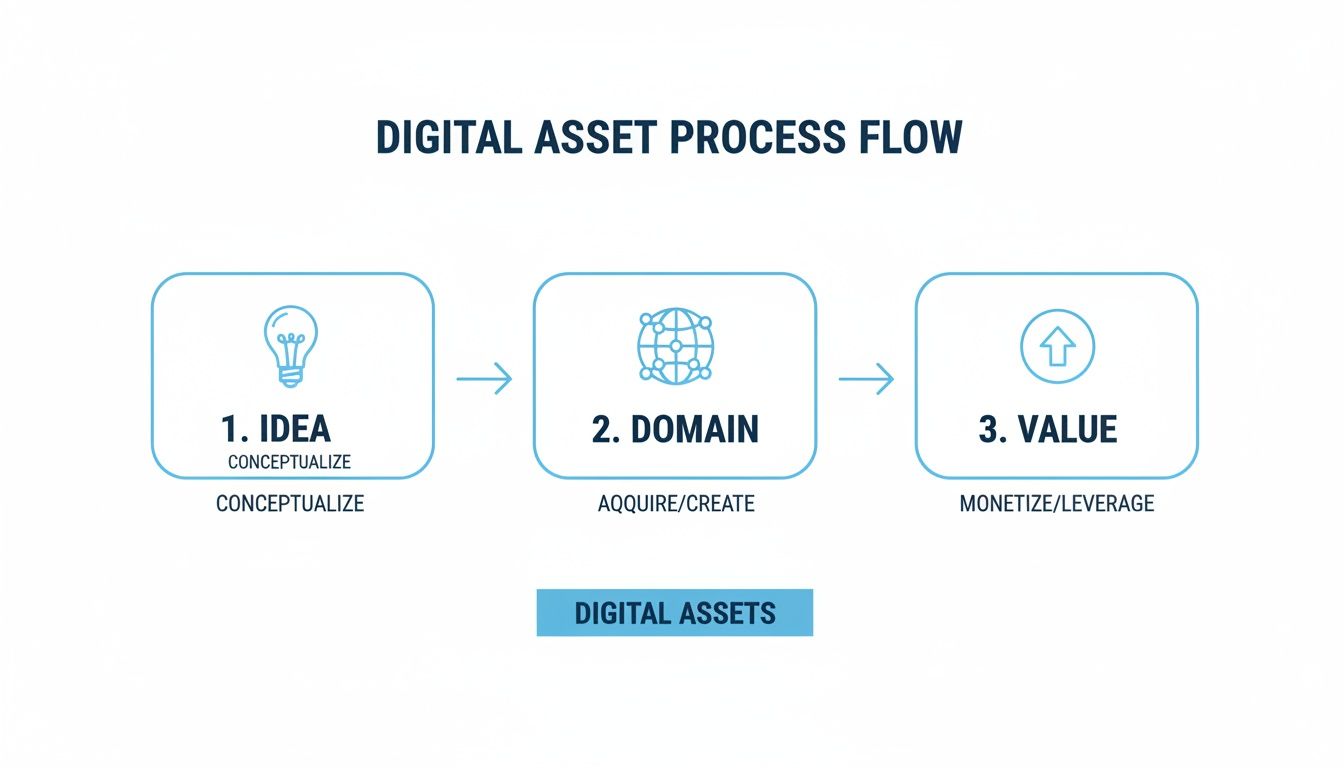
This simple flow—from concept to acquisition to appreciation—is the core of any solid domain investment strategy. The real trick, though, is knowing where to look for these opportunities before everyone else piles in.
The Race for Available Domains
The first goldmine is the world of Available domains. These are the names that have gone through the entire expiration lifecycle, including any grace periods and auctions, and have been "dropped" back into the public registration pool. Anyone can register them immediately for the standard fee, typically just $10-$20.
The catch? It’s a pure race to the finish line. High-quality dropped domains are often snatched up within seconds of becoming available. Trying to do this manually is like trying to catch lightning in a bottle. You'll lose every time.
This is where a tool like NameSnag becomes your secret weapon. Instead of frantically refreshing your browser all day, you get a clean, filterable list of opportunities. Imagine searching for all Available domains that just dropped Today containing the keyword "solar" and having at least one backlink from a .edu site. That’s the kind of precision that wins the race.
Getting a Head Start on Expiring Domains
The second, and frankly more strategic, goldmine is Expiring domains. These are domains whose owners failed to renew them, but they haven't been fully dropped yet. They're stuck in a grace or redemption period, which means they are about to become available—often by heading to a public auction.
This is your chance to get a massive head start. By monitoring these upcoming drops, you can analyze their potential and get your acquisition strategy ready before the domain even hits the open market. You’re no longer just reacting; you’re proactively hunting down top-tier assets.
By focusing on expiring domains, you shift from a reactive "race" to a proactive "watch." This gives you precious time to perform due diligence, evaluate SEO metrics, and decide what a domain is truly worth before the bidding frenzy begins.
Platforms built for this let you set up sophisticated "watchers." For instance, with NameSnag's list of Expiring domains, you can filter for domains that will be dropping within the next 7 Days or 30 Days. This gives you a clear runway to plan your move.
Here's how you can fine-tune your search for these gems:
- Keyword Alerts: Get notified the moment domains containing specific business keywords like "crypto," "health," or "marketing" pop up.
- Backlink Filters: Target domains with powerful and hard-to-get backlinks from .gov or .edu websites. These carry immense SEO weight.
- Metric Thresholds: Filter out all the noise by only looking at domains that meet your minimum criteria for Domain Authority, age, or traffic.
This targeted approach takes the guesswork out of the equation. You’re not just sifting through an endless list of junk; you're building an automated system that surfaces high-potential investments directly to you. For a deeper dive into the mechanics, check out our guide on how to find expired domains with built-in authority. This is how you stay one step ahead, ready to acquire domains that already have proven value.
How to Value a Domain Like a Pro
So, you’ve found a domain that looks like a winner. The name is catchy, it feels right, and your gut is telling you to go for it. That's a great start, but in this business, gut feelings don't pay the bills—data does. This is where we stop being treasure hunters and start acting like professional appraisers.
Figuring out what a domain is really worth is a mix of art and science. The "art" part is its brandability and how much the market wants it. The "science" is all about the cold, hard metrics. A truly great investment has to nail both.
Key SEO Signals to Analyze
Before you even dream of hitting that "buy" button, you have to look under the hood. A domain's past life writes the story of its future value, and that history is all in its SEO profile. These are the absolute non-negotiables you need to check.
Domain Authority (DA): This is a score from Moz that gives you a solid idea of how well a site might rank. While it's not a direct Google ranking factor, it's a fantastic way to compare domains. A domain with a DA of 30+ is in a completely different league than one with a DA of 5.
Backlink Profile: Who’s linking to this domain? A few links from heavy hitters like universities (.edu) or government sites (.gov) are worth infinitely more than thousands of links from spammy directories. Quality crushes quantity every single time.
Domain Age: An older domain with a continuous, clean history is generally seen as more trustworthy in Google's eyes. It has a track record, and that history can give you a massive head start.
Getting a handle on these metrics is what separates the pros from the amateurs. For a deeper look, understanding what is domain authority in SEO and how to boost it is a perfect place to start. This knowledge helps you see not just what a domain is worth now, but what it could be worth.
The Power of Composite Scores
Checking these metrics one by one across a bunch of different tools is a massive time-sink. It’s tedious and inefficient, which is why composite scores are so incredibly useful. They boil down all that complex data into a single, straightforward number.
Take NameSnag's SnagScore, for example. It rolls metrics like Domain Authority, Trust Flow, backlink quality, and domain age into one clean score. This lets you see at a glance if a domain is worth investigating further, saving you hours of manual digging.
A high composite score is your first-pass filter. It instantly separates the high-potential assets from the digital junk, letting you focus your energy on domains that actually stand a chance of delivering a return.
Think of it as a credit score for domains. A higher number signals a healthier, more valuable asset right off the bat.
Understanding Market Dynamics and Trends
Valuation isn't just about SEO metrics; you also have to understand what the market wants. The domain world is always shifting. While global registrations recently hit a staggering 364.3 million, there's a key trend hidden in that number.
For the first time in years, registrations for legacy TLDs like .com and .net actually declined by 2.1% year-over-year. This points to market saturation—the good, short, pronounceable names are taken and expensive. In response, newer TLDs are exploding, growing by around 13.5%. Knowing these shifts can help you find gold in less crowded markets.
Pulling all of this together gives you a solid framework for sizing up any domain. For a complete playbook, check out our in-depth article on how to value domain names effectively: https://namesnag.com/blog/how-to-value-domain-names. It’ll give you the tools and mindset to spot a bargain and avoid overpaying for a dud.
Performing Due Diligence to Avoid Bad Buys
You’ve found it. The one. It has a killer name, a solid SnagScore, and a backlink profile that makes your heart flutter. It’s so easy to get swept up in the moment and slam that "buy now" button.
But hold on a second.
Some of the most promising domains are like beautiful houses with termites in the walls—they look incredible on the surface but are hiding an absolute disaster. A high-authority domain is completely worthless if it comes with a hidden Google penalty or a toxic, spam-filled past.
Doing your homework isn't just a "nice-to-have" step; it's the insurance policy that protects your investment from turning into a massive headache. This is where you put on your detective hat and make sure you're buying a clean asset, not just inheriting someone else's problems.
Peeking into the Past with the Wayback Machine
Your first and most important stop is the Wayback Machine (Archive.org). Think of it as a digital time machine for websites. It lets you see snapshots of what a domain looked like in its previous life. Was it a legitimate business blog, a personal hobby site, or something… less reputable?
Just pop the domain name in and start clicking through its history. You’re looking for consistency and legitimacy. If a domain was a respected gardening blog for five years and then suddenly became a spammy casino site for its last six months, that’s a massive red flag.
A domain's history tells a story. Your job is to read between the lines to ensure it's a story you want to be a part of. A clean, consistent history is one of the strongest indicators of a safe investment.
I know, this process can be a grind, but skipping it is one of the biggest mistakes new investors make. Manually checking dozens of domains a day is soul-crushing, which is why many serious investors look into due diligence automation to speed up the process without cutting corners.
Analyzing the Anchor Text Trail
Next up, you need to dig into the domain's historical anchor text. This is the clickable text in a hyperlink, and it tells search engines what the page being linked to is all about. A healthy anchor text profile looks natural and varied, with a good mix of branded terms, naked URLs, and relevant keywords.
What you're hunting for are the obvious signs of spammy or manipulative tactics.
If a huge percentage of a domain's backlinks use exact-match anchor text like "best payday loans online" or weird foreign-language keywords, you should run for the hills. This is a classic sign that the domain was part of a private blog network (PBN) or used aggressive, black-hat SEO tactics that Google almost certainly penalized.
Your Pre-Purchase Domain Checklist
Think of this as your final inspection before you pull the trigger. Running through this quick checklist can save you from a world of hurt and make sure your plan to invest in domains starts on solid ground.
| Check | What to Look For | Red Flag Example |
|---|---|---|
| Google Index Status | Do a site:domain.com search on Google. Does it show up? |
The domain has a high DA but zero pages are indexed in Google. This strongly suggests a manual penalty. |
| Backlink Velocity | Check its backlink history. Was there a sudden, unnatural spike in new links? | The domain gained 20,000 new links in one month after years of slow growth. This points to spam tactics. |
| Historical Content | Use the Wayback Machine. Was the content relevant and high-quality? | The site was once about pet care but was later replaced with auto-generated, nonsensical articles. |
| Previous Ownership | Check WHOIS history. Did the domain change hands frequently in a short period? | The domain was registered by five different owners in the last two years. This can indicate a "churn and burn" asset. |
This isn't just about checking stats; it's about understanding a domain's complete story. This due diligence process is what separates a calculated investment from a blind gamble, protecting your capital and ensuring you acquire an asset you can build on with total confidence.
Turning Your Domains into Profit
You’ve done the hard work. You sifted through thousands of potential domains, ran your checks, and snapped up a digital asset with real potential. Now for the fun part: turning that smart investment into actual cash.
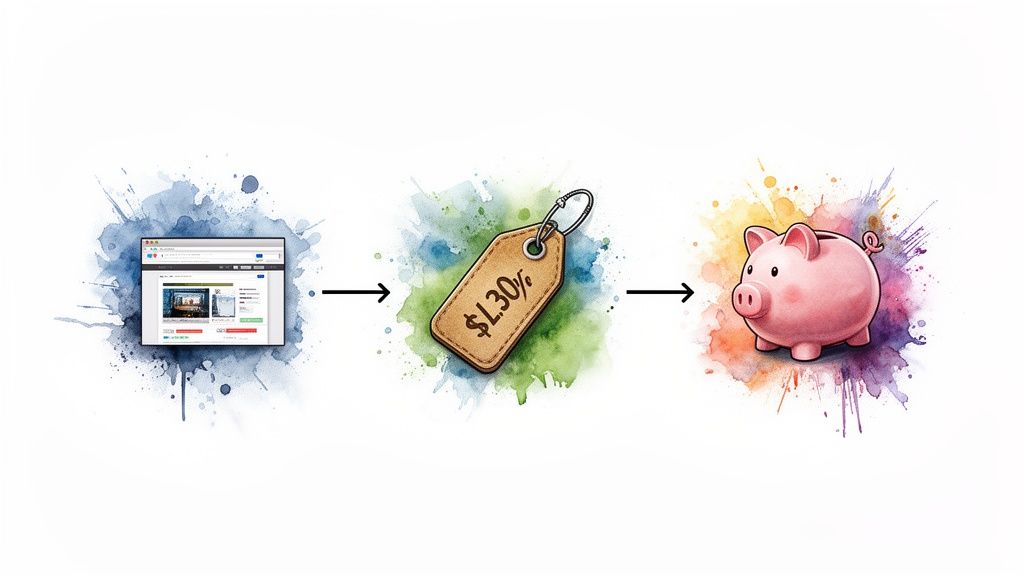
Grabbing a great domain is just the starting line. The real art is figuring out the best way to make it pay. There's no single "right" answer here; the best strategy boils down to the domain's unique traits and what you're trying to accomplish. Let's walk through the three main roads to profitability.
The Quick Flip: Reselling for a Fast Return
This is the most straightforward path to making money when you invest in domains. The game is simple: buy an undervalued domain and sell it for more on a marketplace like Sedo, Afternic, or Dan.com. The whole point is a quick turnaround, often within a few weeks or months.
This approach works best for domains with immediate, obvious commercial appeal.
- Brandable Domains: Think short, catchy, and often trendy names like
PixelFlow.aiorEcoSustain.io. Startups and new brands are constantly on the hunt for these and will pay a premium for a name that nails their vision. - Keyword-Rich Domains: These are names packed with high-value commercial keywords, like
AustinRoofingPros.com. Local businesses love these because they offer a potential leg up in search rankings. - Trending Niches: Got a domain tied to a hot industry like AI, Web3, or sustainable tech? Catching a trend early can lead to a seriously fast and profitable flip.
When you're pricing for a flip, do your homework. See what similar domains have sold for, factor in your domain's metrics, and don't be afraid to set a price that's ambitious but still grounded in reality. The big win here is the potential for rapid profit, but the trade-off is that you need a constant stream of new domains to keep the engine running.
Building a Niche Authority Site
Now, if your domain has a solid SEO history—decent Domain Authority, quality backlinks, and some age—flipping it might be leaving a ton of money on the table. A much more lucrative long-term play is to build a small niche website right on it. This move leverages the domain's existing authority to start ranking in Google way faster than you could from scratch.
Imagine you snagged an old domain about organic gardening with a DA of 25 and a few links from university agriculture departments. Instead of flipping it for a couple hundred bucks, you could:
- Throw up a simple WordPress site.
- Publish 10-15 high-quality articles on organic gardening topics.
- Monetize that content with affiliate links to gardening tools on Amazon or other programs.
By building a site, you transform the domain from a static asset into a cash-flowing machine. The expired domain's built-in SEO power acts as a launchpad, helping your new content rank and generate passive income much, much faster.
This strategy definitely takes more upfront work than a simple flip. But the potential rewards? They're in a completely different league. You're not just selling a name; you're building a sustainable business asset.
The Strategic 301 Redirect
What if you already have a website or business? In that case, a newly acquired domain with a killer backlink profile can act like an SEO supercharger. The magic happens with a 301 redirect, which permanently points the old domain to your main site.
A 301 redirect essentially tells search engines, "Hey, this domain has permanently moved over here," and in doing so, it passes most of its "link equity" or "SEO juice" to your site.
This is an incredibly powerful tactic if you find an expired domain that's directly relevant to your existing business. For instance, if you run a digital marketing agency, acquiring a defunct marketing blog with strong backlinks and redirecting it to your agency's site could give your own search rankings a very real, tangible boost.
Ultimately, a premium domain commands respect. Market data shows 46% of businesses feel a premium domain boosts their credibility, and that trust directly inflates a domain's value. The entire web domain sales industry in the U.S. was projected to hit $10.1 billion in 2026, which is a massive testament to this dynamic. You can dig into more insights about the domain sales market from IBISWorld. This just reinforces why a good domain is such a potent asset—whether you flip it, build on it, or redirect it for a power-up.
A Few Common Questions About Domain Investing
Jumping into any new field can feel like learning a new language. You start hearing all these new terms, seeing different strategies play out, and a million questions start bubbling to the surface. That’s perfectly normal.
So, let's clear the air. I’ve put together a quick rundown of the most common questions newcomers have when they first dip their toes into domain investing. Think of this as your crash course for getting your bearings.
How Much Money Do I Need to Start?
Here’s one of the best things about domain investing: you don't need a huge pile of cash to get in the game. The barrier to entry is surprisingly low compared to, say, real estate or the stock market.
You can often find promising Available expired domains and register them yourself for the standard fee, which is usually just $10-$20. For the more competitive Expiring domains heading to auction, prices can start under $100 but can run into the thousands for truly premium names.
A fantastic starting budget is a few hundred dollars. This gives you enough runway to acquire several hand-registered domains and maybe even throw a bid or two at an auction just to learn the ropes. The key is to start small, get your valuation process dialed in, and then reinvest your profits as you grow.
What Is the Difference Between Available and Expiring Domains?
This one pops up all the time, and it really just boils down to timing and how you get your hands on the domain.
Available Domains: These have gone through the entire expiration cycle and have been "dropped" by the registrars. Anyone can register them immediately for the standard price. It’s a flat-out race to grab them first. A platform like NameSnag lets you see a list of Available domains that dropped Today so you can act fast.
Expiring Domains: These have expired, but they're still in a grace period where the original owner can technically renew them. Eventually, they’ll drop and become available, but often they’ll go to a public auction first. Watching the Expiring domains list gives you a valuable heads-up on quality assets before they hit the chaos of the open market.
Think of "Expiring" as your early-access pass, giving you time to do your homework before the doors fly open. "Available" is when the starting gun fires and speed is everything.
Should I Invest in Brandable or SEO-Focused Domains?
This really comes down to your personal strategy and what kind of investor you want to be. There’s no single right answer here, just different paths to turning a profit.
Brandable domains are short, catchy, memorable, and often tap into current trends (think names like 'AIFlow' or 'Web3Creative'). Their value is almost entirely in their marketability, making them perfect for flipping to startups desperate for a killer name.
On the other hand, SEO-focused domains have existing authority—a history, a strong backlink profile, maybe a high Domain Authority score. Their value is purely in their SEO juice, making them gold for building out niche affiliate sites or for 301 redirects to give an existing project a boost.
The holy grail, of course, is a hybrid: a brandable name with a clean, powerful SEO history. But as a beginner, it's often much easier to evaluate SEO domains because you can lean on hard metrics to make your decision instead of trying to guess market trends.
How Long Does It Take to Flip a Domain for Profit?
The timeline for flipping a domain can vary wildly, and frankly, anyone who gives you a hard-and-fast number is just guessing. This isn't like day-trading a stock.
Some investors get lucky and manage to flip a domain in a matter of days, especially if they catch a trending keyword at the perfect moment. Others might hold onto a domain for months or even years, waiting for the right buyer to come along with the right offer. This long-term approach is often called "domain parking."
A great strategy when you're starting out is to aim for quick flips on lower-value domains. This helps you build not just your capital, but more importantly, your confidence. As you get more experience under your belt, you can start building a more diverse portfolio—some domains you hold for long-term appreciation and those bigger payouts, and others you flip quickly to keep the cash flowing.
Ready to stop guessing and start finding high-value domains? NameSnag uses AI-powered analysis to surface the best expired and expiring domains daily, saving you hours of manual work. Start your search and find your first digital asset today!
Find Your Perfect Domain
Get access to thousands of high-value expired domains with our AI-powered search.
Start Free Trial