Think of one word domain names as the digital equivalent of prime real estate. They're like owning a landmark property in the center of a bustling city—scarce, prestigious, and impossible to forget. We're talking about a single, common word followed by a TLD like .com, such as 'cars.com' or 'voice.com'. This elegant simplicity makes them the ultimate prize for brands and investors, and we're going to show you how to hunt them down.
Why One Word Domains Are Digital Gold
Ever wonder why a domain like voice.com sold for a staggering $30 million? It's simple. Owning a one word domain is like owning the central square in a digital city. It’s not just an address; it's a landmark that radiates immediate authority and credibility.
There's a real psychological advantage at play here. When someone sees a brand on a single-word .com, they instantly assume it's a market leader. This isn't just a hunch; one-word .com domains are the absolute pinnacle of digital real estate, and every single one was snapped up ages ago.
This scarcity creates incredible value. Expired dictionary words can easily sell for over $100,000, while premium names hit astronomical figures. A big reason for this is the 2x higher trust factor they carry with users.
The Unbeatable Branding Advantage
The power of a single-word domain goes way beyond its price tag. It’s a marketing supercharger. Because they're so short, they are incredibly easy to remember, type, and share—a massive leg up in a world of shrinking attention spans.
This memorability translates directly into better marketing ROI and stronger brand recall. Instead of a clunky, multi-word URL, you get a name that is concise, powerful, and often defines the entire category.
A one word domain doesn’t just describe what you do; it declares that you are the definitive source for it. It's an instant claim to leadership in your niche.
Why One Word Domains Are The Ultimate Digital Asset
So, what makes these domains such a prized possession? It really boils down to a handful of core benefits that make single-word domains an unmatched branding and marketing tool.
| Attribute | Branding & SEO Impact |
|---|---|
| Instant Authority & Trust | Signals longevity and market leadership, making customers more likely to trust your brand from the first click. |
| Marketing Efficiency | Unforgettable names reduce ad spend on brand awareness and make word-of-mouth referrals far more effective. |
| SEO & Direct Traffic | Attracts significant type-in traffic and serves as a powerful asset for search engine optimization. |
| Asset Appreciation | Like fine art or prime real estate, these are finite assets that have historically appreciated in value. |
These pillars compound over time, turning a great domain into a cornerstone of a successful business. For a deeper dive into this, check out our guide on finding cool domain names that stick.
How To Value A One Word Domain
So, you've spotted a one word domain. Fantastic! But here comes the million-dollar question (sometimes literally): what’s it actually worth?
Let's be clear, not all single-word domains are created equal. A generic word like Lamp.com has obvious value, but a high-intent, universally understood word like Connect.com is in another universe entirely.
Valuing these digital assets is both an art and a science. It’s about looking past the dictionary definition and digging into its commercial potential, memorability, and the overall vibe it gives off. Think of it like a professional art appraisal—you need to understand the context, the history, and most importantly, the market demand.
This is your valuation playbook. We'll break down the key signals that separate a solid five-figure domain from a seven-figure giant.
The .COM Supremacy
Let's get one thing straight: when it comes to top-tier valuation, .com is king. It’s the original, the most recognized, and the most trusted top-level domain (TLD) on the planet.
Sure, other TLDs like .io or .ai have carved out their own space in tech circles, but .com holds a unique authority that commands the highest prices.
Owning the .com of a powerful word is like owning the flagship store on Fifth Avenue. It carries an inherent prestige and vacuums up "type-in" traffic—those users who just guess the domain by typing the brand name directly into their browser. If you're assessing a one word domain, its value multiplies if it ends in .com.
Commercial Intent and Brandability
This is where the real analysis begins. A domain's value absolutely skyrockets if the word has strong commercial intent. You have to ask yourself: does this word relate to a product, service, or industry where people are already spending money?
- High Commercial Intent: Words like
Loans,Insurance, orTravelare directly tied to massive, cash-rich industries. These are the goldmines. - Moderate Commercial Intent: Words like
KitchenorGardenhave clear consumer applications and are still incredibly valuable. - Low Commercial Intent: Obscure, clunky, or abstract words like
QuibbleorLanguidare just plain harder to build a billion-dollar brand around. Their value reflects that.
Brandability is the other side of this coin. Is the word positive? Easy to say, spell, and recall? A name like Rise.com feels optimistic and action-oriented, making it a branding dream. A clunky or negative-sounding word, even if it's in the dictionary, will always be worth less.
The ultimate prize is a word with high commercial intent that is also short, positive, and easy to remember. This combination creates a category-defining brand waiting to happen.
Analyzing Search Volume and Domain History
Beyond the word itself, you have to investigate the domain's history and its existing SEO footprint. A name with a history of search volume is like buying a retail space with foot traffic already built-in. Tools that measure monthly search volume give you a clear indicator of organic demand. A word with 100,000 monthly searches has a massive head start over one with just a few hundred.
But a domain's history can also be a huge liability. You absolutely must check for red flags:
- Spammy Backlinks: Was the domain previously used for a spam site? A toxic backlink profile can torpedo its SEO potential from day one.
- Trademark Conflicts: Is the word a registered trademark in a relevant industry? Trying to build a computer company on
Apple.netis a legal nightmare waiting to happen. - Previous Penalties: A domain that's been penalized by Google can be nearly impossible to revive. It’s radioactive.
Proper due diligence is non-negotiable here. For a much deeper dive, you can learn more about how to value domain names in our comprehensive guide. Mastering these checks will help you avoid costly mistakes and spot true digital gold.
Strategies To Acquire Your Perfect Domain
Let’s get one thing straight: you can't just hop over to a standard registrar and register a premium one-word .com domain. They were all scooped up decades ago. So, how do you get your hands on one of these digital landmarks? Welcome to the hunt—it's a thrilling chase that involves strategy, patience, and the right set of tools.
Acquiring a one-word domain isn't about finding something new; it's about finding something that has re-entered the market. This happens in a few key ways, and understanding the difference between each channel is your first step. The three main paths are domain auctions, private brokerage, and the art of snagging recently dropped names.
Each path requires a different approach. You've got the high-stakes bidding of an auction on one end and the delicate negotiation of a private sale on the other. For many, though, the most accessible and exciting method is hunting for domains that have recently expired.
Hunting for Expired and Available Domains
Every day, thousands of domains aren't renewed by their owners. Maybe the project died, the company was acquired, or they just forgot. Whatever the reason, these domains enter a lifecycle that eventually leads to them being "dropped" and becoming available for anyone to register again. This is where the real opportunity lies.
This process creates two distinct categories you can target:
- Expiring Domains: These are domains past their renewal date but still in a grace period. The original owner might still reclaim them, but if they don't, the domain will soon be deleted. Think of these as properties heading to foreclosure—you can’t buy them yet, but you can get ready to pounce.
- Available Domains: These domains have completed the full expiration cycle and have just been released back into the wild. They are fair game and can be registered instantly. This is a race against time, as other investors are watching for the exact same opportunities.
Hunting for these names manually is nearly impossible. You'd go crazy. That's why using a dedicated platform is essential. With a tool like NameSnag, you can filter specifically to find Available domains that dropped today or hunt for valuable expiring domains scheduled to drop in the next 3, 7, or 30 days. This gives you a massive leg up on the competition.
The World of Domain Auctions
Another major acquisition channel is the domain auction. When a high-value domain expires, it often doesn’t just drop silently into the void. Instead, registrars will put it up for auction to the highest bidder. This is where you'll find some of the most competitive and commercially viable one-word domain names.
Platforms like GoDaddy Auctions or NameJet are hotspots for these events. The process is straightforward but intense: bidders place their offers, often in a frantic last-minute rush, and the highest bid wins. Success here requires a firm budget, a clear valuation of your target, and nerves of steel.
A key auction strategy is to avoid getting caught in a bidding war fueled by emotion. Know your maximum price before you start and be prepared to walk away if the cost exceeds the domain’s realistic value.
Using a Domain Broker
What if the domain you want isn't for sale? If it's owned by another person or company but isn't actively listed, a domain broker can be your secret weapon. A broker is a professional who acts as an intermediary, negotiating a private sale on your behalf.
Here’s how it usually works:
- Anonymous Outreach: The broker contacts the current owner without revealing who you are. This anonymity prevents the seller from jacking up the price based on your company's size or perceived deep pockets.
- Negotiation: They handle all the back-and-forth on pricing, leveraging their market knowledge to get a fair deal.
- Secure Transfer: Once a price is agreed upon, the broker manages the secure transfer of the domain and funds through an escrow service, so nobody gets burned.
This route is often more expensive due to broker commissions, but it’s sometimes the only way to acquire a premium domain that isn't publicly available. And once you land that perfect name, remember that effective domain management might involve learning about changing the domain name of a WordPress site, which requires careful planning. Whether you win it at auction or buy it privately, a great domain is just the beginning.
A Tactical Workflow For Snagging Expired Domains
Okay, enough theory. Let's get our hands dirty with a battle-tested workflow for finding and vetting those elusive one-word domains. Going from discovery to due diligence doesn't have to be a chaotic mess. If you have the right strategy, you can cut through the noise and zero in on the real gems.
The secret is a methodical process. You start by casting a wide net to find potential targets, then you progressively narrow the field using smart filters and quality checks. This system makes sure you're only spending your valuable time analyzing domains that actually have a shot at greatness.
Stage 1: Zeroing In On Quality Names
First things first: you can't analyze what you haven't found. The initial step is all about building a high-quality shortlist of candidates with advanced filters. Ditch the manual searching; it’s like trying to find a needle in a continent-sized haystack.
Instead, you need to think like a pro and apply layers of criteria. Start with the basics, then get more granular:
- Keyword Inclusion: This is the most direct approach for one word domain names. You can filter for domains that are specific dictionary words or contain a high-value keyword.
- Domain Age: Older domains often carry more authority and trust in the eyes of search engines. Filtering for names aged 5+ years is a great starting point to find ones with an established history.
- SEO Metrics: Look for domains that already have some authority built up. Set minimum thresholds for metrics like Domain Authority (DA), Page Authority (PA), or Trust Flow. A name with a DA of 20+ gives you a massive head start compared to one starting from scratch.
This initial filtering is all about eliminating the 99% of junk that drops every single day. By focusing only on names that meet these baseline quality standards, you're setting yourself up for a much more efficient vetting process.
Stage 2: Decoding The Metrics
Once you've got a shortlist, it's time to dig into the data. A domain might look good on the surface, but the numbers tell the real story. This is where a composite score, which blends multiple data points into a single, easy-to-understand metric, becomes your best friend.
A good score rolls crucial data points like backlink quality, brandability, and domain authority into one number. A high score is an instant signal that a domain has a strong foundation, saving you the hassle of cross-referencing multiple tools yourself. It’s a shortcut to identifying top-tier assets.
The domain acquisition process is a simple flow: you spot a name that's about to be available, and then you pounce the moment it drops.
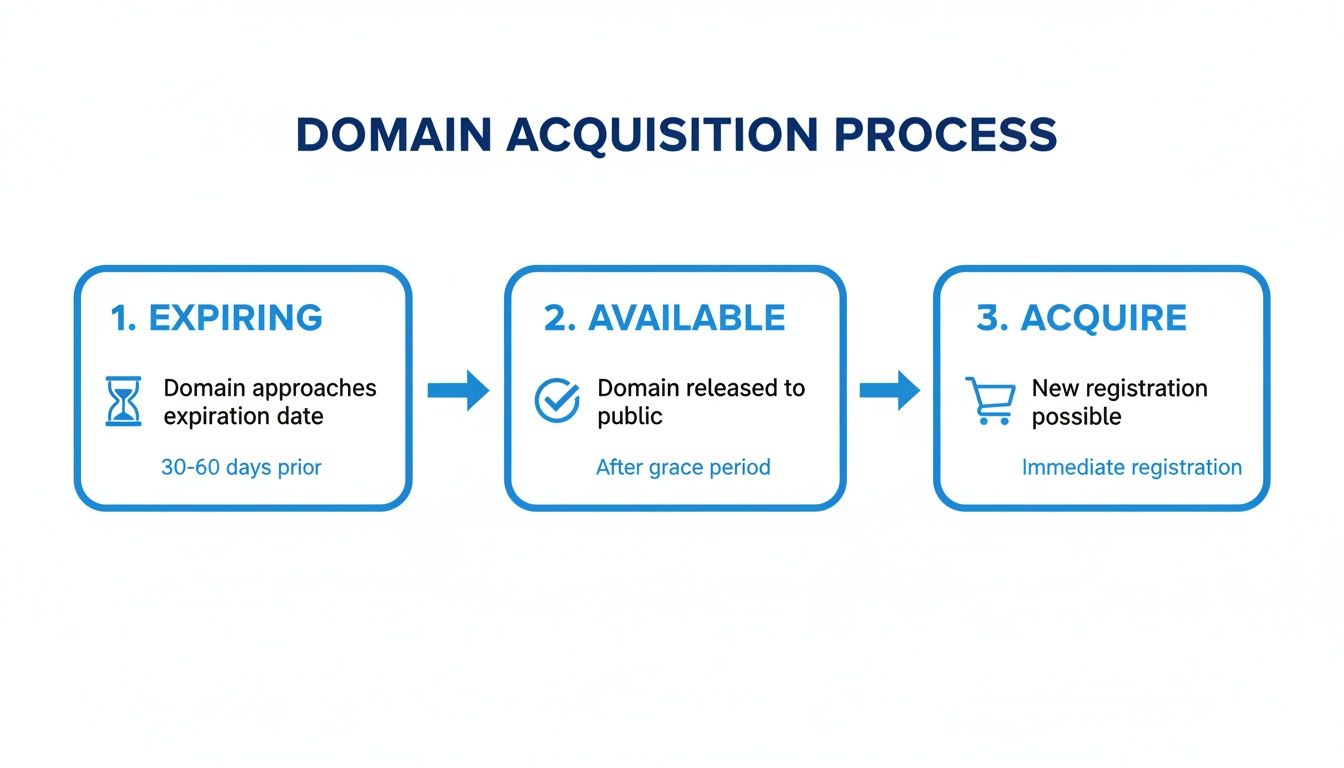
This graphic highlights the critical transition from an expiring state, where you monitor a domain, to an available state, where you can take immediate action to register it.
Stage 3: Spam Checks And Final Vetting
So, you've found a high-scoring, one-word domain with great metrics. Now comes the most critical step: the spam check. A domain’s history can be its greatest asset or its most toxic liability. You absolutely must ensure its past is clean.
A robust spam check looks for signs of previous abuse. Was it used for a link farm? Did it host sketchy content? Any history of Google penalties can make an otherwise perfect domain completely worthless. A "spam-free" verification is non-negotiable before you even think about buying. For a more detailed breakdown, our complete guide on how to find expired domains is a must-read.
Think of a spam check like a background check before hiring someone. No matter how impressive their resume looks, you need to know if there are any hidden red flags that could cause problems down the line.
Finally, you need to act fast. Premium one-word domains are in high demand, which means setting up alerts is the key to getting a first-mover advantage. By creating a "Watcher" for an expiring domain, you'll get a notification the moment it's about to drop. This lets you be ready to register it the second it becomes available, beating the competition who are still manually searching. This proactive approach is what separates the casual hunters from the serious investors.
Before you jump in, it helps to have a mental checklist. This table breaks down the key vetting steps into a quick, at-a-glance reference.
Domain Vetting Checklist At A Glance
| Check | What to Look For | Red Flag |
|---|---|---|
| Brandability | Memorable, easy to spell, and relevant to a niche. | Awkward spelling, negative connotations. |
| SEO Metrics | DA/PA of 20+, strong backlink profile from relevant sites. | Low scores, links from spammy or irrelevant sites. |
| History Check | Clean record in the Wayback Machine, no past penalties. | Used for spam, parked pages, or adult content. |
| Trademarks | No existing trademarks that could lead to legal trouble. | A direct match with an established brand name. |
| SnagScore | A high composite score indicating overall quality. | A low score, signaling potential underlying issues. |
Use this checklist as a final sanity check before committing. It helps ensure you haven't overlooked any critical details in the heat of the moment. Happy hunting!
Real-World Examples (And What They're Worth)
Right, enough with the theory. Frameworks and valuation models are great for building a foundation, but nothing sharpens your instincts like seeing real-world examples in the wild. Let's get out of the abstract and look at some one word domains that have actually turned heads and opened wallets.
Breaking them down into a few key categories helps you start to see the patterns. You'll begin to understand what separates a good name from a legendary one. This is how you connect the dots and develop that gut feeling for spotting a diamond in the rough.
Classic Dictionary Powerhouses
These are the titans of the domain world. We're talking about simple, universally understood dictionary words that basically own an entire industry. Their value comes from their raw authority and the firehose of type-in traffic they naturally attract. Owning one of these is like owning the digital rights to the word itself.
- Weather.com: This is the perfect example. It's the most intuitive, direct, and authoritative name you could possibly have for its niche. There's zero confusion. It instantly signals "this is the go-to source."
- Insurance.com: A commercial juggernaut. That keyword is directly tied to a multi-trillion dollar industry, making the domain an unbelievably valuable machine for generating leads.
- Voice.com: Famous for its $30 million price tag. "Voice" is broad, positive, and hits the nail on the head for countless modern technologies, from AI assistants to new communication platforms.
These kinds of domains are the absolute top of the market. Their valuations aren't just high; they're astronomical. We're often talking $1 million to $30+ million because they represent complete category ownership.
Brandable Abstract and Evocative Words
This is where things get more creative. This category includes words that aren't directly descriptive but are short, memorable, and conjure a strong feeling or idea. Startups love these because they're a blank canvas for building a unique brand identity. It's all about feeling and association.
- Notion.so: The word "notion" brings to mind thought, organization, and concepts—a perfect fit for a productivity app. It's smart, sophisticated, and incredibly brandable.
- Slack.com: At first glance, "slack" might sound negative. But in a work context, it cleverly implies less friction and an easier way to communicate—a break from the usual corporate grind. It's catchy, short, and now totally synonymous with team chat.
- Stripe.com: A "stripe" could be the line on a credit card or just a clean, simple pattern. This lines up perfectly with their mission to make online payments simple. It feels clean, professional, and is a breeze to remember.
These brandable one-word domains usually trade in a more accessible—but still very impressive—range, often from $50,000 to $750,000, depending on how appealing and commercially viable the word is. Stumbling upon a great one that has just become an Available domain can be a massive win.
Modern Verb-Based Tech Names
In the tech world, action is king. Verb-based domains are powerful because they are a call to action baked right into the name. They tell people what they can do with the product, which is a killer marketing advantage.
- Join.com: A simple, powerful verb that everyone gets immediately. It’s perfect for platforms built around collaboration, memberships, or hiring.
- Launch.com: This name just screams "new beginnings." It's a natural fit for any product or service that helps people start something—a business, a product, a campaign.
- Connect.com: Just like "join," this verb is all about bringing people or ideas together. That makes it a premium asset for social networks, communication tools, or enterprise software.
Verb domains are highly sought after by startups and big tech companies alike. Their valuations often land somewhere between the high six-figures and low seven-figures, typically from $250,000 to $2 million+. Keep a close watch on the lists of expiring domains for these action words; they are true digital gold.
Avoiding Common Legal And Trademark Pitfalls
Finding the perfect one-word domain feels like a huge win. But that victory can sour fast if a cease-and-desist letter lands in your inbox. This is the less glamorous but absolutely essential side of domaining: the legal stuff.
Don't worry, we'll skip the dense legal jargon. Think of it this way: you can own a generic word like "apple" for a domain, but you can't use it to sell computers. Context is everything. A trademark protects a brand’s identity within a specific industry. Stumbling over that line, even by accident, can mean losing your domain and getting hit with some serious legal fees.
The Dangers of Being "Confusingly Similar"
The biggest trap isn't always an exact match. The legal standard often boils down to whether your domain is "confusingly similar" to an existing trademark in a way that could mislead customers. So, if a big shoe brand is called "Zentra," grabbing Zentras.com for your new footwear line is basically asking for trouble.
This gets especially dicey with one word domain names that double as well-known brands. Just because a word is in the dictionary doesn't give you a free pass to use it for any commercial venture you want.
Before you even think about bidding on or buying a domain, your first step should always be a preliminary trademark search. It’s the single most important piece of due diligence you can perform.
Your Trademark Search Checklist
You don't need a law degree to do a basic check. Here’s a simple, practical process to get you started:
Google Is Your Friend: A quick search for the term is your first line of defense. Are there established companies all over the first few pages of results? That’s a massive red flag.
Check TESS: The U.S. Patent and Trademark Office (USPTO) has a free database called TESS (Trademark Electronic Search System). Search for the exact word and any similar-sounding variations to see if it's already registered.
Analyze the Industry: If a trademark does exist, is it in a completely unrelated field? Owning
Pioneer.comfor a hiking blog is probably fine. Using it to sell electronics? Not so much.
Once you’ve secured your domain, remember that your legal work isn't quite done. Setting up foundational documents, like comprehensive website privacy policies, is crucial for heading off future compliance issues. Taking these protective steps—both before and after you buy—is what separates savvy investors from those who learn expensive lessons the hard way.
Got Questions? We've Got Answers
Even with the best strategy, a few questions always seem to pop up when you're deep in the hunt for a one-word domain. It's a tricky world, no doubt. Let's clear the air on some of the most common points of confusion so you can get back to finding that perfect name.
Are One-Word Domains in Other TLDs Like .io or .ai Worth Anything?
They absolutely are. While .com is still the undisputed king of the hill, one-word domains in other extensions are gaining serious traction, especially in the tech scene. Think about it: a name like predict.ai or deploy.io is pure gold for a startup in those fields.
Their value is tied directly to how relevant they are to a specific industry. They might not fetch the same multi-million dollar price tags as their .com siblings, but they can still easily be worth tens or even hundreds of thousands of dollars to the right company. For a modern tech business, they are killer branding assets.
How Long Should I Wait For An Expiring Domain To Drop?
This is where things can get a little fuzzy, but there's a general timeline to follow. Once a domain’s expiration date comes and goes, it usually drifts into a grace period for about 30-40 days. The original owner can still swoop in and renew it during this window.
If they don't, it might slide into a "redemption period" and then a "pending delete" phase that lasts about five days. Only after all that does it finally drop and become fair game for anyone to register. The secret is to use a service that does the watching for you. Tools like NameSnag let you keep an eye on specific expiring domains and will ping you right before they drop, so you can be first in line the moment they become Available domains.
What’s the Biggest Mistake New Domain Investors Make?
The single most common—and most expensive—mistake is blowing past trademark law. It happens all the time. A new investor spots a fantastic generic word, snags it, and only later realizes it’s the registered trademark of a huge corporation. Imagine trying to run a travel blog on delta.com; you’d have a cease-and-desist letter on your doorstep before the site was even indexed.
Always, and I mean always, do a thorough trademark search before you spend a dime. It's the most important piece of due diligence you can do to protect your investment.
The second-biggest blunder? Completely ignoring a domain's history. A name with a spammy, toxic past can kill your SEO efforts before they even start, no matter how great the word is. A clean history isn't just a "nice-to-have"—it's a dealbreaker.
Ready to find your own one-word gem? NameSnag uses AI to score over 170,000 domains every day, cutting through the noise so you can find high-value expired and expiring domains with real branding power. Start your hunt on NameSnag today!
Find Your Perfect Domain
Get access to thousands of high-value expired domains with our AI-powered search.
Start Free Trial