You’ve been there. The perfect domain name pops into your head, you rush to register it, and then... that soul-crushing "Already Taken" message. It feels like a dead end, but it doesn't have to be.
This is where a domain broker service, like the one from GoDaddy, comes into play. Think of them as a specialized real estate agent for the digital world. Their entire job is to track down the owner of that "taken" domain, negotiate a deal for you, and make sure the whole thing goes through without a hitch.
What Is a Domain Broker and How Does GoDaddy's Service Work?
Let's stick with the real estate analogy. Imagine you've found the perfect plot of land for your dream business, but there’s a "Sold" sign out front. You wouldn't just walk away, right? You'd probably hire an agent to contact the owner and see if they're willing to sell. A domain broker does the exact same thing, but for website addresses.
When a domain you desperately want is already registered, a broker is the one who steps in to bridge that gap. Their job is to be a professional, and most importantly, an anonymous middleman.
Why You Might Need a Broker
Hiring a broker isn't just for huge corporations; it’s a strategic move, especially when the stakes feel high for your project. Here are the real reasons it makes sense:
- Anonymity is Leverage: When you use a service like the domain broker service GoDaddy offers, you stay completely anonymous. The current owner has no idea if they’re dealing with a solo blogger or a multinational corporation. This prevents them from jacking up the price just because they think you have deep pockets.
- Expert Negotiation: Brokers do this all day, every day. They're seasoned negotiators who have a real feel for market values and can often get a better price than you could on your own. They know how to start the conversation without looking desperate or showing their entire hand at once.
- Security and Safety: Let's be honest, sending a stranger thousands of dollars for a digital asset feels sketchy. A good broker ensures the entire transaction—the payment and the domain transfer—is handled through a secure escrow service. This protects both you and the seller from getting scammed.
GoDaddy is an absolute giant in this space. Their Domain Broker Service is one of the most widely used platforms out there, with a team of over 100 dedicated brokers. These aren't just customer service reps; they're people who manage negotiations across a portfolio of more than 82 million domains. That scale gives them a level of reach and data that’s hard to match.
To put things in perspective, here's a quick rundown of what you're really paying for.
GoDaddy Domain Broker Service at a Glance
| Pros (Why You'd Use It) | Cons (What to Watch Out For) |
|---|---|
| Massive Reach: Access to a huge network of domain owners. | High Commission: The 12% commission on top of the sale price can add up. |
| Anonymity: Your identity is protected during negotiations. | Non-Refundable Fee: You pay the initial $69.99 fee even if they fail. |
| Expertise: Experienced negotiators handle the back-and-forth. | Success Isn't Guaranteed: You might pay the fee and still not get the domain. |
| Secure Transactions: Uses a trusted escrow process for safety. | Impersonal Process: Can feel more automated than a boutique brokerage. |
The table really tells the story: you're trading a bit of money and control for convenience, security, and a potentially better outcome.
A good broker does more than just fire off an email. They do their homework, verify who actually owns the domain, and build a negotiation strategy based on that specific domain and owner. It’s a process designed to seriously increase your odds.
Ultimately, a broker's job is to turn that "taken" domain into your new digital home. It's no magic wand—success is never a sure thing—but it's often the most professional and effective route for getting your hands on a premium, already-owned domain name.
For a broader look at the process and other options, our complete guide on how to buy a taken domain name is a great place to start.
Navigating the GoDaddy Broker Process Step by Step
Alright, so you’ve decided to take the plunge with GoDaddy's Domain Broker Service. How does this thing actually play out in the real world? Let's walk through the whole dance, from the moment your credit card gets charged to the day you might—or might not—get the keys to your dream domain.
The process kicks off the second you fork over the initial, non-refundable broker fee. That payment is the signal for GoDaddy to assign a dedicated agent to your case. Think of this agent as your hired gun—their first job is to start digging to find out who actually owns the domain you're after.
The 30-Day Negotiation Window
Once your agent is on the case, a 30-day timer starts ticking. During this month, they get to work trying to make contact. This isn’t always as clean as firing off an email. More often than not, it involves sifting through old, dusty registration records and trying to find the one person who has the authority to sell.
The huge advantage here is total anonymity. The domain owner only ever knows they're talking to a broker from GoDaddy. They have no clue if you’re a bootstrapped startup or a Fortune 500 company, which stops them from jacking up the price based on who they think you are. Your broker handles every single bit of the back-and-forth, keeping you shielded from the nitty-gritty of the negotiation.
This flow chart gives you the simple, three-step overview.
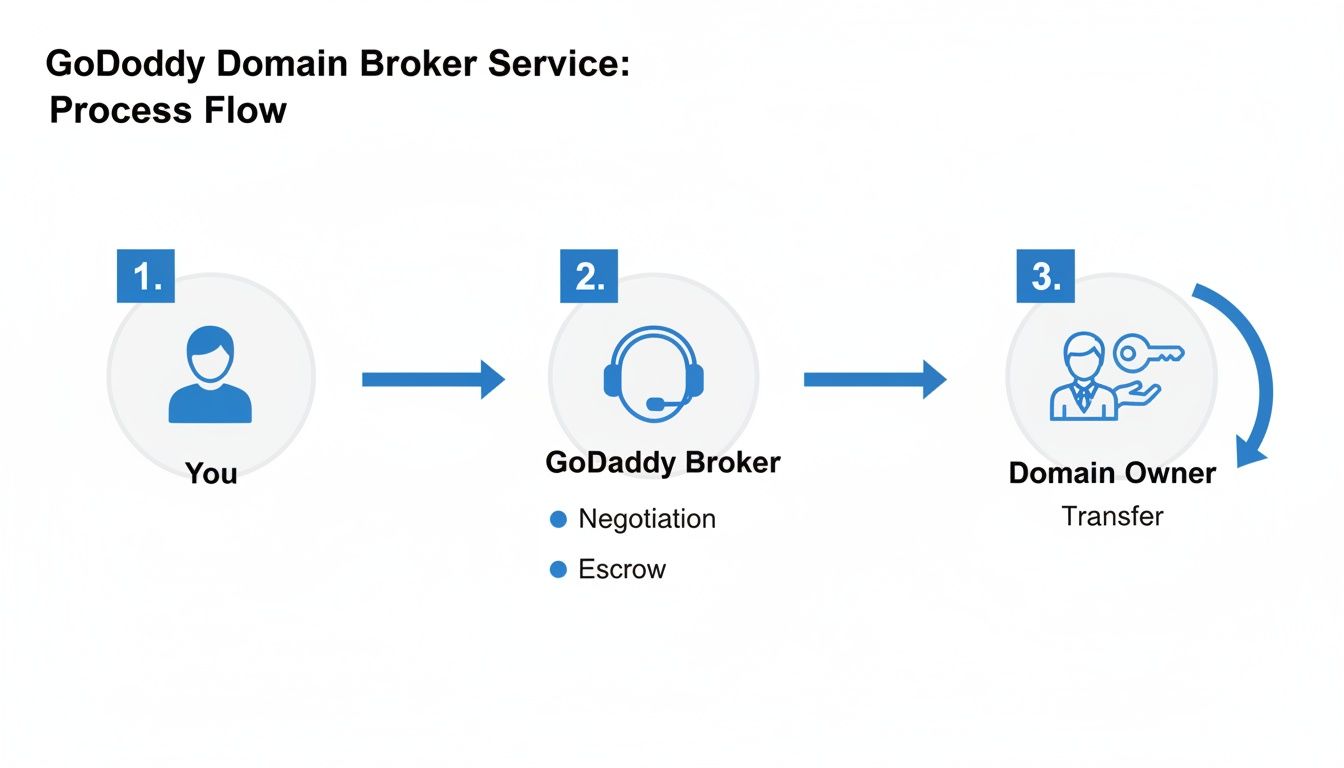
As you can see, the service acts as a professional buffer between you and the current owner, sanitizing the whole transaction.
Setting a Budget and Reaching a Deal
One of the most critical moves you'll make is setting your budget. Your broker will only operate within the price range you authorize. They won't go rogue and agree to a million-dollar price tag unless that's what you’ve signed off on. It keeps you firmly in control of the wallet, even while they're doing the talking.
Here’s how the 30-day process can shake out:
- Success! A Deal is Made: If the owner bites and agrees to a price inside your budget, the broker closes the deal. The whole transaction is handled through a secure escrow process, making sure you get the domain and the seller gets paid.
- No Contact or No Deal: Sometimes, the owner is a ghost. Or they just don't want to sell. If that 30-day window closes without an agreement, the service ends. You're out the initial fee, but you won't owe a dime in commission.
The most common reason a deal goes sideways is a massive gap between the buyer's budget and the seller's pie-in-the-sky asking price. A broker can help close that gap, but they can't work miracles if the numbers are in different universes.
If a deal gets done, your broker handles the secure transfer of the domain right into your GoDaddy account. If not, you’re back to square one. You can always try again later or pivot. Sometimes the smartest play is to look for great available domains that just dropped and can be registered on the spot, no negotiation required.
Alright, let's get down to brass tacks. When you're considering GoDaddy's broker service, two massive questions loom: "How much is this going to cost me?" and "Will it even work?" Let's break down the numbers and the odds so you can go in with your eyes wide open.

The fee structure is pretty simple, split into two parts. First, you pay a non-refundable broker fee. Think of this as the cost to get a dedicated agent on the case and start the 30-day negotiation process.
If they succeed, GoDaddy takes a cut of the final sale price. This is their commission.
Understanding GoDaddy's Fee Structure
Let's see how this plays out in the real world. The exact dollar amounts can shift over time, but the model stays the same:
- Initial Broker Fee: This is what you pay to get the ball rolling. It's an upfront cost, and you don't get it back, even if the deal falls through.
- Success Commission: If your broker lands the domain, GoDaddy currently charges a 20% commission on the agreed-upon price.
So, if your broker negotiates a deal for $2,000, your total cost will be the initial fee plus $400 for the commission. This model incentivizes GoDaddy to close the deal, but you absolutely have to factor that 20% into your budget from the start. For a deeper look, you can learn more about GoDaddy's auction fees and other related costs.
The real math isn't just the final price; it's the final price plus the 20% commission. Always calculate your maximum offer with that extra cost baked in to avoid any sticker shock after a successful negotiation.
What Are Your Chances of Success?
Now for the million-dollar question: what are the odds of actually getting the domain? The honest answer is that success is never guaranteed. GoDaddy's size and reach definitely help, but a few critical factors are always at play.
The outcome often boils down to a handful of variables:
- The Domain's Value: Are you chasing a premium, generic keyword like
insurance.comor a more niche, brandable name? The higher the perceived value, the harder—and more expensive—it's going to be. - The Owner's Willingness to Sell: Some owners are actively trying to sell their domains. Others bought the name a decade ago, forgot about it, and couldn't care less. An unwilling or unresponsive owner is an immediate dead end, no matter how good your broker is.
- Your Offer: A competitive, realistic offer is key. Throwing a lowball offer at a premium domain is a great way to get ignored and end the negotiation before it even begins.
Figuring out whether to hire a broker or go on the hunt yourself is a huge strategic choice. It's not just about money; it's about what you're trying to accomplish. Using a domain broker service like GoDaddy is like hiring a high-end realtor to convince someone to sell you their specific, off-market house in a prime neighborhood. The other option? That's like being a savvy property scout, digging up undervalued gems just before they hit the open market.
Both paths can land you a fantastic domain, but they serve completely different needs, budgets, and frankly, mindsets.
Go with a Broker for These Scenarios
Hiring a broker is the right call when your heart is set on one specific, high-value domain that someone else already owns. The name is non-negotiable for your brand, you know it, and you've got the budget to make a serious play for it. Think of names like Spark.com or Thrive.com—short, memorable, and almost certainly held by someone who knows its worth.
A broker becomes your best bet when:
- The Domain is Your Brand: You aren't looking for a domain; you're looking for the domain. Your business name is set in stone, and this exact URL is critical to your success.
- Anonymity is a Must: You have a strong suspicion the current owner would jack up the price if they knew who was asking. A broker acts as a professional shield, keeping your identity confidential during the delicate negotiation dance.
- You Have a Healthy Budget: You understand that acquiring a premium, taken domain will cost thousands, if not tens of thousands, of dollars. You're also prepared to pay the broker's commission on top of the final sale price.
In these situations, the cost and structure of the domain broker service GoDaddy provides make total sense. You’re not just paying for a name; you’re paying for access, professional negotiation, and a secure transfer for a high-stakes asset.
Hunt for Hidden Gems to Get More for Less
But what if you don't have a CarInsurance.com budget? (That one sold for a staggering $49.7 million.) Or what if your brand has some flexibility? This is where you put on your treasure hunter hat. Instead of chasing one expensive, occupied domain, you can find incredible value by discovering domains with built-in authority that everyone else has overlooked.
The smartest play isn't always paying top dollar for a taken domain. Often, it's finding a domain with existing power that's about to become available for nothing more than the standard registration fee.
This is where a platform like NameSnag completely changes the game. Instead of spending time and money negotiating for one pricey domain, you can uncover powerful alternatives. For instance, you could find incredible expiring domains that are just about to drop. These aren't just random strings of characters; they can be aged domains with years of SEO equity, quality backlinks, and even established traffic. Securing one of these is like buying a house that already comes with great landscaping and a solid foundation.
You might also discover fantastic available domains that were just dropped and are ready to be registered on the spot. With the right tools, you can skip the broker fees and lengthy negotiations entirely. You get a powerful asset for a tiny fraction of the cost, giving your new project an immediate head start. If you want to go deeper on this tactic, check out our guide on how to find domains that are about to expire.
Comparing GoDaddy with Boutique Brokers and DIY Methods
So, the domain you want is taken. This isn't a dead end; it's just the start of a different kind of negotiation. GoDaddy is the biggest name in the domain game, but they're not the only option on the table. When you need to pry a domain name from its current owner, you've really got three paths you can walk down.
Let's unpack how the big-box, volume-driven approach of the domain broker service GoDaddy offers compares to bringing in a specialist or just doing the dirty work yourself.

The Three Flavors of Domain Acquisition
Think of it like this: you need to buy a house that isn't for sale. You could go through a massive real estate agency that handles thousands of properties (GoDaddy), hire a high-end buyer's agent who specializes in unlisted, multi-million dollar estates (a boutique broker), or you could just find the owner's address and knock on their door yourself (DIY).
Each approach has a time and a place.
GoDaddy's Broker Service: This is your scaled, process-driven option. They run a high-volume operation with a standardized playbook. It's built for efficiency and reach, making it a solid choice for most premium domain pursuits where you value anonymity and a secure transaction but don't need a lot of strategic hand-holding.
Boutique Brokers: These are the white-glove consultants of the domain world. They take on fewer clients, focus on extremely high-value names, and offer deep strategic advice that goes far beyond just sending an offer. You're paying for their personal network and high-touch negotiation skills, and their fees reflect that.
The DIY Method: The "Do-It-Yourself" route means you're digging through WHOIS records, tracking down the owner, and starting a conversation from scratch. The appeal is clear: you pay no broker fees. The reality? Your emails will almost certainly be ignored, you have zero negotiation leverage, and you're wading into territory ripe with potential scams.
If you do manage to snag a domain yourself, don't forget the next step. Getting the domain is one thing; making it work for you is another. A good SEO checklist for new websites is essential to make sure you're not just parking your new asset.
A broker's true value isn't just their ability to find an email address. It's their ability to get a response. They know how to craft a message that gets past the gatekeepers and lands in front of the actual decision-maker—a hurdle where most DIY attempts fall flat.
To make the decision a bit more concrete, let's put these methods head-to-head.
Domain Acquisition Method Comparison
Choosing how to acquire a domain isn't just about cost; it's a calculation of your time, risk tolerance, and the value of the name itself. This table breaks down the tradeoffs you're making with each approach.
| Method | Best For | Typical Cost | Pros | Cons |
|---|---|---|---|---|
| GoDaddy Broker | Most premium domains ($1k - $25k range) where process and anonymity are the main concerns. | $119.99 + 20% commission. | Huge reach; secure, trusted process; keeps you anonymous. | Standardized, less personal approach; not ideal for ultra-high-value, complex deals. |
| Boutique Broker | Six-figure (or higher) domain acquisitions that require deep strategy and personal connections. | High retainer and/or higher commission (20-30%). | Unmatched expertise; high-touch, personalized service; access to exclusive networks. | The most expensive option; total overkill for the vast majority of domain acquisitions. |
| DIY Method | Low-value domains where your budget is zero and you have plenty of time and a high tolerance for failure. | Your time + escrow service fees (if you get that far). | No commission fees. | Extremely low success rate; high risk of scams; no negotiation experience or leverage. |
Ultimately, your choice depends on what you're trying to achieve. GoDaddy's service provides a reliable, secure middle ground that works well for a wide range of business needs. But knowing when to call in a specialist—or when to just walk away—is key to making the right investment.
After digging into the costs, the process, and some powerful alternatives, we arrive at the big question: Is GoDaddy's broker service actually worth your money?
There's no simple "yes" or "no" here. The right answer really comes down to your specific situation, how much cash you're willing to part with, and just how badly you want that one particular domain.
For a very specific type of person, the service is an absolute no-brainer. You're the ideal customer if that one premium, already-registered domain is completely non-negotiable for your brand. You also understand the value of a secure, professionally-handled transaction and want the anonymity a broker gives you to sidestep potential price gouging.
The Ideal Broker Service User
You should be seriously thinking about using GoDaddy's service if you tick these boxes:
- You must have a specific, high-value domain. The name is core to your identity, and settling for a "good enough" alternative just won't do.
- Your budget is realistic. You get that a premium name is going to cost you, likely thousands of dollars plus that 20% commission.
- Security and anonymity are top priorities. You want a pro to handle the back-and-forth confidentially and make sure the final payment is handled without risk.
For this person, the broker fee isn't just a cost—it's a smart payment for access, expertise, and a whole lot of peace of mind.
But for a lot of entrepreneurs and SEOs, chasing one expensive domain is the wrong game to play. The much savvier move is often to find an undervalued asset that everyone else has overlooked.
Instead of forking over a premium, you could find killer available domains with great metrics that you can register right now for a few bucks. Better yet, you could snag powerful expiring domains with built-in SEO authority right before they go back on the open market.
This approach lets you land a fantastic domain for a tiny fraction of the cost, freeing up capital you can pour back into actually building your business.
Frequently Asked Questions
Alright, let's get into the nitty-gritty. When you're thinking about dropping cash on a broker service, a lot of "what if" questions pop up. Here are the answers to the ones I hear most often, without the corporate fluff.
What Happens If GoDaddy Can't Contact the Domain Owner?
This happens more often than you'd think. If your GoDaddy broker can’t get a response from the owner within that 30-day window, the chase is over. The attempt is marked as unsuccessful.
You don't get your initial broker fee back—that was for the effort—but you won't be on the hook for the much larger success commission. The service simply ends. It's a clean break, leaving you to decide whether to try again down the road or move on.
Frankly, this isn't a dead end. It’s just a sign to pivot. Instead of waiting around, you could switch gears and hunt for high-quality Available domains that just dropped and can be snapped up instantly.
Can I Set a Maximum Budget for the Negotiation?
Yes, and if you don't, you're making a huge mistake. During the sign-up process, you'll be asked to provide a budget range. Your broker is required to treat this as a hard ceiling. They will not exceed your maximum authorized amount without coming back to you for explicit, written permission.
This is the most important financial guardrail in the whole process. It keeps you in control and prevents the negotiation from spiraling into a price you never wanted to pay.
Your identity is kept completely confidential throughout the entire process. The domain owner will only know they are dealing with a GoDaddy broker, which prevents them from inflating the price based on who you are or the size of your company.
Is the GoDaddy Domain Broker Service Anonymous?
Absolutely. This is probably the single biggest reason to use a service like this. Your identity stays under wraps from start to finish.
The owner of the domain will only know they’re talking to an agent from GoDaddy. They have no idea if the real buyer is a bootstrapped startup or a Fortune 500 company, which stops them from jacking up the price based on who they think you are.
Instead of waiting for a broker to maybe get a response, you can take control and find valuable domains right now. With NameSnag, you can discover high-authority expiring domains before they hit the open market or find brandable names that are available today.
Find Your Perfect Domain
Get access to thousands of high-value expired domains with our AI-powered search.
Start Free Trial