
Found the perfect domain, only to discover it’s already taken? Ugh, we’ve all been there. The good news is that "taken" doesn't mean "gone forever." The quickest way to figure out your next move is to run a WHOIS lookup. This simple, free search reveals the domain's "Registry Expiry Date," giving you the first crucial clue in your treasure hunt.
Your Treasure Map to a Domain's Expiration Date
So, you stumbled upon a domain name that feels like it was made for you, but someone else got there first. Don't throw in the towel just yet! Finding out when that domain might become available is your first strategic move, turning wishful thinking into a real opportunity.
The digital world is in constant flux. Every single day, thousands of domains expire globally, with databases tracking millions of them across hundreds of TLDs. For savvy entrepreneurs and SEOs, this churn represents a massive opening. The key is knowing how to pinpoint that crucial expiration date. If you're curious, you can learn more about the scale of daily expired domains to see the potential.
The Power of a Simple WHOIS Lookup
The most direct method to find a domain's expiration date is a WHOIS lookup. Think of it as a public library card for the internet. Every domain registration is logged in a massive database, and a WHOIS query is how you get access to that information.
It's dead simple to use:
- Find a WHOIS lookup tool—most registrars like GoDaddy offer one for free.
- Enter the domain name you're curious about (no "www" or "https://").
- Hit search and check out the results.
You'll see a bunch of information, but the golden nugget you're looking for is labeled "Registry Expiry Date" or something similar. This is the official date the current registration period ends.
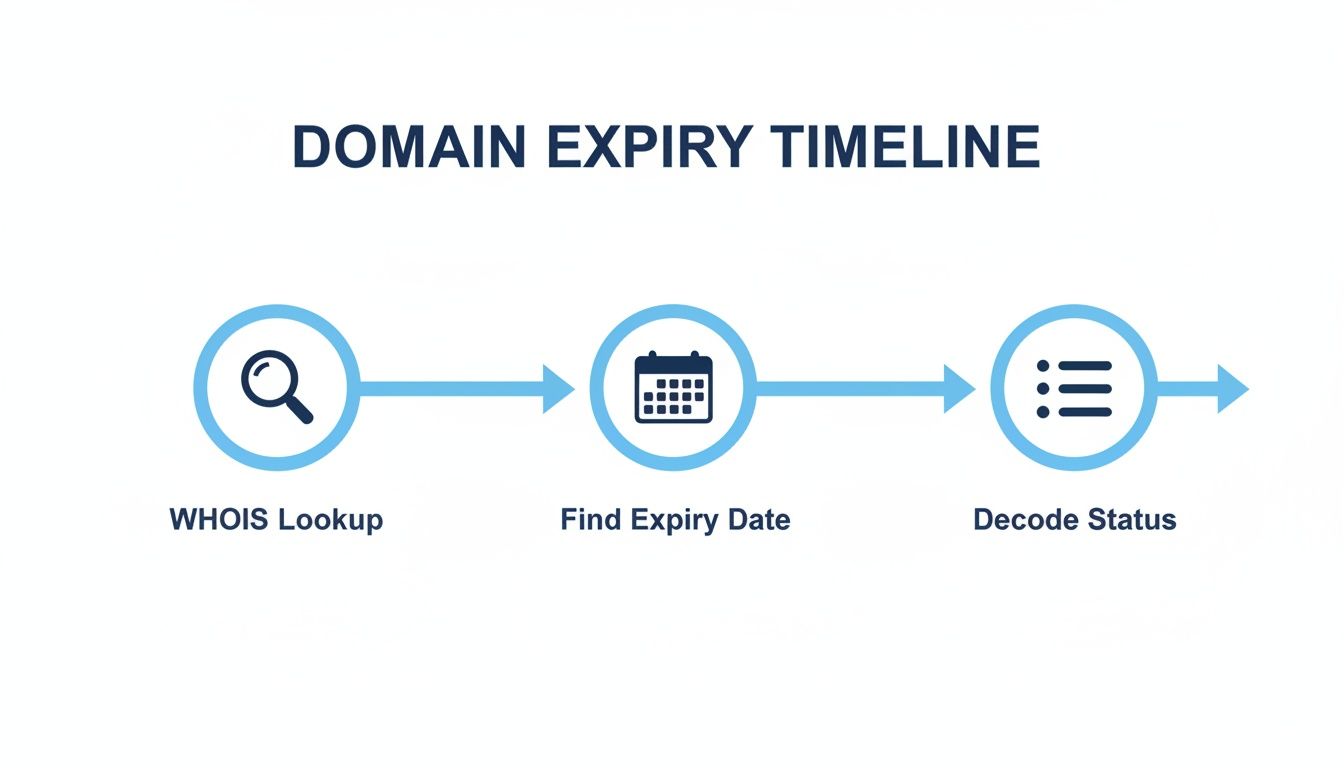
This simple flow—lookup, find the date, and decode the status—is the foundation of any solid domain acquisition strategy.
Decoding the Expiration Date and Status
Finding the date is step one, but understanding what it really means is the secret sauce. A domain's expiration date isn't the day it suddenly becomes available for you to register. Instead, it's the start of a multi-stage process called the domain lifecycle.
A domain's expiration date marks the start of a journey, not the finish line. It triggers a series of grace periods and redemption phases that can last for months before the domain is finally deleted and released back to the public.
To become a true domain hunter, you need to learn the signals. The domain's status code, also found in the WHOIS data, tells you exactly where it is in this lifecycle.
This is where you go from just watching to actively planning. Understanding these statuses can mean the difference between snagging a great name and missing out entirely.
Decoding Domain Statuses: A Quick Guide
Here’s a breakdown of the common statuses, what they mean for you, and what your next move should be.
| Domain Status | What It Means for You | Your Next Move |
|---|---|---|
| Active / OK | The domain is registered and in use. The owner can renew it at any time. | Note the expiration date and set a reminder to check on it later. |
| Renewal Grace Period | The domain has expired, but the owner has a window (usually 30-45 days) to renew it at the standard price. | The clock is ticking! This is a great time to find Expiring domains that will be dropping soon. |
| Redemption Period | The grace period has passed. The owner can still reclaim it, but they'll have to pay a hefty redemption fee. | The chances of it dropping are increasing. Keep a close watch. |
| Pending Deletion | The domain is in its final days (usually 5) before being deleted from the registry. It cannot be recovered by the owner. | Get ready! The domain will soon appear in lists of Available domains for immediate registration. |
By mastering the WHOIS lookup and learning to read these statuses, you stop being a hopeful spectator and become a strategic player, ready to act the moment that perfect domain becomes available.
The Full Expiration Lifecycle Explained
So you've run a WHOIS lookup and found the "Registry Expiry Date." That’s the end of the story, right? Not even close.
That date is just the first domino to fall in a much longer, more interesting chain reaction. If you want to know exactly when you can pounce on a domain, you need to understand the entire process. It’s the real secret to timing your move perfectly.
Think of it like a tenant moving out of a killer apartment. Their lease might end on the 31st, but you can't just show up with a U-Haul on the 1st. There’s a whole dance of inspections, final chances, and clean-up before anyone else gets the keys. A domain's journey from expired to available is surprisingly similar.
The domain market is a massive ecosystem. With 368.4 million registrations in Q1 2025 and a renewal rate of 75.3% for .coms, tens of millions of domains still get dropped every year. That creates a constant flow of opportunities for anyone who knows the rules of the game. You can get a sense for the sheer scale of it all over at CircleID.com.

Let's walk through each stage of this journey so you know exactly when to make your move.
The Renewal Grace Period: The First Chance Saloon
Once the expiration date officially passes, the domain doesn't just vaporize. It slips into the Renewal Grace Period. This is the original owner's last-ditch opportunity to renew at the normal price, and it usually lasts between 30 to 45 days.
During this time:
- The website and any email services typically go offline.
- The owner can still log into their registrar and renew it—no questions asked, no penalty fees.
- The domain is effectively "on hold," completely unavailable for anyone else to register.
This is a critical window for you. The domain isn't available yet, but its status is a flashing neon sign that it might be soon. This is the perfect time to add it to a watchlist. On NameSnag, you'll find these sitting in the Expiring domains section, giving you a serious head start.
The Redemption Period: The Costly Last Call
If the owner misses their shot during the grace period, things get serious. The domain sinks into the Redemption Period, which is a much pricier stage lasting about 30 days. Think of it like the registrar putting a boot on the domain's metaphorical car—it can be recovered, but it's going to hurt the wallet.
To get the domain back now, the owner has to fork over a hefty redemption fee (often $100-$200+) on top of the standard renewal cost. Because of that steep price, the odds of the domain being released just shot up dramatically. Many owners simply decide it's not worth the cash and let it go.
The Redemption Period is a powerful filter. It weeds out the owners who were on the fence, leaving a pool of domains that are far more likely to actually drop.
Once a domain hits this stage, it's locked down. No changes can be made, and it definitely can't be registered by a new party. Your job is to keep watching and wait for the final countdown to begin.
Pending Deletion: The Final Five Days
After the Redemption Period ends with no hero swooping in to save the day, the domain enters its final, irreversible phase: Pending Deletion. This is the point of no return.
This stage typically lasts about five days. During this time, the domain is queued up in the central registry's system for total deletion. The original owner can't get it back, it can't be renewed, and it can't be transferred. It's locked in a digital vault, waiting for the doors to swing open.
At the end of these five days, the domain is "dropped" and becomes available for anyone to register on a first-come, first-served basis. This is where tools that track Available domains become your best friend, letting you grab it the second it’s released. And if you want to get better at spotting the hidden gems, our guide on using the Archive.org Wayback Machine for domain analysis is a great place to start.
Your Toolkit for Hunting Expiring Domains
Ready to move from being a passive observer to an active domain hunter? Having the right tools isn't just a convenience—it's the difference between snagging a diamond in the rough and spending weeks chasing dead ends. Your strategy should start with the basics, but it needs to scale with powerful analytics if you're serious.

Let's gear up. This is the essential toolkit for anyone who wants to know how to see when a domain name expires and, more importantly, what to do with that information.
Starting with Manual WHOIS Lookups
Your first port of call is the trusty manual WHOIS lookup. Almost every domain registrar, from GoDaddy to Namecheap, offers a free tool on their site. You just plug in a domain, hit enter, and get a raw data dump.
Pros:
- It's free and fast. You can get an expiration date in seconds without signing up for anything.
- It’s universally available. No matter the registrar, you can find a way to check a domain's status.
Cons:
- It’s just raw data. You get the expiration date, but zero context. Is the domain valuable? Spammy? You won't know from a simple lookup.
- It’s incredibly inefficient. Checking domains one by one is a huge time sink. If you're researching dozens of domains, this process will quickly become your least favorite chore.
Manual lookups are fine for a quick, one-off check on a domain you've stumbled upon. But for any kind of serious hunting, you'll outgrow this method fast.
Upgrading to a Specialized Domain Platform
This is where the real fun begins. Instead of just finding an expiration date, specialized platforms like NameSnag do the heavy lifting for you, analyzing a domain's true value before it ever hits your radar. This shifts your approach from reactive to proactive and data-driven.
Think of it this way: a WHOIS lookup tells you a house is for sale. A platform like NameSnag gives you the full inspection report, neighborhood comps, and a structural analysis before you even book a viewing.
These tools go way beyond a simple date. They provide the critical metrics that determine a domain's actual worth, including:
- SnagScore: A proprietary metric that instantly summarizes a domain's overall quality based on dozens of factors.
- Backlink Quality: Analysis of referring domains, including powerful .edu and .gov links that signal authority.
- Spam Checks: Automated verification to ensure you’re not inheriting a domain with a toxic history.
This data saves you countless hours of manual research across multiple SEO tools. Finding the true gems requires more than just knowing a date; it demands a deep understanding of a domain's history and potential. For a deeper dive, check out our complete guide on using an expired domain finder to streamline your search.
Manual WHOIS vs. Automated Platforms: A Head-to-Head Comparison
Choosing the right tool depends on your goals. Here’s a breakdown of how manual checks stack up against a comprehensive platform like NameSnag.
| Feature | Manual WHOIS Lookup | NameSnag Platform |
|---|---|---|
| Primary Function | Provides raw registration data for a single domain. | Discovers and analyzes thousands of expiring and expired domains daily. |
| Key Data Point | "Registry Expiry Date." | SnagScore, backlink data, spam checks, domain age, traffic estimates. |
| Efficiency | Very low. Each domain must be checked individually. | Extremely high. Filter and sort thousands of domains in seconds. |
| Strategic Value | Minimal. It's a single piece of a much larger puzzle. | Massive. Provides the data needed to make informed investment decisions. |
| Best For | A quick, one-off check on a domain you already know. | Serious domain investors, SEOs, and niche site builders. |
The bottom line is simple: a manual WHOIS lookup tells you when a domain expires. An automated platform tells you if you should even care.
This shift in perspective is what separates amateur domain dabblers from professional hunters. By using a tool that surfaces quality domains automatically, you gain an enormous competitive advantage and can focus your energy on acquisition and strategy, not tedious manual labor.
How to Capitalize on Expiring Domains
Knowing a domain's expiration date is just step one. It's like having a ticket to a sold-out show—you're in the door, but now you need a strategy to get to the front row. Finding the date is easy; capitalizing on it is where the real work begins.
You've really got two main ways to play this game: you can hunt for domains that are about to drop, or you can pounce on ones that have just become available. Both are viable, but they require different mindsets.
The opportunity here is massive. As of late 2025, there are over 371.7 million domain names registered worldwide. But here's the kicker: a staggering 25% of premium .com and .net domains—the blue-chip assets everyone wants—fail to renew each quarter. We're talking millions of valuable names just falling off the radar, ripe for the picking. You can get the full rundown in Verisign's industry brief.
Hunting for Domains in the Grace Period
The first approach is all about getting ahead of the curve. You identify domains that have expired but are still stuck in their grace or redemption periods. These aren't available to register just yet, but they're on deck. This is where patience and preparation pay huge dividends.
This method gives you one massive advantage: time.
You get a chance to do your homework. Dig into the domain's history, check out its backlink profile, and decide if it's actually worth pursuing before it turns into a mad dash. You’re not reacting; you're planning your attack.
Platforms like NameSnag make this ridiculously easy. Instead of manually slogging through WHOIS data for every domain on your list, you can just use a filter to pull up a curated list of high-potential names that are currently in limbo. The best part? You can filter by how soon they drop, whether it's Today, in the next 3 Days, or up to 30 Days out.
For example, here's what you see when you filter for Expiring domains on NameSnag.
This view gives you an instant snapshot of domains in their final countdown, complete with key metrics like SnagScore, so you can spot the gems in seconds.
Snagging Freshly Dropped Domains
The second strategy is for those who love the thrill of the chase: grabbing a domain the exact moment it becomes available. This is a much faster-paced game where timing is absolutely everything. Once a domain finally clears the pending deletion phase, it's released back to the public for anyone to register.
This is the perfect way to find hidden gems that others might have missed. Because they're immediately available, you can register them at any standard registrar—no auctions, no backorder services. The trick is having a tool that updates in real-time so you're the first to know.
On NameSnag, this is handled by the Available domains filter. It's a live feed of domains that have just dropped and are ready for registration right now. You can slice and dice the list by metrics like domain authority or the presence of valuable .edu backlinks to cut through the noise and find exactly what you're looking for.
Pro Tip: Don't pick one strategy—use both. Build a watchlist of high-priority targets from the "Expiring" list. Set your alerts. When they finally drop, you’ll be the first in line to grab them from the "Available" list.
To Backorder or Not to Backorder
For the really juicy, high-competition domains, you might want to consider a backordering service. Think of it as hiring a professional sniper. You pay a company to use their powerful, automated systems to try and register a domain for you the millisecond it becomes available.
- When to Backorder: If you've found a truly premium domain with a killer backlink profile and obvious commercial value, a backorder is a smart investment. The competition will be fierce.
- When to Wait: For less competitive or niche-specific domains, you can often save money by setting an alert and trying to "hand-register" it yourself the moment it drops.
The decision really comes down to the domain's value versus the expected competition. By using a platform that lays all the data out for you upfront, you can make an informed call and dramatically boost your odds of walking away with the prize.
Automate Your Hunt and Never Miss a Domain
The market for expiring domains moves fast. Trying to manually check a list of your top prospects every single day is a quick way to burn out—and worse, to miss the one you really wanted. If you're serious about snagging high-value domains, automation isn't just a nice-to-have; it's the only way to play the game.
Setting up alerts is the strategic shift from chasing domains to having them come to you. You get to ditch the tedious, repetitive work of checking statuses and instead focus on what really matters: analyzing the gems that meet your specific criteria.
Create Your Personalized Monitoring System
This is where you build a system that works for you, 24/7. With NameSnag, you can use features like 'Early Access Alerts' and 'Watchers' to build a custom setup that drops prime domains right into your inbox. This isn't just about saving time; it's about getting a crucial head start on your competition.
Imagine setting up notifications based on your exact specifications. This goes way beyond simple keyword alerts and lets you get incredibly specific with your search.
You can build a highly targeted system based on criteria like:
- Specific Keywords: Get an alert for any domain containing "crypto" or "solar."
- Minimum SnagScore: Only get notified about domains that meet a certain quality threshold. This filters out the junk automatically.
- Domain Age: Target established domains by setting a minimum age, like 5+ years.
- Powerful Backlinks: Receive alerts only for domains that have valuable .edu or .gov backlinks.
This level of customization means you aren't just finding expired domains; you're finding the right expired domains for whatever you're trying to accomplish.
A Real-World Agency Scenario
Let's make this practical. Say you run a digital marketing agency and just landed a new client in the hyper-competitive real estate niche. They need to build authority, and they need it fast. You know a clean, aged domain would give them an incredible SEO head start.
Instead of burning hours sifting through endless lists, you set up a quick alert on NameSnag.
You configure a watcher for domains with "realty," "homes," or "property" in the name, set a minimum SnagScore of 70, and add a filter for at least one .edu backlink. You save the alert and get back to your actual client work.
A week later, an email hits your inbox: LuxuryPropertyGuide.com just entered its renewal grace period. It's 12 years old, has a SnagScore of 78, and boasts a backlink from a university's business school blog. Bingo. You just found the perfect asset for your client's campaign without lifting a finger. That's the power of putting a system to work for you.
Advanced Automation with API Access
For developers and agencies that need to pull domain monitoring into their own systems, the possibilities get even bigger. An API lets you feed this data directly into your custom dashboards, client portals, or internal tools.
You could build workflows that automatically analyze expiring domains against your own proprietary metrics or trigger other actions inside your software. This gives you a level of control and efficiency that's just not possible with manual checks. If you're technically inclined, you can dive into the full potential by checking out the NameSnag API documentation.
By embracing automation, you stop reacting to the market and start anticipating it. You'll save yourself countless hours, slash the risk of missing out on a killer domain, and ultimately make smarter, data-driven decisions that give you a real competitive edge.
Your Domain Expiration Questions Answered
We've walked through the entire lifecycle of a domain, from its active days right up to the final drop. Still, a few questions always seem to pop up. Let's tackle them head-on to clear up any lingering confusion and get you ready to act with confidence.
Think of this as your quick-reference guide for the trickiest parts of the hunt. Getting these details right can be the difference between a successful grab and a painful miss.
What Is the Difference Between the Expiry Date and the Drop Date
This is a fantastic and absolutely crucial question. That 'Registry Expiry Date' you see in a WHOIS lookup? That’s just the day the current owner's registration period officially ends. The domain does not become available for you to register on that day. Far from it. It's just the start of the process.
Once a domain expires, it first enters a 'Renewal Grace Period,' which usually lasts about 30-45 days. During this window, the original owner can waltz in and renew it at the standard price, no problem. If they don't, it then slides into a costly 'Redemption Period' for another 30 days. Only after all that does it hit a final 'Pending Deletion' phase for about five days before it finally gets "dropped" and released back into the wild.
The actual drop date—the day you can pounce on it—is often 65 to 80 days after the listed expiry date. Grasping this timeline is the single most important part of timing your acquisition strategy.
Can I Find the Expiration Date if a Domain Has WHOIS Privacy
Yes, you absolutely can. This is a common misconception that trips a lot of people up.
WHOIS privacy is designed to hide the owner's personal contact info—their name, address, email, and phone number—from public view. It’s a great way to cut down on spam and protect an owner's identity.
But it almost never hides the core registration data. The central registry needs that info for the system to work. Key details almost always remain visible, including:
- The original registration date
- The last update date
- And most importantly, the 'Registry Expiry Date'
So go ahead and run that WHOIS lookup. Even with privacy enabled, the logistical data you need to plan your move is still right there for you to see.
Should I Backorder a Domain or Try to Register It Myself
This is the big strategic question, and the answer really boils down to the domain's value and how much competition you're expecting.
Backordering is where you pay a specialized service to unleash their powerful, automated systems to try and register the domain for you the millisecond it becomes available. It's your best bet for high-value domains where you know other investors and their bots will be fighting for it. The only real downside is the cost, especially if the domain gets pushed to an auction.
Trying to register it yourself, often called "hand-registering," is essentially free outside the normal registration fee, but you’re relying on perfect timing and a bit of luck. You're going up against those same automated bots, and that's a tough fight to win on your own.
A smarter play is often a hybrid approach. Use a platform to spot promising domains ahead of time. For the true A-list gems, place a backorder to give yourself the best possible shot. For the less competitive but still valuable names, set up an alert and get ready to snag it from the list of newly Available domains the moment it drops. This way, you put your money where it counts the most.
Ready to stop guessing and start snagging high-value domains with a real strategy? NameSnag gives you the data and tools to find and monitor the best expiring and available domains before anyone else. Start your hunt today.
Find Your Perfect Domain
Get access to thousands of high-value expired domains with our AI-powered search.
Start Free Trial