
If you're hunting for a powerful, aged domain but don't have a king's ransom to spend, you've just stumbled upon the motherlode. GoDaddy's expired auctions are a sprawling marketplace for digital real estate, packed with hidden gems that can supercharge your SEO, become your next killer brand, or turn into a quick, profitable flip.
So grab a coffee, and let's go treasure hunting. This guide is your map.
Why GoDaddy Auctions Are a Goldmine
Think of GoDaddy's auction house as the world's biggest, most chaotic garage sale for websites. Every single day, thousands of domains just... expire. Owners forget, businesses close, projects fizzle out. For whatever reason, they don't get renewed, and many of them eventually land here.
This isn't just a pile of digital junk, though. It's a living, breathing ecosystem where you can snag established domains with real history and authority baked right in.
What makes this so compelling? You're not starting from zero. Many of these names come with a head start:
- Existing Backlinks: Some domains have a trail of backlinks from reputable sites already pointing to them, giving you an immediate SEO leg up.
- Domain Age: Search engines tend to look more favorably on older domains. It’s like having a bit of seniority on your first day—it can help you rank faster than a brand-new name.
- Sheer Brandability: You might just find that short, memorable, keyword-rich domain you thought was impossible to get your hands on.
The Scale of the Opportunity
The sheer volume here is staggering. As the world's largest domain registrar, GoDaddy sees an unmatched number of domains expire on its platform. This creates a buyer's market overflowing with potential. You get a massive inventory of domains that transfer directly to you, letting you sidestep the high-speed, bot-driven "drop-catching" wars you'll find elsewhere.
The value is very real. Between June and August, 203 premium domains sold for over $2,000 each. September alone saw 70 such sales, pulling in nearly $300,000 in high-value deals. You can see how GoDaddy stacks up against other platforms to get a sense of the scale.
The key takeaway is simple: instead of building a digital presence from scratch, you can acquire a property with a foundation already in place. This guide will show you exactly how to do it.
Of course, not every domain is a winner. Far from it. The real skill is learning how to sift the gold from the garbage, and that's all about strategy. Before a domain even hits the auction block, savvy investors are already deep into their homework. Many of the best deals are spotted while they're still in their post-expiration grace period.
This is where a little preparation pays off big time. Using a tool to find Expiring domains lets you get a jump on the competition. You can filter for domains expiring today, in the next 3 days, or even a month out, letting you build a watchlist of prime targets and be ready to act long before the bidding frenzy kicks in. This proactive approach is the secret to consistently finding and winning the best domains without getting caught in a bidding war.
The GoDaddy Domain Expiration Timeline
Understanding this timeline is your first strategic advantage. Here's a quick breakdown of a domain's journey after expiration and where you can step in.
| Day(s) After Expiration | Domain Status | Your Opportunity |
|---|---|---|
| 1-18 | Grace Period | The original owner can still renew. This is your window to research and add potential targets to your watchlist. |
| 19-25 | Renewal Auction | The owner can still renew, but the domain is now listed for a 10-day public auction. Get your pre-bidding in. |
| 26-30 | Auction Continues | The domain is now officially in the GoDaddy Expired Auction. Bidding is live and active. |
| 36-41 | Closeout Auction | If unsold, the domain moves to a 5-day, no-reserve "fire sale" auction. Potential for deep discounts. |
| 42 | Deletion | If it remains unsold, the domain is deleted and will soon be available for public registration. |
Knowing these phases lets you pinpoint exactly when to start your due diligence and when to prepare your bidding strategy. The early bird really does get the worm here.
Navigating The Domain Auction Lifecycle
Every expired domain follows a predictable journey before it lands in your account. Think of it like a river with different stages—a gentle stream, some rapids, and finally, a waterfall. Mastering this lifecycle is your secret weapon in GoDaddy expired auctions because it tells you exactly when to watch, when to pounce, and when to just sit back.
It all kicks off the moment a domain's registration lapses. But this doesn't mean it's immediately up for grabs. The original owner gets a fighting chance to reclaim their digital property, but the clock is ticking.
This visual timeline breaks down the key phases a domain goes through, from the moment it expires to when it hits the auction block.
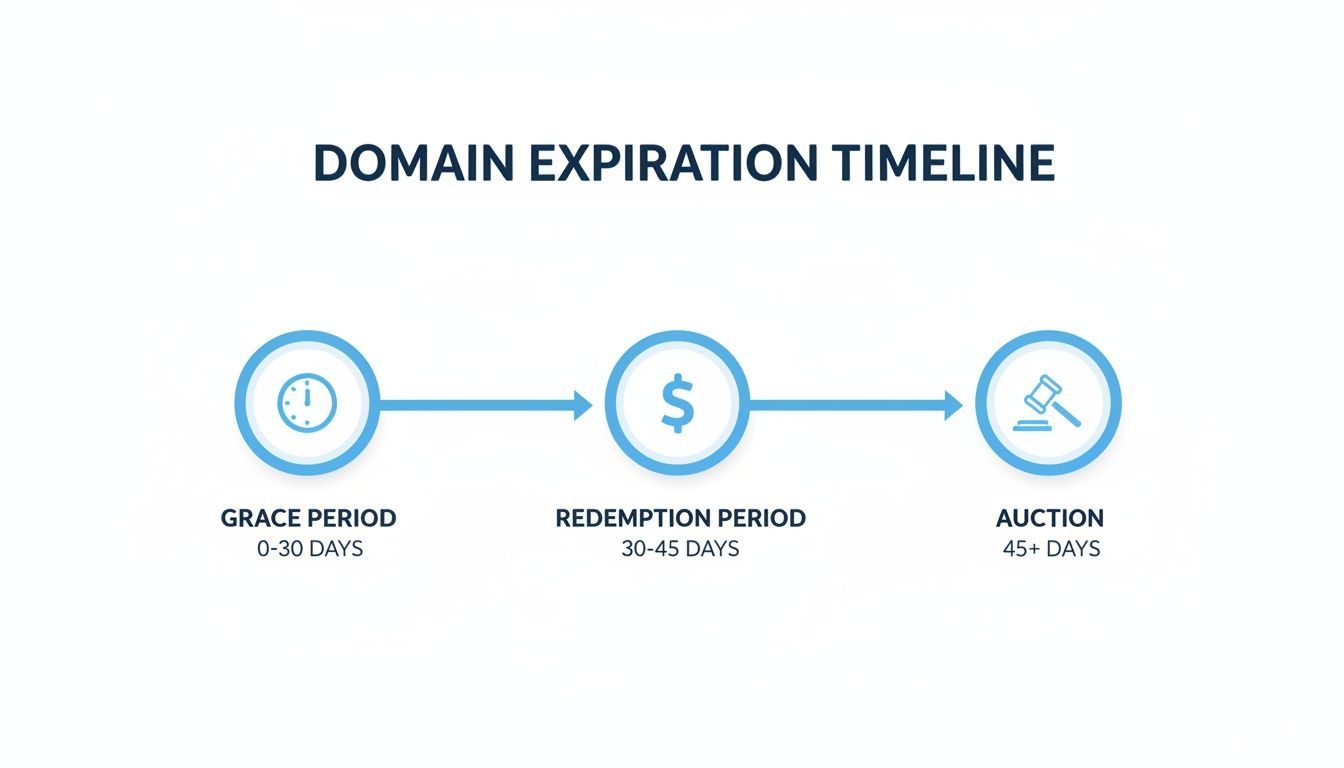
As you can see, the whole thing is a structured countdown, creating distinct opportunities for savvy investors at each turn.
The Grace And Redemption Periods
First up is the Grace Period. For about 30 days after expiration, the original owner can renew the domain at the standard rate, no questions asked. During this time, the domain is essentially in limbo. You can't buy it, but this is your golden window for research.
This is when you should be identifying promising names that are on the brink, adding them to your watchlist, and doing your due diligence without the pressure of a ticking auction clock. Fine-tuning your timing is key, and you can learn more about the specifics of when domains actually expire.
If the owner doesn't renew, the domain enters the Redemption Period. This is a last-ditch, much more expensive opportunity for them to get it back, usually involving a hefty redemption fee on top of the normal renewal cost. For you, this is a strong signal that the domain is very likely headed to auction.
The transition from Grace to Redemption is a major green light. It means the original owner has missed the cheap and easy renewal window, dramatically increasing the odds that the domain will become available.
The Main Event: The Expired Auction
Around day 26, while still technically in the redemption phase, the domain officially hits the GoDaddy Expired Auction block. This is your standard 10-day public auction. The bidding starts low, and the highest bidder at the end wins the prize.
This is where most of the action happens and where you'll compete with other investors for the most desirable names.
The Bargain Bin: Closeout Auctions
What happens if a domain goes through the entire 10-day auction and gets zero bids? It’s not sent to the digital graveyard just yet. Instead, it enters a GoDaddy Closeout Auction.
Think of this as a five-day fire sale. The domain gets listed with a low "Buy It Now" price, often starting around $5 or $11. Each day it remains unsold, the price drops. This is a fantastic place to find hidden gems and bargains that others overlooked.
It’s a game of chicken, though. Do you wait another day for the price to fall, or do you grab it now before someone else does?
One of the biggest perks of winning any of these auctions is GoDaddy's direct transfer system. Once you win and pay, the domain is moved directly into your GoDaddy account. You gain immediate control—a massive advantage over other platforms where you might have to wait or deal with complicated transfer processes.
Winning at GoDaddy expired auctions often feels like a high-speed chase, but the smartest investors know the real race is won long before the bidding even starts. While everyone else is scrambling over domains in active auctions, you can get a massive head start.
The real value is hiding in plain sight, quietly sitting in the grace period, just waiting for someone strategic enough to look.
Instead of getting tripped up in a last-minute bidding war, you can pinpoint promising domains that are expiring but haven't hit the auction frenzy yet. This proactive approach lets you build a watchlist, conduct thorough research, and figure out a valuation without the pressure of a countdown timer breathing down your neck.
It’s the difference between impulse buying and making a calculated investment.
Tapping into the Stream of Expiring Domains
Every single day, thousands of domains slip into their grace period. This is your prime hunting ground. Manually sifting through this firehose of names is impossible, so using a specialized tool to monitor this flow is essential.
A killer tactic is to regularly scan a list of Expiring domains that are dropping within the next few days. You can set a time filter for domains expiring today, in 3 days, or even 7 days out, giving you a sneak peek at what's coming down the pipeline. This lets you spot domains with strong metrics and start your analysis way ahead of the competition.
The key, of course, is to filter out the noise. A good tool will let you cut through the junk and focus on what actually matters. I always filter my searches by a few key metrics:
- Domain Authority (DA): This helps you instantly spot domains with existing SEO power.
- Domain Age: Older, more established domains are often more trusted by search engines. Target these.
- Keywords: Find names that are a perfect match for your niche or brand.
- Backlink Profile: Hunt for domains with high-value links, like those from .edu or .gov sites.
This filtered approach turns a massive, overwhelming list into a manageable set of high-potential targets. You can learn more about finding expired domains with these advanced methods. And when you're doing this kind of deep research, it's critical to know how to scrape a website without getting blocked to make sure you can gather all the data you need efficiently.
The Advantage of Early Research
Spotting a domain early gives you the most valuable asset in this game: time. Time for deep due diligence—something you can’t afford to rush during a fast-moving auction.
This is your chance to use tools like the Wayback Machine to check a site's history, comb through its backlink profile for spam, and confirm it wasn’t used for anything shady.
Building a pre-auction watchlist is the single most effective strategy for consistently winning high-value domains. It shifts you from being a reactive bidder to a proactive investor.
This prep work allows you to set a firm maximum bid based on solid data, not auction-fever emotion. By the time the domain finally hits the GoDaddy auction block, you've already done your homework and know exactly what it's worth to you.
Bypassing the Auction Entirely
Now, beyond the expiring list, there's another category of domains worth watching: Available domains.
These are names that have gone through the entire expiration cycle—grace period, auction, closeout—and were never purchased. They've been "dropped" and can be registered immediately at any registrar for the standard fee. No auction, no bidding war.
While it's less common to find high-metric domains this way, you can absolutely find some fantastic, brandable gems. I’ve snagged some great ones by setting up alerts for newly Available domains on NameSnag. You can often grab a great name for around $10, completely sidestepping the competitive and often costly auction process.
It’s the ultimate bargain find in the world of domain investing.
Separating High-Value Domains From Junk
So, you’ve found a promising domain on a GoDaddy expired auction list. It looks good on the surface—it’s short, brandable, maybe even has a few years of age on it. This is the exact moment where fortunes are made or lost. Not all expired domains are hidden treasures; many are just digital toxic waste dumps painted to look like prime real estate.
Welcome to domain forensics. This is, without a doubt, the most crucial part of the entire process. Skipping your due diligence here is like buying a house without an inspection—sure, you might get a steal, or you might inherit a crumbling foundation and a serious pest problem. Your job is to tell the difference before you spend a single dime.

This isn't just about avoiding the bad domains; it's about confidently identifying the truly great ones. A clean, powerful domain can give you a massive head start, while a toxic one can sink your project before it even launches.
Peeking Into The Past With The Wayback Machine
Your first stop should always be the Wayback Machine. This incredible tool from Archive.org is a time machine for the internet, showing you snapshots of what a website looked like in its past life. This step is non-negotiable.
What are you looking for? A consistent, legitimate history. If a domain was a blog about gardening for five years, that’s a great sign. If it was a legitimate small business website, even better.
These are the red flags to watch for:
- Foreign Language Spam: If the site was suddenly plastered with Chinese, Russian, or other foreign-language text, it was likely hacked and used for spam. Run away. Fast.
- PBN (Private Blog Network) Usage: Did the site look like a cookie-cutter blog with generic articles and links pointing to a bunch of random "money sites"? This is a classic PBN footprint and a huge penalty risk.
- "Pills, Poker, or Porn": If the domain’s history shows content related to pharmaceuticals, gambling, or adult material, it's almost certainly toxic. Google penalizes these niches heavily, and that stain is incredibly hard to wash off.
A spotty or suspicious history is an immediate disqualifier. No amount of SEO potential is worth inheriting a Google penalty. For a more detailed breakdown, you can dive deeper into how to check a domain's history effectively.
Unpacking The SEO Metrics
Once you've cleared the history check, it's time to dig into the numbers. The two most important things to assess are its authority and its backlink profile. This is where you separate the domains with real power from the pretenders.
Domain Authority (DA) from Moz and Domain Rating (DR) from Ahrefs are metrics that predict a domain's ranking potential. While not a direct ranking factor for Google, a higher score (let's say, DA 20+) often indicates a stronger backlink profile.
Think of Domain Authority like a credit score for a website. It doesn't guarantee success, but a high score tells you it has a history of being trusted by other sites on the web.
But DA alone isn't enough. Not by a long shot. You have to inspect the quality of the backlinks fueling that score. A high DA can be easily faked with thousands of low-quality, spammy links.
The Art of Backlink Analysis
This is where you put on your detective hat. Use a tool like Ahrefs, Majestic, or a platform like NameSnag that aggregates these metrics for you. You're looking for a clean, natural backlink profile. A few powerful links from authoritative sites like .edu domains, major news outlets, or respected industry blogs are worth infinitely more than thousands of spammy links from junk sites.
The biggest red flag here is toxic anchor text. The anchor text is the clickable text in a hyperlink. If you pull up a domain’s anchor text cloud and it's filled with terms like "online casino," "cheap viagra," or other shady keywords, it’s a dead giveaway of manipulative link building. This domain is radioactive—avoid it at all costs.
Essential Domain Vetting Checklist
Use this quick checklist to evaluate any potential domain. A 'No' on any of these should be a major red flag.
| Check | Tool or Method | What to Look For |
|---|---|---|
| Clean Visual History | The Wayback Machine | A consistent, legitimate past. No spam, PBNs, or sketchy content. |
| Strong Authority | Ahrefs, Moz, NameSnag | A DA/DR score of 20+ is a good starting point for a quality domain. |
| Quality Backlinks | Ahrefs, Majestic | Links from trusted, relevant sources. Not spam directories or PBNs. |
| Natural Anchor Text | Backlink Analysis Tools | Anchor text should be mostly brand or naked URL links. Avoid spammy keywords. |
| Not Blacklisted | Google Search Console | Make sure the domain has no existing manual actions or security issues. |
A tool that provides a "SnagScore" or a simple spam check can automate much of this process. It analyzes all these factors—DA, backlink quality, anchor text, and history—to give you a quick thumbs-up or thumbs-down, saving you countless hours of manual vetting. By combining these checks, you can confidently bid on domains that are clean, powerful, and ready to become valuable assets.
Crafting A Winning Bidding Strategy
Winning at GoDaddy expired auctions isn’t about having the deepest pockets. It’s about playing chess when everyone else is playing checkers. This is a game of psychology, timing, and most of all, discipline. After you’ve done your homework and zeroed in on a clean, high-value domain, the real fun begins.
This is where you need to shift gears from researcher to strategist. A solid bidding plan maximizes your chances of winning without letting you get sucked into the emotional vortex of a bidding war, which almost always ends in overpaying.

The cornerstone of any good strategy is simple: know your absolute limit before you place your first bid. Let your research, not your adrenaline, set your maximum price.
Understanding GoDaddy Proxy Bidding
Before we get into tactics, you have to understand GoDaddy’s proxy bidding system. It’s the engine that runs the whole show, and it’s specifically designed to make last-second "sniping" mostly useless.
Here’s the gist: you enter the absolute maximum amount you’re willing to pay for a domain. GoDaddy’s system then automatically places bids for you, but only just enough to keep you in the lead. So, if the current bid is $50 and you set a max bid of $200, the system will bid you up to $55. If someone else bids $60, the system instantly counters for you at $65. This goes on until your max is reached.
This system is your best friend. It lets you set your price, walk away, and avoid the temptation to inch your bid up one dollar at a time in a heated back-and-forth.
To Bid Early Or Bid Late
With proxy bidding in mind, two main schools of thought have emerged on when to jump in.
Bidding Early: Placing a bid early in the 10-day auction cycle shows other potential buyers there's interest. This can sometimes scare off casual browsers who are just looking for uncontested names. The downside? You’ve just put the domain on everyone’s radar for the entire auction, which can attract more competition.
Waiting Until The End: Many seasoned investors prefer to keep their powder dry and only bid in the final hours—or even minutes. This tactic keeps the domain looking "unpopular" for as long as possible, potentially letting it fly under the radar of bidders who sort by "most active."
Honestly, the timing of your first bid is far less important than setting a firm, emotionless maximum based on your earlier valuation.
The most critical rule in any auction is this: Decide what a domain is worth to you and do not bid one penny more. Emotional bidding is how you turn a great potential investment into a costly mistake.
The Closeout Auction Gamble
Closeout auctions are a completely different animal. There’s no bidding here—just a "Buy It Now" price that drops every day for five days. This introduces a fascinating bit of game theory.
Do you snag it on day one for $11, guaranteeing you get it? Or do you risk waiting until day three, when it might be just $7, knowing full well someone else could grab it at any moment?
My take? If it's a domain you truly want and see clear value in, paying the extra few dollars on day one is almost always the smart move. If it's more of a "nice-to-have," then you can afford to gamble and wait for a lower price.
The platform itself is built for these kinds of strategic plays. GoDaddy's auctions are designed to prevent sniping by extending the auction time with any late bids, and they provide robust tools to track domains, filter lists, and view bidding history. You can find more detail on how to use these platform features effectively. This whole setup ensures that the winner is typically the person willing to pay the most, not just the one with the fastest trigger finger.
Your GoDaddy Auction Questions Answered
So, you're diving into GoDaddy auctions. It can feel like a whole new world with its own language and unwritten rules. You’ve probably got the big-picture strategy figured out, but now come the practical, in-the-weeds questions.
I’ve pulled together some of the most common ones I hear, from people just starting out to seasoned pros. Think of this as your quick-reference guide for those "wait, what happens now?" moments.
What Happens After I Win An Auction?
First off, congrats! You made it through the research gauntlet, stared down the competition, and came out on top. The good news is that GoDaddy's post-win process is refreshingly simple—honestly, it’s one of the best things about their platform.
Once the clock runs out and you're the winner, GoDaddy charges the payment method you have on file. Within a few days, the domain just appears in your account. That's it. It's yours, and you now own the remainder of its registration period.
From that moment, you have total control to:
- Update the nameservers and point them to your hosting.
- Forward the domain to another one of your sites.
- Get to work building a new website on it right away.
This direct-transfer system is a huge time-saver. It completely sidesteps the headache of transfer codes (often called EPP codes) and the delays that plague other auction platforms.
Is The GoDaddy Auctions Membership Worth It?
For anyone even remotely serious about buying expired domains, the answer is an absolute, unequivocal yes. In fact, it's not even a choice—you can't place a single bid without it. The cost is a paltry $4.99 per year, an amount so small it pays for itself the second you decide to get in the game.
Think of it as your all-access pass to the world's biggest market for digital real estate. That tiny fee unlocks the entire ecosystem:
- Expired Auctions: This is the main event, where you'll find aged domains with real SEO history.
- Closeout Auctions: The "Buy It Now" bargain bin where you can find overlooked gems for next to nothing.
- Member-to-Member Auctions: A marketplace where other investors and flippers list their own domains for sale.
Without it, you're just a spectator. For five bucks, you get a seat at the table. It's a no-brainer.
How Do I Avoid Overpaying In A Bidding War?
This is maybe the most important question for staying profitable. There's a golden rule here, and it’s simple to understand but requires real discipline: set your maximum price before you place your first bid, and then walk away.
The heat of an auction creates a powerful "fear of missing out" (FOMO) that short-circuits rational thinking. The only antidote is cold, hard data from your due diligence.
Your valuation work is your anchor in the storm of a bidding war. When you know a domain's true value based on its metrics, history, and brandability, you can bid with confidence and, more importantly, know exactly when to let go.
Let GoDaddy’s proxy bidding system be your enforcer. Enter the absolute most you believe that domain is worth to you, and let the system do the work. If you get outbid, it simply means the price has exceeded your calculated value. Let it go. There are thousands of new domains hitting the auction block every single day. The next opportunity is right around the corner.
What Is The Difference Between Expired And Closeout Auctions?
Getting this distinction is key to finding different kinds of deals. An Expired Auction is the main show. It's a standard, public, 10-day auction where domains that GoDaddy's system flags as having some value are fought over. Highest bidder wins. Simple.
But what happens if a domain gets zero bids during those 10 days?
It moves to a Closeout Auction. Think of this as a five-day "Buy It Now" fire sale. The price starts low—often around $5 to $11—and gets progressively cheaper each day it remains unsold. It's a fantastic way to scoop up bargains that slipped through the cracks.
The catch? It’s a game of chicken. Waiting for the price to drop another dollar or two means you risk someone else snatching it first. If you find a name you love in a closeout, my advice is usually to just grab it.
Navigating GoDaddy's auctions is a powerful skill, but the real advantage comes from having the right data at your fingertips before the bidding even begins. Instead of spending hours manually checking dozens of tools, NameSnag centralizes all the critical metrics for you. From spam checks to authority scores, it helps you find clean, high-value domains and bypass the junk.
Ready to find your next digital asset without the guesswork? Discover your first gem with our powerful search filters for Available domains or get a head start on the competition by exploring Expiring domains.
Find Your Perfect Domain
Get access to thousands of high-value expired domains with our AI-powered search.
Start Free Trial