Ever feel like all the good, short domain names are taken? For available four-letter domains, you’re mostly right. At least if you're thinking about brand-new registrations. The gold rush for four-letter .coms ended a long, long time ago. But that doesn't mean the opportunity is gone—it just moved to a different neighborhood.
The Hidden Market for Four-Letter Domains
Let's get one thing straight: you can't just go to a registrar and hand-register a fresh four-letter .com. That ship sailed back in December 2013, when the last of the 456,976 possible four-letter .com combinations was officially scooped up. Researchers confirmed it by checking everything from AAAA.com to ZZZZ.com. It was a big deal.
So, if they're all taken, how do people keep getting them? The game isn't about finding something new. It’s about finding something someone else let go of. This is the secondary market, and it’s where the real treasure hunt begins.
Where the Real Opportunity Lies
The hunt for these domains boils down to two main scenarios. You're either catching a name as it falls or picking it up after it has already hit the ground.
To help you get a clearer picture of what you're up against, here's a quick rundown of the main types of four-letter domains you'll be hunting for.
Four-Letter Domain Types At a Glance
| Domain Type | Description | Best For | Where to Find |
|---|---|---|---|
| Expiring Domains | Previously owned names that weren't renewed. They enter a "drop" cycle. | Snagging premium names before they're publicly available. Requires patience and timing. | Specialized drop-catching services, domain auction sites. |
| Available (Dropped) Domains | Names that have completed the expiration cycle and are now open for anyone to register. | Immediate acquisition. It's a race to register them the moment they become available. | Domain search tools with filters for dropped names, like NameSnag. |
| Premium Aftermarket | High-value names being sold by their current owners, often at a significant markup. | Acquiring a specific, highly brandable name when budget is less of a concern. | Domain marketplaces like Sedo or Afternic. |
Understanding these categories is crucial. It tells you whether you need your wallet, your reflexes, or both.
Think of these domains as prime digital real estate. Their scarcity alone makes them valuable for branding, SEO, and investment. A short, memorable name sticks in a customer's head and looks fantastic on a business card. The demand is also getting a big push from new ventures, like those developing NFT projects, where a short, punchy brand is everything.
From Manual Guesswork to Smart Hunting
Forgetting to check for these dropped gems is a mistake I see all the time. In the old days, finding one required endless manual searches and a whole lot of luck. Today, the pros use specialized tools to get an edge.
The key is to stop thinking like a traditional domain buyer and start thinking like a digital treasure hunter. You aren't looking for an empty plot of land; you're looking for an abandoned property with great bones that you can claim and build upon.
Instead of just guessing what might be free, you use platforms that watch this activity for you. For example, on a tool like NameSnag, you can filter specifically for Available domains you can register right now or get a sneak peek at Expiring domains that will be up for grabs soon.
This strategic shift from manual searching to automated monitoring is how you find these rare assets before they're gone again.
Finding a great available four letter domain isn’t about luck or stumbling upon a hidden treasure chest. It's about having a system. A repeatable strategy. It's time to stop poking around aimlessly and start filtering like a pro.
This is where the real hunt begins. Forget scrolling through endless lists of junk. Instead, you can zero in on domains with specific, valuable traits—think age, existing backlinks from solid sources, or minimum SEO metrics. This is what separates the dabblers from serious domainers.
A dead-simple, powerful tactic is to focus your search based on a domain's current status. On a platform like NameSnag, this is easy. You can toggle between two critical categories.
First, you have Available Domains. These are the instant wins. They’ve already dropped and are sitting there, ready for you to register immediately at any standard registrar. It’s the "buy it now" of domain hunting.
Then there are Expiring Domains. Think of this as your crystal ball. These names haven't dropped yet but are in their final grace period. This gives you a crucial heads-up to do your research and decide if you want to place a backorder or be ready the second it becomes available.
This simple distinction is fundamental. Searching for Available domains is all about speed and immediate action. Monitoring Expiring domains is about strategic planning and getting a jump on the competition.
The Power of Time-Based Filters
Here’s a killer tactic most people overlook: filtering by time. The world of dropped domains moves incredibly fast. A valuable name can be registered within minutes, sometimes even seconds, of becoming available. If you’re looking at a list that's a week old, you’re looking at picked-over inventory.
That's why time filters are so effective. By setting your search to show only domains that dropped Today or in the Last 3 Days, you’re looking exclusively at the freshest opportunities. This move alone dramatically increases your odds of being the first one to spot and act on a quality name.
A domain that dropped an hour ago is a hot lead. A domain that dropped three weeks ago is ancient history. Prioritize recency in your searches to give yourself the best possible shot at success.
For example, you could start your day with a five-minute check on the 'Today' filter for newly available four-letter domains that meet a minimum Trust Flow. That quick scan could land you a gem that others won't even see for hours.
A Real-World Workflow Example
Let's walk through a quick, effective workflow. Say you need a short, brandable domain for a new tech project.
First, you’d head over to the 'Available' domains list. The sheer number might feel overwhelming at first, but that's what the filters are for.
Next, you start applying your criteria. You might set it to 4-letter .com domains only. Then, you can add a metric-based filter, like a minimum number of referring domains, to weed out any names with zero link equity.
Now for the crucial part: you set the time filter to "Today" or "3 Days." This ensures you're not wasting a single second on domains that are already long gone.
With your highly-filtered list, you can now quickly eyeball the remaining candidates for brandability and other qualities. Find a winner? Go grab it from your favorite registrar. It's that simple.
This process transforms domain hunting from a game of chance into a methodical search. If you want to get deeper into the mechanics of checking if a name is truly up for grabs, our guide on using a domain name availability checker has even more tips. By combining status, metric, and time filters, you create a powerful system for consistently finding valuable domains.
How to Evaluate a Four Letter Domain Like a Pro
Alright, you've stumbled upon an available four-letter domain that looks like a real winner. It’s short, punchy, and you can already see the logo in your mind's eye. But pump the brakes—don't sprint to your registrar just yet. Just because a domain has four letters doesn't automatically mean it's a pot of gold.
A cool name is a fine start, but the real value is hiding under the hood in its history and SEO profile. A lot of dropped domains come with serious baggage, like a sketchy past or a Google penalty. Snapping one up without due diligence is like buying a used car from a guy in a trench coat—you might just be inheriting someone else's expensive, time-sucking problems. Think of this as your masterclass in domain valuation, teaching you how to spot a champion and dodge a lemon.
Beyond the Name Brandability
First, let's get the obvious out of the way: brandability. A name you can actually pronounce, like "FOHO.com," is almost always going to be worth more than a jumble of consonants like "XQJZ.com." Our brains like patterns that are easy to grab onto.
- CVCV (Consonant-Vowel-Consonant-Vowel): Think
BODA.comorRIMA.com. They roll off the tongue and are dead simple to remember. - Acronyms: Does it stand for something meaningful?
SAAS.comis a multi-million dollar asset for a reason. It's not just a name; it's an entire industry. - Phonetic Flow: This is the gut check. Just say it out loud. Does it sound good? Or does it sound like you're choking on Scrabble tiles?
Once you’ve given the brandability a solid thumbs-up, it’s time to get your hands dirty with the technical metrics. This is what separates a pretty name from a powerful business asset.
The SEO Metrics That Truly Matter
An aged domain with a strong, clean backlink profile can give you an absolutely ridiculous head start with your SEO. You're not just buying a name; you're buying its established authority on the web. Here are the metrics you absolutely must investigate.
Trust Flow (TF) This metric, cooked up by the folks at Majestic, is a solid predictor of how trustworthy a URL is based on the quality of links pointing to it. A high Trust Flow score—look for 15+ on a dropped domain—suggests it has earned links from reputable, authoritative places. It's a fantastic gauge of link quality, not just sheer quantity.
Referring Domains (RDs) This is your total count of unique domains linking back to your target. Ten links from ten different quality domains are infinitely more valuable than 100 links from one spammy blog. You're looking for a healthy number of RDs from a diverse set of sources.
Domain Age Older domains, provided they have a clean history, are generally viewed as more trustworthy by search engines. A domain that's been consistently registered for 5-10 years or more is a good signal. It suggests stability and that someone thought it was worth keeping around for a while.
Key Takeaway: A domain with a handful of powerful links from places like a university or a major news outlet is worth more than a domain with thousands of junky, spam-filled links. Quality beats quantity. Every. Single. Time.
Using Composite Scores for a Quick Health Check
Trying to analyze all these metrics one by one can feel like a full-time job. That's where composite scores, like NameSnag’s SnagScore, become incredibly useful. These scores blend multiple data points—Trust Flow, referring domains, domain age, backlink quality—into a single, easy-to-digest number.
A high SnagScore acts as a quick but surprisingly thorough health check. It lets you instantly toss out the junk and focus your real analysis on domains that actually show promise. Think of it as your first-pass filter, helping you find those needle-in-a-haystack opportunities.
The Most Important Step Spam and Penalty Checks
This is the one step you cannot, under any circumstances, afford to skip. A domain can have a killer name and what look like great metrics, but still be radioactive if it was used for spam or got slapped with a Google penalty. A penalty can make a domain practically invisible on search engines, making it totally worthless for SEO.
The best place to start is by digging into its past. A little investigation can reveal if the domain was ever used for shady activities. For a much deeper dive into this critical process, you might want to check out our complete guide on how to check domain history.
Here's a quick checklist for your spam investigation:
- Check the Anchor Text Cloud: What text is being used in the links pointing to the domain? If you see a wall of spammy keywords related to gambling, pills, or adult content, walk away. Don't even think twice.
- Review the Backlink Profile: Are the links coming from legitimate sites, or are they from low-quality link farms and spam blogs in foreign languages? Be ruthless here.
- Search for the Domain on Google: Use the
site:domain.comsearch operator. If Google returns zero results for a domain that should be indexed, it's a massive red flag for a penalty.
Evaluating an available four letter domain is a blend of art and science. It's about appreciating a brandable name while being a ruthless detective with its technical and historical data. By following this process, you’re no longer just gambling; you're making a calculated investment in a genuinely valuable digital asset.
Let's be honest: hunting for an available four-letter .com is a fool's errand for most of us. They're incredible assets, sure, but they’re also almost entirely locked up and priced into the stratosphere. While .com will always be king, the competition and price tags are a brick wall.
So what's a smart domain hunter to do? It's time to get creative. We need to look past the crowded .com block and into the world of alternative Top-Level Domains (TLDs). You'd be shocked at how many high-quality, available four letter domains are just sitting there, waiting.
Why .Net Is a Hidden Gem
One of the most powerful and consistently underrated alternatives is the .net TLD. It has a rock-solid reputation, especially in tech circles. Think of it as the technically-savvy, slightly cooler cousin to the mainstream .com.
A premium LLLL.net can be a killer asset for a new tech company, a software project, or any niche site that wants a modern, connected feel. More often than not, you can grab a fantastic four-letter .net for a tiny fraction of what its .com twin would demand. That's serious branding power without torching your budget.
This isn't just a hunch; the numbers paint a pretty stark picture. Every single four-letter .com was registered by late 2013. But the .net space? Out of the same 456,976 possible combinations, an incredible 177,717 .net domains were still open for registration years later. That’s nearly 39% of the entire inventory, just sitting there. Even as total .com/.net registrations climbed to 169.8 million by Q1 2025, .net's smaller share of 12.6 million means you're swimming in a much smaller, less competitive pond. You can find more on this in the in-depth sales data for top LLLL.net names.
Finding Your Next .Net Winner
Alright, so how do you actually find these things? The strategy is almost identical to a .com hunt, but your odds of actually landing something great are exponentially higher. I use a platform like NameSnag to cut through the noise.
Here’s a simple, effective method to get started:
- Head over to the main domain search page.
- Set your filters for
.netTLDs that are exactly 4 letters long. - Now, you'll want to toggle between two key views to find the best stuff.
First, check the Available domains that have just dropped. These are ready to be registered immediately. I usually set the time filter to "Today" or "3 Days" to make sure I’m only seeing the absolute freshest opportunities. It’s all about getting that head start.
Next, I'll switch over to the Expiring domains list. This is like getting a sneak peek of what's about to hit the market. It gives you time to do your homework on a promising name before it's even available, so you can be ready to pounce.
Don't ever dismiss a domain just because it isn't a .com. A strong four-letter .net offers far better branding and value than some clunky, forgettable .com that costs ten times as much. Value is about finding the right asset for the right project, period.
Beyond .Net: Other TLDs to Watch
While .net is a goldmine, it's not the only game in town. The TLD landscape has blown up, and there are other pockets of value if you know where to look. I always keep an eye on these:
- .io: Still the darling of tech startups, SaaS companies, and developers. It just screams "tech."
- .co: Widely seen as the next-best-thing to .com. It works well for companies and communities.
- .ai: The undisputed king for anything related to artificial intelligence. Demand and prices are exploding here.
- Country Codes (ccTLDs): You can get really creative with these. Think
.ggfor a gaming community or.lyfor a clever brand hack.
The trick is to match the TLD to your project and its audience. A four-letter .io for a new API service is a perfect fit. A .gg for an esports team is a no-brainer. If you think strategically about the TLD, you can uncover incredible value and snag a short, memorable domain that everyone else has completely overlooked.
The best available four letter domains don’t stick around. It’s that simple. In the high-stakes world of domaining, the good ones get snapped up in minutes—sometimes seconds—after they drop. If you’re not watching the market around the clock, you’re going to miss out. Guaranteed.
This is the point where you stop being a passive searcher, refreshing a page and hoping for the best, and become a prepared buyer. It’s time to put your hunt on autopilot.
Manually hitting refresh is a recipe for frustration. Instead, let's talk about setting up an automated system that does the heavy lifting for you. A dedicated tool like NameSnag lets you create a 'Watcher' that basically acts as your personal domain scout, 24/7.
From Manual Searching to Automated Alerts
The whole idea is simple: instead of you constantly checking for domains, a system checks for you and pings you when it finds something that meets your exact standards. This isn't just some generic alert; it’s a hyper-specific notification system you can tune to your heart's content.
Let's say you’re only hunting for top-tier names. You could set up an alert for a four-letter .com that has to meet these ridiculously strict criteria:
- A SnagScore above 70, showing solid overall metrics.
- At least one
.eduor.govbacklink, which signals real authority. - A domain age of over 5 years.
When a domain matching that exact profile becomes available, you get an instant notification. This completely changes the game. It cuts through thousands of worthless domains and only shows you the actual gems worth your time.
Fine-Tuning Your Alerts to Find Gold
The real power here comes from the granularity of your alerts. A common mistake I see is setting up watchers that are way too broad. You end up with a flood of notifications that quickly just becomes noise you ignore. The key is to be ruthlessly specific.
Your goal isn't to be notified about every four-letter domain that drops; it's to be notified about the one domain that fits your project perfectly. A well-crafted alert is your best defense against notification fatigue.
For example, if you're trying to build a brand, you might create a Watcher specifically for CVCV (consonant-vowel-consonant-vowel) patterns. They're just more pronounceable and brandable. On the other hand, if you're an SEO looking for link equity, you’d set up a completely different Watcher focused only on domains with a high Trust Flow and a specific number of referring domains.
This flowchart gives you a high-level view of where the opportunities are. The .com space is obviously the most sought-after, but it's also the most picked over.
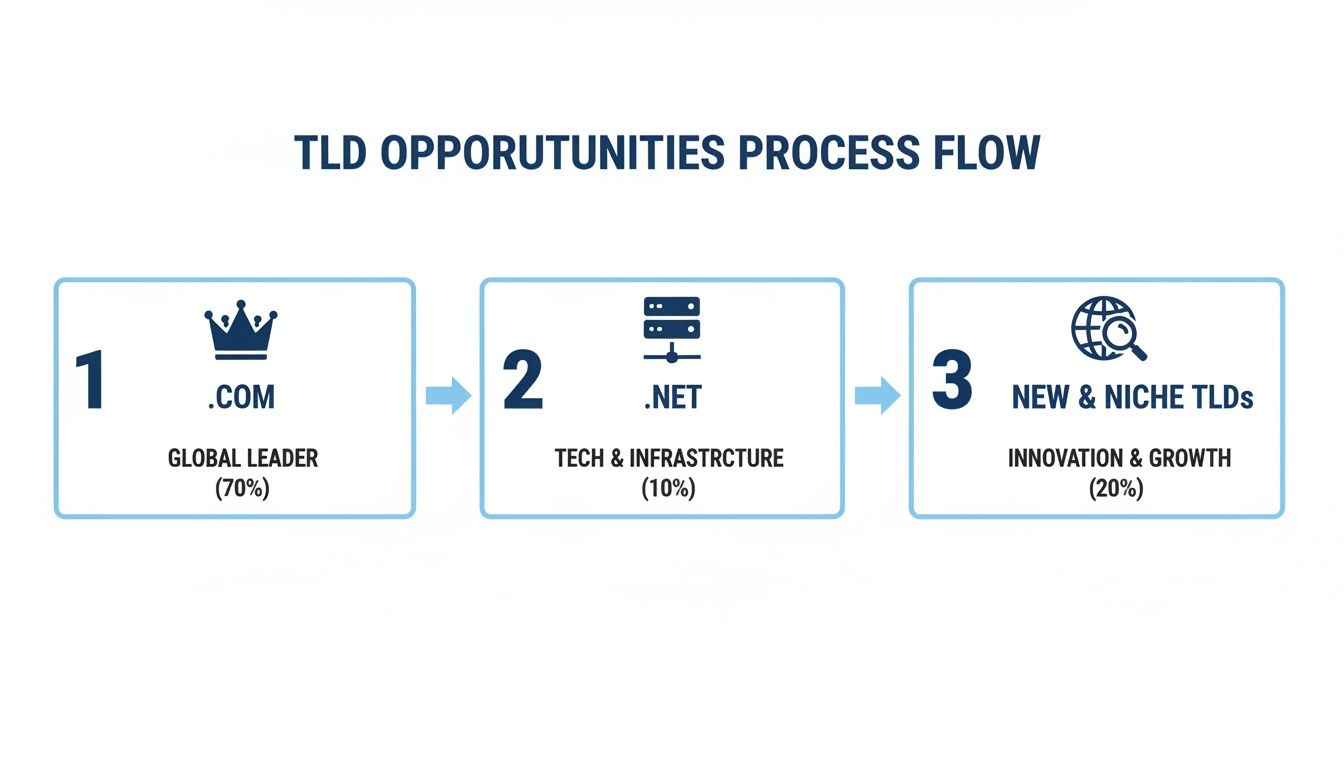
As the graphic shows, while the ultimate prize might be a .com, a smart alert system can uncover serious value in less-contested TLDs like .net. Don't sleep on them.
Choosing Your Notification Channels
Once your alerts are dialed in, the last piece of the puzzle is making sure you get them instantly, no matter where you are. Speed is everything. A domain can drop while you're in a meeting, making coffee, or away from your desk entirely.
Most serious monitoring tools will give you a few options for notifications:
- Email Alerts: These are great for a detailed summary you can review later. Think of it as a daily or weekly digest of domains that met your criteria.
- SMS Alerts: This is your "go button." For your most important Watchers—the ones targeting high-value, blink-and-you'll-miss-it domains—an SMS alert is non-negotiable. It hits your phone instantly, letting you act within seconds.
By setting up both, you create a fail-safe. The SMS gives you the immediate heads-up, and the follow-up email provides the detailed metrics you need for a final, quick gut check before you race to the registrar. For more on this, our guide on using a domain name monitor dives even deeper into these strategies.
This automated approach transforms domain hunting from a soul-crushing chore into an efficient, strategic operation. You define what a perfect domain looks like, and the system goes out and finds it for you, giving you the edge you need to grab valuable available four letter domains before anyone else even knows they're gone.
Frequently Asked Questions About Four Letter Domains
Diving into the world of four-letter domains can feel a bit like learning a new language. You've got expiring versus available, metrics to decipher, and the nagging question of what's actually valuable. Let's cut through the noise and tackle the questions that always seem to pop up.
Think of this as your quick-reference guide. It's the stuff I wish someone had told me when I started, designed to help you sidestep the usual beginner traps and make smarter decisions.
Are All Four-Letter Domains Valuable?
Absolutely not, and this is probably the most critical lesson to learn early on. While pure scarcity gives them a certain appeal, a domain's real value comes from a mix of its brandability, its history, and its SEO profile. A random jumble of letters like 'XQJZ.com' is functionally worthless. It has no brand value. Compare that to a pronounceable CVCV (consonant-vowel-consonant-vowel) name like 'FOHO.com', and you can see the difference.
A domain's value is not in its four letters, but in its memorability and its story. A name with a history of spam or a Google penalty is a liability you're buying, not an asset.
True value emerges when a memorable name also comes with a clean, powerful backlink profile. This is precisely why you can't just guess. You have to use tools that let you dig into metrics like Trust Flow and backlink quality. That data tells you the story behind the name, helping you spot a hidden gem instead of walking into a trap.
What Is the Difference Between Available and Expiring Domains?
Getting this distinction right is crucial; it will shape your entire strategy. Mixing them up just means you'll waste a lot of time chasing domains you can't actually get.
Available Domains: These are often called "dropped" domains. They have gone completely through the expiration cycle because the previous owner didn't renew. Now, they're back in the public pool, ready for anyone to register immediately at a standard registrar like GoDaddy for a normal fee. When a platform like NameSnag shows a domain as "available," you can act on it right now.
Expiring Domains: These are domains that have passed their renewal date but are still stuck in a "grace period." The original owner can still swoop in and renew them, so they are not yet public. You can't just go register one. The reason tools show you these is to give you a heads-up, letting you prepare to place a backorder or get ready for the exact moment it might drop.
Basically, browsing Available domains is like shopping off the rack. Watching Expiring domains is like getting a sneak peek at next season's collection before it hits the store.
How Quickly Do I Need to Act on a Good Available Domain?
You need to be fast. And by fast, I don't mean hours or even minutes. I mean seconds.
High-quality four-letter domains, especially .com names with solid SEO metrics, can get snapped up within seconds of dropping. This is largely an automated game now. Savvy investors run scripts—bots—that constantly scan for valuable dropped domains and register them the instant they become available.
This is why a real-time alert system isn't a luxury; it's a necessity. An SMS alert the moment a domain on your watchlist drops gives you a fighting chance to get to your registrar and claim it by hand. For the absolute best names, a backordering service is often the only realistic shot. But for many hidden gems you uncover, being quick on the draw after an alert can be all it takes.
Can I Really Find a Good Four-Letter .Com Domain Today?
Yes, you absolutely can, but with one major caveat. You're not going to find one by just typing names into a registrar and hoping they're unregistered. We already know that every single possible four-letter .com combination was registered by the end of 2013. The only way to get one now is to catch one that an existing owner lets expire.
Millions of domains expire every year for all sorts of reasons. The owner forgot to renew, the business went under, the project was abandoned. This creates a constant, churning river of opportunity.
The secret is to use a service that watches this churn for you. Instead of trying to guess which of the 456,976 names might be dropping, you use a platform that scans them daily, analyzes their SEO value, and flags the ones with a clean history and strong metrics. This is how you sift through the mountains of junk to find genuinely valuable available four letter domains.
Ready to stop guessing and start finding? NameSnag uses powerful analytics to scan over 170,000 expiring and dropped domains daily, so you can find the hidden gems with real SEO power and brand potential. Find your next high-value domain with NameSnag today.
Find Your Perfect Domain
Get access to thousands of high-value expired domains with our AI-powered search.
Start Free Trial