You've probably got a spreadsheet open right now. It's full of domains with hopeful little notes beside them. “Maybe good.” “Check backlinks.” “Looks aged.” “Review later.” That sheet feels productive until you realize it's become a parking lot for decisions you never made.
That was the old trap. Copy a domain. Paste it into a checker. Wait. Repeat. Half the list turns out to be junk, the other half gets stale while you're still “researching,” and the few worthwhile names disappear before you act. Manual review feels careful, but most of the time it's just slow motion procrastination with tabs.
A solid Domain Authority checker bulk workflow fixes that. Not because DA is magic. It isn't. It fixes the actual problem, which is turning a messy pile of possible domains into a short list you can trust enough to move on quickly.
Why Your Spreadsheet Is a Graveyard of Lost Opportunities
The ugly part of domain hunting isn't finding names. It's qualifying them before someone else does.
Individuals often collect first and judge later. They scrape lists, export marketplace results, pull expired domains, bookmark a few random finds, then dump everything into one heroic spreadsheet. Then comes the ritual. Open checker. Paste one domain. Glance at authority. Open another tab. Check backlinks. Open archive history. Lose the tab. Start over.
That process doesn't just waste time. It creates hesitation. And hesitation is expensive in domain investing because the domain you finally decide is “pretty good” is often the same one someone faster already grabbed.
The manual method breaks at scale
The web is too big for one-by-one review. The internet now has over 1.1 billion websites, which is why manual authority verification is impractical for large campaigns, according to the verified industry summary above. Bulk tools evolved for that reason, moving from tiny batches in the early days to much larger batch processing as workflows matured.
Even if you're not an agency, scale still catches up with you. A domain investor can burn a whole afternoon just checking a modest list. An SEO team can burn a whole week arguing over which prospects deserve outreach. Neither group is doing the actual money-making work during that time.
Practical rule: If your process requires you to look up every domain before the list is filtered, your process is backwards.
Why spreadsheets become domain cemeteries
A dead spreadsheet usually has three problems:
- No prioritization: Good domains sit next to obvious trash, and everything gets the same attention.
- No filtering logic: You haven't decided what counts as “good enough,” so every row becomes a debate.
- No action layer: Even after scoring, nothing routes into a watchlist, buy list, outreach queue, or drop alert.
That's how “research” turns into hoarding.
I've seen people spend more time coloring cells than deciding whether a domain is worth chasing. Green for DA, yellow for backlinks, red for spam, then the file gets closed and nobody touches it again. That's not a workflow. That's digital composting.
The better way
A bulk checker should act like a bouncer. Most domains should get rejected fast. You want a system that lets weak candidates fail early, so your attention goes to the handful that deserve manual inspection.
The primary shift is mental. Stop treating domain review like a scavenger hunt. Treat it like triage. Bulk first. Human judgment second.
Sourcing High-Potential Domains for Your Bulk Check
Bad inputs create fake confidence. If your source list is trash, your authority metrics will only help you sort trash more efficiently.
The smart move is to start with domains that are in play. That means domains you can register now, or domains likely to become available soon. Freshly dropped names and expiring names are where a bulk process starts paying for itself because you're analyzing assets you can realistically act on.
Start with domains that have a path to acquisition
For immediate opportunities, use lists of available domains. Those are domains that have already dropped and can be registered right away at a registrar. This is the fast lane. If your authority check and backlink review come back clean, you can move.
For strategic hunting, build a queue from expiring domains. Those names are in the grace-period zone and may drop soon. In such cases, patient buyers get an edge, especially when a domain looks promising but isn't yet available to register.
Time filters matter more than people think. “Today” is useful when you want fresh action. Broader windows like 7, 14, or 30 days are better when you're hunting patterns, comparing niches, or building a backlog for later review.
Build a list that deserves your API credits
Use a simple sourcing stack:
- Pull fresh available names for immediate registration opportunities.
- Add expiring names that fit your niche, brand, or link profile goals.
- Group by intent, such as rebuild candidates, redirect candidates, resale candidates, or outreach targets.
- Remove obvious junk before any authority check. Spammy strings, broken branding, and nonsense terms don't deserve metric calls.
- Tag anything with niche relevance so later filtering doesn't flatten all opportunities into one pile.
A lot of people skip that last step and regret it. A domain with modest authority but strong niche fit can be far more useful than a generic domain with a prettier score and useless history.
Freshness matters. A clean list of currently available or soon-to-drop names beats a giant export of stale “possibles” every time.
If you want a broader view of where these lists come from and how to compare discovery tools, this guide to the best expired domain finder is worth reading before you start feeding random domain lists into a checker.
What I throw out before checking anything
I reject domains early if they look like:
- Auto-generated junk: Weird hyphen chains, awkward number strings, and obvious machine-made sludge.
- Trademark bait: Not worth the headache.
- Topically useless leftovers: A high metric won't rescue a domain that doesn't fit your use case.
- Names with no believable resale or rebuild angle: If I can't explain why I'd want it, I don't waste a check on it.
Bulk authority checking works best when the source list already has some standards. Otherwise, you're just building a faster shovel for the same pile of dirt.
Choosing Your Bulk Checker Weapon from Free Tools to APIs
A bad tool choice wastes the list you just cleaned.
I learned that the expensive way, by running solid domain lists through random free checkers, then wondering why the exports were inconsistent, the batches failed, and half the names needed to be checked again somewhere else. The problem was never the domains. The problem was using the wrong checker for the job.
The decision is simple. How many domains are you checking, how often, and what happens after the scores come back?
Free tools for small checks
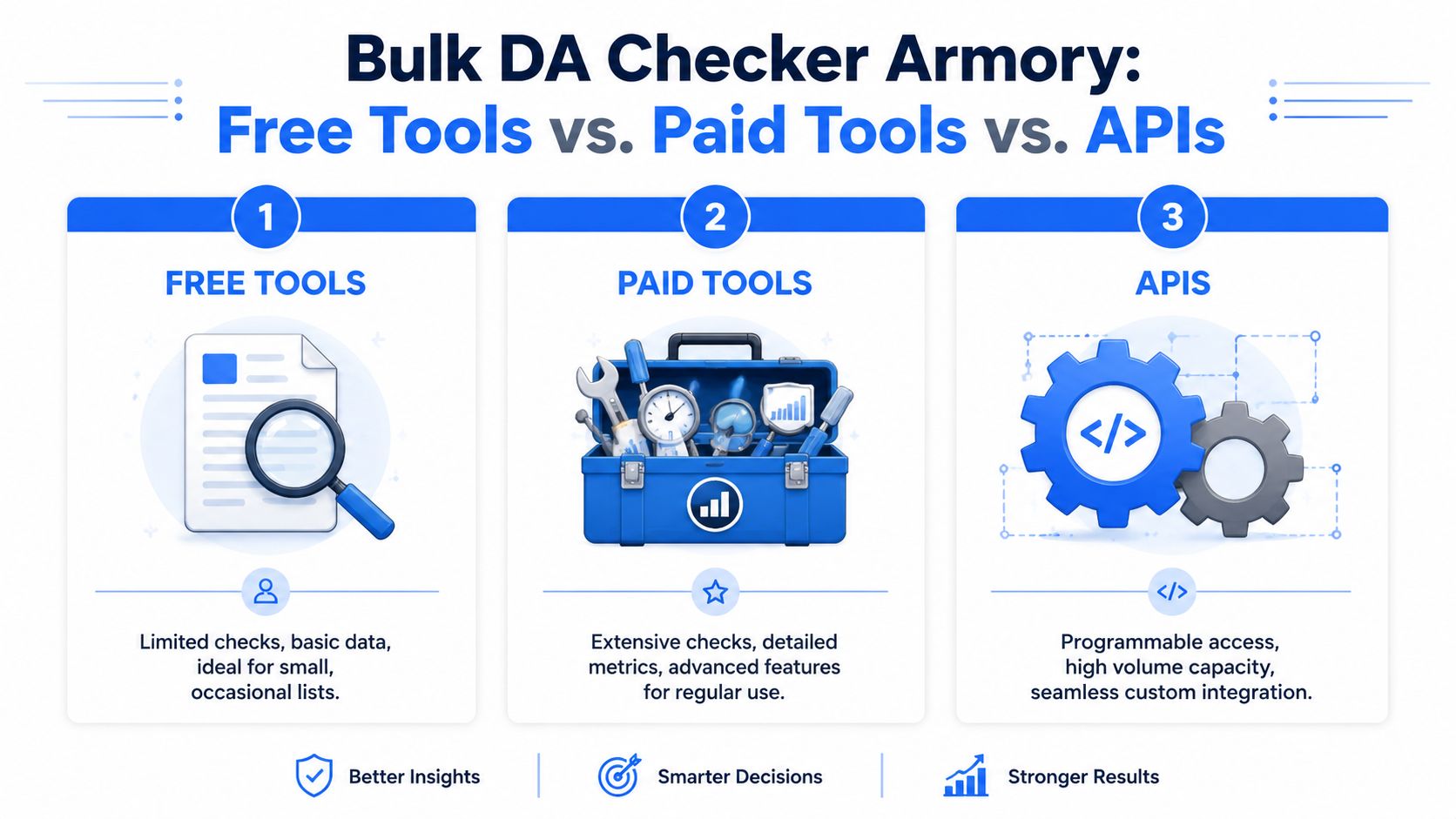
Free browser tools are fine for spot checks. They are not a system.
Verified guidance from Bishopi's bulk checker workflow says browser tools fit very small checks, while web-based bulk tools handle only modest batches before the workflow starts to break down. That matches real-world use. Free tools help when you want a quick read on a few names, sanity-check a shortlist, or decide whether a source list deserves paid lookups.
Use free tools when:
- You're checking a few domains by hand
- You want a quick pass before spending money
- You only need rough directional data
Skip them if you plan to export, sort, filter, and act on the results at scale. Rate limits, missing fields, and inconsistent outputs turn a quick test into rework.
Paid platforms for regular domain hunting
Paid platforms are the practical middle ground. Serious buyers, SEO operators, and brokers should start with these if they process lists every week but do not want to maintain scripts.
A decent platform gives you batch checking, exports, and enough supporting metrics to make decisions without pretending DA alone is the whole story. That matters because the check itself is only one step. You still need to qualify the domain, compare it against similar candidates, and decide whether it belongs in a buy pile, rebuild pile, watchlist, or trash bin.
Here's the trade-off:
| Tool type | Best for | Weak spot |
|---|---|---|
| Free tools | Quick spot checks | Limited batch size and thin data |
| Paid platforms | Recurring prospecting and filtering | Less flexible than a custom workflow |
| APIs | High-volume processing and automation | Setup time and maintenance |
Paid tools also play well with adjacent tasks. After you qualify a domain, you may want to enrich the record instead of stuffing every job into one bloated checker. For outreach or due diligence, you can scan domains for email addresses separately and keep authority scoring focused on qualification.
If you're already hitting the ceiling on batch limits and exports, this guide to choosing a domain authority checker API for larger workflows will save you from buying the wrong stack twice.
APIs for volume and control
APIs are what you use when domain checking stops being a task and becomes a pipeline.
If you review big drop lists, run recurring prospecting, or score domains as part of a larger investing process, an API gives you consistency. The same rules get applied every time. The same fields land in the same columns. The same filters can trigger the same action without you babysitting browser tabs.
That matters more than people admit. Manual checking fails in boring ways. Someone forgets a filter. Someone copies the wrong column. Someone reruns a partial list and overwrites the clean data. APIs cut out that sloppiness.
As noted earlier, larger lists work better in an API-driven process. The win is not just speed. The win is what happens after the pull. You can route stronger domains into one queue, send edge cases into manual review, and ignore junk automatically. That is the difference between checking metrics and running a domain acquisition system.
Here's a useful walkthrough before you decide how technical you need to get:
APIs make sense when:
- You process domain lists constantly
- You want the same qualification rules every time
- You combine authority data with other signals in sheets, scripts, or internal tools
- You're tired of repeating manual checks
A free checker is fine for curiosity. A paid platform is fine for regular hunting. An API is what you use when you want the data to lead somewhere useful instead of dying in a spreadsheet.
Running Your Bulk Check Like a Pro
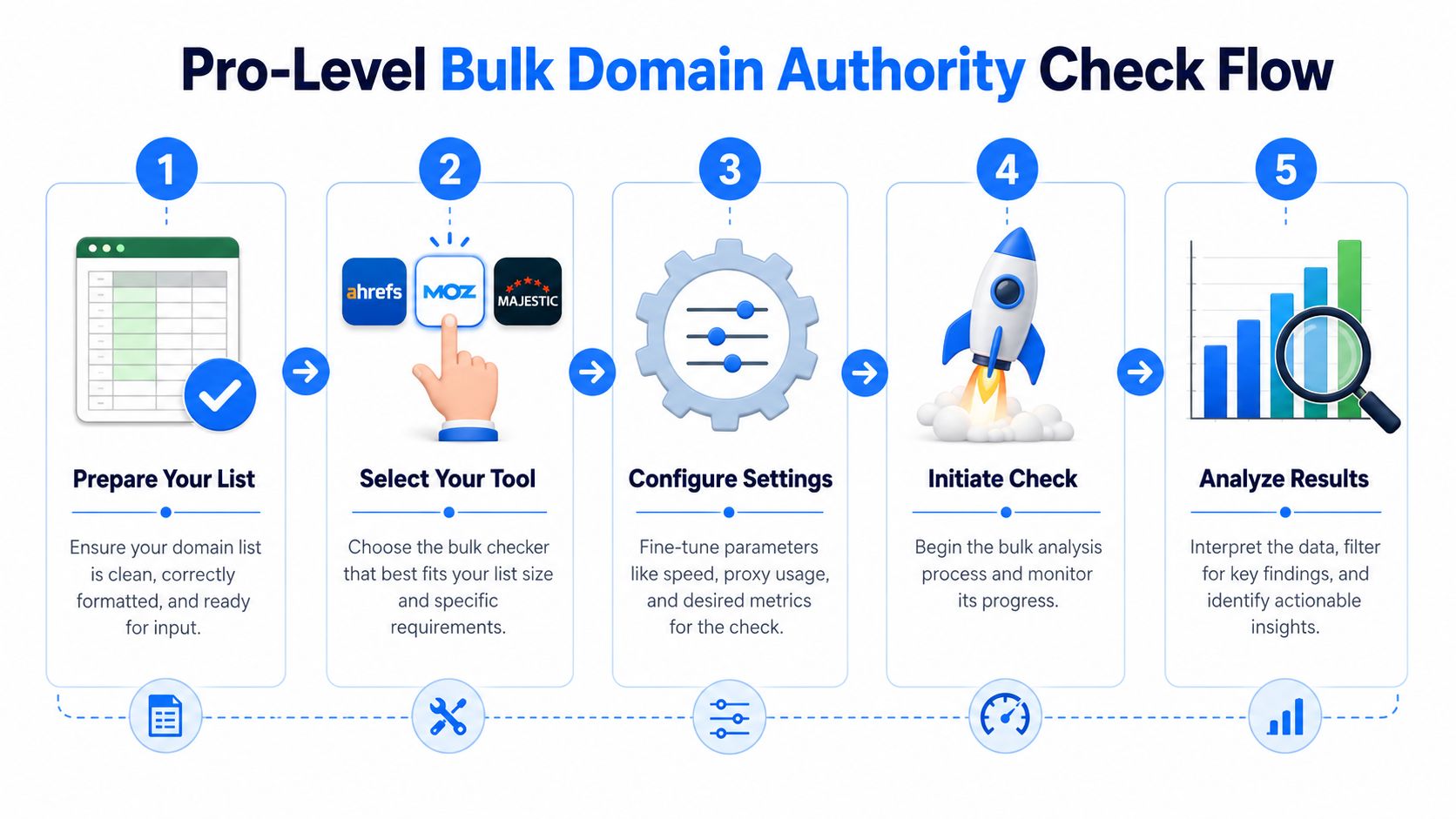
A bulk check falls apart long before the scoring stage if your input list is messy. Duplicate rows, mixed URLs and root domains, protocol junk, and stray subdomains will wreck your results and make good domains look inconsistent.
The cleanest operators treat prep as part of the check, not a chore before it.
Clean the list before you spend a single lookup
A few sheet formulas save a lot of grief. If your list includes full URLs, strip them down to domains before uploading. If the data source is inconsistent, standardize everything into one format first, then deduplicate.
A practical cleanup routine looks like this:
- Normalize inputs: Convert URLs to root domains only.
- Remove duplicates: One domain, one row. No exceptions.
- Split giant lists into batches: Smaller batches are easier to monitor and retry.
- Tag source and intent: Keep “available,” “expiring,” “brandable,” or “niche” in separate columns.
If you're working in Google Sheets, even basic text cleanup functions can do a lot of the dirty work. The point isn't elegance. The point is to stop feeding malformed data into your checker and then blaming the output.
Batch with intention, not optimism
Big uploads fail for boring reasons. Timeouts. Rate limits. Bad rows. Temporary API hiccups. The fix is not “hope harder.” The fix is controlled batching.
I like to break large lists into chunks tied to action. One batch for names I can buy now. One for expiring watchlist candidates. One for oddballs that need deeper manual review. That makes retries painless and keeps your final output usable.
Don't make one giant batch unless you enjoy debugging one giant failure.
Use this simple decision frame:
| Situation | Better move |
|---|---|
| Tiny shortlist | Run one batch and review manually |
| Medium list | Split by source or niche |
| Very large list | Queue in batches and automate exports |
Respect rate limits if you're using an API
If you go the script route, keep it boring. Boring scripts survive. Fancy ones break at 2 a.m.
The essentials are straightforward:
- Read domains from a CSV or sheet export
- Send requests in controlled batches
- Pause between requests if the provider requires it
- Write every response to a file immediately
- Log failures for retry instead of rerunning everything
If you're using Python, that means simple loops, request throttling, and saving partial results often. You don't need a software engineering degree. You need discipline. The most common amateur mistake is trying to fire everything at once, then wondering why half the rows came back blank.
Filter before manual review
Once results land, don't stare at the whole sheet. Filter aggressively. Put your thresholds in place first, then inspect survivors.
That's the proper pro move. Manual review belongs at the end of the funnel, not the beginning.
I also keep a “suspect” bucket for anything that almost passes. Sometimes a domain misses one metric but still has enough relevance or brand potential to justify a second look. The point is to make that second look selective, not automatic.
Looking Beyond Domain Authority to Find Real Gems
A batch report lands. One domain is sitting there with a fat DA score, and ten minutes later somebody has already convinced themselves it is a steal. Then you check the anchors, look at the old snapshots, and find a graveyard of spun content, foreign forum links, and expired junk redirects. I have watched people burn good money that way for years.
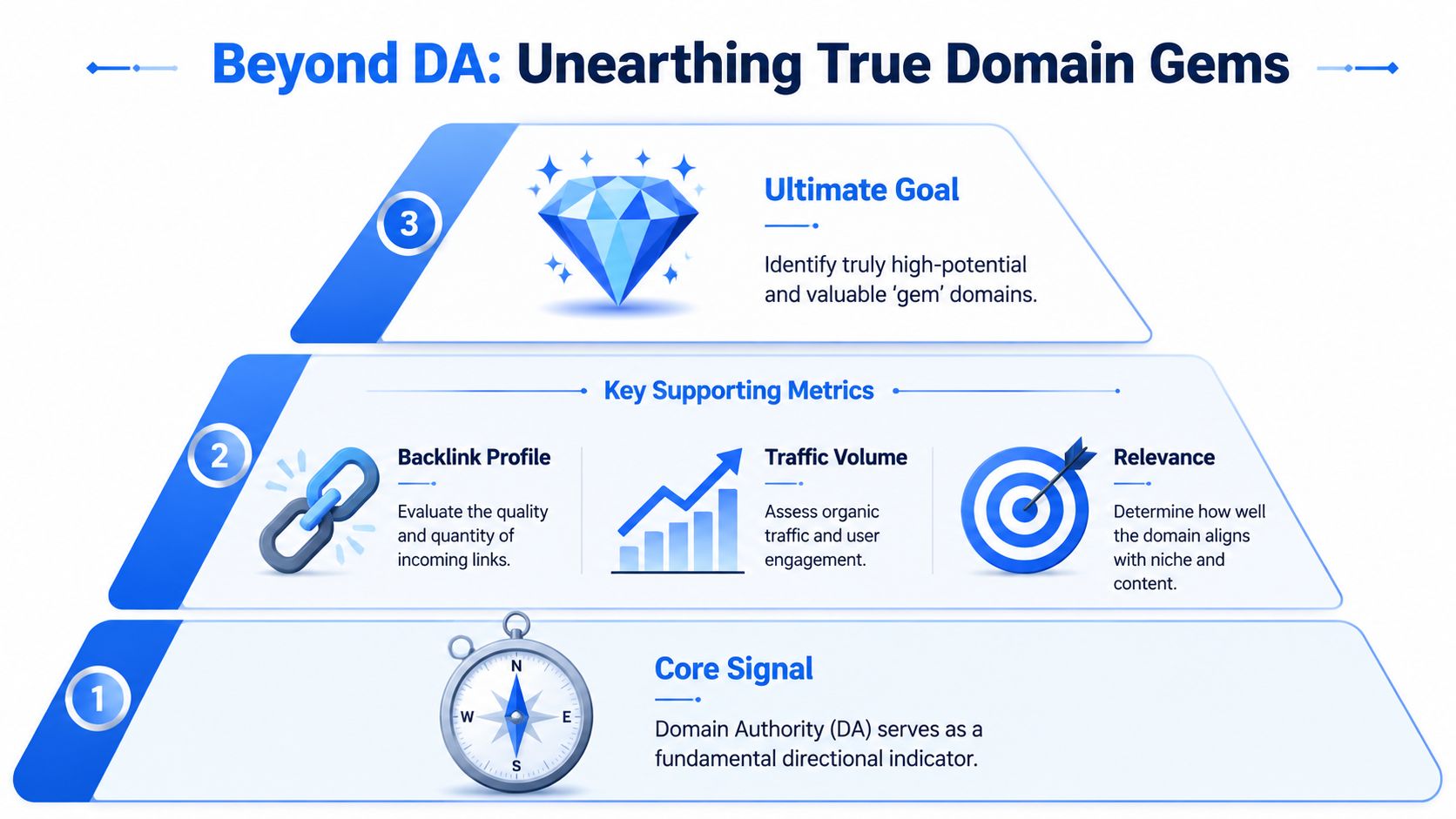
Domain Authority is still useful. Moz created it as a 1 to 100 predictive score, and its scale is logarithmic, which is why climbing from a middling number gets harder as you go higher. Moz explains that directly on its Domain Authority documentation. That context helps you read the column correctly. It does not tell you whether the domain is clean, relevant, or worth owning.
DA is a starting filter, not a buy signal
The mistake is simple. Buyers see one strong metric and stop asking questions.
Ahrefs says as much on its website authority checker. DR measures backlink strength. Moz says DA estimates ranking potential. Useful proxies, yes. Final verdicts, no.
A domain can post a solid authority score and still be useless if the links are irrelevant, the anchor text is poisoned, or the site history is a mess. I care more about signal agreement than headline numbers. If authority, referring domains, topical fit, and spam checks point in the same direction, I keep digging. If they fight each other, I move on.
What a real candidate looks like
The names worth a second pass usually share a few traits:
- Authority that fits the profile: The score should match what you see in the backlink data, not float way above it for no obvious reason.
- Referring domains that look earned: A smaller set of relevant links often beats a huge pile of junk.
- Anchor text that looks human: Brand, URL, and natural topic phrases are fine. Casino, pills, and exact-match nonsense are how bad buys happen.
- Topical relevance: A domain with links from the right corner of the web gives you more options than a random strong-looking name with no connection to your target use.
- Clean enough history: Not perfect. Clean enough that you are not inheriting somebody else's penalties, spam campaigns, or burned-out brand.
If you need a refresher on why link quality matters more than raw link count, this comprehensive backlink guide covers the basics well.
A boring domain with a clean profile often outperforms a flashy one with baggage. That is not theory. That is the kind of mistake that empties budgets.
Use composite judgment, not score worship
Experienced buyers separate themselves from spreadsheet tourists. They do not ask only, “How high is the DA?” They ask, “Does this domain give me a usable asset once I factor in risk, relevance, and cleanup cost?”
That is why I prefer blended evaluation over single-metric sorting. Authority gets a domain into the review pile. Backlink quality, age, historical use, and spam risk decide whether it stays there. If you want a clearer framework for combining those signals, this breakdown of domain score explains why one number rarely captures the whole picture.
Common ways people talk themselves into bad buys
These mistakes keep showing up:
- Buying on DA alone
- Ignoring spam flags because the score looks exciting
- Comparing domains from unrelated niches as if the same thresholds apply
- Assuming authority means a clean ownership or content history
- Confusing ranking proxies with actual resale or build value
Bulk checking saves time. It does not replace judgment.
That's where the actual judgment starts.
Turning Bulk Data Into a Domain-Grabbing Machine
You spend an hour cleaning a list, run the bulk check, spot a few strong candidates, then get distracted. Two days later, one is registered, one drops into auction, and the rest blur back into the pile.
That is how good domains get lost.
The bulk check is only the middle of the job. The real edge comes from what happens after the scores come back. Buyers who treat the report like a final answer usually end up with a messy spreadsheet and a weak hit rate. Buyers who build a simple action system turn the same raw list into actual acquisitions.
Build an action layer after filtering
Every domain that survives your first pass should go somewhere specific. No floating maybes. No giant tab called “good ones.”
I sort qualified names into four buckets:
- Buy now list: Available domains that cleared your filters and deserve a same-day decision.
- Watchlist: Expiring domains, auction candidates, or names with upside that are not actionable yet.
- Manual review queue: Domains that need archive checks, backlink spot checks, or trademark review before money goes out.
- Reject file: Domains with enough baggage, weak fit, or fake-looking authority that they should stay dead.
The reject file saves more time than people expect. If you do not keep one, bad domains keep coming back dressed as “maybe” every time you import a fresh list.
Turn scores into decisions
A high DA is not a green light. It is triage.
The next step is operational. Is the domain available now. Is it heading to auction. Does it need a Wayback check before you touch it. Is the backlink profile clean enough to build on, or will cleanup eat the margin. Those questions decide whether a name belongs in your cart, on a calendar, or in the trash.
This is the part spreadsheet-only buyers skip. Then they wonder why their list looked great on paper and lousy in practice.
Reduce the delay between review and action
Speed matters after qualification because domain opportunities decay fast. A clean domain that fits your thesis should not sit in a sheet waiting for “later.” Later is how someone else gets it.
I prefer a routine that forces a next step immediately:
- Available and clean: buy or reject the same day.
- Expiring soon: add alerts and note the target venue.
- Borderline but interesting: assign a manual review deadline.
- Dirty or off-strategy: move it to reject and stop thinking about it.
That one habit fixes a lot. It cuts hesitation, reduces repeat work, and keeps your best names from disappearing into spreadsheet purgatory.
Good bulk analysis saves time. Good follow-through wins domains.
Treat the process like a pipeline. New lists come in. Weak names get filtered out. Viable names get routed to an action queue. Reminders and alerts keep the queue moving. That is how bulk checking stops being a vanity report and starts acting like an acquisition system.
If you want a faster way to turn raw domain lists into something actionable, NameSnag is built for exactly that grind. It helps you discover available and expiring domains, surface stronger candidates with composite scoring, and cut through the junk before you waste time checking names you were never going to buy anyway.
Find Your Perfect Domain
Get access to thousands of high-value expired domains with our AI-powered search.
Start Free Trial