Finding expiring domains for sale is a bit like stumbling upon a digital treasure chest. You're not just buying a name; you're acquiring a web property with a pre-built history, established authority, and sometimes, a motherlode of valuable backlinks. This gives you a massive head start, letting you bypass the dreaded "Google Sandbox" and hit your SEO goals way faster than starting from scratch.
The Hidden Value in Expiring Domains
Ever feel like you're shouting into the void with a brand-new website? Building authority from zero is a slow, painful grind. You create incredible content, but for months, it feels like Google doesn't even know you exist.
This is where the magic of expiring domains comes into play.
Think of it this way: instead of building a house on an empty lot, you're buying a property with a solid foundation already poured. These domains were once active websites, collecting backlinks and earning trust from search engines over years. When the previous owner forgets to renew, that accumulated value doesn't just vanish—it becomes available to the next savvy owner who knows what to do with it.
Why Bother with Someone Else's Old Domain?
The opportunity is massive. Every single day, over 150,000 domains expire or fail to renew worldwide. This creates a constant, churning river of high-value assets for those who know where to look. It's also why platforms like NameSnag are so crucial; sorting through that much noise to find the actual gems is a full-time job in itself.
This isn't just about grabbing any old domain. It's about strategically acquiring assets that can seriously accelerate your projects. Here’s what makes them so powerful:
- Instant Authority: An aged domain with quality backlinks is seen as more trustworthy by search engines right out of the gate.
- Established Backlink Profile: You inherit a network of links that would have taken months, if not years, to build from scratch.
- Faster Indexing and Ranking: Google is already familiar with the domain, which often leads to quicker indexing of your new content.
Understanding the Different Use Cases
Not all expiring domains are used the same way. The right strategy depends entirely on your end goal. For some, it's a shortcut to SEO success; for others, it's a pure investment play.
To get a better sense of the timeline you're working with, it helps to understand the lifecycle of an expiring domain.
The Expired Domain Lifecycle: What You Need to Know
This table breaks down the key stages a domain goes through from expiration to availability, helping you understand when to act.
| Stage | Typical Duration | What It Means for You |
|---|---|---|
| Grace Period | 0-45 Days | The original owner can still renew, usually at the standard price. The domain is offline but not yet available. |
| Redemption Period | 30 Days | The owner can still reclaim the domain, but now with a hefty redemption fee. It's still locked. |
| Pending Delete | 5 Days | The final stage. No one can renew or recover the domain. It's about to be released to the public. This is the window backorder services target. |
| Available | - | If no one snags it through a backorder, the domain becomes publicly available for anyone to register at the standard price. |
Once you have a target, the real fun begins. For a deeper dive, check out our complete guide on using expiring domains for SEO.
Here are the most common ways people put these digital assets to work:
- Build a Niche Authority Site: Find a domain that already has topical relevance and backlinks in your niche, then build a new website on it. This can slash the time it takes to see organic traffic.
- Strengthen Your Main Website: Use a 301 redirect to pass the "link juice" from a powerful, relevant expired domain to your primary money site. It's a classic move for a reason.
- Private Blog Network (PBN): Create a network of authoritative sites that you control to build powerful, targeted links to your main projects. (Use with caution!)
- Flip for Profit: Buy undervalued domains, hold them, and sell them later on marketplaces for a handsome profit. It's a lot like digital real estate.
How To Pinpoint High-Value Expiring Domains
Finding a great expiring domain for sale feels a lot like panning for gold. You’re wading through tons of silt and gravel, but every now and then, you find a shiny nugget of pure SEO value. The secret isn't just luck; it's knowing how to sift through all that noise efficiently. And that always starts with a clear, focused strategy.
Before you even think about typing a keyword into a search bar, you've got to ask yourself one question: "What's my goal here?" The answer changes absolutely everything. Your objective is the compass that guides your entire search, making sure you don't waste hours on domains that are useless for your mission.
Are you hunting for a domain to build a brand-new niche site from scratch? If so, things like topical relevance and brandability should be at the top of your list. Or maybe you're an SEO pro looking for a domain with raw authority to 301 redirect to your main site. In that case, metrics like Trust Flow and the quality of its referring domains are king.
Setting Your Search Parameters
Once your goal is locked in, it's time to get tactical. A scattergun approach is just a recipe for frustration. What you need are filters to narrow that vast ocean of expiring domains down to a manageable pool of high-potential candidates. Think of it like creating a "buyer's profile" for your ideal domain.
This starts with a few foundational filters:
- Keyword Filters: Look for domains that contain your main niche keywords. If you're building something in the pet care space, starting your search with "dog," "cat," or "pet" is just common sense. It ensures topical relevance right out of the gate.
- Metric Minimums: Don't waste your time analyzing weak domains. Set some minimum thresholds for key metrics, like a Trust Flow of 10+ or a specific number of referring domains. This way, you're only looking at domains that already have some authority.
A Practical Walkthrough With NameSnag Filters
This is where a powerful tool makes all the difference, turning what could be hours of manual digging into a few simple clicks. Let's say you're building a finance blog and you want a domain with some serious credibility baked in. You can use NameSnag’s filters to instantly find domains that have backlinks from .edu or .gov websites—links that search engines trust immensely.
Now, let's put this into action. You'll be looking at two main buckets of domains, and each has its own strategic advantage.
First, you have the domains you can grab right now. These are domains that have finished their expiration cycle and are ready for immediate registration.
Pro Tip: When you find a fantastic available domain, speed is everything. Have your registrar account logged in and your payment details ready to go. The best ones get snatched up in minutes, sometimes even seconds, after they drop.
To find these, you’d use the "Available" filter. You can pop over to NameSnag and see a real-time list of Available domains that you can register at any standard registrar instantly. This is perfect for when you need a domain for a project you're starting today.
On the other hand, sometimes the truly great domains are the ones that are about to drop. They’re still in their grace or redemption period. You can't register them immediately, but you can plan your attack, whether that means gearing up for an auction or placing a backorder. For a deeper dive into the tools out there, our guide on choosing an expired domain finder offers more context.
To scout these upcoming opportunities, you'd switch over to the "Expiring" filter. This shows you a list of Expiring domains that will become available soon, giving you a strategic head start.
Using Time Filters To Beat The Competition
The world of expiring domains moves incredibly fast. A domain that's available now could easily be gone in five minutes. To stay ahead of the curve, using time-based filters is non-negotiable.
Both the "Available" and "Expiring" searches on NameSnag have time filters that let you zero in on the freshest opportunities. You can set them to:
- Today: See only the domains that have dropped or entered the expiring phase in the last 24 hours. This is your go-to for daily hunting.
- 3 Days: Widen the net just a bit to catch recent gems you might have missed over the weekend.
- 7 Days or More: This is useful for broader research or trying to spot trends in a niche.
By combining keyword filters, metric minimums, and time-sensitive searches, you turn a chaotic treasure hunt into a precise, strategic operation. You'll spend way less time wading through junk and more time evaluating high-quality candidates that can actually move the needle for your projects.
Evaluating Domains Beyond the Metrics
Metrics like Domain Authority or Trust Flow are a decent first filter for sorting through a mountain of expiring domains for sale. They give you a quick, high-level snapshot. But relying on them alone is like buying a used car just because the odometer is low—it tells you almost nothing about what's actually under the hood.
A domain might flash an impressive score, but that number could be juiced by thousands of spammy, low-quality backlinks from random foreign blogs or sketchy directories. It's a classic trap. To find the real gems, you've got to put on your detective hat and look past the surface-level numbers.
This is where the real work—and the real opportunity—begins. The metrics get you in the ballpark, but a deep dive into a domain's history, backlink quality, and overall vibe is what separates a killer investment from a costly mistake.
Digging into the Domain's Past Life
Before you even think about placing a bid, you absolutely have to check the domain's history. What was this website before it dropped? Was it a legit business, a personal blog, or some spam-filled link farm? Your best friend for this is the Wayback Machine.
Just plug the domain into the Wayback Machine, and you can see snapshots of the site from years back. You're looking for two things: consistency and relevance.
- Topical Relevance: Did the old site's topic make sense for what you want to do? A domain that was once a blog about dog grooming is a fantastic fit for a new pet care site.
- Clean History: Keep an eye out for red flags. Hacked content, pages that suddenly switch to foreign languages, or signs it was part of a PBN are all bad news. If anything looks sketchy, just walk away.
A domain's history is its digital DNA. A clean, relevant past means you're building on solid ground. A sketchy history means you're inheriting problems that could haunt your SEO efforts for years.
This step is completely non-negotiable. A domain with a toxic past can carry Google penalties that are incredibly difficult to shake off, no matter how good its metrics look on paper.
Assessing Backlink Quality, Not Just Quantity
I'll take a domain with 50 high-quality, relevant backlinks over one with 5,000 links from junk sites any day of the week. The key is to actually look at the referring domains—the websites linking to your target domain. Are they authoritative sites in your niche, or are they worthless spam?
NameSnag helps by verifying domains are spam-free, but you should still do your own spot-checks. You want to see links from respected blogs, industry news sites, or maybe even universities. Those are the links that carry real weight with search engines. A handful of powerful links from the right sources can provide a massive SEO boost right out of the gate.
The expired domain aftermarket is booming, currently valued at $0.64 billion and projected to hit $1.17 billion by 2033. This growth is fueled by people who get it—they understand the immense power of inheriting a clean, authoritative backlink profile instead of building one from scratch. You can dig into these market trends and domain registration stats from recent industry analysis.
Is the Domain Actually Brandable?
SEO metrics are vital, but don't forget the human element. A great domain has to be brandable. It needs to be memorable, easy to spell, and ideally, short and punchy. A name like BestDogTrainingTipsOnline.com is descriptive, sure, but it’s a mouthful. Something like Pawsitive.com is far more brandable and has a professional feel.
Ask yourself these simple questions:
- Is it easy to say and spell?
- Is it short and memorable?
- Does it sound like a real brand?
- Does it have a clean, positive feel to it?
Your ultimate goal will really determine which factors you should prioritize.
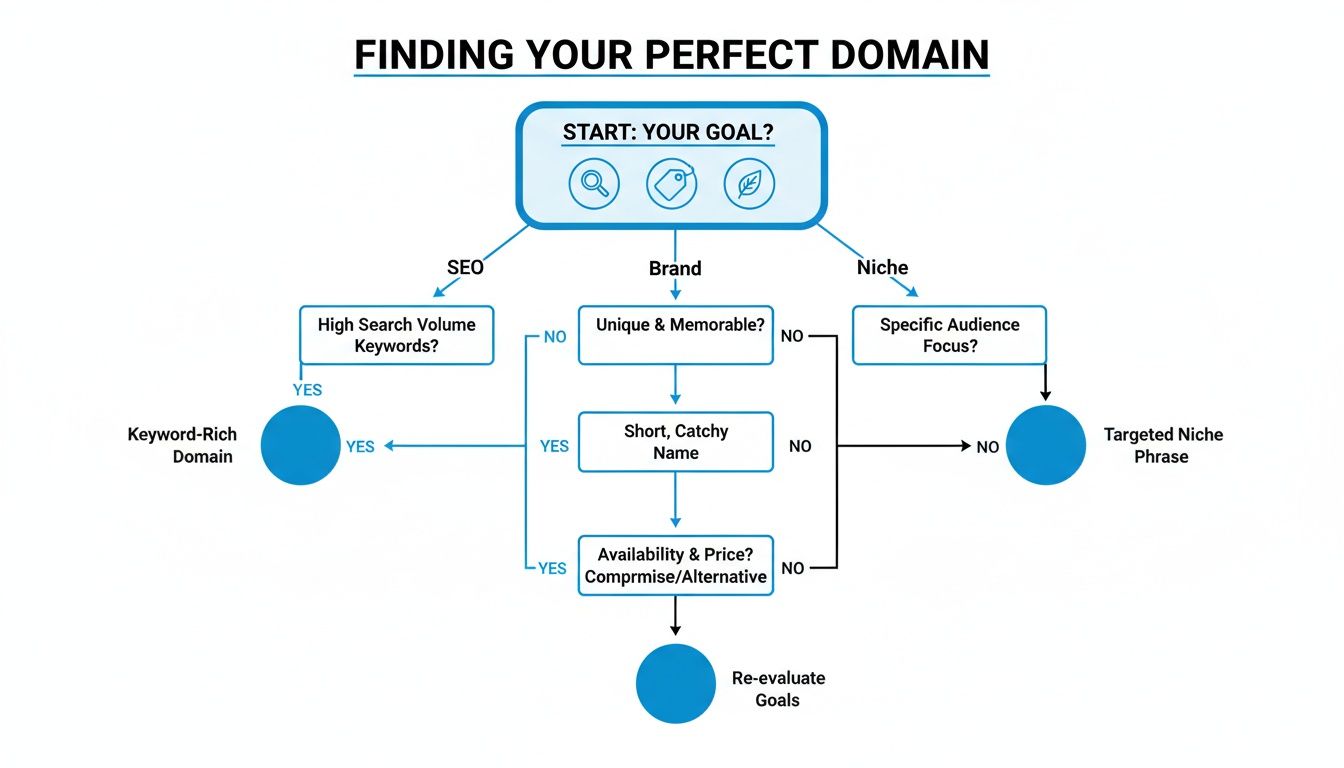
This flowchart helps visualize how your main objective—whether it's raw SEO power, building a strong brand, or cornering a specific niche—should steer your entire evaluation process.
Using SnagScore for At-a-Glance Insights
Manually checking every single metric for every domain is exhausting and a massive time sink. This is where a composite score like NameSnag's SnagScore comes in handy. It rolls up multiple data points—like Trust Flow, referring domains, age, and brandability—into a single, easy-to-digest rating.
You should still do your own homework, of course. But SnagScore gives you an immediate gut check on a domain's potential. A high score tells you it has already passed several quality filters, letting you focus your deep-dive analysis on the most promising candidates instead of wasting time sifting through duds.
Acquiring Your Chosen Domain Like a Pro
You’ve done the detective work, sifted through the digital equivalent of dusty antique shops, and finally pinpointed the perfect domain. Now comes the exciting part—making it yours. The path to ownership isn't a straight line; it forks depending on the domain's current status.
Think of it as two different types of races. One is a flat-out sprint where pure speed wins. The other is a strategic marathon where timing and patience are everything.
The Sprint for Available Domains
If you find a gem listed as "Available" on NameSnag, the clock is ticking. Loudly. These are domains that have completed their entire expiration lifecycle and are now back in the wild, ready to be registered instantly by anyone, anywhere. It’s a first-come, first-served free-for-all.
Your mission is simple: be faster than everyone else looking at that exact same name.
- Be Prepared: Have your accounts ready to go at popular registrars like GoDaddy or Namecheap.
- Save Your Info: Make sure your payment and contact details are pre-filled. Fumbling for your credit card is the easiest way to lose a great domain.
- Act Immediately: Don't hesitate. The second you decide it’s the one, head straight to a registrar and hit that checkout button.
For these domains, speed is your only real advantage. There's no auction, no bidding war—just a race to the finish line.
Mastering the Art of the Domain Auction
When a high-value expiring domain for sale catches your eye, you’re almost certainly heading to an auction. This is where real strategy comes into play. It's less about raw speed and more about calculated moves, smart bidding, and knowing when to walk away.
Your first step is to set a realistic budget. How much is this domain really worth to you and your project? It's incredibly easy to get swept up in the heat of the moment and find yourself in a bidding war that drains your wallet. Base your maximum bid on cold, hard data: the domain's metrics, its brandability, and the potential return on your investment.
Key Takeaway: Winning an auction isn't just about placing the last bid; it's about winning at a price that actually makes sense for your goals. An overpriced "win" is still a financial loss.
Bidding tactics are crucial here. A lot of people swear by "sniping"—placing a bid in the final seconds—and while it can work, it's a high-wire act. A slow internet connection or a last-second counter-bid from someone else can leave you empty-handed. A more stable approach is to place your maximum bid early on. Most auction platforms will then automatically bid on your behalf up to that limit, shielding you from the emotional rollercoaster of a live bidding war.
This brings up a key trend in the domain world. Current domain investing trends show a heavy focus on expired and aged .coms. Some surveys indicate that 65% of investor portfolios are allocated to .coms and 30% to specific niches. These investors are playing the long game, with 73% holding domains for at least a year, understanding that their value often appreciates over time. You can dig into more of these patience-driven domain investing strategies to get a feel for the market.
Your Secret Weapons for Acquisition
Constantly refreshing an auction page is a recipe for insanity. This is where tools from NameSnag become your unfair advantage, letting you stay one step ahead of the competition without being glued to your screen.
Here’s a look at the NameSnag dashboard, where you can monitor lists of expiring domains.
This view gives you a heads-up on domains still in their grace period, giving you precious time to plan your acquisition strategy before they ever hit a public auction.
Tools like Early Access Alerts and Watchers are total game-changers. Just "watch" a domain you're interested in, and you’ll get an instant notification the second its status changes or it becomes available. This proactive approach ensures you're always ready to pounce, whether that means placing a backorder or jumping into an auction at the perfect moment. For a full breakdown of the purchasing process, you might be interested in our guide on how to buy expiring domains. It turns what can be a stressful, manual process into an efficient, automated strategy.
Putting Your New Expired Domain to Work
Alright, you did it. The domain is officially yours. There’s nothing quite like that feeling of snagging a high-value asset you’ve been hunting for, but owning it is just step one. Now it's time to make that digital property pull its weight and turn all that latent potential into actual results.
What you do next boils down entirely to your original goal. Why did you start digging through expiring domains for sale in the first place? Whatever your mission was, your strategy from here on out should be a direct path to making it happen.
Let's break down the three most common blueprints people follow.
The SEO Power Play: The 301 Redirect
For a lot of SEOs, a good expired domain is basically a concentrated shot of authority. The whole point is to inject that power directly into a primary website. The tool for the job is the 301 redirect, a permanent redirect that tells search engines, "Hey, all the trust and authority this old domain had? It now belongs to this new one."
When you get it right, it’s a fantastic way to give your main site’s rankings a serious boost. But a sloppy redirect can be useless at best and harmful at worst. The absolute key here is topical relevance. If you redirect a defunct pet grooming blog to your SaaS company’s pricing page, Google is almost certainly going to look at that link equity and just ignore it.
To do this the right way, you need a plan:
- Map Old URLs to New Ones: Use a backlink checker to see which pages on the old domain had the most valuable links pointing to them. Don't just lazily redirect the entire domain to your homepage. Instead, you want to redirect
olddomain.com/popular-postto a similar, highly relevant article onyourmainsite.com. - Recreate Content if You Have To: If you don't have a perfect page to redirect to, make one. Rebuilding a piece of content that aligns with the old page's topic keeps the context of those backlinks strong, which is what you're paying for.
- Watch Out for Redirect Chains: Make sure your 301 points directly to the final page. You don't want it going to another page that then redirects somewhere else. That just dilutes the authority you're trying to pass.
The Niche Site Resurrection
Maybe you bought the domain to be the foundation for a brand-new project. If that's the case, your job is to become a digital archaeologist. The goal is to rebuild the site in a way that honors its history, because that history is what gave it value. This approach lets you tap into its existing authority and rank way faster than you ever could starting from scratch.
First stop: the Wayback Machine. Figure out what the site used to be about. Your first move should be to recreate the core topic and site structure. If it was a blog about sustainable gardening, your new content needs to live in that same niche. This maintains the topical relevance for all those existing backlinks, ensuring they keep passing SEO value.
Don't throw away the domain's history—embrace it. Building a new site that aligns with the domain's original topic is the fastest way to leverage its built-in authority and get a head start in the SERPs.
Your initial content plan should be laser-focused on the pages that had the most powerful backlinks. By restoring or, even better, improving upon that original content, you give those old links a logical and relevant place to point. You preserve their power from day one.
The Investor Flip
Perhaps your goal was never to build or boost, but simply to buy low and sell high. For a domain investor, this new asset is like a house you plan to flip. You're not moving in; you're just adding a coat of paint to attract the right buyer and walk away with a tidy profit. The name of the game here is patience and smart marketing.
Your first move is to "park" the domain. A parked page is just a simple landing page, usually with a "This Domain Is For Sale" notice. You might even throw some relevant ads on there to generate a few bucks while you wait for a buyer.
Next, think about making a few small improvements to its profile. You could disavow a few of those spammy links you found during your audit or even build one or two high-quality links to nudge its metrics up a bit.
Finally, list your expiring domain for sale on major marketplaces like GoDaddy Auctions, Sedo, or Afternic. When you write the listing, make it compelling. Highlight its best features: the key metrics, its brandability, and the strength of its backlink profile. This is how you maximize your return on investment.
Common Questions About Expiring Domains
Jumping into the world of expiring domains for sale can feel like learning a new language. You start hearing terms like "grace period," "backlinks," and "spam checks" tossed around, and it's easy to feel a little lost. Let's clear the air and walk through some of the questions I hear most often.
Think of this as your field guide for getting started.
Is Buying Expiring Domains Safe for SEO?
Absolutely—if you do your homework first. Buying an expiring domain isn't risky by itself. The risk comes from buying a bad one that gets you into trouble with search engines.
The key to keeping it safe is thorough due diligence. A domain with a clean history, relevant topic, and high-quality backlinks is an incredibly powerful SEO asset. Seriously, it's like starting a race halfway to the finish line.
The real danger lies with domains that were previously used for spam or as part of some shady link network. That’s why checking its past life with tools like the Wayback Machine and carefully analyzing its backlink profile for red flags is a non-negotiable step. If it looks clean and topically relevant, you’re building on solid ground.
Expiring vs. Available Domains: What's the Difference?
This is a big one, and the distinction is crucial. It changes how you'll try to acquire the domain.
- An Expiring Domain is one that the previous owner didn't renew. It's now in a "grace" or "redemption" period, which can last for several weeks. You can't just register it yet, but you can get ready to pounce by placing a backorder or preparing for an auction. You can scout for domains that are dropping soon to plan your moves.
- An Available Domain has already gone through that entire cycle and has "dropped." It's now back on the open market, and anyone can register it instantly at a standard registrar. These are the hidden gems that are available right now for projects you want to start today.
How Much Should I Pay for a Domain?
Ah, the million-dollar question—or, hopefully, the sub-$100 question. Prices for expiring domains for sale are all over the map, ranging from a standard registration fee (around $15) to tens of thousands of dollars at a competitive auction.
The value of a domain is directly tied to its potential ROI for your specific project. A domain worth $5,000 to an e-commerce brand might only be worth $50 to a niche blogger.
A domain's worth really comes down to a few key factors:
- Backlink Quality: High Trust Flow and links from authoritative sites add huge value.
- Brandability: Short, memorable, and easy-to-spell .com names will always command a premium.
- Commercial Intent: Does the name suggest a product or service? Think something like
buywidgets.com.
My best advice? Set your budget before you get caught up in the heat of a bidding war.
Do I Lose Backlinks After Buying a Domain?
Nope, you inherit the whole lot of them! Backlinks point to the domain name itself, not the specific content that used to live there. The moment you acquire the domain, you become the new owner of that entire backlink profile.
However, you have to be smart about preserving their value. The best practice is to figure out which old URLs had the most valuable links pointing to them. Then, you can either recreate relevant content on those exact pages or set up 301 redirects to point them to the most similar pages on your new site. This makes sure all that "link juice" flows exactly where you want it.
Ready to find your own digital treasure? NameSnag cuts through the noise, analyzing over 170,000 domains daily to surface high-value, spam-free opportunities with real SEO potential. Find your next winning domain at NameSnag today!
Find Your Perfect Domain
Get access to thousands of high-value expired domains with our AI-powered search.
Start Free Trial