A one-word domain is the internet's version of prime real estate. Think of names like Voice.com or Mint.com—a domain made up of a single, powerful word. These are some of the most sought-after digital properties online, prized for their scarcity, instant authority, and effortless brandability. They’re short, memorable, and project immediate credibility from the moment someone hears the name.
The Ultimate Digital Address
Think about your business's physical address for a second. Are you a flagship store on Fifth Avenue, or are you tucked away in a suburban strip mall? A one-word domain is that Fifth Avenue storefront. It’s memorable, prestigious, and tells the world you’re a serious player before anyone even visits your site.
This instant recognition is a massive branding shortcut. Instead of a clunky, multi-word name that needs explaining, a single, potent word does all the heavy lifting for you. It builds trust and makes your brand feel like an established leader in its space right out of the gate.
Why Rarity Creates Value
The hunger for these elite domains isn't some new trend; it’s been a cornerstone of the domain investing world for over a decade. Back in 2015, data showed a huge surge in sales for dictionary one-word .com domains, with 475 transactions averaging nearly $20,000 each. That was a 71% jump in sales volume from the year before, proving that even with new domain extensions popping up, the classic .com held its ground. You can explore more data on these historic domain sales here.
This history of high-value deals highlights a simple truth: scarcity drives value. With all the common dictionary words in the .com space registered long ago, getting your hands on one is a serious investment.
A one-word domain isn't just a web address; it's a strategic business asset. It communicates confidence, simplifies marketing, and creates an immediate competitive advantage that is nearly impossible to replicate.
The core benefits of locking down a domain like this are crystal clear:
- Instant Brand Authority: A name like Loans.com doesn't need to explain what it does. The name is the message, giving it automatic credibility.
- Superior Memorability: Single words are far easier for people to remember and type directly into their browser. This boosts direct traffic and makes you less reliant on search engines.
- Marketing Efficiency: Your marketing gets simpler and punchier. The domain is the brand, which makes for cleaner slogans, ads, and social media handles.
The Hunt for Digital Gold
While the most obvious one-word domains were scooped up years ago, the game is far from over. Every single day, valuable domains expire and are dropped back into the public pool, creating opportunities for sharp-eyed investors and founders. You can find just-dropped domains by searching for Available domains that you can register right away.
For a more strategic play, you can monitor Expiring domains to get a jump on them before they hit the open market. This is where the real treasure hunt begins.
The Power of One Word for Branding and SEO
Owning a one-word domain is the digital equivalent of planting your flag on the moon. It's more than just a memorable address; it’s a quiet declaration of confidence and market leadership. When you own a domain like Voice.com, which sold for a staggering $30 million, you aren’t just buying a name—you're laying claim to an entire category.
This kind of branding is incredibly potent. It cuts through the noise and gets straight to the point. The name itself communicates everything, bypassing the need for clever taglines or convoluted explanations. It's simple, direct, and authoritative, and it sticks.
Carving Out Instant Authority
Think about the psychological impact here. A brand built on a single, powerful word feels established and trustworthy right out of the gate. It suggests you're not just another player in the market; you are the market. This creates a powerful halo effect that makes it easier to attract customers, partners, and media attention.
For instance, a startup named "Quicklytics" has to burn cash and man-hours just explaining what they do. A company holding the keys to Analytics.com doesn't. The name does all the heavy lifting, freeing up resources to actually build the product.
A one-word domain acts as a brand amplifier. It takes whatever equity and trust you've built and multiplies it, creating a perception of leadership that multi-word domains struggle to achieve.
This instant credibility is a game-changer, especially for new ventures trying to break through. It’s a shortcut to building a brand that feels timeless and dominant from day one.
The Hidden SEO Advantages
While the branding benefits are obvious, the SEO advantages of premium one word domains are just as compelling, if a little more subtle. Many of these domains aren't new; they've been around for years, sometimes decades. That history can be a massive SEO asset.
An aged domain often comes with a pre-existing backlink profile. Even if the previous site was dormant, it might have passively collected valuable links from reputable sources over the years. Acquiring a domain like that is like starting a race halfway to the finish line. You're inheriting an SEO foundation that a brand-new domain would take years to build.
On top of that, these domains are just plain "linkable." Journalists, bloggers, and content creators are far more likely to link to a clean, authoritative name like Insurance.com than to a clunky, keyword-stuffed alternative. It just looks more professional and trustworthy, which directly translates into higher-quality, natural backlinks—the absolute lifeblood of SEO.
This linkability creates a virtuous cycle:
- Higher Trust: The authoritative name encourages more high-quality links.
- Better Rankings: Google's algorithm rewards sites with strong, natural backlink profiles.
- More Direct Traffic: As brand recognition grows, more users type the domain directly into their browser, which means you're less reliant on paid search.
This is how you build a long-term, defensible SEO strategy that drives organic growth and cuts down your ad spend over time.
One Word vs Multi-Word Domains: A Strategic Comparison
To really put this into perspective, let's break down the core differences between grabbing a one-word domain versus settling for a multi-word alternative. The strategic implications for your brand, marketing, and long-term value are huge.
| Attribute | One-Word Domains | Multi-Word Domains |
|---|---|---|
| Brand Perception | Signals market leadership, confidence, and authority. Immediately seen as a category-defining brand. | Often perceived as a smaller player or a niche-specific business. Can sound descriptive rather than authoritative. |
| Memorability | Extremely high recall. Easy for users to remember and type directly, leading to more direct traffic. | Lower recall. Users may forget the exact phrasing, order of words, or use of hyphens. |
| Marketing Simplicity | Simplifies all marketing efforts. The brand is the domain, making slogans, ads, and social handles clean and powerful. | Requires more effort to build brand recognition around a longer, more complex name. |
| SEO & Linkability | Highly linkable. Attracts natural, high-authority backlinks. Often has valuable domain age and history. | Less likely to attract unsolicited links. SEO foundation must be built entirely from scratch. |
| Investment Value | A premium digital asset that appreciates over time. Considered a long-term investment with high resale potential. | Lower initial cost but also limited appreciation potential. Not typically viewed as a standalone asset. |
As you can see, the choice isn't just about the name itself; it's about the kind of business you're trying to build. A one-word domain is a bet on becoming a category leader, while a multi-word domain is often a more pragmatic, niche-focused play.
How to Value a One-Word Domain Like a Pro
So, you’re ready to hunt for a one-word domain. Fantastic! But before you dive in, let’s get one thing straight: not all single-word domains are created equal. One might be a priceless gem like Insurance.com, while another could be a digital paperweight. Knowing the difference is what separates savvy investors from hopeful amateurs.
Valuing these domains is part art, part science. It's about looking beyond the word itself to see its true commercial potential and digital health. Think of it like a home inspection for a piece of prime real estate; you need to check the foundation before you admire the view. This is how you figure out what you’re really buying.
The Core Valuation Metrics
When you're sizing up a potential one-word domain, a handful of key indicators will tell you most of what you need to know. These are the non-negotiables that determine whether a domain is a high-potential asset or a dud.
- Commercial Intent and CPC: What are advertisers willing to pay for clicks on this keyword? A high Cost-Per-Click (CPC) in Google Ads is a massive signal of commercial value. Words like "Loans," "Software," or "Travel" have high CPCs because they're directly tied to profitable industries where companies are fighting for leads.
- Search Volume: How many people are searching for this exact term each month? High search volume means built-in organic traffic potential. A domain that perfectly matches a popular search query has a natural, almost unfair, advantage in attracting visitors from day one.
- TLD Strength (.com is King): The domain extension matters. Immensely. A .com is the gold standard, carrying the most authority, trust, and global recognition. While other TLDs have their place, a one-word .com will almost always command the highest value, no questions asked.
- Word Length and Pronunciation: Shorter is almost always better. A concise, easy-to-say, and easy-to-spell word is more memorable and brandable. If people stumble trying to say it or need you to spell it out, its value drops significantly. Think simple. Think memorable.
These metrics give you a quick, data-backed snapshot of a domain's raw potential. A domain that scores well across all four is likely a strong contender worth a much closer look.
Think of domain valuation as a scorecard. A high CPC shows it's profitable. High search volume shows it's popular. A .com TLD shows it's trustworthy, and a short, clear word shows it's brandable. The more boxes you can tick, the more valuable the asset.
Spotting the Red Flags
Now for the crucial part—the inspection. A domain might look great on the surface but hide serious issues that could tank its value or even land you in legal trouble. Honestly, ignoring these red flags is one of the biggest and most expensive mistakes you can make.
Don't get dazzled by a cool-sounding name without doing your homework first. A domain with a toxic past can be a massive liability, poisoning your SEO efforts before you even write a single line of code. This is where a little due diligence goes a very long way.
Here’s what to look out for:
- Spammy Backlink Profile: Has this domain been used for shady SEO schemes in a past life? A history of links from spammy, low-quality, or completely irrelevant websites can saddle you with a Google penalty right out of the gate. Use a backlink checker to make sure its link history is clean.
- Potential Trademark Conflicts: This is a big one. A huge one. Does the word infringe on an existing trademark? A quick search on the USPTO's TESS database is non-negotiable. Buying a domain that conflicts with a registered trademark is a surefire way to get a cease-and-desist letter in your inbox.
- Previous Content and History: What was this domain used for before? Use the Wayback Machine (Archive.org) to see snapshots of its past. If it was a spam site, a parked page full of sketchy ads, or something unsavory, you might want to steer clear.
Finding a domain that passes this health check is critical. You're looking for a clean slate—an asset with strong commercial potential and no hidden baggage. This is the foundation upon which you can build a powerful brand or a profitable niche site.
Your Treasure Map to Finding Hidden Domain Gems
Think all the truly great one-word domains are long gone, locked away in some digital vault from the dot-com boom? That's a common myth. The reality is far more exciting: every single day, thousands of valuable domains expire and are released back into the wild.
This isn't about finding leftovers; it's about being the first to spot the gold nuggets others have dropped.
This section is your treasure map. We're going to ditch the idea of manually sifting for hours on end. Instead, we’ll focus on two powerful, efficient strategies for your hunt: snagging just-dropped domains and getting a head start on those about to expire.
Strategy 1: The Available Domain Gold Rush
The first method is all about speed and immediate gratification. We're talking about finding Available domains—names that have just been dropped by their previous owners and can be registered instantly by anyone. Think of it as panning for gold; you're sifting through the river of recently expired domains to find the shiny ones you can claim on the spot.
These are the low-hanging fruit of the domain world. No auctions, no backordering, and no waiting. If you find one you like, you can head to your favorite registrar and make it yours in minutes. The key is knowing where and how to look, so you aren't just staring at a wall of junk.
It’s a numbers game, but one you can definitely win with the right tools. The sheer volume of available one-word domains is huge, though the .com remains the top prize for building a trusted, global brand. One market analysis found a database of over 1.3 million available brandable one-word domains across 93 extensions, all sourced from just over 27,000 English words. You can explore more insights about the vastness of the one-word domain market here.
Using a platform designed for this purpose turns a chaotic search into a structured hunt. By filtering specifically for "Available" domains, you immediately cut through the noise.
For instance, a tool like NameSnag gives you a clean list of just-dropped domains ready for registration, complete with valuable data points like domain age and backlinks to help you qualify opportunities instantly.
Strategy 2: The Art of Tracking Expiring Domains
While finding available domains is great for quick wins, the real strategic advantage comes from tracking Expiring domains. These are domains that have expired but are still in their "grace period"—a window of time where the original owner can still renew them. If they don't, the domain will soon drop and become available.
This is less like panning for gold and more like being a geologist who knows exactly where a vein of gold is about to surface. It gives you a critical head start.
By monitoring expiring domains, you can identify high-value targets before they hit the public market or go to a competitive auction. This is where you find the domains that others aren't even watching yet.
This approach lets you play chess while everyone else is playing checkers. You can prepare your strategy, line up your budget, and be ready to act the moment a domain becomes available.
Your Automated Domain Hunting Workflow
Manually checking domain expiration dates is a recipe for missed opportunities and massive headaches. The smart move is to automate the process with a targeted workflow. Here’s a simple, effective way to set it up:
- Start with the "Expiring" Filter: Your first step is to focus exclusively on domains in their grace period. In a tool like NameSnag, you can jump directly to the list of Expiring domains to see what's on the horizon.
- Narrow by Timeframe: Are you looking for immediate opportunities or building a long-term watchlist? Use time filters like "Today," "3 Days," or "7 Days" to align the search with your timeline. This helps you prioritize without feeling overwhelmed.
- Filter by Keywords and TLDs: Get specific. If you're building a brand in the finance space, filter for keywords like "cash," "invest," or "fund." Stick to your target TLD—if you're only interested in the authority of a .com, filter out everything else.
- Set Up Alerts: This is the game-changer. Once you've defined your ideal criteria, create an alert or add domains to a watchlist. You'll get a notification the moment a domain matching your needs is about to drop, giving you the crucial edge you need to acquire it.
Inspiring Success Stories and Use Cases
All the theory and valuation metrics are great, but what does success with a one-word domain actually look like out in the wild? At the end of the day, results are what matter. This is where the rubber meets the road—where a carefully chosen digital asset morphs into a thriving business, a niche site with serious authority, or a massively profitable flip.
These stories aren't just here to get you fired up; they're blueprints. By dissecting real-world examples, we can see the tangible ROI and strategic power that comes from locking down the perfect name. Let's dig into how others have turned a single word into a significant win.
From Startup to Instant Brand Leader
For a new company, a one-word domain is the ultimate shortcut to being taken seriously. It projects confidence and credibility long before your product has any real traction.
A classic example is the story of Mint.com. Before it was a household name for personal finance, it was just a premium domain. The founders knew that a name like "Mint" was simple, fresh, and suggested financial well-being. By grabbing that name, they instantly positioned themselves as a major player, making it far easier to attract early adopters and get press.
The name didn't need any explaining. It was memorable, trustworthy, and passed the "radio test" with flying colors. That branding head start was a key ingredient in its explosive growth and eventual $170 million acquisition by Intuit.
The right one-word domain doesn't just name your business—it defines the entire category. It tells the market, "We are the definitive solution," creating a powerful psychological advantage from day one.
Building an Authority Site on an Aged Domain
Now, let's pivot to the world of affiliate marketing and niche sites. Here, the game is all about building a website that ranks high in Google and pulls in passive income. An aged one-word domain with a clean history is pure rocket fuel for this strategy.
Picture an affiliate marketer who stumbles upon an expiring domain like Gardening.net. It’s been registered for over 15 years and has a few natural, high-quality backlinks from university extension programs and hobbyist blogs. Instead of starting from scratch, the marketer snags it.
What happens next is a perfect storm for SEO:
- Inherited Authority: The domain's age and existing links give it immediate trust in Google's eyes.
- Topical Relevance: The name itself is the main keyword, signaling exactly what the site is about.
- High Linkability: Other gardening bloggers are just more likely to link to a simple, authoritative-sounding domain.
Within months, the new site starts ranking for competitive keywords far faster than a brand-new domain ever could. The marketer focuses on creating top-notch content, and the site becomes a go-to resource, generating substantial affiliate revenue. This isn't about reinventing the wheel; it's about building your house on a solid, pre-existing foundation. You can find these kinds of aged gems by monitoring the list of Expiring domains before they drop.
The Art of the Domain Flip
Finally, there's the pure investment play. Domain investors treat one-word domains like digital real estate—buying undervalued assets and selling them for a handsome profit.
Imagine an investor spots the domain Visualize.com becoming available after it drops. They recognize its broad commercial appeal for software, design, and data analytics companies. Using the strategies we've talked about, they secure it for a simple registration fee. You can find similar opportunities by checking for newly Available domains each day.
The investor doesn't build a site. They just hold the asset and list it for sale. A few months later, a tech startup building a new data visualization tool comes along. For them, Visualize.com is the perfect brand. After a bit of back-and-forth, they purchase the domain for $25,000—a massive return on a tiny initial investment. It’s a textbook example of the incredible asset value locked inside a versatile, brandable one-word domain.
Your Game Plan for Snagging a One-Word Domain
Alright, you get the value, you've seen the proof, and you're ready to start your own treasure hunt. This is where theory gets real. Let's boil everything down into a repeatable, step-by-step playbook for finding and acquiring a killer one-word domain.
This isn’t just a list of vague suggestions; it’s a process. A workflow you can run again and again to find the gems while dodging the duds. Whether you're a founder after the perfect brand name or an investor looking for your next flip, this is how you do it.
Step 1: Define Your Mission and Your Budget
You can't hit a target you can't see. Wandering aimlessly into the domain market is a surefire way to waste time and money. Get specific first.
Start by hammering out your core niche keywords. Are you in finance, health, crypto, or travel? Make a list of 10-20 fundamental terms that define your space. This list is the foundation for your entire search.
Next, be brutally honest about your budget. One-word domains are a wild market. You might find a dropped gem for a simple registration fee, or you could be looking at thousands of dollars at auction. Know your absolute limit before you even start looking. It’s the only way to avoid getting swept up in a bidding war you have no business winning.
Step 2: Automate Your Search
Now, let the machines do the heavy lifting for you. Manually sifting through the thousands of domains that drop every single day is a fool's errand.
- Filter for Available Gems: Start with the low-hanging fruit. Head over to a tool that lets you filter for Available domains that just hit the market. Plug in your niche keywords and you might just find a name you can grab immediately from any registrar.
- Track Expiring Treasures: To get a real edge, you need to look ahead. Focus on domains that are about to drop. You can set up alerts for Expiring domains using your keywords. This gives you a crucial head start to do your research before it becomes a free-for-all.
- Narrow Your Timeframe: Don't boil the ocean. Use time filters like "Today," "3 Days," or "7 Days" to keep your search focused and sane. This lets you zero in on the most immediate opportunities without getting overwhelmed.
The goal here is to build an automated pipeline that brings potential domains to you. Let the tools do the searching so you can spend your time on what really matters: analysis.
Step 3: Do Your Homework (Seriously)
This is the step that separates the pros from the amateurs. A great name with a toxic history isn't an asset; it's a landmine. Do not skip this part.
- Check Trademark Status: Before you get emotionally attached to a name, do a thorough trademark search. A conflict here makes the domain completely unusable and opens you up to a world of legal pain you do not want.
- Analyze the Backlink History: Fire up an SEO tool and dig into the domain's backlink profile. You're looking for red flags—spammy, irrelevant links from shady neighborhoods of the internet. A history of SEO abuse can mean the domain is carrying a penalty from Google.
- Review Past Content: Use the Wayback Machine to see how the site was used in its past lives. Was it a real business? A spam blog plastered with ads? A clean history is always what you want to see.
Step 4: Get Ready to Pounce
You've found a clean, high-potential domain. Time to make your move.
If the domain has already dropped and is available, stop what you're doing and go register it. Now. Use a trusted registrar and lock it down before someone else does.
If it’s an expiring domain heading to auction, it’s time to plot your strategy. Based on your research and budget, set a maximum bid and—this is the hard part—stick to it. Understand the auction rules and be ready to act the moment it goes live. Securing your target is the final, rewarding step in a well-played game.
Frequently Asked Questions About One Word Domains
Even with a solid game plan, you're bound to have questions when hunting for one-word domains. It's a bit of an art and a science. So, let's walk through some of the most common things people ask to clear things up before you jump in. This quick FAQ should give you the confidence you need, covering everything from budget expectations to the best tools for the job.
Are All Good One Word Domains Already Taken?
It’s easy to look at the landscape and think the gold rush is long over. That's a common misconception. Sure, the premium, single-word dictionary domains in the .com space are incredibly rare finds. But here's the thing: thousands of valuable domains expire every single day.
The real game isn't about finding a name no one has ever thought of. It's about being the first to spot a high-quality name the moment it drops back into the public pool. This is where a disciplined acquisition process becomes your secret weapon. The workflow is simple but effective: start with a wide search, use smart filters to zero in on the good stuff, and then do your homework with thorough due diligence.
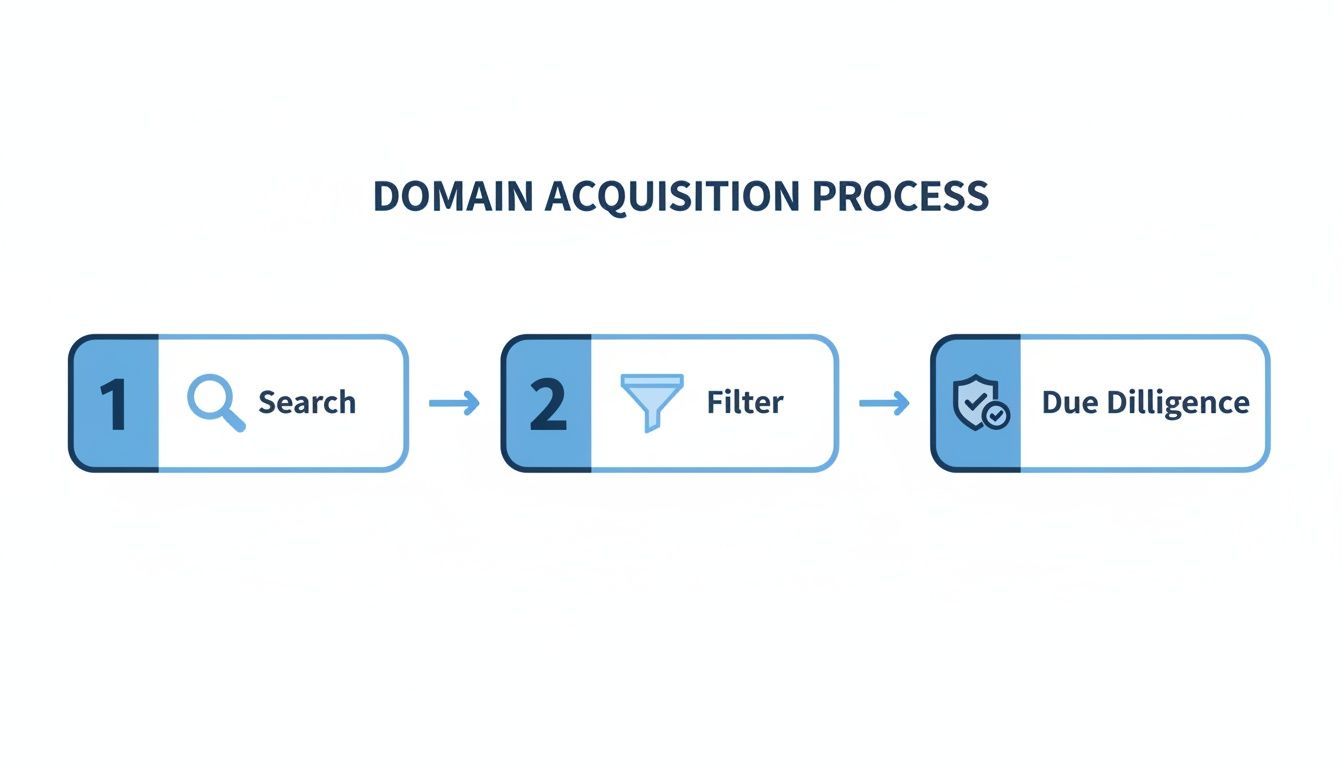
Following these steps turns what could be a chaotic, needle-in-a-haystack hunt into a methodical search. It’s how you consistently increase your odds of finding those hidden gems.
What Is a Realistic Budget for a Good Domain?
This is the classic "it depends" question, and for good reason. On one hand, you could get incredibly lucky and scoop up a freshly dropped one-word domain for a standard registration fee—think around $10-$15. It happens.
More often, though, commercially valuable names end up at auction. For these, the price can quickly climb into the hundreds or even thousands of dollars.
Your budget should really mirror your goal. If you're building a brand, a higher investment is often justifiable. If you're looking to flip the domain for a profit, your math needs to be sharp—you have to calculate the potential return on investment.
How Can I Find Domains Before They Go to Auction?
The best way to get an edge is to monitor domains that are expiring but haven't officially "dropped" yet. These names are stuck in a grace period where the current owner still has a chance to renew. By keeping an eye on them, you get a critical head start.
Here's how to play it:
- Set Up Alerts: Use tools that let you create watchlists for Expiring domains. You can filter by keywords, TLDs, and other metrics to track names that fit your criteria.
- Act Fast: When a domain on your list is about to drop, you have to be ready. That means being prepared to register it instantly or jump into the auction the second it begins.
This proactive approach is how serious investors find the best one word domains before the rest of the world catches on.
Ready to find your own digital gold? NameSnag uses AI to cut through the noise, analyzing over 170,000 domains daily to surface high-value opportunities. Find your next premium domain by exploring Available domains or getting a head start on Expiring domains today.
Find Your Perfect Domain
Get access to thousands of high-value expired domains with our AI-powered search.
Start Free Trial