You find a domain that looks promising. Good name, clean spelling, maybe a niche you understand. Then you open a tool and get smacked with a pile of acronyms: DR, DA, TF, maybe a few more depending on how deep you've wandered into the swamp.
That's usually the moment buyers split into two camps. One group decides domain score is magic and overpays for anything with a big number. The other group gets annoyed, calls the whole thing fake, and ignores signals that could have saved them from buying junk.
Both camps lose money.
A domain score is best treated like a reputation shortcut. Not a verdict. Not a guarantee. Just a compressed signal that tells you whether a domain has built some kind of authority, trust, or risk history that's worth investigating further. If you buy expired or expiring domains long enough, you learn fast that the number itself is never the asset. The story behind the number is.
I've seen domains with flashy authority metrics that were basically decorative trash once you checked the link profile. I've also seen plain-looking names with modest scores that turned out to be the better buy because the history was clean, the links made sense, and the domain still had practical upside for SEO or resale.
If you're staring at a dashboard right now wondering whether a domain score matters, the short answer is yes. But not in the way most sales pages suggest. The useful question isn't “is this a good score?” It's “good for what, and why?”
That Moment You Realize Every Domain Has a Score
The first time this happens, it feels like someone changed the rules halfway through the game.
You thought you were buying a name. Then suddenly you're evaluating a mini financial instrument with a history, baggage, and a reputation trail scattered across the web. One domain looks clean but has a weak score. Another has a stronger score but weird anchors, odd redirects, and backlinks from places you wouldn't trust with your email address.
That confusion is normal.
Why buyers get tripped up
Most domain score tools present the number as if it's self-explanatory. It isn't. A score only means something when you connect it to intent.
If you're buying for a brand launch, a lower score on a clean, memorable domain can be perfectly fine. If you're buying for an SEO rebuild or a content site, authority signals matter more, but only if they come from a backlink profile that still holds up after inspection. If you're buying to flip, the buyer pool matters just as much as the metric. SEO buyers care about one thing. startup founders care about another.
A domain with a strong-looking score and a rotten history is a renovation project, not a premium asset.
The trick is to stop treating domain score as a trophy. Treat it like the first screen in a due diligence process.
The useful mental model
The easiest way to think about domain score is a rough credit score for web reputation. Different companies calculate it differently. None of them are Google. None of them have a divine window into rankings. But they're all trying to estimate whether a domain has earned enough trust, authority, or stability to deserve attention.
That makes the metric useful, especially when you're sorting through lots of domains. It also makes it dangerous when you forget it's only a model.
Here's where buyers usually get burned:
- They buy the number, not the profile: A high score can hide spam, irrelevant links, or a history that won't help your intended use.
- They dismiss low scores too quickly: A domain can have a low score and still be a sharp buy if the history is clean and the name is commercially strong.
- They compare across tools like they're exchange rates: They're not. Different systems weigh different things.
Once you accept that, the whole topic gets easier. You stop asking whether the score is “real” and start asking whether it's useful.
What Really Goes Into a Domain Score
Under the hood, domain score is a generic label for a bunch of proprietary systems trying to summarize a domain's authority or risk in one number. In SEO, the common thread is backlinks. In abuse detection, it's often historical behavior and infrastructure clues.
Moz says Domain Authority is a 1–100 score that predicts how likely a site is to rank compared with competitors, is not a Google ranking factor, and is built from a machine-learning model using backlink-related signals. Ahrefs' Domain Rating is also on a 0–100 scale and is based on the quantity and quality of unique referring domains and the authority of those linking domains, then mapped onto that scale. In practice, that means these are composite, relative ranking models, not direct measures of SEO performance (Moz on Domain Authority).
The ingredients that matter
If you strip away the branding, most authority-style scoring systems are trying to answer a few basic questions:
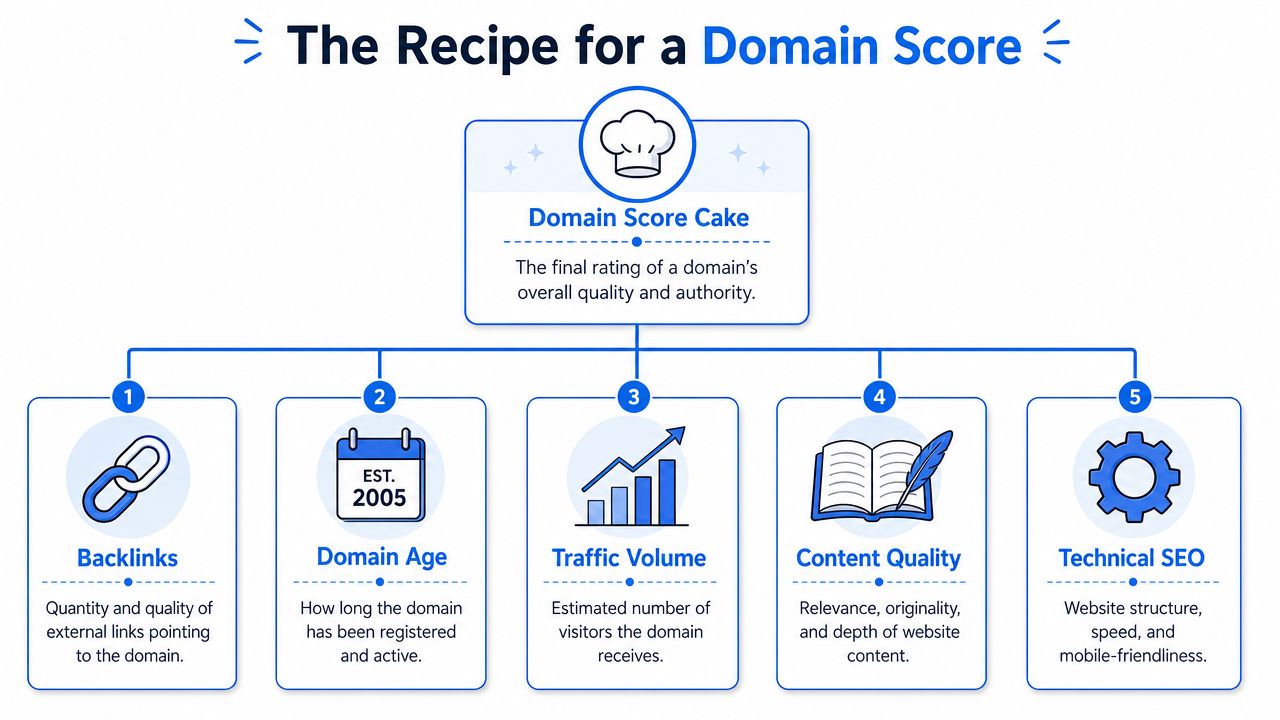
- Who links to this domain
- How many unique sites link to it
- How strong those linking sites appear to be
- How the domain compares with other domains in the same ecosystem
That's why I think of it as a recipe, not a raw count. One hundred random links don't equal one respected editorial link. Ten links from ten legitimate sites usually tell a more interesting story than fifty links from one recycled network.
What the score is trying to approximate
Scoring vendors love clean dashboards because buyers love simple answers. Real domains are messier.
A solid score often points to real backlink equity. It can suggest that a domain has earned mentions, citations, and links from sites that search marketers care about. But the score itself isn't the value. The value is the underlying profile.
That's why content quality and topical fit still matter after you buy. If you're rebuilding a domain or using it as a foundation for a site, authority without a sensible content plan is wasted. Teams thinking about that side of the equation usually benefit from a sharper content strategy for B2B marketing teams, because authority and content only compound when they point in the same direction.
What doesn't work
Buyers often make three bad assumptions:
- Higher always means safer
- Any score increase means improvement
- One metric can stand in for full diligence
None of those hold up for long.
Practical rule: Use the score to narrow the field. Use the backlink profile to make the decision.
A domain score is useful because it compresses complexity. It becomes dangerous the second you forget what got compressed.
The Big Three Scoring Systems Explained
The three names most buyers run into are Ahrefs, Moz, and Majestic. They all score authority, but they don't look at the web through exactly the same lens. That's why one domain can look solid in one tool and merely decent in another.
Think of them like three scouts watching the same player. One cares about raw strength. One cares about competitive potential. One cares about trust.
Ahrefs DR
Ahrefs' Domain Rating, or DR, is the metric a lot of domain buyers anchor on first. It's built on a 0–100 logarithmic scale, and Ahrefs bases it on the quantity and quality of external backlinks, including unique linking domains and the authority of those linking domains. Because the scale is logarithmic, the metric is highly non-linear. Moving up at the lower end is generally easier than moving up when a domain already has a strong profile (DashThis on Domain Rating).
The same source notes practical benchmark bands that many marketers use:
- DR 0–20 for new or low-authority sites
- DR 20–40 for growing sites
- DR 40–60 for established sites
- DR 60+ for highly authoritative sites
For investors, DR is good for quick triage. It tells you whether a domain likely has real backlink depth. It does not tell you whether that depth is clean, relevant, or still useful after a drop.
Moz DA
Moz's Domain Authority, or DA, is more of a comparative ranking estimate. It's less useful as a status symbol than as a way to understand where a domain might sit relative to others in a competitive set.
If you want a cleaner breakdown of how buyers compare these models in practice, this guide on understanding website authority metrics is a useful companion read. It helps explain why DR and DA often move differently without making that difference sound mysterious.
A related practical read is this look at SEO domain authority, especially if you're sorting through domains for search value rather than pure brandability.
Majestic TF and CF
Majestic tends to come up in more old-school SEO and domain investing circles because Trust Flow and Citation Flow are useful for sanity-checking whether a domain's authority looks earned or inflated.
I won't pretend every buyer uses Majestic as heavily as Ahrefs or Moz. But experienced buyers often like TF because it adds another opinion on trust, especially when a domain's raw authority looks suspiciously polished.
Domain score systems at a glance
| Metric | Provider | Primary Focus | Best For |
|---|---|---|---|
| DR | Ahrefs | Backlink strength and referring domain authority | Fast filtering of authority-style domains |
| DA | Moz | Comparative ranking potential against competitors | Benchmarking domains in a market or niche |
| TF and CF | Majestic | Trust signals and citation volume | Spotting authority that may be strong, weak, or inflated |
Different scores aren't disagreeing with each other so much as measuring different slices of the same history.
The mistake is hunting for the one true number. The smarter move is reading disagreement between tools as a clue.
How to Check and Interpret Any Domain Score
Checking a domain score is easy. Interpreting it well is where buyers separate themselves from tourists.
You can pull these metrics from the vendors directly or from aggregators that surface them in one place. That part isn't hard anymore. The hard part is resisting the urge to stop at the number.

Start with purpose, not the metric
Ask one question first: why am I buying this domain?
That answer changes what a “good” score looks like.
- For a brand build: clean history, strong name, and no obvious baggage often matter more than raw authority.
- For an SEO rebuild: the quality and relevance of the referring domains matters far more than a pretty front-page score.
- For a flip: you need a domain another buyer can immediately understand and value.
A score without a use case is just decoration.
What to inspect after the number
At the low end, tiny score differences can be noise. Rankguide's 2026 guide says sites starting below DR 20 may need three to four months before meaningful movement shows up in Ahrefs, and that in this range the marginal difference in raw DR matters less than the composition and toxicity of the referring-domain profile (Rankguide on Domain Rating).
That lines up with what buyers learn the hard way. A domain with slightly better numbers but a dirty profile is often the worse asset.
Here's the review sequence I trust most:
- Check the score
- Check the referring domains
- Scan anchor text for weirdness
- Look for obvious topic mismatch
- Decide whether the history helps your intended use
For a faster workflow, a dedicated domain name authority checker can help centralize the first step, but you still need judgment after that.
Good score, bad domain
This happens more than people think.
A domain can show a respectable authority metric because it once belonged to a real site, picked up a lot of links, and then spent time being abused, repurposed, or redirected in ways that ruined the practical value of those links. The score may lag behind the reality.
If the backlink profile looks unnatural, the score is old news.
The reverse also happens. A clean aged domain with modest authority can be a better buy because it gives you a usable foundation without hidden cleanup work. That kind of domain rarely wins the beauty contest in a spreadsheet, but it often wins in actual use.
Using Domain Scores to Find Hidden Gems
Domain scoring became important because third-party authority metrics turned into common market signals for comparing websites, not just describing them in isolation. Moz's Domain Authority and Ahrefs' Domain Rating helped push domain scoring from a niche SEO metric into a standard part of acquisition and evaluation workflows (history of domain authority metrics).
That's exactly why savvy buyers use domain score as a filter first and an investigation tool second.
The filtering mindset
If you're reviewing domains one by one with no filter, you're wasting time on obvious losers. The practical move is to use authority signals to reduce the pile before you start manual review.
That usually means splitting the hunt into two buckets:
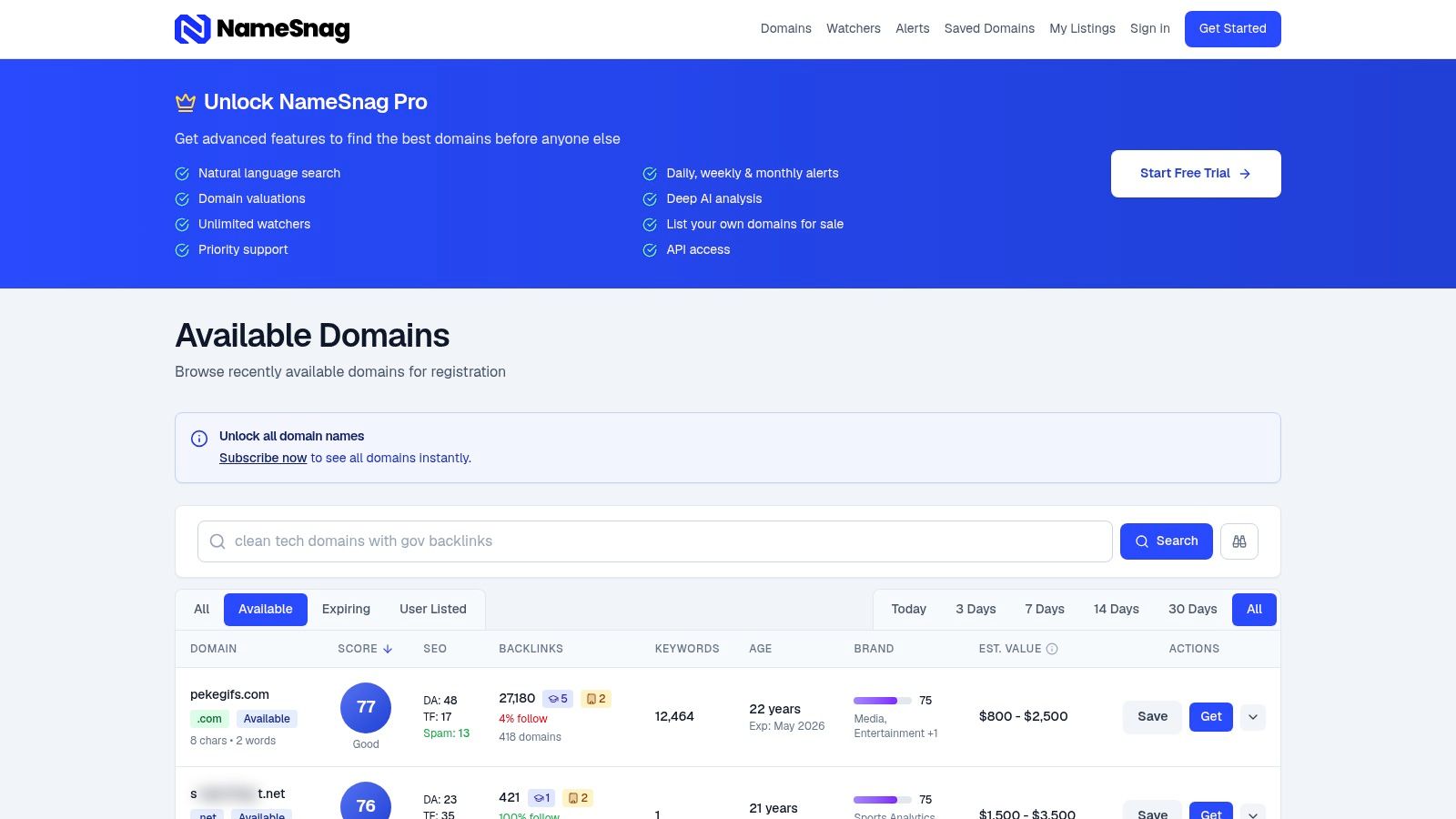
- Freshly dropped names: domains you can register immediately if they're still available
- Domains in the grace window: names that are expired and likely to drop soon
For freshly dropped names, browsing available domains lets you surface immediate opportunities. For names that haven't dropped yet but are on their way, expiring domains are where you watch ahead of time. The time filters matter here. Today is useful for speed, while broader windows like 3 Days, 7 Days, 14 Days, 30 Days, or All are better when you're trying to build a deeper shortlist.
A practical buying workflow
This is the workflow I'd recommend to any buyer who wants fewer junk candidates:
- Set a minimum authority floor: Not because the score is truth, but because it removes domains with no visible traction at all.
- Filter by timing: Short windows are better when you want fresh opportunities before everyone else sees them.
- Review names manually after the filter: That's where you catch spam, weird history, and names that look powerful but won't resell.
- Keep separate lists for SEO buys and brand buys: Mixing those two usually creates bad decisions.
Here's a quick walkthrough if you want to see the process in motion:
What hidden gems actually look like
The best hidden gems usually don't look dramatic. They tend to have a few traits in common:
- A believable backlink history: The links make sense for the site that once existed.
- A name with reuse potential: Brandable, topical, or commercially intuitive.
- No obvious contamination: No casino mess, malware baggage, or anchor text that screams abuse.
- A score that supports the story: Not necessarily huge. Just credible.
Hidden gems are usually quiet. The loud domains are where everyone else is already bidding with their emotions.
That's why score-first filtering works. Not because it picks the winner for you, but because it helps you spend your attention where there's at least a case to investigate.
Beyond the Score With NameSnags Smarter Approach
Single-metric buying has a ceiling.
DR alone can mislead you. DA alone can flatten too much nuance. TF can help, but it still won't tell you whether the domain is brandable, usable, or likely to become a headache after purchase. Serious buyers eventually end up stitching together multiple tools, multiple tabs, and multiple judgment calls just to avoid stepping on a landmine.
That's the gap a smarter composite approach is meant to close.
Why composite scoring is more useful
In security and abuse analysis, this idea is already familiar. DomainTools' Domain Risk Score combines historical behavior, registration signals, and infrastructure proximity, then uses threat classifiers for phishing, malware, and spam. The final score is used as a triage signal so analysts can prioritize what needs deeper review (DomainTools risk scoring).
That logic translates well to domain investing. A useful score shouldn't just summarize authority. It should help you avoid false positives.
What a smarter review process looks like
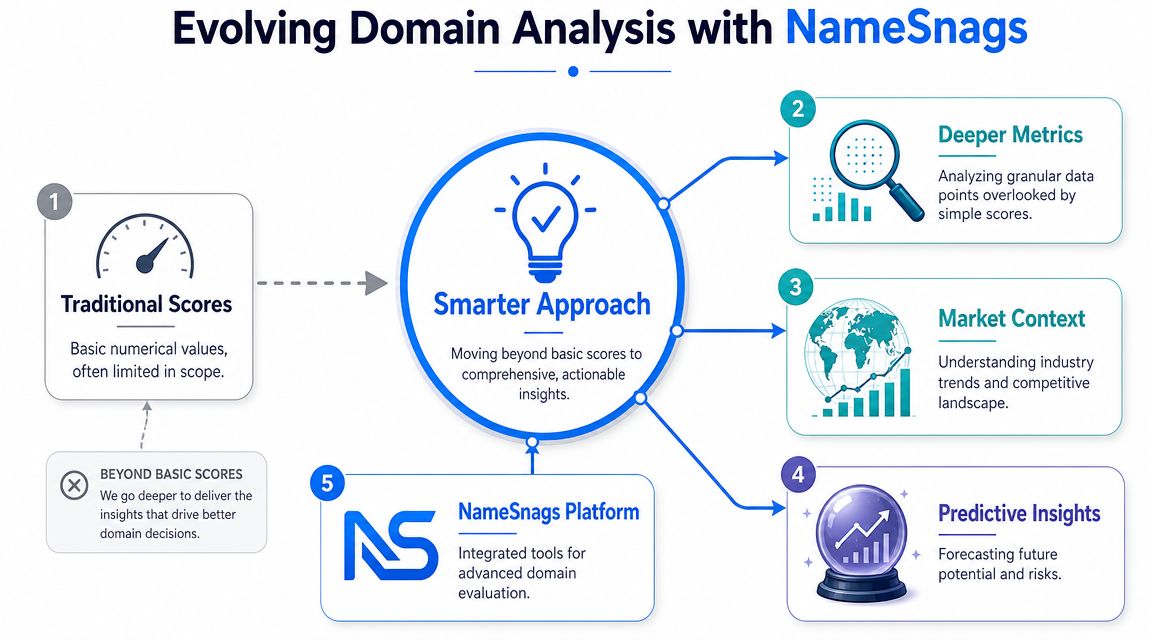
A better system blends authority signals with practical screening:
- Multiple authority inputs: You get a broader picture than any one vendor can provide.
- Spam and penalty screening: This cuts down on domains that look good until you inspect the baggage.
- Brandability checks: A domain can have authority and still be hard to use or resell.
- Use-case context: Buyers need to know whether a domain fits SEO rebuilding, resale, or brand launch.
That's why a composite model like SnagScore is a more practical layer than a single authority metric. It's not trying to replace judgment. It's trying to save you from spending hours chasing domains that a better first-pass system would have ruled out.
If you're curious how automation and buyer behavior are changing domain acquisition, this article on the domain name bot landscape is worth a read too. It gives useful context for why speed, filtering, and better scoring matter so much now.
The sharpest buyers don't worship a domain score. They use it, challenge it, and then move on to the evidence that determines whether the domain deserves money.
If you want a faster way to sort through dropped and expiring domains without juggling a stack of separate SEO tools, NameSnag is built for that job. It helps you scan fresh opportunities, compare authority signals, and focus on domains with real upside instead of spreadsheet noise.
Find Your Perfect Domain
Get access to thousands of high-value expired domains with our AI-powered search.
Start Free Trial