
You run a domain name bot at night and wake up feeling rich for about thirty seconds.
Then the spreadsheet opens.
Rows and rows of “opportunities” stare back at you. Weird hyphenated names. Obvious trademark bait. Domains with backlink profiles that look strong until you inspect them and realize the links came from garbage. A few look promising, but sorting the good from the junk feels like panning for gold in a landfill.
That’s the part that often remains unsaid.
The fantasy is easy to sell. Point a bot at expiring domains, scrape every drop list you can find, bulk-check availability, and let automation uncover forgotten gems before everyone else. In theory, it’s beautiful. In practice, old-school automation usually produces more noise than edge.
The Bot-Fueled Dream vs The Junk-Filled Reality
A lot of domain investors start with the same mental model. More coverage means more chances to win. If a bot can process far more names than a human ever could, then a bot should outperform manual research. That logic feels airtight right up until you start buying what the bot finds.
The problem isn’t speed. It’s judgment.
A basic domain name bot can scan lists all day, but it can’t tell the difference between a clean, brandable asset and a domain that only looks valuable because the metrics are dirty, the history is messy, or the wording is dead on arrival for resale. It will happily hand you all three in the same batch.
What the dream looks like
Many individuals seek one of three outcomes:
- A brandable domain they can flip later
- An expired SEO asset with clean authority signals
- A niche-relevant name for a project, redirect, or build
That’s a sensible goal. The domain market can reward sharp positioning, especially in AI-related naming. The sale of Bot.ai for $1,200,000 through Sedo on March 4, 2026, documented in DNJournal’s sales charts, shows how much premium buyers will pay for the right AI-focused term. That same source notes that “Bot” ranked in Sedo’s top 3 search terms in March 2026.
That’s why people chase this space so aggressively.
What the reality looks like
The junk pile usually arrives in predictable forms:
- Fake authority from spammy backlinks
- Trademark risk disguised as “brandable”
- Names nobody would build on
- Metrics without context
- Lists so large you stop thinking clearly
Practical rule: If your workflow produces too many names to review properly, your workflow isn’t giving you leverage. It’s giving you homework.
Old bot-driven hunting creates a strange trap. You feel productive because the list is long. You feel ahead because the machine found it. But volume isn’t the same as edge, and raw output isn’t the same as discovery.
The investors who stay in this game stop worshipping the list. They start filtering for decisions.
What Exactly Is a Domain Name Bot
A domain name bot is software that automates part of the domain hunting process. It can check availability, watch expiry streams, pull metrics, monitor drops, or try to register a name the second it becomes available. The label covers a lot of tools, and that’s part of the confusion.
Some of these bots are nothing more than fast scripts. They scrape lists, sort by a few columns, and dump thousands of names in front of you. That was the old model. It saved time on collection, then handed the time cost right back in review.
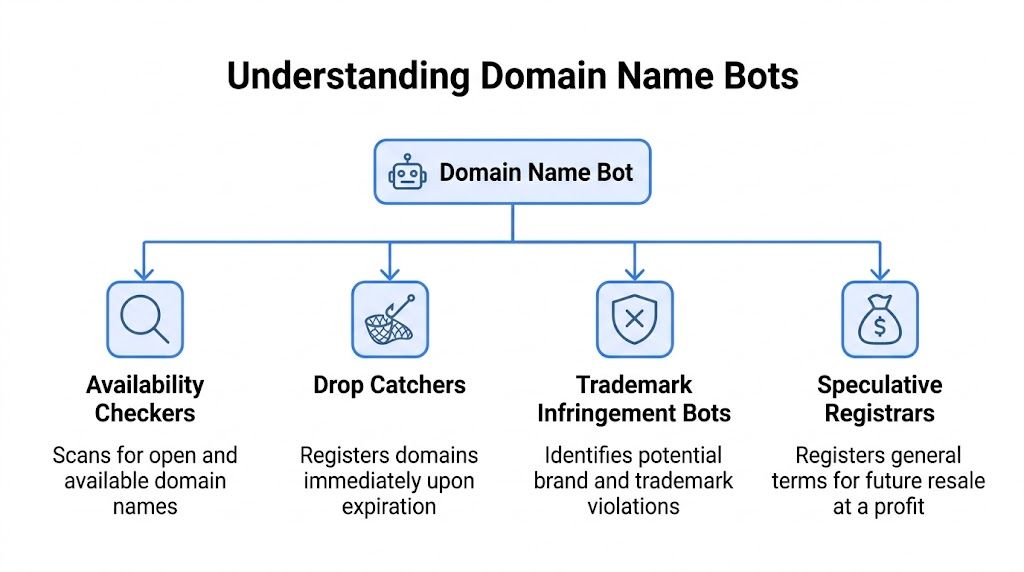
The better category of tool does something different. It cuts the pile before you ever see it. That’s the key distinction between a brute-force bot and a modern system like NameSnag. One floods you with candidates. The other tries to surface names that already pass basic quality filters.
The common bot types
Here’s the practical breakdown.
| Bot type | What it does | Where it helps | Where it fails |
|---|---|---|---|
| Availability checker | Checks whether names can be registered now | Fast screening | No judgment on quality |
| Drop catcher | Tries to register domains the moment they drop | Timing-sensitive acquisitions | Can secure weak names just as fast |
| List scraper | Pulls expiring or dropped domains from multiple sources | Broad coverage | Buries good opportunities under junk |
| Metric analyzer | Pulls backlinks, age, authority, and similar data | Faster first-pass review | Can make bad domains look good |
Availability bots are simple, and often overrated
Bulk availability tools are useful for brainstorming hand registrations. They are weak investment filters.
An available name may be open for a good reason. Experienced buyers passed on it, the wording is awkward, the commercial use is thin, or the resale pool is tiny. Availability matters, but only as the first check. It says nothing about whether a name deserves money.
Drop catchers are execution tools
Drop catchers solve a speed problem. If you already know a domain is worth owning, they help you compete for it at the moment of release.
I’ve seen newer investors treat that speed as if it adds quality. It doesn’t. A fast bot can still win a bad domain. All it really proves is that your software was quicker than someone else’s.
Good automation improves execution. It does not fix weak judgment.
Analysis bots separate into two camps
The gap between old bots and newer platforms becomes obvious.
The old style pulls raw inputs from everywhere. Age, backlinks, archive history, keyword match, registrar data, comparable sales, traffic estimates. On paper, that sounds useful. In practice, it often creates a bigger review burden because the user still has to decide which signals matter and which ones are noise.
Smarter systems try to do the first round of filtering for you. That’s the direction the market is moving, and for good reason. Domain investors do not need more rows in a spreadsheet. They need fewer bad options.
Earlier in the article, the sales-history source already cited showed how large the domain data universe has become. That scale is exactly why brute-force bots break down. More data feels powerful until you spend two hours checking domains that never had a real shot.
A domain name bot is worth using only if it improves selection, not just collection. If the tool leaves you staring at a longer junk list with a false sense of progress, it’s doing the old bot job. If it narrows the field to names with cleaner signals and clearer upside, it starts acting like a real assistant.
The Hidden Dangers of Automated Domain Hunting
Automation doesn’t just create clutter. It can create expensive mistakes.
A lot of those mistakes happen because domain investors trust the surface layer. They see a catchy keyword, a decent authority snapshot, or a backlink count that looks promising, then they stop digging. Bots make that temptation worse because speed encourages shallow judgment.

Toxic history hides behind pretty metrics
An expired domain can carry baggage long after the old site disappears. Spam campaigns, parasite pages, junk redirects, hacked content, and manipulative links don’t always show up in the quick-glance metrics people love to sort by.
That’s the first danger of automated hunting. Bots often flag numerical strength without understanding whether that strength came from anything legitimate.
A domain can look clean enough to buy and still be a terrible foundation for SEO or resale.
Security risk gets ignored
Domain bots are often thought of as buying tools, not risk magnets. That’s a mistake, especially with bot-themed naming.
An often-overlooked issue is the .bot extension itself. Verified data tied to a NamePros discussion on .bot domains states that DataDome’s 2024 report found 95% of advanced bot attacks go undetected, and that bot-themed domains face higher scrutiny from malicious crawlers as AI agent traffic rises.
That doesn’t mean every .bot name is bad. It means owners need to think beyond registration. If you buy a bot-related domain with a messy past, then put a money site on it without checking what kind of traffic and abuse history it may attract, you’re walking in blind.
The financial leak is boring, which is why it hurts
Nobody goes broke on one bad registration. They go broke on a pile of “cheap” bad registrations.
The classic brute-force workflow encourages exactly that:
- scrape massive lists
- sort by rough metrics
- register a batch
- rationalize later
That approach looks affordable until you tally the names you can’t use, can’t rank, and can’t resell.
Cheap domains get expensive when you buy them in bulk without conviction.
Legal traps are more common than beginners think
Bots are especially good at finding names that sound valuable because they resemble established brands, products, or categories with obvious commercial demand. That’s not edge. That’s legal exposure.
A domain name bot doesn’t care whether a string crosses into trademark trouble. It only sees patterns and availability. You’re the one who inherits the problem.
A quick judgment table helps:
| Signal | What beginners think | What experienced buyers think |
|---|---|---|
| Brand-like wording | “This could sell fast” | “This may be infringement bait” |
| Strong backlink count | “Authority” | “Why did those links exist?” |
| Bot-themed TLD | “Perfect niche fit” | “Needs extra scrutiny” |
| Large scraped list | “More options” | “More ways to waste time” |
Terms of service and bad collection habits matter too
Some domain hunters build or buy bots that hammer registrars, marketplaces, or third-party tools in ways those systems didn’t intend. Even when the tactic “works,” it can get fragile fast. Endpoints change. Access gets throttled. Data quality drops. The workflow that felt clever turns brittle.
The bigger issue is philosophical. If your process depends on collecting everything first and judging later, you’ll usually lose to someone with a better filter.
That’s the difference between automation that scales insight and automation that scales mistakes.
Moving From Dumb Bots to Smart Domain Assistants
The old mindset says the winner sees the most domains. That isn’t how experienced buyers operate.
The winner usually sees the right shortlist first, then applies judgment faster than everyone still scrolling through noise.
More data usually means more junk
Traditional bots are built around appetite. More feeds, more drops, more checks, more exports. You end up with huge datasets and a false sense of coverage. But in domain investing, raw volume can lower quality control.
That’s where a smarter assistant changes the game. Instead of asking, “How many names can I pull?” the better question is, “How many bad names can I eliminate before I waste attention on them?”
That sounds simple. It isn’t. Most tools still lean too hard on quantity.
Human-style filtering still matters
Verified data tied to EstiBot notes that bots excel at scale but often miss nuanced spam signals, while human oversight can catch 30-50% more gems according to anecdotal investor reports. The same verified data warns that automated valuations can get skewed when tools lack integrated spam verification.
That’s the fundamental trade-off.
A machine can process far more names than you can. It cannot always understand why a domain feels off. The wording may be awkward. The backlink story may be too neat. The historical use case may not match the current metrics. The thing may technically qualify on paper and still be unbuyable.
The best modern workflow uses automation for compression, then uses human judgment for conviction.
Composite scoring beats single-metric obsession
Single metrics seduce beginners because they’re easy to sort. Referring domains. Trust Flow. age. Domain Authority. Pick your favorite and you’ll eventually buy garbage.
Smart assistants work better when they combine signals instead of worshipping one of them. That includes:
- Backlink quality instead of raw volume
- Brandability instead of keyword stuffing
- Age plus relevance instead of age alone
- Spam checks before any valuation shortcut
- Use-case fit for SEO, resale, or brand launch
That’s much closer to how a good investor thinks. They don’t ask whether a number is high. They ask whether the whole story holds together.
AI should narrow choices, not make final calls
A lot of people hear “AI-powered” and assume fully automated. That’s the wrong goal. Good AI doesn’t replace your brain. It cuts down the time you spend opening ten tabs for domains that never deserved ten seconds.
The same logic applies beyond domains. If you work in search, this guide to the AI SEO agent is a useful parallel because it frames AI as a system for guided execution rather than blind autopilot. That’s exactly how smart domain research should work too.
The old domain name bot hunted everything. The modern assistant should do something narrower and more valuable. It should pre-filter, surface edge cases, and let you spend your judgment where it matters.
That’s a huge difference in practice. One workflow gives you a bigger pile. The other gives you a smaller, better shot list.
The NameSnag Workflow Your Bot Replacement Strategy
The cleanest replacement for a traditional domain name bot isn’t another scraper. It’s a workflow that starts with pre-filtered opportunities and cuts manual checks before they start.
A lot of investors still work backward. They scrape first, panic later, and then spend the rest of the day trying to verify whether anything on the list is worth touching. A smarter process flips that. You begin with a narrower pool and apply intent-based filters from the start.
Here’s what that looks like in practice.
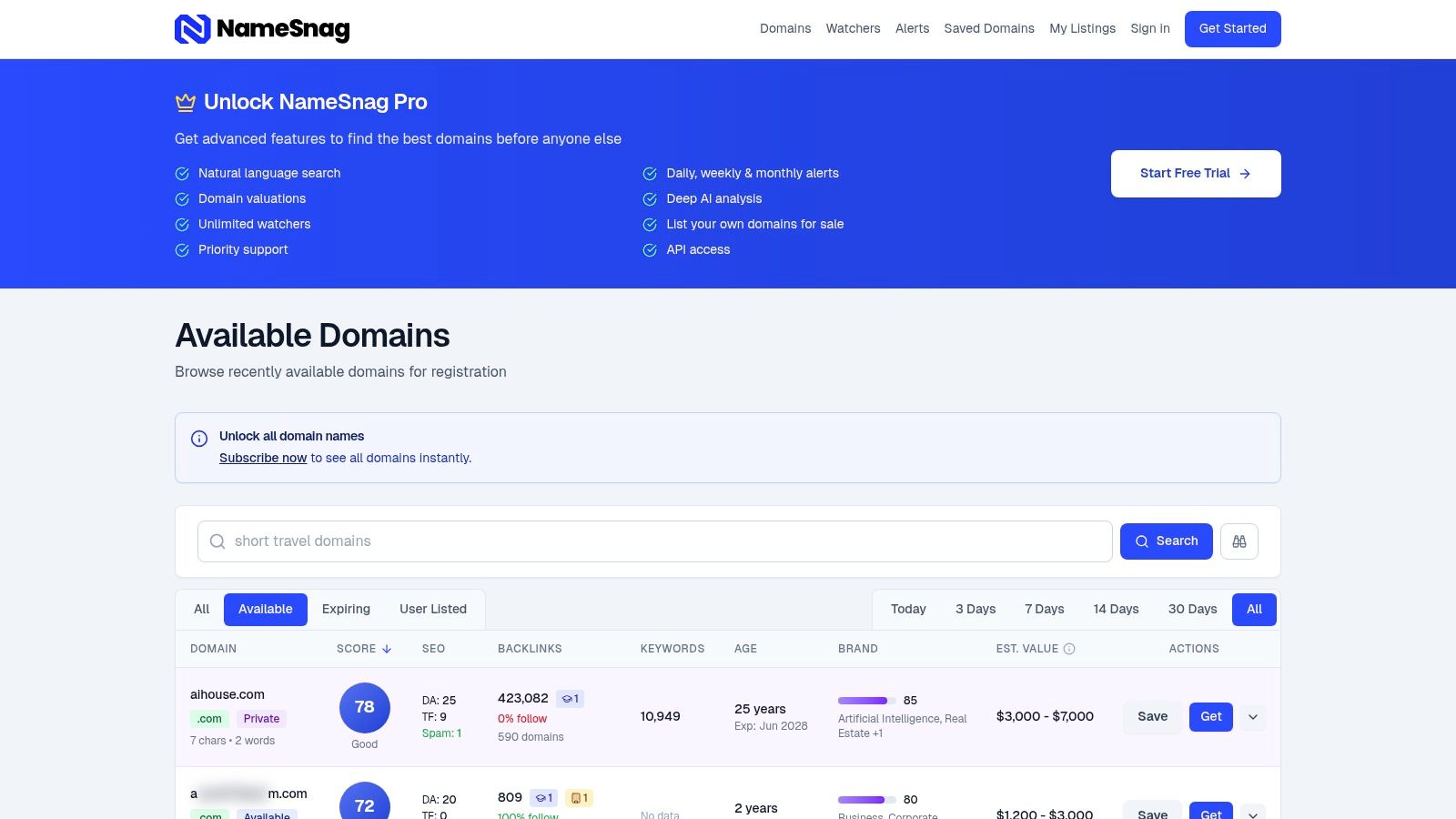
Start with the market state, not a blind scrape
The first fork in the road is simple.
If you want names you can register right now, work from the available domains view. If you want names that are expired and moving through the drop cycle, use the expiring domains view.
That sounds obvious, but it changes how you think. Instead of building a bot to gather every source you can find, you’re starting with a live feed organized around actionability.
The time filters matter too. Today is great when you want immediacy. Three-day and seven-day windows help when you’re trying to stay ahead without drowning in stale names. Thirty-day and all-time views are more useful for pattern spotting and broader market scanning.
Filter for your actual objective
Most investors waste time because they don’t define what “good” means before they search. They say they want quality. That’s too vague.
Use a tighter decision frame:
| Goal | What to prioritize | What to ignore |
|---|---|---|
| SEO rebuild | age, backlink quality, topical fit, spam checks | catchy branding alone |
| Resale flip | brandability, clean wording, broad buyer appeal | narrow niche relevance |
| Money site launch | memorability, trust signals, clean history | random authority with bad naming |
When you filter this way, the list gets smaller fast. That’s good. You’re not trying to impress yourself with volume.
Let machine learning narrow the field
Verified data from Domainsbot says advanced domain intelligence platforms use machine learning to curate over 100 million domain records. It also notes that expired domains with more than 500 referring domains can recover SERP rankings 2.5x faster post-registration, and that filtering for metrics such as Trust Flow above 20 can yield 40% higher resale values.
Those figures matter, but only if they’re used as part of a filter stack rather than as a single trigger. A domain with strong referring-domain depth still needs a clean profile, usable wording, and a history that makes sense.
That’s why the modern workflow is filter-first. You’re not asking one metric to tell the whole story.
Strong domain selection comes from stacked signals, not silver bullets.
Use due diligence before you feel attached
The emotional mistake happens fast. You spot a promising name, picture the resale, imagine the site, and start rooting for it. That’s when buyers get sloppy.
A better move is to push every candidate through a formal review process. NameSnag’s own article on due diligence automation is worth reading for this mindset alone. The big win isn’t just speed. It’s consistency. You want the same standards applied every time, especially when a name looks exciting.
Check for:
Backlink sanity
Are the links thematically coherent, or do they smell manufactured?Naming quality
Could a real buyer picture this on a logo, pitch deck, or asset list?History fit
Does the domain’s prior life support your intended use, or fight it?Penalty risk
Any sign the name carries old abuse baggage?
Use available names differently from expiring names
Available domains and expiring domains deserve different behavior.
Available domains are where hand-reg opportunities, overlooked brandables, and immediate project launches shine. You can move quickly because there’s no waiting game.
Expiring domains are where patience pays. The value often lies in timing, profile quality, and catching names before the public feeding frenzy starts.
That’s where a lot of old bots fail. They treat both pools like interchangeable inventory. They’re not. One is about instant action. The other is about monitored timing.
A quick visual walkthrough helps if you want to see the interface in motion:
Build a short list, then decide like an investor
Once the filters do their job, stop searching. Start judging.
My preferred rule is simple. A domain should earn its place on the shortlist in at least two ways. It might be brandable and clean. Or strong for SEO and tightly relevant. Or memorable and commercially broad. If it only has one attractive trait, I usually let it go.
That’s the quiet advantage of replacing a brute-force domain name bot with a smarter workflow. You spend less time collecting and more time deciding.
And that’s where the money usually is.
Best Practices for Safe Automated Domain Discovery
Open any old-school bot, pull a giant list, and you can feel productive for about ten minutes. Then the cleanup starts. Trademark problems. Spam history. Fake authority signals. Names no serious buyer would touch. Safe automation starts by accepting that the actual job is not collection. It is rejection.

Follow evidence that affects a buying decision
Historical sales databases and appraisal tools are useful for context. They help set pricing expectations, spot category demand, and sanity-check your assumptions. They do not approve a domain for you.
That distinction matters. Older bots were built to scrape first and judge later. Smarter systems cut noise earlier, which is why an AI-assisted workflow like NameSnag is more useful than another oversized export. Better inputs produce better decisions.
A practical checklist that holds up
Keep the candidate pool small enough to review properly
If a tool hands you hundreds of names a day, the tool is shifting work onto you. Tight filters beat broad scraping.Check why a metric looks strong
A domain can show authority because of old redirects, churned links, or irrelevant legacy pages. Numbers without cause are not an edge.Review legal risk before you get attached
If the value depends on someone else’s brand recognition, pass. Even a cheap win can turn into a useless asset.Judge resale and use case separately
A domain might be great for a niche build and weak for resale, or the reverse. Safe buying means knowing which lane you are in before you spend.Require a manual decision point
Let automation surface candidates. Let a human approve capital allocation.
Tool choice still matters
Process comes first, but software shapes behavior. Tools like Domain Hunter Gatherer are useful reference points because they show how domain discovery used to work. Big scrape sets, lots of raw inventory, and heavy cleanup after the fact. That approach can still surface the occasional winner, but it also burns hours sorting through junk that should have been filtered out upstream.
The better standard is simple. Use automation that reduces your review burden instead of expanding it.
Good automation removes weak candidates before they reach your shortlist.
Balance past signals with future usability
A domain with age and backlinks can still be a bad buy if the name is awkward, narrow, or hard to resell. The reverse is also true. A clean, brandable name with no history might fit a founder perfectly and still do nothing for an SEO buyer.
That is why safe discovery needs two questions. What did this domain used to be, and who would want it next?
If you want a tighter framework for evaluating aging inventory, NameSnag’s guide to an expired domain finder is worth reading. It helps separate domains with actual potential from domains that only look interesting inside a dashboard.
The investors who stay out of trouble do not chase the most data. They use systems that pre-vet obvious junk, then they apply judgment where it counts.
Stop Hunting and Start Discovering
A domain name bot can still be useful. It just can’t be your strategy.
The old brute-force model promised advantage and usually delivered clutter. You got giant lists, shallow signals, and a lot of names that looked exciting until real due diligence began. That’s why so many investors spin their wheels. They automate collection, not judgment.
The better path is narrower and more disciplined. Use automation to surface candidates. Use filters to remove obvious junk early. Use human review to make the final call. That’s how you stop wasting hours on domains that were never serious opportunities in the first place.
This shift matters even more now because domain investing has become a research game, not a scraping contest. The buyers who keep improving aren’t the ones with the noisiest bots. They’re the ones with the cleanest process.
If you’re still reacting to giant drop lists, start building a watchlist mentality instead. Systems for domain name monitoring make more sense than random hunting because they keep your attention on domains and patterns that fit your goals.
The unvarnished truth is simple. Better domain investing usually doesn’t come from seeing more names. It comes from rejecting the wrong names faster.
If you’re tired of sorting through junk and want a cleaner way to find strong expired and expiring domains, NameSnag is worth trying. It’s built for people who want pre-filtered discovery instead of brute-force chaos, with AI-assisted scoring, spam-aware analysis, and workflows that help you move from endless hunting to better decisions.
Find Your Perfect Domain
Get access to thousands of high-value expired domains with our AI-powered search.
Start Free Trial