Most advice about SEO domain authority starts with a ritual contradiction. People obsess over it. SEOs roll their eyes at it. Then everyone goes right back to checking the number anyway.
That happens because Domain Authority is useful, just not in the way it's often interpreted. It's not a magic SEO health score. It's not a Google scorecard. And it definitely isn't a shortcut to predicting whether a page will rank next week. But if you buy domains, vet link prospects, or need a fast way to compare a messy pile of websites, it can save you a lot of time.
The mistake is treating DA like a destination. The smarter move is to use it like a rough map. Helpful for orientation. Dangerous if you mistake it for the terrain.
Why We Are Still Obsessed with SEO Domain Authority
Ask a founder, a client, or a junior marketer what they want to know about a site, and Domain Authority usually comes up fast. It has the appeal of any simple score. One number feels easier than evaluating backlinks, topical fit, historical use, spam risk, and whether the site is even alive in search.
That's why DA survives every “it doesn't matter” debate. It solves a real workflow problem. People need a shortcut.
The catch is that a shortcut becomes a trap when you forget what it's shortening. Domain Authority can help you compare domains quickly. It can help you spot which sites deserve a closer look. It can help you avoid wasting time on obvious weaklings. What it cannot do is tell you, with any confidence, how Google will treat a domain in practice.
Why the number keeps winning
A lot of SEO reporting is still built for meetings, not decisions. A single authority score fits neatly into a spreadsheet, slide deck, or outreach list. It travels well. You can sort by it. You can filter by it. You can pretend it's objective.
That convenience is exactly why people overvalue it.
DA is like checking a restaurant's star rating without reading the reviews. Useful for triage. Reckless as a final decision.
If you've been around SEO long enough, you've seen the pattern. Someone buys a domain because the DA looks strong. The backlink profile turns out to be junk. Or someone ignores a lower-authority domain that had cleaner links, tighter topical relevance, and a much better chance of becoming an asset.
The industry keeps relearning the same lesson because vanity metrics are comforting.
The practical way to think about it
A better frame is simple. Domain Authority is a comparison tool, not a truth machine. It helps answer questions like these:
- Should I inspect this domain further: DA can help you narrow a large list down to a workable shortlist.
- Is this prospect obviously weaker than the others: It's useful for quick prioritization in link outreach.
- Does this site appear to have some historical authority: It can hint that there's link equity worth investigating.
If you want a sharp reset on metric worship in SEO, ShuttleSEO's piece on the important SEO truth revealed is worth reading. It gets at the core problem. People confuse measurable with meaningful.
That's the heart of the DA obsession. We keep asking a rough benchmark to do the job of real analysis.
The Real Definition of Domain Authority
Domain Authority exists to speed up judgment, not replace it.
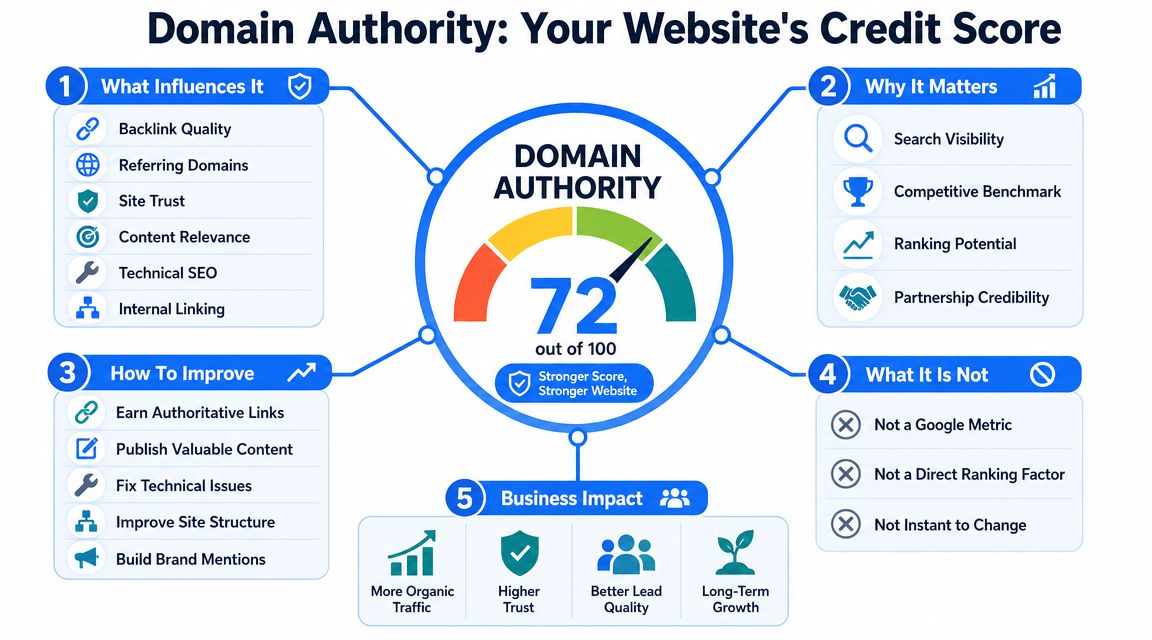
Moz created DA as a score from 1 to 100 that estimates how likely a domain is to rank compared with other domains in its index, and Moz is clear that it is not a Google ranking factor in its Domain Authority guide. That distinction matters because a lot of bad SEO decisions start when people treat a third-party score like a Google signal.
What the score is actually measuring
At its core, DA is Moz's summary of link-based authority. It pulls a messy backlink profile into one number so you can sort faster. That is why it became popular with link builders, brokers, and anyone sifting through a long list of domains.
The useful part is speed.
The dangerous part is what gets lost in compression. A DA score can suggest that one domain deserves a closer look before another. It cannot confirm that the links are clean, the site is topically relevant, the traffic is legitimate, or the domain is worth buying. I use it the same way I use a quick domain authority checker tool. Good for triage. Useless as due diligence.
Two details people miss
First, DA is logarithmic. A jump in the middle of the scale is easier than a jump near the top. So a move from 20 to 30 does not mean the same thing as a move from 70 to 80. People talk about DA points like they are dollars. They are not.
Second, DA is relative to Moz's own index and model. Your score can change even if your site barely changed, because the tool's view of the web changed. That is normal. It is one reason score watching becomes a waste of time.
Practical rule: Treat DA as a rough sorting signal from one vendor, not a fixed property of a domain.
Why this matters in actual SEO work
In domain investing, DA helps narrow a list of expired domains before you spend an hour in Wayback, anchor text, and referring domain history. In link building, it helps separate prospects that might be worth outreach from the ones that obviously are not.
That is the job.
The mistake is asking DA to answer questions it was never built to answer. I have seen domains with strong DA and terrible link neighborhoods sell for too much because the buyer stopped at the headline metric. I have also seen lower-DA domains turn into better assets because the links were relevant, the history was clean, and the site sat in a healthier part of the web.
DA is a shortcut. Shortcuts are useful when you know what they skip.
DA vs DR vs Trust Flow Which Metric to Trust
If you are looking for one authority metric to trust, you are already setting yourself up to buy bad domains and chase bad links.
Moz's Domain Authority, Ahrefs' Domain Rating, and Majestic's Trust Flow are vendor scores built from different link indexes and different models. They measure related things, but they are not interchangeable. That is why one expired domain can look strong in Ahrefs, average in Moz, and suspicious in Majestic.
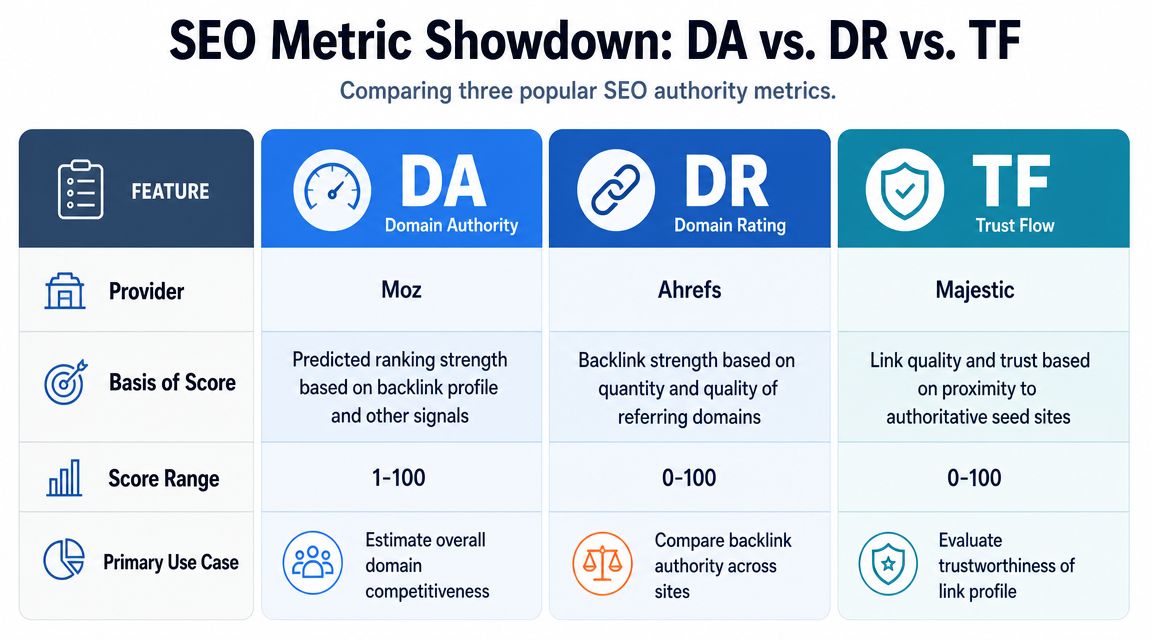
The useful question is not which score is "best." The useful question is which score helps you make a faster, safer decision for the task in front of you.
The fast comparison
| Metric | Best used for | Main strength | Main weakness |
|---|---|---|---|
| DA | Broad comparisons across mixed domains | Decent top-level benchmark | Easy to read as more precise than it is |
| DR | Checking link popularity fast | Strong signal for raw backlink power | Can look better than the site deserves |
| Trust Flow | Screening for trust and spam risk | Good at flagging bad neighborhoods | Too narrow to judge a domain on its own |
My working rule for each
DA is the general-purpose filter. I use it when I need to sort a messy list of prospects, expired domains, or competitors without pretending I have done due diligence. It is useful for triage because it gives a quick sense of relative strength.
DR is the crowd meter. It tends to reward domains that have attracted a lot of link equity, which makes it handy when you want a blunt read on link popularity. In link building, that can save time. In domain investing, it can also lure buyers into overpaying for a domain with noisy, low-trust links.
Trust Flow is the smell test. It helps catch the domain that looks clean on headline metrics but sits in a bad part of the web. I pay more attention to it when a site has strong DA or DR and the backlink profile still feels off.
If you want a side-by-side look at the platforms behind these scores, this guide to domain authority checker tools is a useful reference.
A video can also help if you prefer hearing the trade-offs explained visually:
Which one should you trust
Use the metric that fits the job, then verify with the backlink profile.
For outreach prospecting, DA or DR can both do the first cut. For expired domains, I want all three if I can get them, because disagreement between metrics is often the clue. A domain with high DR, middling DA, and weak Trust Flow deserves scrutiny. That pattern often shows up on domains with inflated link popularity, recycled histories, or links from places no serious buyer would want.
That disagreement is useful. It tells you where to look.
A good link builder learns this fast. The prettiest score on the screen is often the site with the least believable value. The same is true in domain investing. Fool's gold usually shines at the top of one column, not across the full profile.
How to Actually Use Domain Authority Scores
A “good” DA score depends on the decision in front of you.
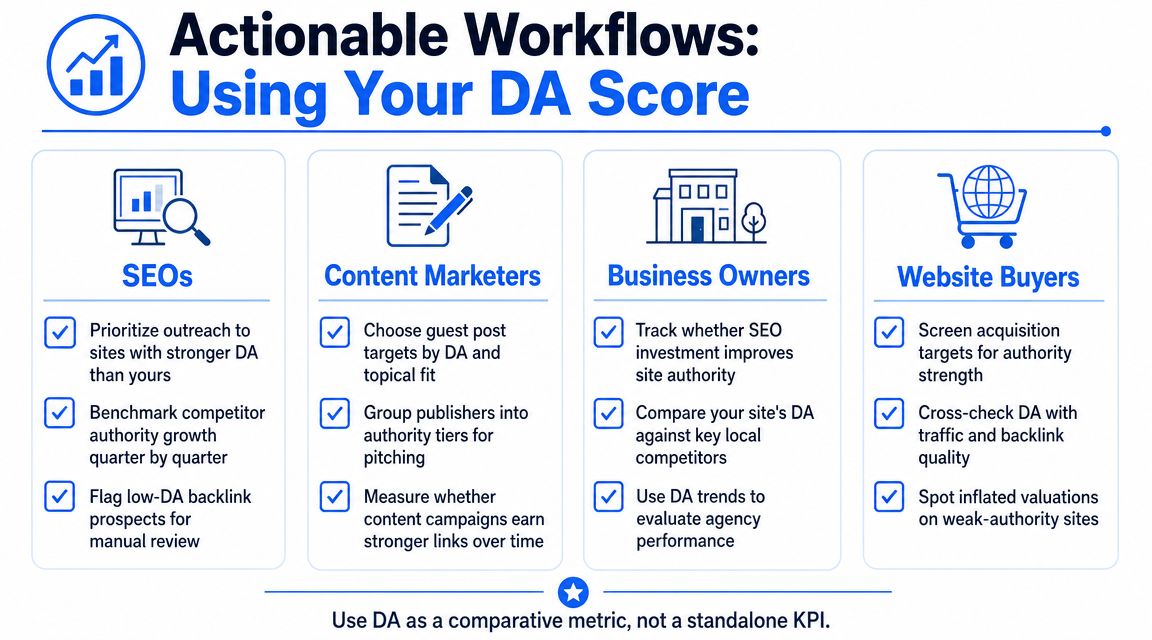
For a local service site, DA 12 can be enough. For a national software category, DA 12 may not get you into the conversation. The useful question is whether the domain has enough authority, relevance, and credibility for the specific SERP, outreach target, or purchase you are evaluating. That is why competitor context matters more than the raw number, as noted in The Media Captain's guide to what a good authority score looks like.
For competitor benchmarking
Use DA to set expectations before you set goals.
If the sites ranking above you all sit in a different authority tier, that does not mean your project is dead. It means the path is narrower. You will need tighter topical coverage, better pages, and stronger links than a site entering an easier SERP.
A few rules keep this useful:
- Compare against the middle of the pack. The strongest outlier can distort the whole picture.
- Match intent before comparing scores. Local SERPs and national SERPs behave differently.
- Treat DA as a workload estimate. A big gap usually means more than a title tag refresh.
For link prospecting
Here, DA earns its rent.
On a large outreach list, DA helps cut the list down fast. I use it the same way domain investors use quick filters on expired inventory. It narrows the pile. It does not tell you what is worth buying.
A simple workflow works well:
- Remove sites with weak enough metrics to be a poor use of outreach time.
- Check relevance before anything else. A strong site in the wrong topic is still a weak link opportunity.
- Review the site's own backlink profile. If the domain is propped up by spam or toxic backlinks, skip it.
- Look at the site like a human would. If it looks abandoned, scraped, or built only to sell links, move on.
That last step saves a lot of wasted emails.
For buying aged, expired, or dropped domains
At this point, DA is most useful and most dangerous.
Useful, because you need a fast way to sort hundreds of domains. Dangerous, because a clean-looking score can make bad inventory look premium. I have seen plenty of domains with a respectable DA and a history nobody should touch. Old redirects, foreign-language junk, spam anchors, wiped content, or links that made sense only for the previous owner.
Use DA as a trigger for manual review, not a reason to bid harder.
When I review an aged domain, I want to see:
- A believable score. High enough to matter, low drama.
- Links that fit the domain's history and future use.
- A clean archive trail. The old site should tell a coherent story.
- No obvious reputation problem. If the domain spent years in casino, pharma, or parasite SEO territory, the score does not rescue it.
The best domain buys are usually the boring ones. Clean history, sensible links, modest authority, no strange surprises.
Where DA helps and where it hurts
Here is the practical split.
| Use case | DA helps | DA hurts |
|---|---|---|
| Prospect filtering | Yes, as a first pass | If used as the only pass |
| Competitive benchmarking | Yes, for rough context | If treated as a ranking forecast |
| Domain buying | Yes, for shortlist creation | If it replaces history and spam review |
| Reporting to clients | Sometimes, as shorthand | If it becomes the KPI |
Use DA to make faster decisions. Do not use it to pretend a shortcut is due diligence.
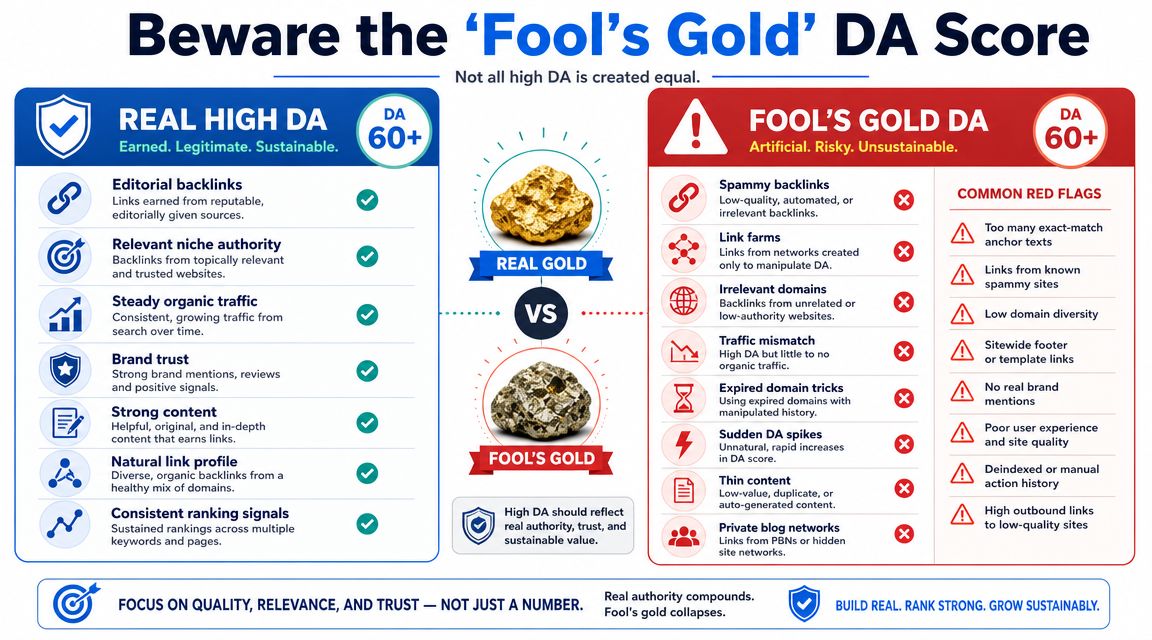
Spotting Fool's Gold and Inflated Domain Authority
High DA fools buyers and link builders every week.
The trap is simple. A domain shows a strong score, the spreadsheet lights up, and people skip the hard part. Then they discover the authority came from expired redirects, irrelevant foreign links, sitewide footer junk, or a backlink profile that made sense only for a previous version of the site. DA can still be useful here, but only as a screening metric. It does a decent job helping you sort piles of domains fast. It does a terrible job telling you whether a domain is clean, durable, or worth paying up for.
What inflated authority usually looks like
Inflated DA rarely hides well once you stop staring at the score.
In domain investing, this usually shows up as a name with impressive metrics and a weird past life. In link building, it shows up as a prospect that looks strong in a tool but has no business ranking, no audience, and no believable reason those links exist. The common patterns are familiar:
- Irrelevant backlinks: Referring domains have little connection to the site's topic, geography, or likely future use.
- Anchor text problems: Too many money terms, foreign-language anchors, or spam categories like casino, crypto, or pharma.
- Sharp link spikes: Big jumps in referring domains with no matching product launch, press coverage, or useful content.
- Dead-site signals: The domain has metric strength but thin content, broken pages, or no sign of real brand activity.
- Recycled authority: Old redirects or acquired domains passed signals into the profile, but the current site does not deserve those links.
If you need a refresher on what bad links look like in practice, NameSnag's guide to toxic backlinks is a useful reference.
The inspection step that saves money
Treat DA like the listing price on a house. It gets your attention. The backlink profile, archive history, and index status decide whether the property is worth buying.
I have passed on plenty of higher-DA domains because the underlying story was nonsense. A gardening domain with anchors from poker forums. A local service site with links from scraped blogs in three languages. A once-legitimate brand that got wiped, redirected, dropped, and revived by someone hoping the old score would survive the abuse. Those are cleanup projects, not assets.
A lower-DA domain with sane links often wins. It is easier to rebuild on a clean foundation than to inherit someone else's manipulative history and hope Google keeps ignoring it.
A quick review checklist
Before you buy a domain or chase a link prospect because of DA, check five things:
- Referring domain quality: Do the linking sites look edited, maintained, and selective?
- Topical fit: Do the links match what the site was and what you want it to become?
- Anchor distribution: Are anchors mostly branded, URL-based, and natural?
- Archive history: Does the Wayback trail show a coherent business or a string of unrelated uses?
- Search reality: Does the site look indexed and trusted, or just technically alive?
One more check gets overlooked. Search for brand mentions without links. If nobody cites the site, talks about it, or references it outside link graphs, the authority may be thinner than it looks. That is one reason entity SEO and AI search matters more than score-chasing suggests.
A simple rule for walking away
If the score is good but the story is bad, walk.
That rule saves money in domain auctions and saves time in outreach. Real authority leaves a believable trail. You can explain why the site earned links, who linked to it, and why those links still make sense today. Inflated authority always asks you to squint a little. That is usually the moment to close the tab.
Strategies to Build Real Authority Not Just a Score
The fastest way to improve authority metrics is to stop obsessing over authority metrics.
That sounds glib, but it's true. Chasing DA directly leads people into junk link deals, irrelevant placements, and content built to impress tools rather than people. Building real authority takes longer, but it compounds in a way vanity tactics don't.
Build things people actually cite
The cleanest links usually come from assets that deserve them. Not “10 tips” filler. Not interchangeable AI sludge. Something with a reason to exist.
That can be:
- Original research or curated data: Give people something worth referencing.
- Useful free tools: Even simple calculators and checkers can earn links when they solve a real problem.
- Definitive guides: Not long for the sake of length. Thorough because the topic demands it.
When people link because your page helped them do their job, the backlink profile tends to stay healthy.
Use digital PR like an adult
A lot of link building still feels like coupon-clipping with email templates. Real authority comes more often from being worth quoting, citing, or mentioning.
That's why brand visibility matters beyond old-school link metrics. If you're thinking about where search is headed, this piece on entity SEO and AI search is worth your time. It's a useful lens for why mentions, context, and recognized expertise keep mattering more.
Focus on relevance before volume
One respected, topically aligned mention can do more for your long-term authority than a pile of random placements. Relevance acts like quality control. It keeps your link profile from drifting into nonsense.
A simple operating model:
- Choose one topic cluster you want to be known for
- Publish the best practical resource you can
- Promote it to people who already cover that topic
- Repeat until your site has a recognizable center of gravity
If you want a more tactical checklist, NameSnag has a useful guide on how to improve domain authority.
Real authority is what's left when you strip away the dashboards and ask, “Would anyone still cite this if metrics tools disappeared tomorrow?”
That question kills a lot of bad SEO ideas very quickly.
Your SEO Domain Authority Questions Answered
How long does it take to increase Domain Authority
Usually longer than people want, and that's one reason it's a poor short-term KPI. Authority signals build gradually because quality links, useful content, and recognition don't appear on command. If your whole strategy depends on moving DA fast, you're probably focusing on the wrong outcome.
Why did my Domain Authority go down
Because DA is comparative, not fixed. Your score can shift even when you didn't do anything dramatic. Sometimes your own link profile changes. Sometimes the model changes. Sometimes other sites in the index strengthen faster. A drop is a prompt to investigate, not a reason to panic.
Is a DA of 20 good
It depends on who you're trying to beat. In some local or niche SERPs, that can be completely workable. In harder national spaces, it may not mean much on its own. The useful question isn't whether 20 is “good.” It's whether 20 is competitive for your target search results.
Should I buy a domain just because it has high DA
No. High DA should buy the domain a closer review, nothing more. Check relevance, anchor text, historical use, and backlink quality before spending money.
What's the best use of SEO domain authority
Speed. It's great for first-pass comparisons across prospects, competitors, and aged domains. It's terrible as a ranking promise.
If you spend time hunting aged, dropped, or soon-to-drop domains, NameSnag is worth a look. You can browse available domains that can be registered right away or track expiring domains that are still in their grace period and dropping soon. The time filters make it easy to focus on today's inventory or widen the search across recent drops without manually digging through junk.
Find Your Perfect Domain
Get access to thousands of high-value expired domains with our AI-powered search.
Start Free Trial